Barn Record Coventry
RETURN TO ‘FIND BARNS’- Building Name (Common)
- Capron-Phillips Carriage Barn / Allure Hair Studio
- Building Name (Historic)
- Capron-Phillips House & Carriage Barn
- Address
- 1129 Main Street (Rte 31), Coventry
- Typology
- Overview
-
Designations
Historic Significance
Architectural description (adapted from Ransom, Section 7):
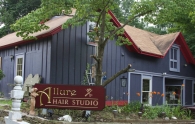
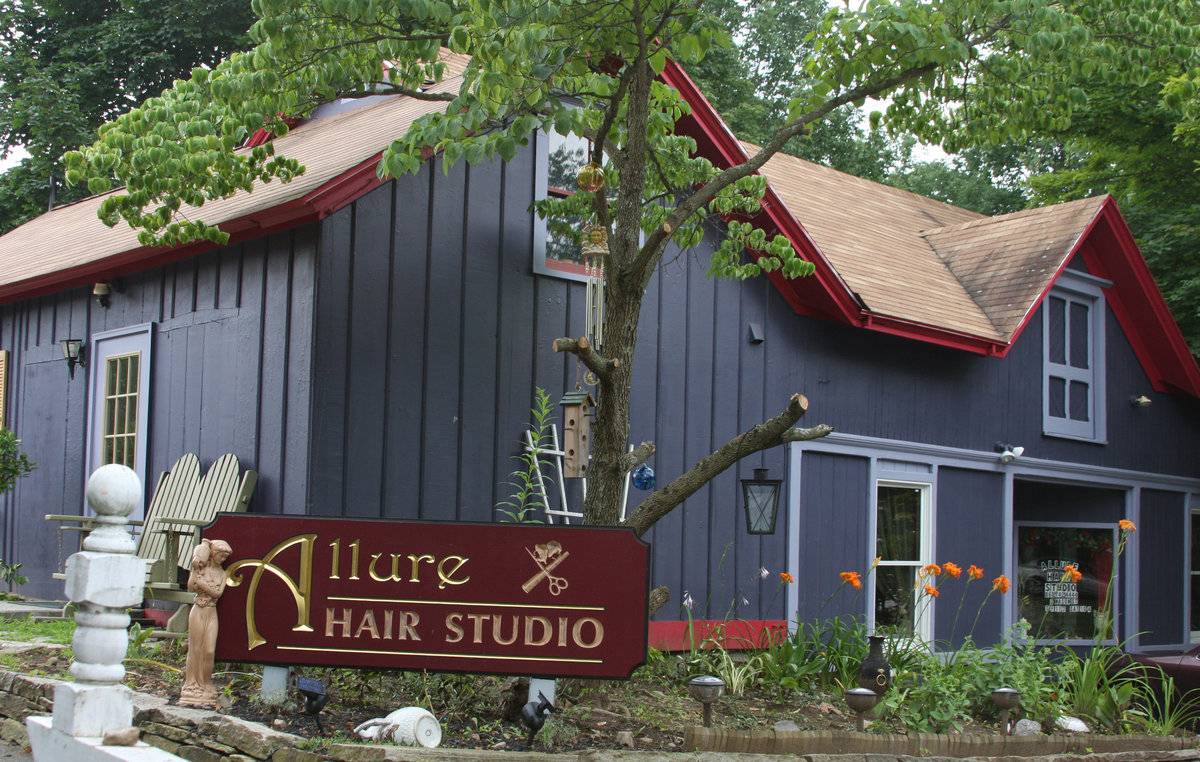
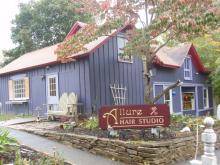
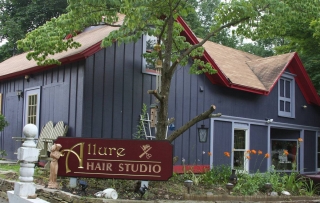
The 1 ½-story, ell-shaped, gable roofed barn was built in two sections. The first, 15 x 30-foot section, with ridge line oriented east-west perpendicular to Mason Street, has board-and-batten siding and a corrugated metal roof. The south slope of the roof and the board-and-batten siding are visible on the interior in the second story, at the point where the second section was joined to the first. The west gable end of the first section, facing Mason Street, has a two-over-two double hung window. The north elevation, facing the house, has an old door with a four-pane window, and a modern multi-pane window. The east end has a six-over-six window under a diamond-shaped gable window of four panes. The partial south elevation of the east end of the first section has a small six-over-six window.
The second, 20 x 30 foot section of the barn has flush, vertical siding. The roof, with its ridge line parallel to Mason Street, is covered with bitumen and roofing paper. There is a central cross gable over a modern entrance, as the barn is now used as a store. The entrance surround appears original, suggesting an eave or side entry. Its size suggests that originally there were double barn doors. There is a large door with cross battens in the gable, perhaps a hay door or a goods door. There is a two-over-two window in the first story south of the entrance. All openings in this section have caps of flat plank over moldings.
Historical significance:
Until the 1830s, the horses used for riding and driving carriages were often kept in the main barn along with the other farm animals. By the 1850s, some New England farmers built separate horse stables and carriage houses. Early carriage houses were built just to shelter a carriage and perhaps a sleigh, but no horses. The pre-cursor to the twentieth-century garage, these outbuildings are distinguished by their large hinged doors, few windows, and proximity to the dooryard.
The combined horse stable and carriage house continued to be a common farm building through the second half of the nineteenth century and the first decade of the twentieth century, until automobiles became common. Elaborate carriage houses were also associated with gentlemen farms and country estates of the late 19th and early 20th centuries. Another form of carriage barn, the urban livery stable, served the needs of tradespeople.
Board-and-batten siding became a popular alternative to wooden shingles on barns during the mid-nineteenth century, especially after the development of the circular saw made the production of long wooden battens easier. Typically measuring about one-and-a-half to two-and-a-half inches wide and about one-and-a-quarter inches think, these battens were nailed over the gaps between the sheathing boards.
Field Notes
Carriage barn converted to current use as a hair salon. Capron-Phillips House is individually listed on the National Register of Historic Places and in the South Coventry Historic District.
- Use & Accessibility
Use (Historic)
Use (Present)
Exterior Visible from Public Road?
Yes
Demolished
n/a
Location Integrity
Unknown
- Environment
Related features
Environment features
Relationship to surroundings
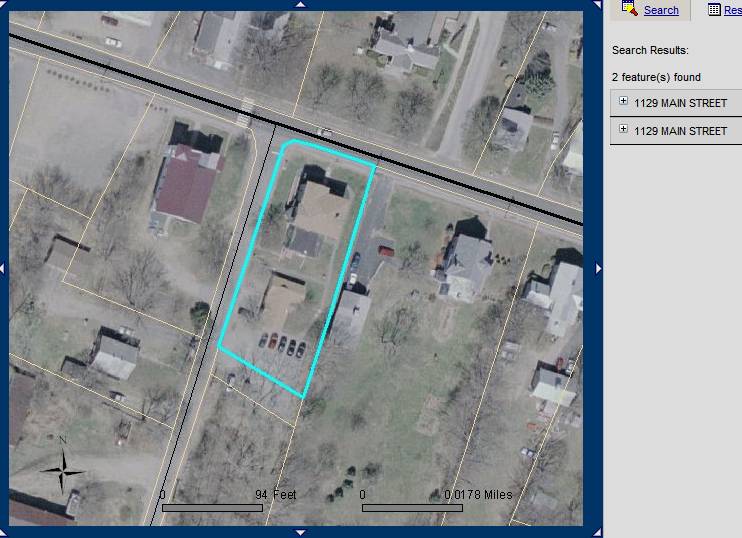
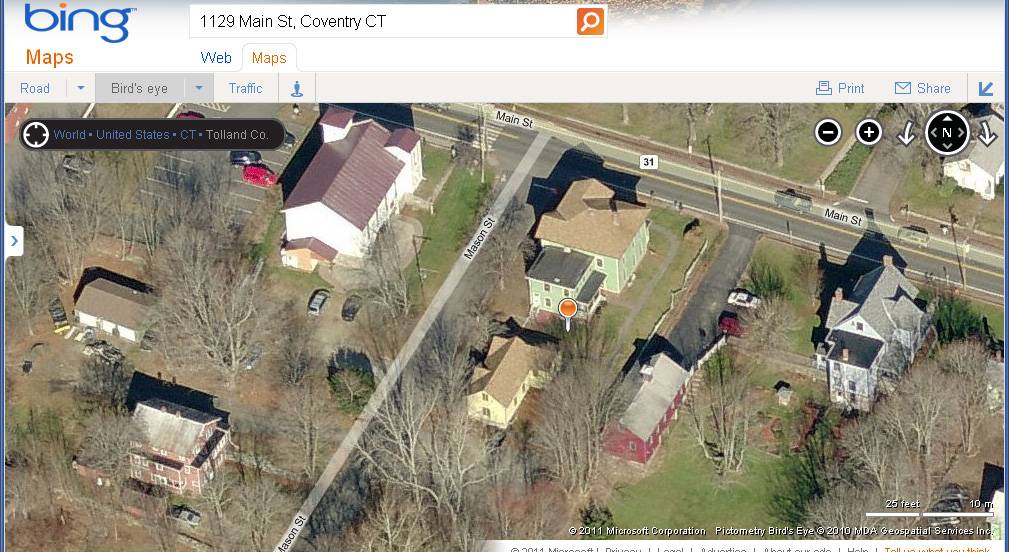
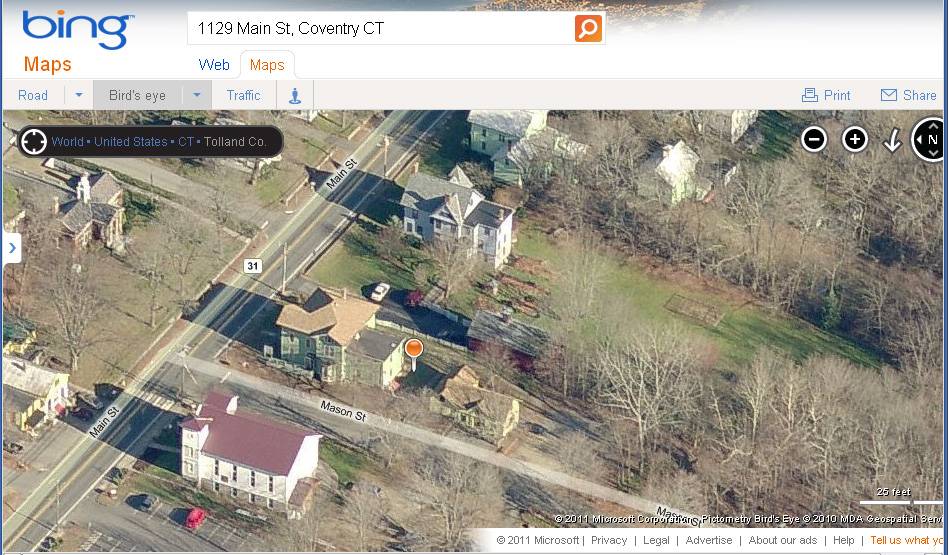
The site is located on the south side of Main Street east of the intersection with Mason Street, in the village of South Coventry. Main Street heads roughly east-west, paralleling Mill Brook which runs on the south side of the street, and provided water power for a series of 19th-century mills. This area is lined with residential and commercial uses including churches, the town library, and several antique shops. South Coventry grew up as a 19th-century mill town and has seen little 20th-century development.
The Capron-Phillips House is an asymmetrical, three-story, clapboard, hipped roof Italianate house with a square, two-story wing to the rear and an ell-shaped barn located south of the house, accessible from its west side along Mason Street. The Capron-Phillips House itself contributed to the village center’s activities for many decades by serving as the Post Office and drug store.
- Typology & Materials
-
Building Typology
Materials
Structural System
Roof materials
Roof type
Approximate Dimensions
15 x 30 feet, 20 x 30 feet
- Source
-
Date Compiled
06/30/2011
Compiled By
T. Levine, C. Hitchcock, reviewed by CT Trust
Sources
Photographs by Charlotte R. Hitchcock & Julie Rosen 08/24/2009.
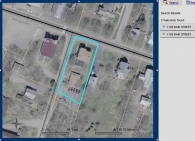
Town of Coventry Assessor’s Record and GIS Viewer: http://ceo.fando.com/coventry/find.aspx?service=Coventry
Parcel ID: 00N/0064/0001
Acres: .53 retail bldg 1023 sf.
1964 first phase - 1879 (barn addition)Aerial Mapping:
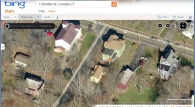
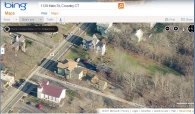
http://maps.google.com
http://www.bing.com/maps accessed 6/30/2011.Andrews, Gregory, and Lewis, Barbara, Historic and Architectural Resources Survey of Coventry: the Coventry Village Area, 1980.
Andrews, Gregory E., South Coventry National Register Historic District Nomination No. 91000482, National Park Service, 1991.
Ransom, David, Capron-Phillips House National Register Nomination No. 82004384, National Park Service, 1982.
Sexton, James, PhD, Survey Narrative of the Connecticut Barn, Connecticut Trust for Historic Preservation, Hamden, CT, 2005, http://www.connecticutbarns.org/history.
Visser, Thomas D., Field Guide to New England Barns and Farm Buildings, University Press of New England, 1997.
- PhotosClick on image to view full file
-