Barn Record Preston
RETURN TO ‘FIND BARNS’
- Overview
-
Designations
n/a
Historic Significance
Architectural description:
Barn I:
This is a series of connected structures: from north to south, a 2 1/2-story Dutch gambrel barn (I-A) attached perpendicular to a gable-roofed gable-entry barn (I-B), with a shed-roofed attachment sloping down toward the south, connecting to a gable-roofed shed (I-C). The ridgeline of the main structure is approximately north-south. The ridge-line of the gable-roofed portion is east-west, as is the southernmost shed. The main entry is small barn door centered at grade on the north gable-facade. Flanking the entry are a pair of unglazed stable window openings. The apex of the roof has a projecting hay hood. Beneath the hayhood are a pair of fixed six-pane windows, one on either side.
The east eave-facade that faces Hewitt Road combines the eave-side of the gambrel barn flush with the east gable-end of the gable-roofed barn and has a series of thirteen stable windows on the first floor, broken up with two pass-through doors; one at the south-east corner and the other beneath the corner of the cross gable. The first floor is concrete block masonry and the second is wood-framed with vertical wood siding. The second floor has three hay door openings; two in the main structure and one in the center of the gable-end. Between the two hay doors in the main structure are letters spelling “PRESTON FARMS.” A fixed twelve-pane window is next to the haydoor on the cross gable. Above the haydoor, beneath the apex of the roof of the cross gable is a pair of swinging hinged hay doors and a hay track. On the peak of the gable roof, off center towards the road, is a wooden cupola. A metal ventilator is centered on the peak of the gambrel roof of the main structure. A small attic gable just beneath the apex of the roof of the south gable-facade of the main structure is visible where Barn I-B and the main structure (I-A) meet. That section has a fixed six-pane window. Attached to the south eave-facade of cross gable is a shed-roofed addition, which is attached to a gable-roofed shed (I-C) which has three windows and a pass-through door in its east gable-end.
The west side appears to be similar to the east side, although no hay doors are visible.
Barn II:
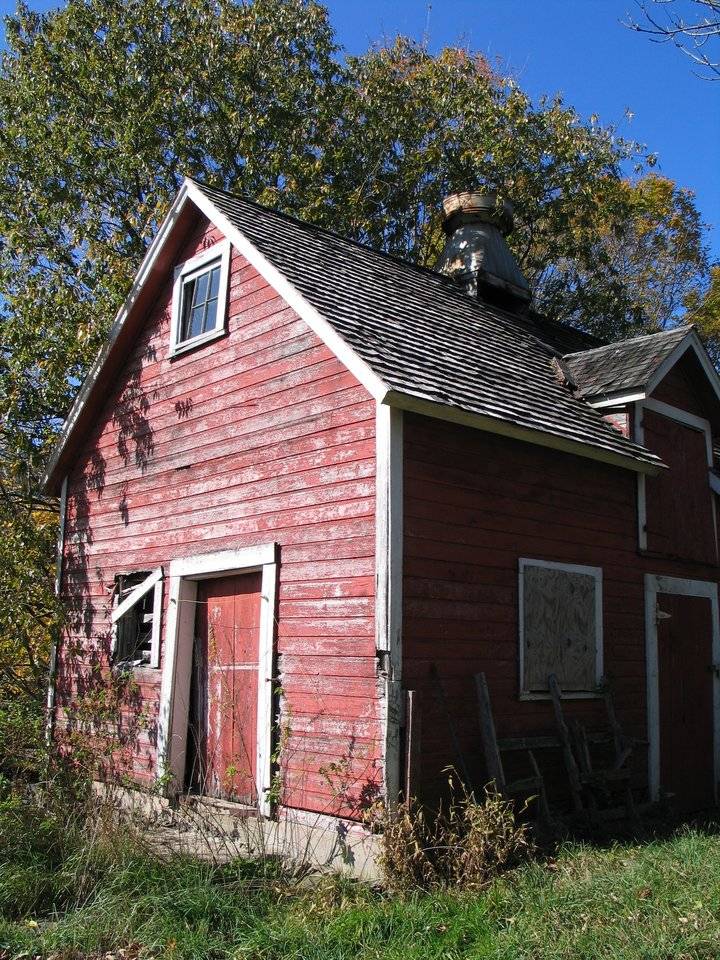
This is a Dutch gambrel-roofed barn with its ridge-line oriented north-south. the ground level is concrete block masonry with a series of seven stable windows on each eave side - on the west, the northernmost opening is a pass-through door and the windows are larger. The south gable-end has a wide sliding door off-center toward the left (west) flanked by a stable window on the left. Above in the loft level is a hay door and in the attic under a projecting hay hood is a large pair of hinged hay doors flanked by six-pane windows. The north gable-end has one stable window off-center to the left (east) at grade and a small attic vent. Siding above the ground floor is wood horizontal lap siding. The roof is metal panels. There is one metal ventilator on the ridge.
Historical significance:
By the early 20th century agricultural engineers developed a new approach to dairy barn design: the ground-level stable barn, to reduce the spread of tuberculosis bacteria by improving ventilation, lighting, and reducing the airborne dust of manure. A concrete slab typically serves as the floor for the cow stables. Many farmers converted manure basements in older barns into ground-level stables with concrete floors. Some older barns were jacked up and set on new first stories to allow sufficient headroom. With the stables occupying the entire first story, the space above serves a a hayloft. By the 1920s most ground-level stable barns were being constructed with lightweight balloon frames using two-by-fours or two-by-sixes for most of the timbers. Tongue-and-groove beveled siding is common on the walls, although asbestos cement shingles also were a popular sheathing. Some barns have concrete for the first-story walls, either poured in place or built up out of blocks. The gambrel roof design was universally accepted as it enclosed a much greater volume than a gable roof did, and its shape could be formed with trusses.
In this instance it seems possible that two barn frames were jacked up onto new concrete masonry lower walls to create the ground level stable configuration. The gambrel roof could have been added to an older barn or could have been original. A considerable amount of deformation is visible at the interface of the different types of construction.
Field Notes
Addresses include 15-24 Hewitt Road. Landmark on Route 2 a few miles west of Foxwood Casino. Part of currently operating dairy farm - barns replaced by new facility on southern side of highway - Historic dairy farm - third generation currently farming - Grabarek family. Street address is confusing as historic property has local road (Hewitt) and state highway (Route 2) running through it. Area zoned for industrial/commercial - one of only two dairy farms in the southern portion of Preston. House is rented while Grabarek family still farms the property.
- Use & Accessibility
Use (Historic)
Use (Present)
Exterior Visible from Public Road?
Yes
Demolished
n/a
Location Integrity
Unknown
- Environment
Related features
Environment features
Relationship to surroundings
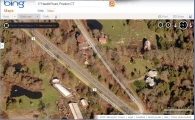
Hewitt Road is a short bybass from Route 2, the Norwich Westerly Road, creating a lozenge-shaped site between the two roads. This farm straddles Hewitt Road, occupying the site between the roads and additional acreage to the north of Hewitt Road. The Grabarek family owns 70 acres here and additional acreage south of Route 2 where their modern farm operation is located.
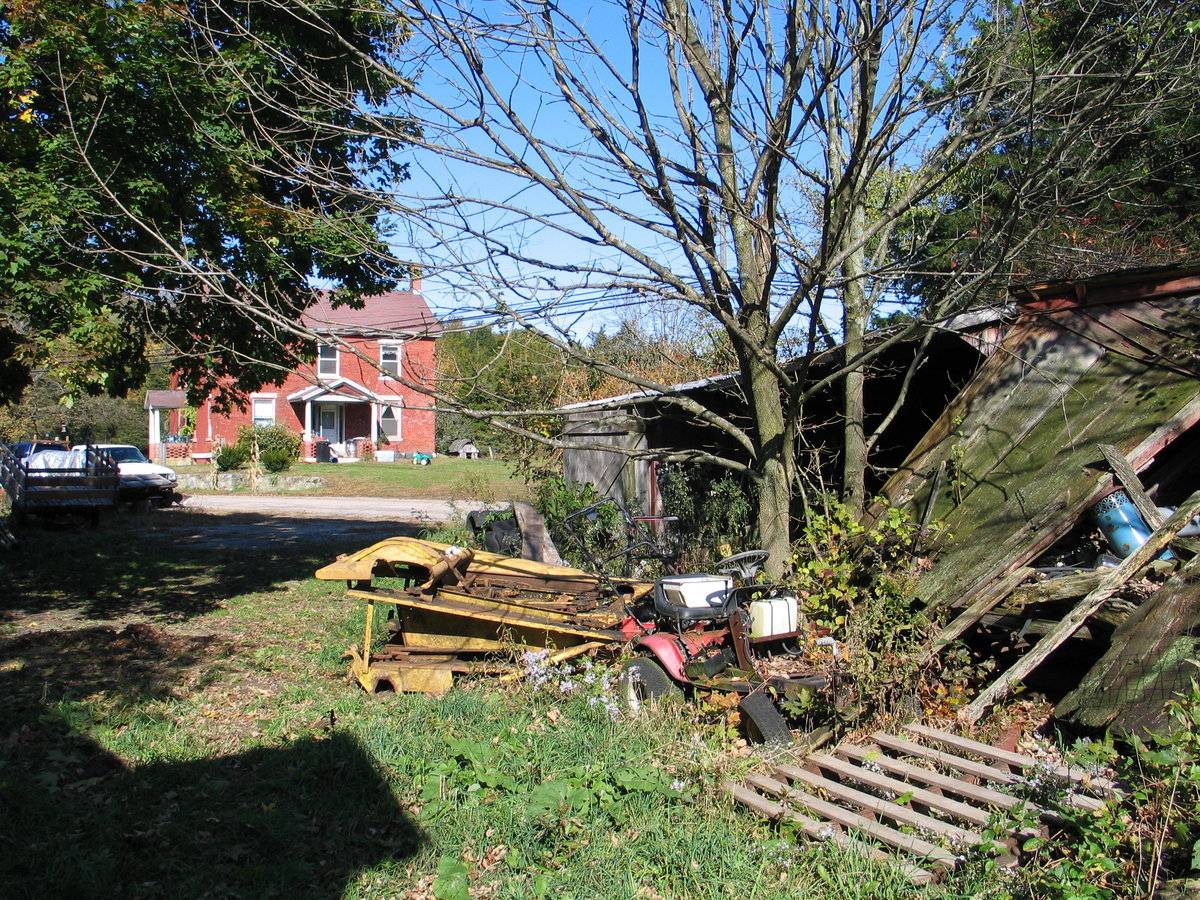
A historic farmhouse is located north of Hewitt Road. It is a 2 1/2-story brick vernacular Federal style building with its gable roof oriented east-west and its three-bay south entry facade faces toward the intersection of the two roads. Additions project north off the rear. Windows are double hung (original sash replaced) In the gable-ends there are pairs of quarter-round attic windows.
To the southwest across Hewitt Road is the large barn complex consisting of multiple connected structures, including Barn I-A, a Dutch gambrel-roofed structure, Barn I-B, a gable-roofed structure perpendicular to Barn I-A, a shed connector and Barn I-C, a smaller shed. Additional smaller outbuildings are located south of these. To the east of the house is Barn II, a Dutch gambrel-roofed structure surrounded by a stony pasture.
To the north the land is wooded, to the east beyond a strip of woods is a farmed area of field or pasture land, and to the south of Route 2 is a mixture of woods and fields.
- Typology & Materials
-
Building Typology
Materials
Structural System
Roof materials
Roof type
Approximate Dimensions
n/a
- Source
-
Date Compiled
03/18/2010
Compiled By
Todd Levine, reviewed by the Connecticut Trust
Sources
photographs and field notes by Gail Rigney - 12/09/2009
Assessor’s Record: http://data.visionappraisal.com/PrestonCT/findpid.asp?iTable=pid&pid=1197
Parcel ID: 17-0/ HEW1/ 15/ / / 15 Hewitt Road 63.50 Acres land
17-0/ HEW1/ 17/ 17 Hewitt Road 2 acres 1976 Cape style house
17-0/ HEW1/ 23/ 23 Hewitt Road 1.5 acres 1850 (or earlier base on style) house
17-0/ HEW1/ 24/ 24 Hewitt Road 3 acres barns
FGR1GARAGE 528 S.F.
BRN1 BARN - 1 STORY 384 S.F.
BRN1 BARN - 1 STORY 480 S.F.
LNT LEAN-TO 384 S.F.
SHD1 SHED FRAME 224 S.F.
BRN4 1 STY LFT&BSMT 2788 S.F.
SHED FRAME 420 S.F.Aerial Mapping:
http://maps.google.com
http://www.bing.com/maps accessed 6/30/2011.Sexton, James, PhD, Survey Narrative of the Connecticut Barn, Connecticut Trust for Historic Preservation, Hamden, CT, 2005, http://www.connecticutbarns.org/history.
Visser, Thomas D., Field Guide to New England Barns and Farm Buildings, University Press of New England, 1997.
- PhotosClick on image to view full file
-