Barn Record Avon
RETURN TO ‘FIND BARNS’- Building Name (Common)
- Avon Self Storage
- Building Name (Historic)
- Gold Farm
- Address
- 230 Old Farms Road, Avon
- Typology

- Overview
-
Designations
n/a
Historic Significance
Architectural description:
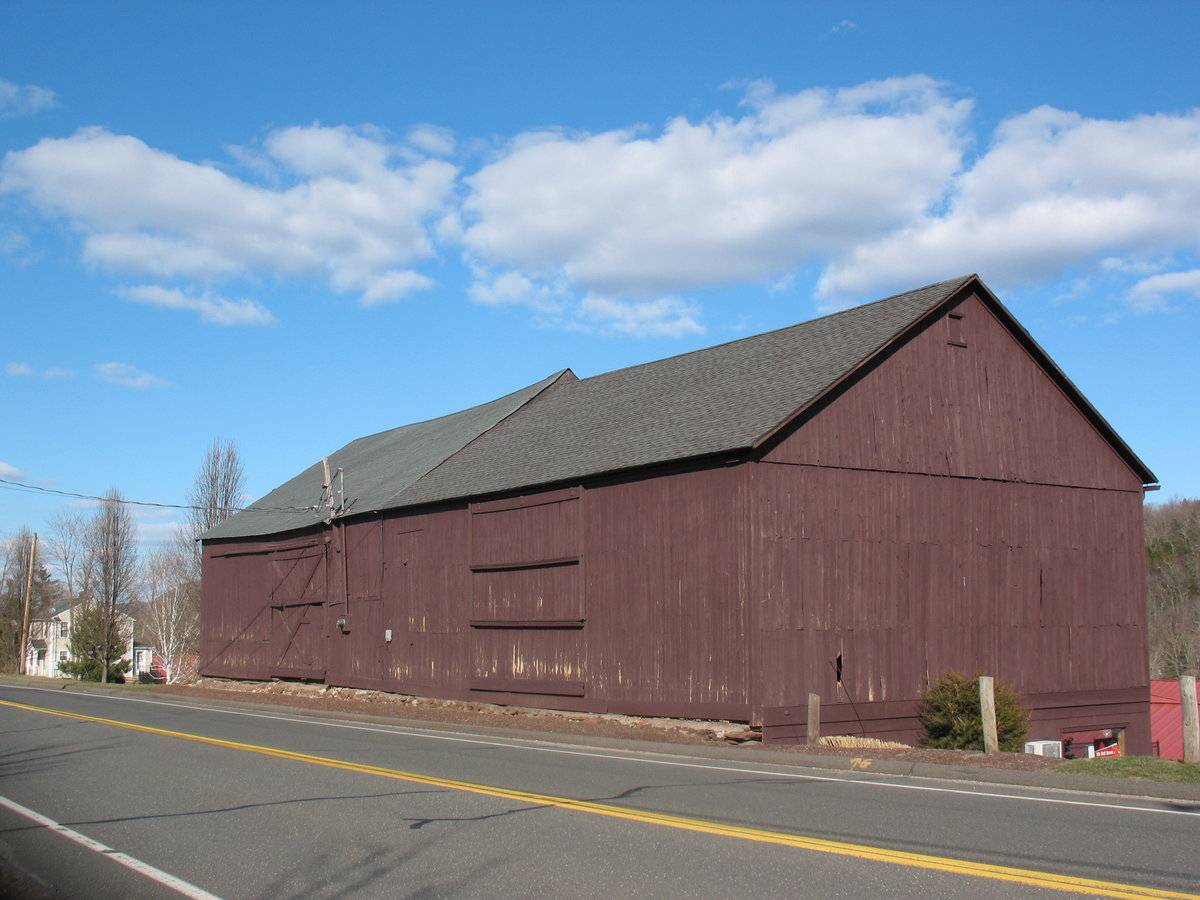
These are two attached 1 ½-story eave-entry bank barns, each with a gable roof. They are attached end-to-end and aligned parallel with Old Farms Road. The road passes this property at a southwest to northeast angle. Although they are attached, for documentation purposes these will be referred to as the south barn and the north barn.
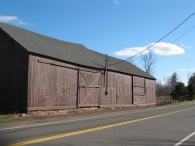
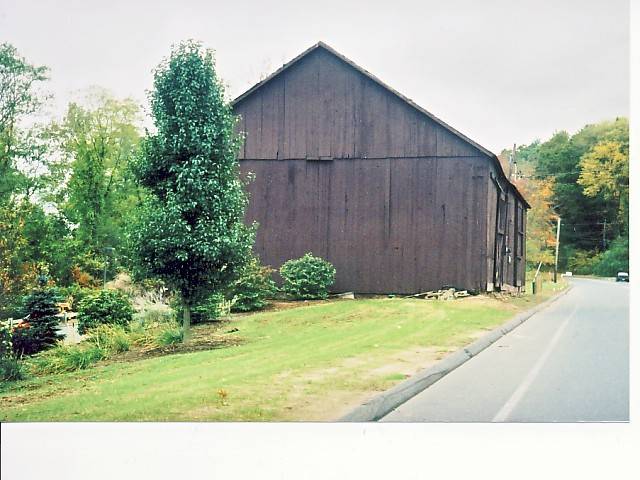
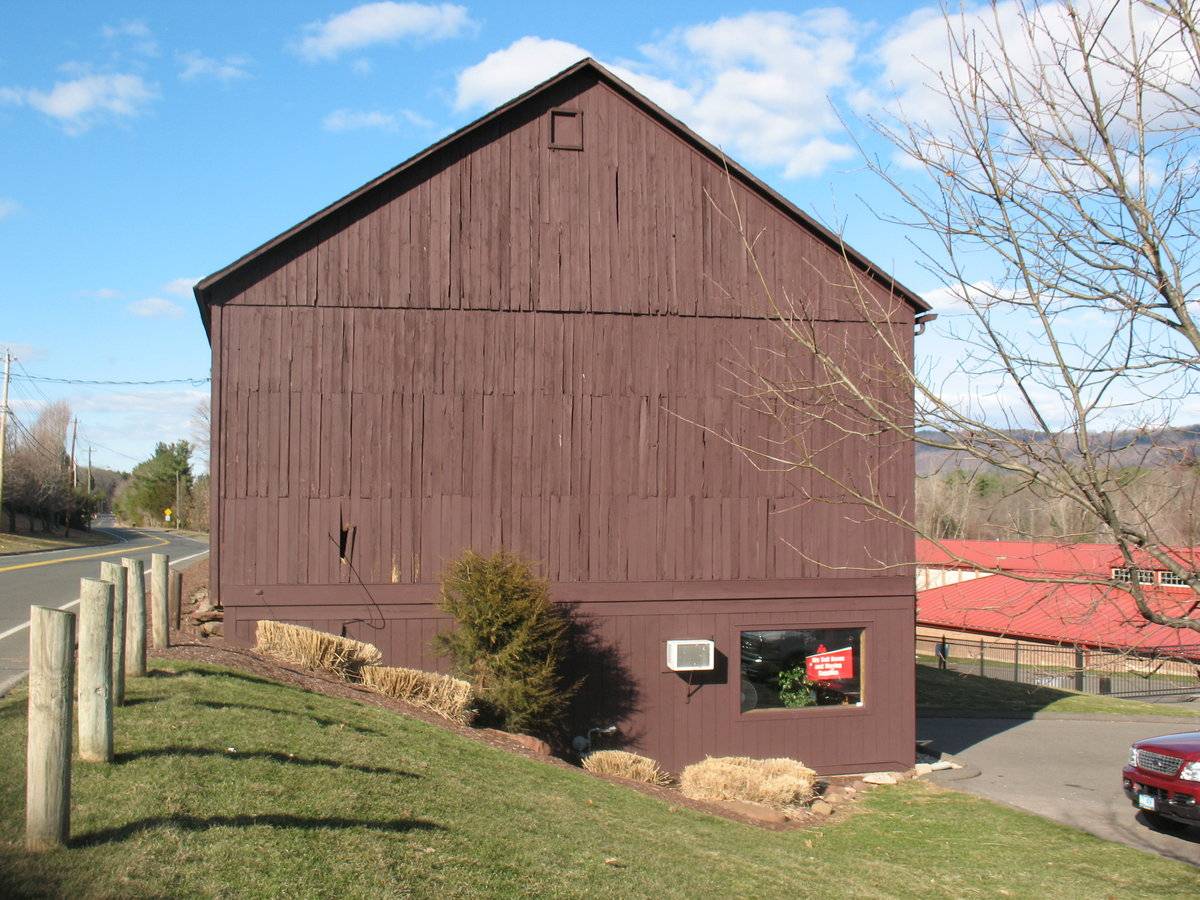
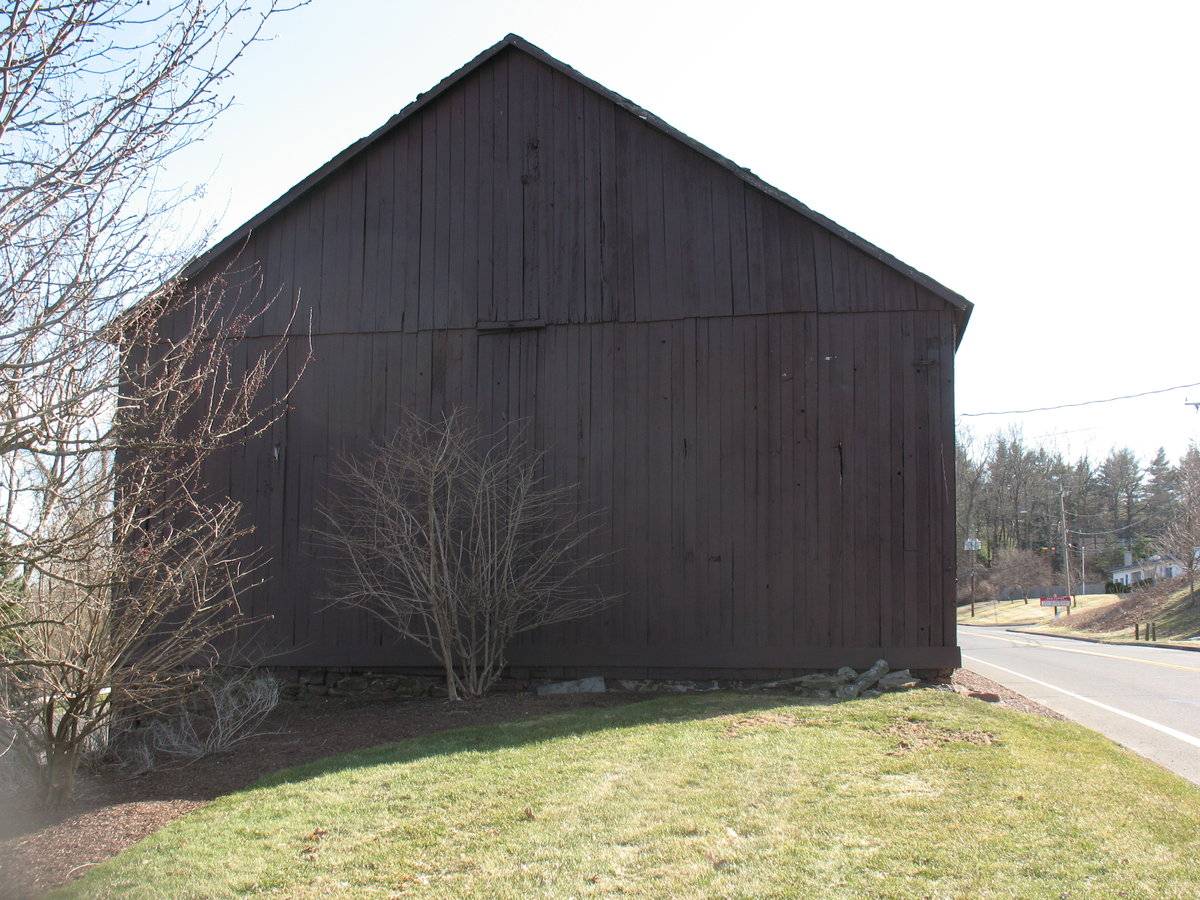
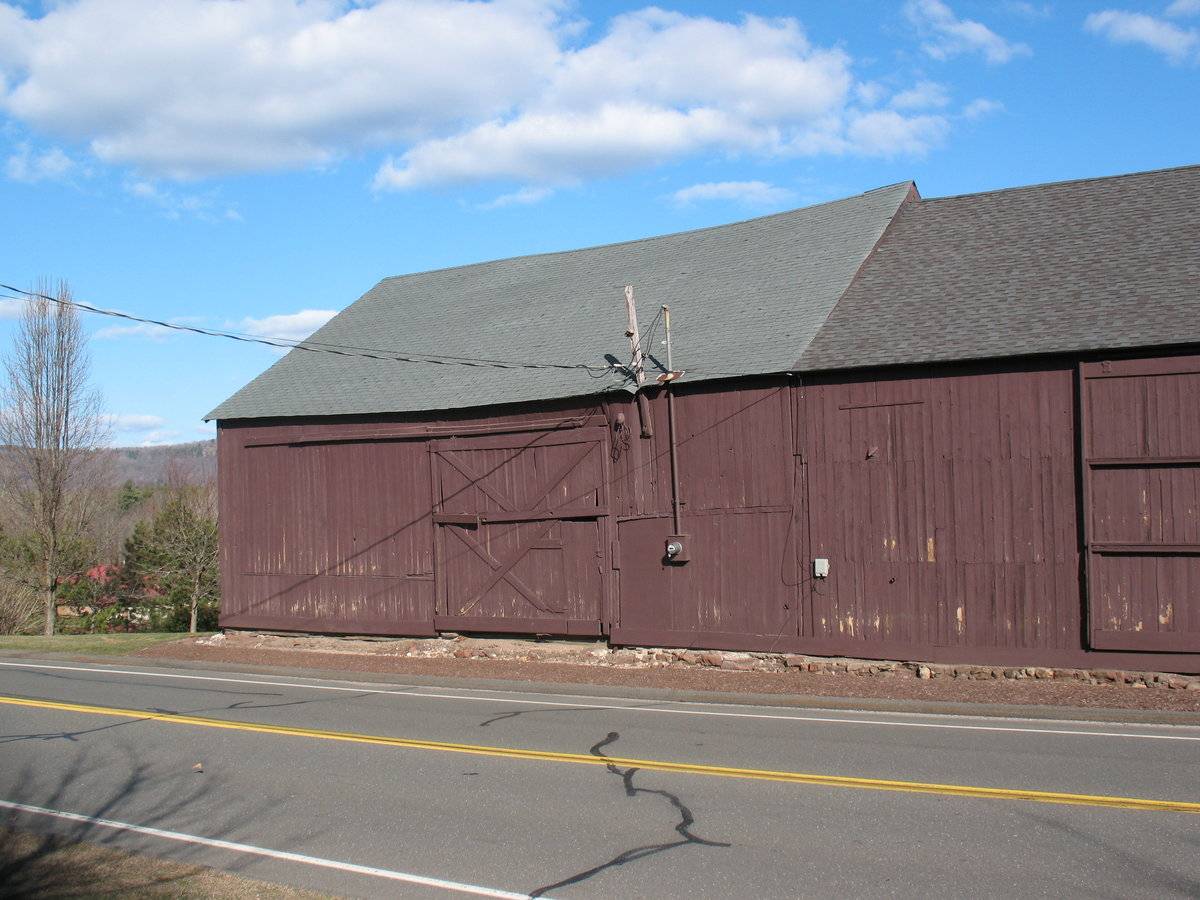
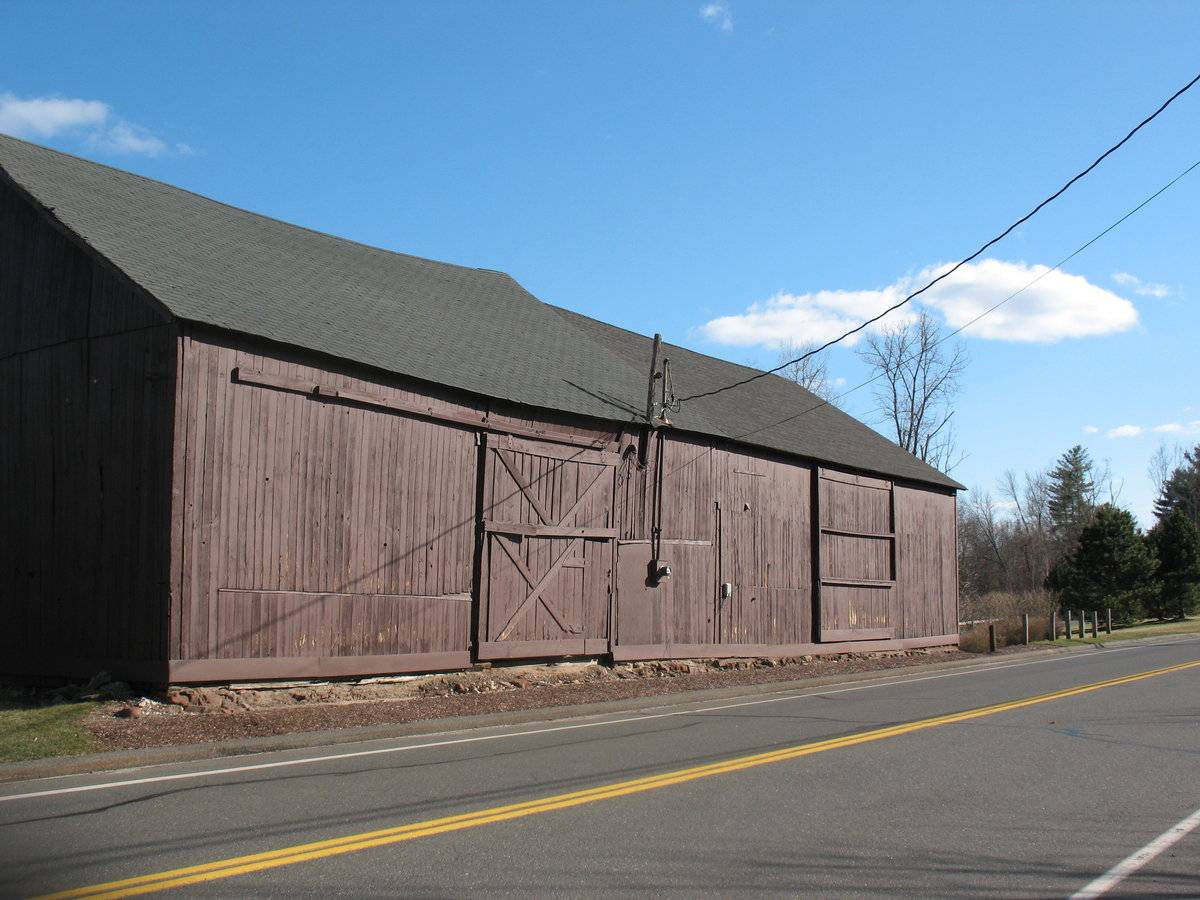
The south barn is a 1 ½-story eave-entry bank barn with a gable roof. The primary façade of this barn is the northwest eave-side, which directly fronts Old Farms Road. The main entry on this side is an oversized sliding door of wood plank construction, mounted on an upper track, and centered. The southwest gable-end reveals a portion of the basement level as the ground drops steeply from the west corner to the south corner. A large picture window is located in the basement level near the south corner. A window-style external air-conditioner is permanently mounted in the wall to the immediate west of this window. No other openings are present on the basement level. The first-story is blank on this end. A small square opening is located slightly-off-center to the west beneath the roof ridgeline in the gable-attic, which has been plated over from the inside with a piece of wood.
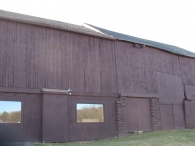
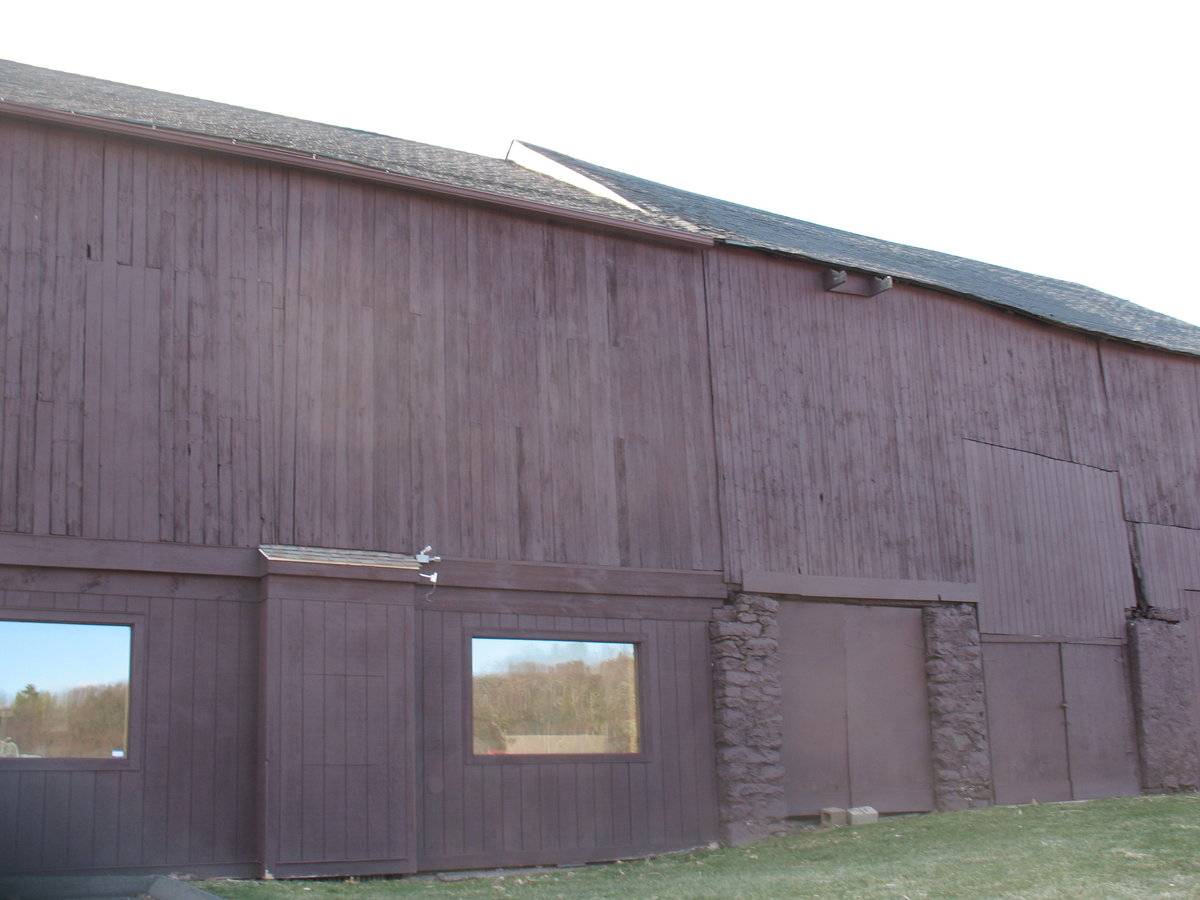
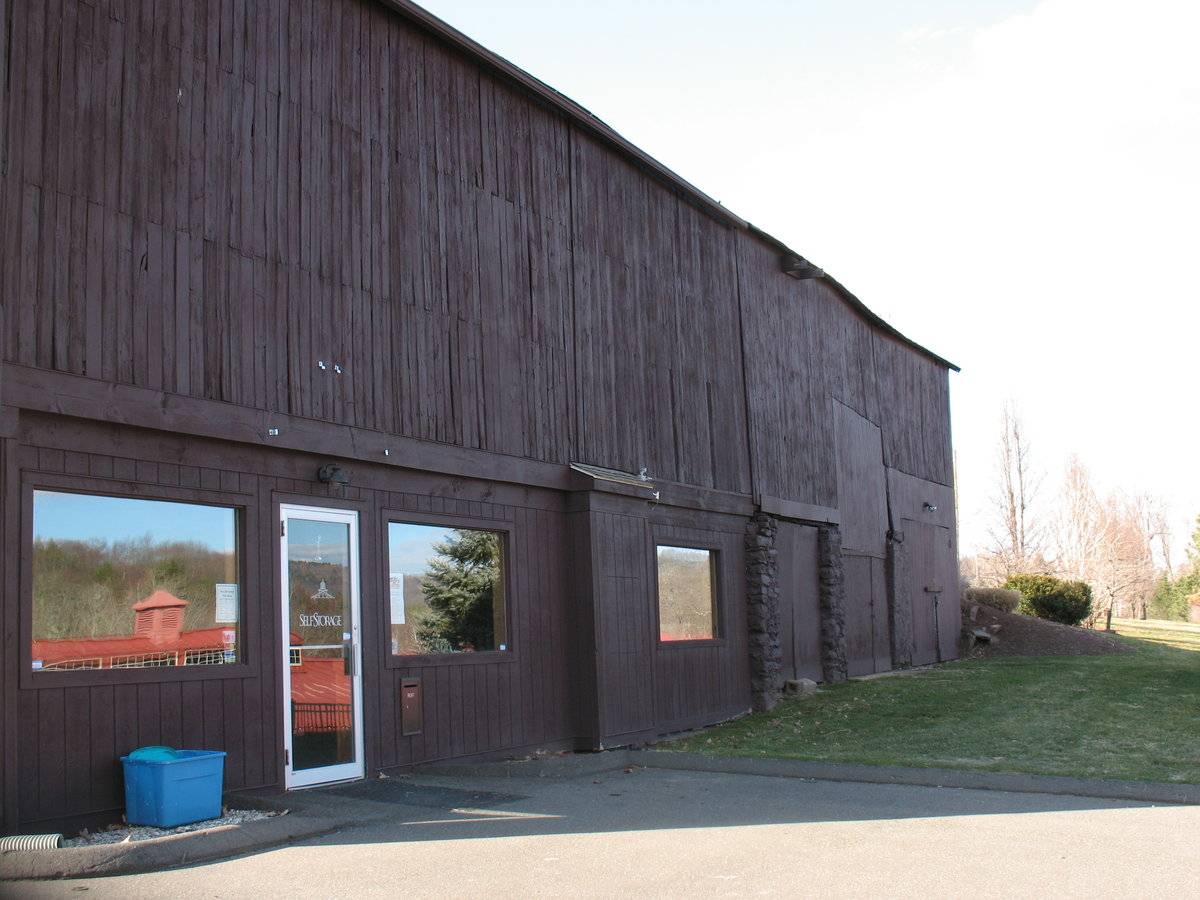
The southeast eave-side of the south barn exposes the full basement level along its length. The basement level is divided into three sections, each with a large picture window located within. The gap between the south window and the center window contains a modern glass pass-through door. A modern mail chute is located beneath the center window, near the south end. A small projecting portion of the wall exists between the center window and the north window, with a narrow shed-roof located overhead. The first-story is blank along this entire eave-side. The northeast gable-end is directly connected to the north barn.
The exterior of the south barn is faced in vertical wooden flush-board siding. A wider-width of vertical flush-board siding is located on the basement level beneath the sill, which appears to be a more modern treatment. The exterior walls of this barn and basement level are painted dark brown. The roof is covered in dark gray asphalt shingles.
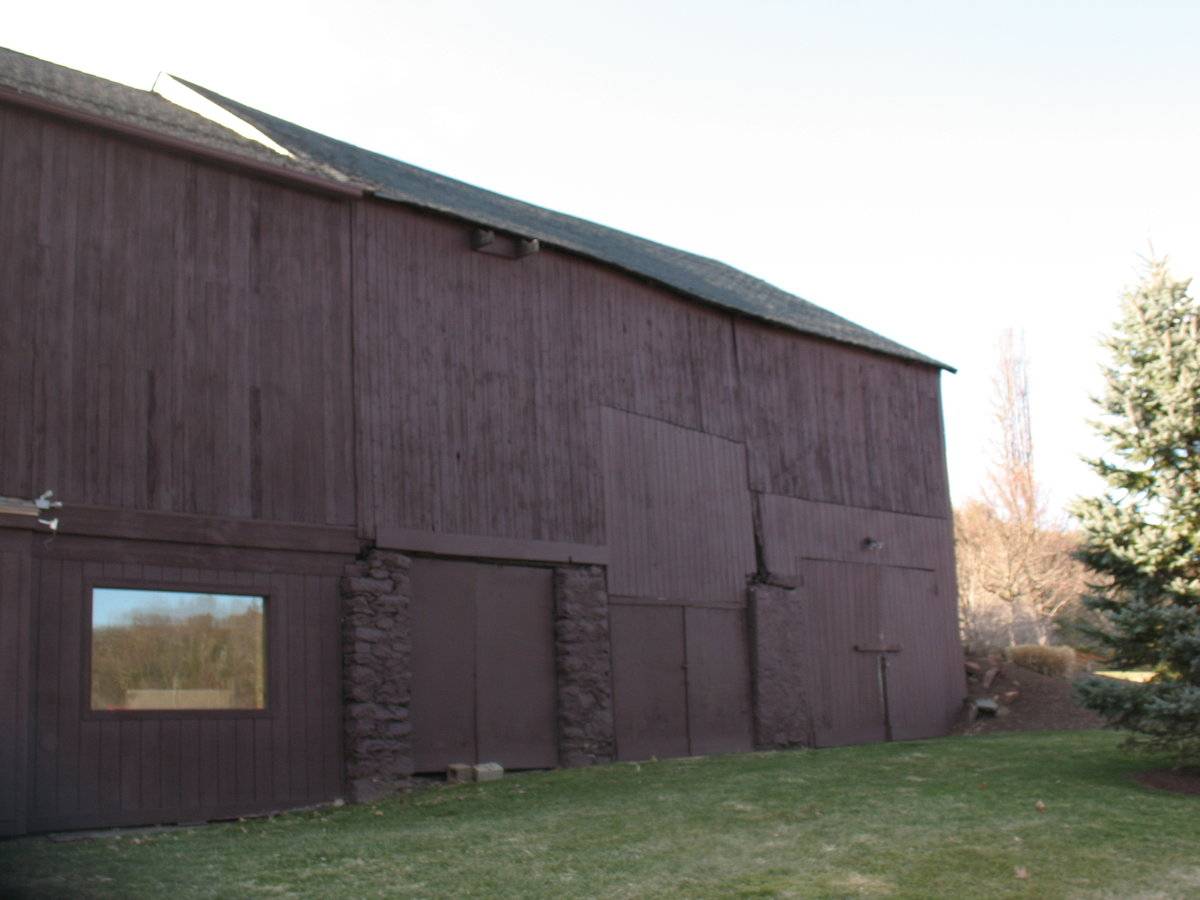
The north barn is a 1 ½-story eave-entry bank barn with a gable roof. The southwest gable-end is directly connected to the south barn. As with the south barn, the southeast eave-side of the north barn exposes the full basement level along its length. Three mortared fieldstone piers are present along this eave-side on the basement level. These piers separate three separate doorways on this level. A pair of oversize hinged doors of wood construction are located between the south and middle piers, extending in height to the sill line. A second pair of hinged wooden doors are situated between the middle and the north pier. These doors do not extend as high as the sill line. An oversize pair of hinged doors of wood plank construction are located between the north pier and the east corner of the building. A modern security light is located above the north pair of doors. The first story is blank. Some of the external siding has been replaced on the first story, particularly above the central and upper pairs of doors on the basement level.
The northeast gable-end exposes a portion of the basement level, which appears to be blank. The first-story and gable-attic of this gable-end also are blank. As with the south barn, the northwest eave-side contains the main entry to the north barn. This entry consists of an oversize wooden plank sliding door, mounted in an upper track, off-center to the south. To the immediate south of this door is a modern electrical hook-up with wall-mounted meter. The remainder if this façade is blank.
The exterior of the north barn is also faced with vertical wooden flush-board siding, painted dark brown. The roof, which peaks at a slightly higher level than the south barn, is covered with light gray asphalt shingles.
Historical significance:
The oldest barns still found in the state are called the “English Barn,” “side-entry barn,” “eave entry,” or a 30 x 40. They are simple buildings with rectangular plan, pitched gable roof, and a door or doors located on one or both of the eave sides of the building based on the grain warehouses of the English colonists’ homeland. The name “30 by 40” originates from its size (in feet), which was large enough for 1 family and could service about 100 acres. The multi-purpose use of the English barn is reflected by the building’s construction in three distinct bays - one for each use. The middle bay was used for threshing, which is separating the seed from the stalk in wheat and oat by beating the stalks with a flail. The flanking bays would be for animals and hay storage.
The 19th century saw the introduction of a basement under the barn to allow for the easy collection and storage of a winter’s worth of manure from the animals sheltered within the building. The bank barn is characterized by the location of its main floor above grade, either through building into a hillside or by raising the building on a foundation.
This innovation, aided by the introduction of windows for light and ventilation, would eventually be joined by the introduction of space to shelter more animals under the main floor of the barn.
Field Notes
Related features: This barn is actually two barns, joined together. In the photos, you can see that the left roof is higher than the right roof. The left was built in 1913, but no one is sure when the right was added. Environmental features: Close to road. Cement storage facilities are down the hill - very ugly. The lower floor of the right barn has been converted into a reception room and offices. Threats: The barns are so close to the road that if Old Farms is ever widened, it will impact the barns. Materials: Constructed of trees cut on the property, no nails, post and beam pegged - information taken from a book written by one of the Gold descendants.
- Use & Accessibility
- Environment
Related features
Environment features
Relationship to surroundings
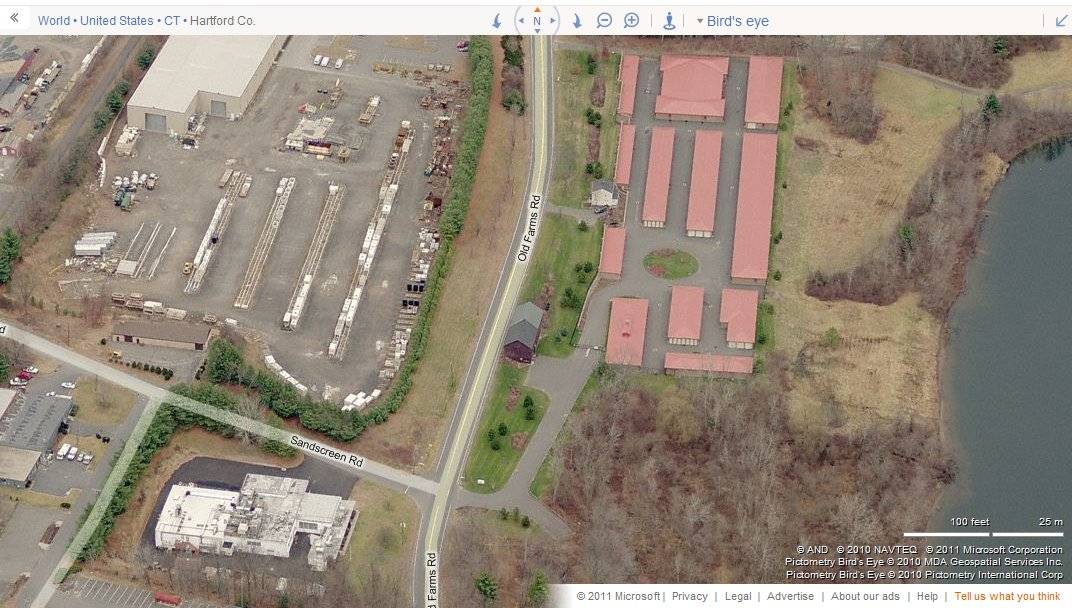
These barns are joined gable-end to gable-end and directly front Old Farms Road along their northwest eave-side. Old Farms Road passes this property at a northeast to southwest angle. The barns are presently situated on a property which is occupied by modern self-storage units. To the immediate north and south of the barn along Old Farms Road is a strip of banked earth with a grassy lawn and occasional scattered trees atop it. The basement level of the south barn, with the large picture windows, serves as the office for this self-storage. The ground slopes down from west to east, onto the floodplain for the Farmington River, which is located some distance to the east of this barn. Between the barn and river is the southern part of the self-storage facility (several long sheds), and a small reservoir. Asphalt roads are situated between each of the self-storage buildings. These connect to the main driveway, which leads to the south from the barns and up an incline to meet the height of Old Farms Road some distance south. A wide parking area is located to the immediate south of the south barn, adjacent to the self storage office. The area across the street from these barns is industrial in nature, with a cement mixing and lumberyard operation in close proximity. A row of screen-trees makes this less visible from the barn site.
- Typology & Materials
-
Building Typology
Materials
Structural System
Roof materials
Roof type
Approximate Dimensions
n/a
- Source
-
Date Compiled
06/06/2011
Compiled By
N. Nietering & T. Levine, reviewed by CT Trust
Sources
Photographs by Liz Neff.
Sexton, James, PhD; Survey Narrative of the Connecticut Barn, Connecticut Trust for Historic Preservation, Hamden, CT, 2005, http://www.connecticutbarns.org/history.
Visser, Thomas D., Field Guide to New England Barns and Farm Buildings, University Press of New England, 1997, 213 pages.
Map of Avon, CT, retrieved on June 5, 2011 from website www.bing.com/maps.
Avon Assessor’s Records - Avon Assessor’s Office Real Estate Property Information online - http://www.avonassessor.com/
- PhotosClick on image to view full file
-