Barn Record Plainfield
RETURN TO ‘FIND BARNS’- Building Name (Common)
- Wauregan Wood
- Building Name (Historic)
- n/a
- Address
- 91 South Walnut Street, Plainfield
- Typology

- Overview
-
Designations
Historic Significance
Architectural description:
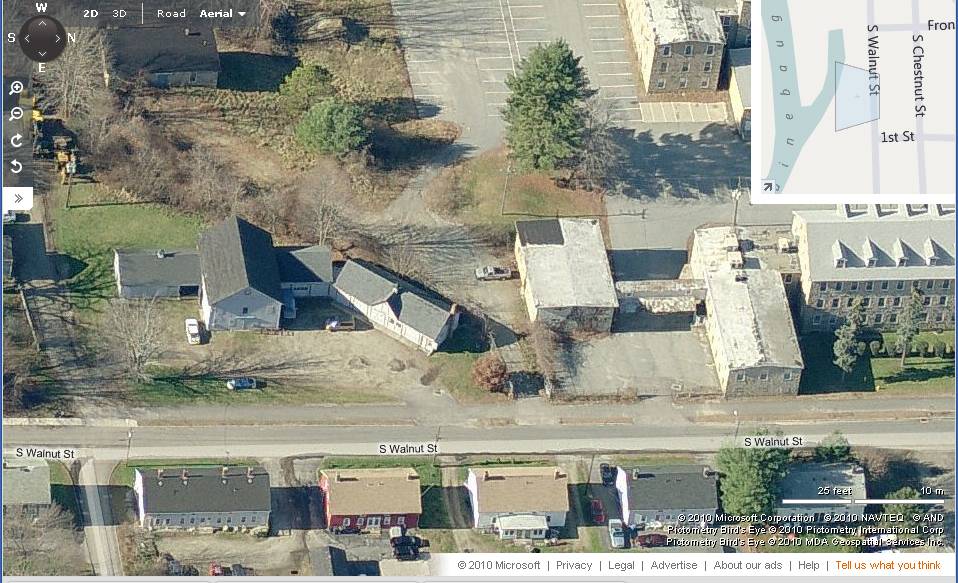
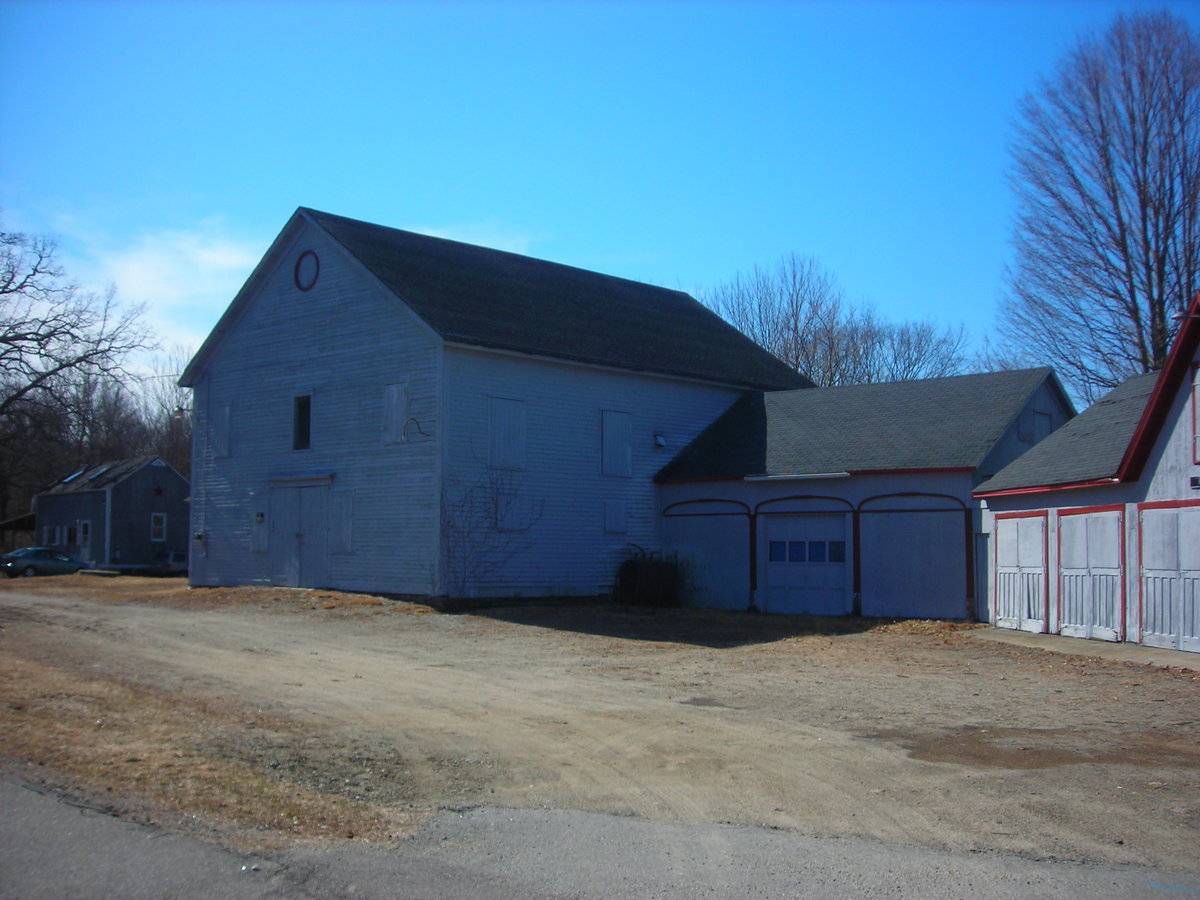
The cluster of agricultural buildings at this site include a central perpendicular barn with a side-wing on each eave-side, and a stand-alone wagon-shed building canted at an angle to both the main barn and the road. The main barn is a 2 ½-story structure with a gable-roof. A subservient parallel addition of 1 ½-stories projects off both the north and south eave sides, which are referred to as the North Addition and South Addition, respectively. The Wagon Shed is five and one half bays in width and also had a gable-roof, with a prominent gable-dormer, centered on the façade. These buildings are located to the immediate south of the main Wauregan Mill building, directly fronting South Walnut Street.
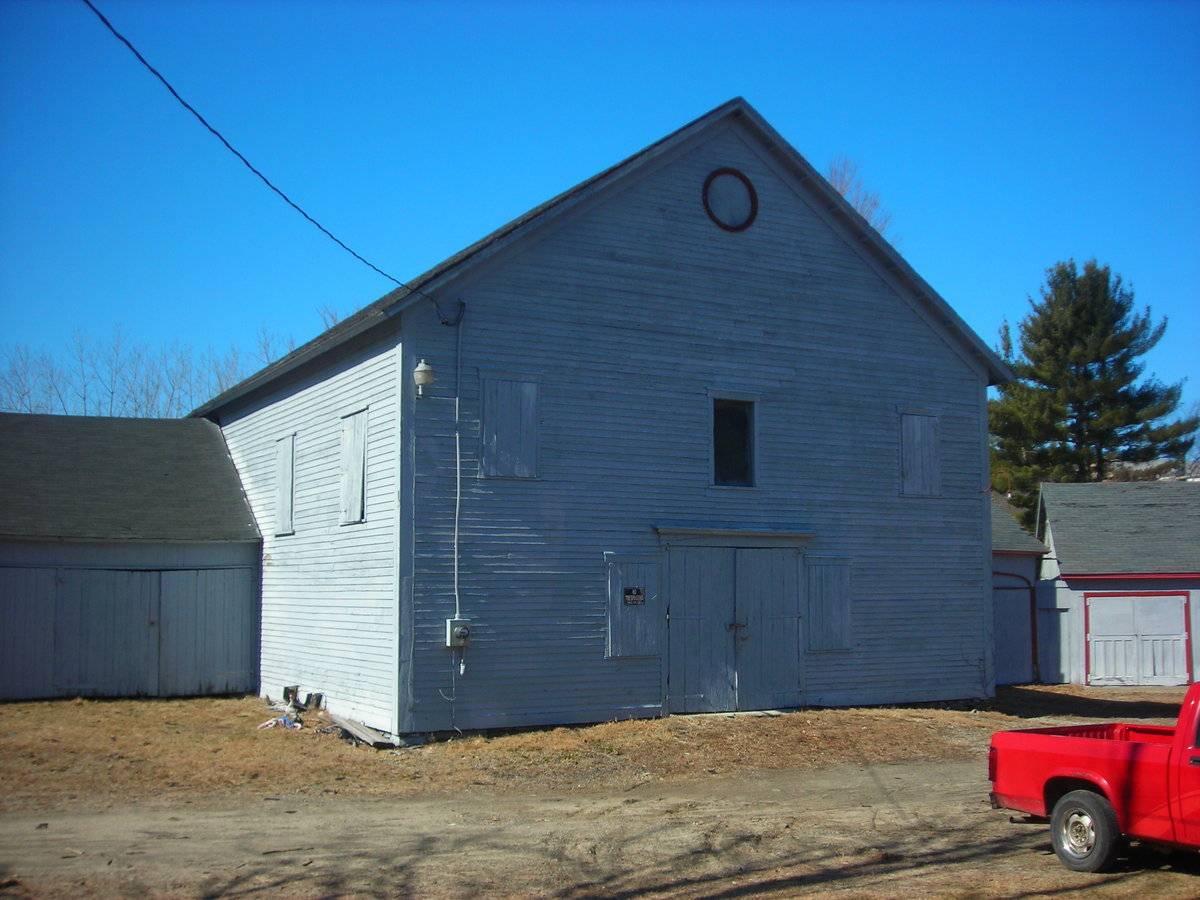
The main barn on this site is a large 2 ½-story structure with a gable-roof, oriented perpendicular to South Walnut Street. The primary façade is the east gable-end, which directly fronts the street. The main entry consists of a pair of centered hinged wood-plank doors on the first-story. A decorative molded wood lintel stretches over the doorway. Framing for a window opening to each side of this entry is present, but covered over with wood. Three equally-spaced rectangular window openings are located on the second-story; the outer openings are covered with wood. A circular opening is centered beneath the roof ridgeline in the gable-attic. A modern electrical meter is mounted to the building near the southeast corner, as is a modern security light on the second-story.
The western portion of the south eave-side of the main barn is occupied by the south addition and its roof. The eastern half is visible on the exterior. The first-story is blank, but two rectangular window openings are located on the second-story, each covered with wood paneling. The north eave-side generally mirrors the south eave-side. The western portion on this side is also occupied by an addition, the north addition. As on the south side, two rectangular windows with wooden covers are located on the second story. Beneath them, two small square windows, also with wooden covers, are located on the first-story. A small ventilation fan is also projecting from the second-story, to the west of the window openings. The west gable-end, appears to have three stall-openings stretching across the first-story, each with clipped upper corners. The remainder of this end appears to be blank.
The south addition is a 1 ½-story gable-roof structure, oriented parallel to South Walnut Street, and projecting to the south from the west half of the south eave-side of the main barn. This addition appears to be three bays in width, and the primary entries are on the east eave-side. These entries consist of an oversize opening to each bay, which appear to be wooden doors of either the sliding or hinged type. The south gable-end appears to be blank. The west eave-side appears to include at least one window opening, roughly in the center of the structure.
The north addition is a 1 ½-story gable-roof structure, oriented parallel to South Walnut Street, and projecting to the north from the west half of the north eave-side of the main barn. This addition is also three bays in width, although the bays are narrower and therefore the structure is not as long as the south addition. The primary façade is the east eave-side. A modern paneled overhead garage door is located in the center bay. The outer bays at one time had identical-size doorways, but appear to have been covered over. The north gable-end contains a single square hay-door in the gable-attic, centered. The west eave-side is not visible for the purposes of an Historic Resource Inventory.
The exterior of this main barn is faced with horizontal wooden clapboard siding. The two additions are faced with vertical wooden siding. The entire exterior is painted light gray. Trim on the north addition is painted red. All roof surfaces are of black asphalt shingling. A small cupola appears to be visible centered on the roof ridgeline of the south addition.
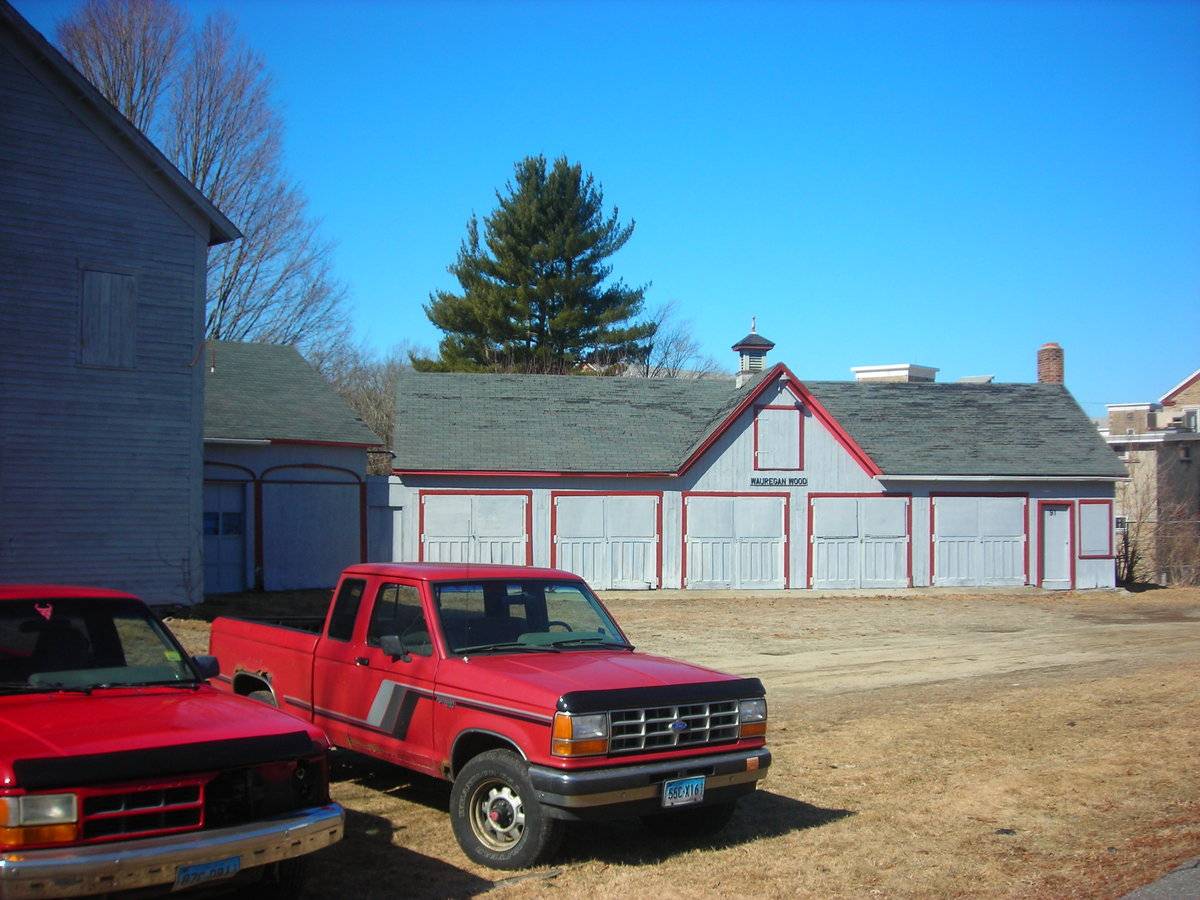
The Wagon Shed is a 1 ½-story five and one half bays-wide gable-roof structure, with a prominent gable-dormer centered on the façade. It is located to the immediate north of the main barn and addition complex, but is canted at a forty-five degree angle to both this complex and the street.
The primary façade of this wagon shed is the southeast eave-side. Five oversize entries occupy the five full bays along this side. Each entry consists of a pair of hinged wooden doors, with panels in the lower half and a window opening in the upper half which has been blanked over. The half-bay, which is at the north end of the structure, includes a pass-through door and blanked-over window opening beside it. The dormer contains a rectangular hinged doorway of wood plank construction. Beneath this doorway is painted “Wauregan Wood”. A security lamp fixture is mounted over the dormer door, centered beneath the apex.The northeast gable-end contains an external brick chimney, nearly centered. A window opening appears to bracket the chimney to each side. The northwest eave-side is not visible for the purposes of an Historic Resource Inventory. The southwest gable-end appears to include two window openings within the gable-attic.
The exterior of this wagon shed is clad in vertical wooden flush-board siding, painted light gray. Line the north addition of the main barn, trimwork on this shed is painted red. The roof is covered in gray asphalt shingles. A small square cupola is centered on the roof ridgeline of the wagon shed. It contains a louvered vent on each of the four sides and is topped by a shallow pyramidal roof.
Historical significance:
The New England barn or gable front barn was the successor to the English barn and relies on a gable entry rather than an entry under the eaves. The gable front offers many practical advantages. Roofs drain off the side, rather than flooding the dooryard. With the main drive floor running parallel to the ridge, the size of the barn could be increased to accommodate larger herds by adding additional bays to the rear gable end. Although it was seen by many as an improvement over the earlier side-entry English Barn, the New England barn did not replace its predecessor but rather coexisted with it, as both types continued to be built.
Distinguished by the long shed or gable roof and the row of large openings along the eave side, the typical wagon shed was often built as a separate structure or as a wing connected to the farmhouse or the barn. These open-bay structures protect farm vehicles and equipment from the weather and provide shelter for doing small repairs and maintenance.
Historical background:
This complex of agricultural buildings is located to the immediate south of the large cotton mill structure, the focal point of industry in this historic village. Most of Wauregan is included as a historic district on the National Register of Historic Places, and was designated in 1979. According to the National Register nomination forms referring to these specific buildings, “Also on the south side of the front mill are the former barn and carriage house (#27) where horses and wagons, used to haul bales of cotton up from the railroad siding and to deliver finished goods there were kept and maintained. They are large frame structures with wide, segmental-arched doorways.” (Section 7, Page 20). The first portion of the mill was constructed in 1853, with subsequent additions expanding it to its current size and scale completed by about 1870, creating a massive mill façade stretching 1,250 feet. The village was platted to the immediate east of the mill and included lodging and residences for the workers as well as a church and store. The mill continued in operation until the late 1950s. The mill structure continues to serve in industrial and commercial uses today. See the National Register nomination forms linked in the Sources section of this Historic Resource Inventory for more information about the Wauregan Historic District.
Field Notes
Next to (south of) Wauregan Mill Parcel ID 01W/0079/0033 91 South Walnut Street .51 acres c. 1853 30' x 60' (approximate by measuring on map) Located in the Wauregan National Register Historic District.
- Use & Accessibility
Use (Historic)
Use (Present)
Exterior Visible from Public Road?
Yes
Demolished
n/a
Location Integrity
Unknown
- Environment
Related features
Environment features
Relationship to surroundings
The structures highlighted in this Historic Resource Inventory are situated along the west side of South Walnut Street, to the immediate south of the large Wauregan Mill building. A gravel parking and staging area is situated between both the main barn with additions and the wagon shed and South Walnut Street. The Quinebaug River passes to the west of these structures, flowing from north to south. As such, the ground level slopes down into the floodplain of the river to the west of the structures, although it is not apparent if these are actually banked buildings or not. A small grassy lawn is situated to the north and west of the buildings before descending to the flood plain, which is heavily forested. To the east of these structures are the orderly streets of Wauregan village, which are lined with the former workers’ houses, which are still residences today. Wauregan has since expanded outside of its historical boundaries, and is intermixed with surrounding open land and woodlands.
- Typology & Materials
-
Building Typology
Materials
Structural System
Roof materials
Roof type
Approximate Dimensions
Wagon shed: 1440 square feet, Main barn: 1730 square feet, South Addition: 1003 square feet, North Addition, 714 square feet.
- Source
-
Date Compiled
06/15/2011
Compiled By
N. Nietering & T. Levine, reviewed by CT Trust
Sources
Photographs by Charles and Irene Hutchinson.
Sexton, James, PhD; Survey Narrative of the Connecticut Barn, Connecticut Trust for Historic Preservation, Hamden, CT, 2005, http://www.connecticutbarns.org/history.
Visser, Thomas D.,Field Guide to New England Barns and Farm Buildings,
University Press of New England, 1997, 213 pages.Map of Plainfield, CT, retrieved on June 12, 2011 from website www.bing.com.
Plainfield Assessor’s Records - Plainfield, CT Assessor Database online - http://plainfield.ias-clt.com/parcel.list.php
Keiner, Harry, “Wauregan National Register District,” National Register Nomination Form, 1979. Available from the Web: http://pdfhost.focus.nps.gov/docs/NRHP/Text/79003789.pdf
- PhotosClick on image to view full file
-