Barn Record Roxbury
RETURN TO ‘FIND BARNS’
- Overview
-
Designations
n/a
Historic Significance
Architectural description:
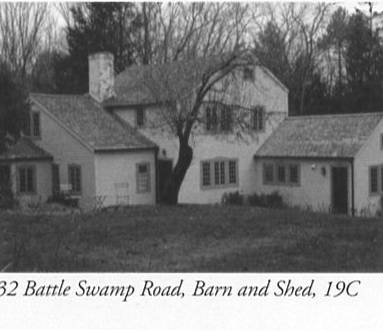
This tract was once known as Raven Rock, a name reportedly derived from the Native American practice of holding sacred ceremonies on the ledges here. A sawmill, shingle mill, blacksmith shop, wagon shop and cider mill were once located on the brook. The original section of the house is the small c. 1790 saltbox located at the west end of the rambling building. The remaining sections consist of a barn and sheds moved from other locations on the farmstead and attached to the historic saltbox. Dr. Henry Smith Williams, a noted painter, etcher and ornithologist, bought the farm in 1915 and named it Three Brooks.
Williams turned the property into a nature preserve, damming the brook to create a pond. It may have been he who enlarged the house by grafting the barns to it. Clapboards, put on some time in the last ten years, cover the vertical barn siding.The house, with attached barns, stands on a terraced site on the north side of Battle Swamp Road. Across the road, a ledge drops down to Battle Swamp Brook. Features include: 25 x 29 (main barn section); 11 x 25; 14 x 16 ; 22 x 20 (Saltbox portion); asymmetrically massed structure consists of 1 ½-story saltbox house with three sections added to create rambling profile; screened porch at northwest corner; varied fenestration (new) includes casements and double-hung windows; post-and-beam construction; clapboard.
Historical significance:Connected barns tied all of the functions of a farmstead - home, hearth, workplace and barn - into a series of linked buildings. This is the “big house, little house, back house, barn” of nursery rhymes.
Field Notes
Information from a survey of Roxbury by Rachel Carley.
- Use & Accessibility
Use (Historic)
Use (Present)
Exterior Visible from Public Road?
Yes
Demolished
n/a
Location Integrity
Unknown
- Environment
Related features
n/a
Environment features
Relationship to surroundings
n/a
- Typology & Materials
- Source
-
Date Compiled
08/02/2011
Compiled By
Rachel D. Carley - KY
Sources
Carley, Rachel D., Barn Stories from Roxbury Connecticut, Roxbury Historic District Commission/Town of Roxbury/CT Commission on Culture & Tourism, 2010.
Cunningham, Jan, Roxbury, A Historic and Architectural Survey, Roxbury Historic District Commission, 1996-97.
Sexton, James, PhD; Survey Narrative of the Connecticut Barn, Connecticut Trust for Historic Preservation, Hamden, CT, 2005, http://www.connecticutbarns.org/history.
Visser, Thomas D.,Field Guide to New England Barns and Farm Buildings, University Press of New England, 1997, 213 pages.
- PhotosClick on image to view full file
-