Barn Record Litchfield
RETURN TO ‘FIND BARNS’- Building Name (Common)
- Edward W. Simons Barn- Milkhouse - IF No.3
- Building Name (Historic)
- Edward W. Simons Barn- Milkhouse
- Address
- 336 Bantam Lake Road, Litchfield
- Typology
-
- Overview
-
Designations
n/a
Historic Significance
Architectural description:
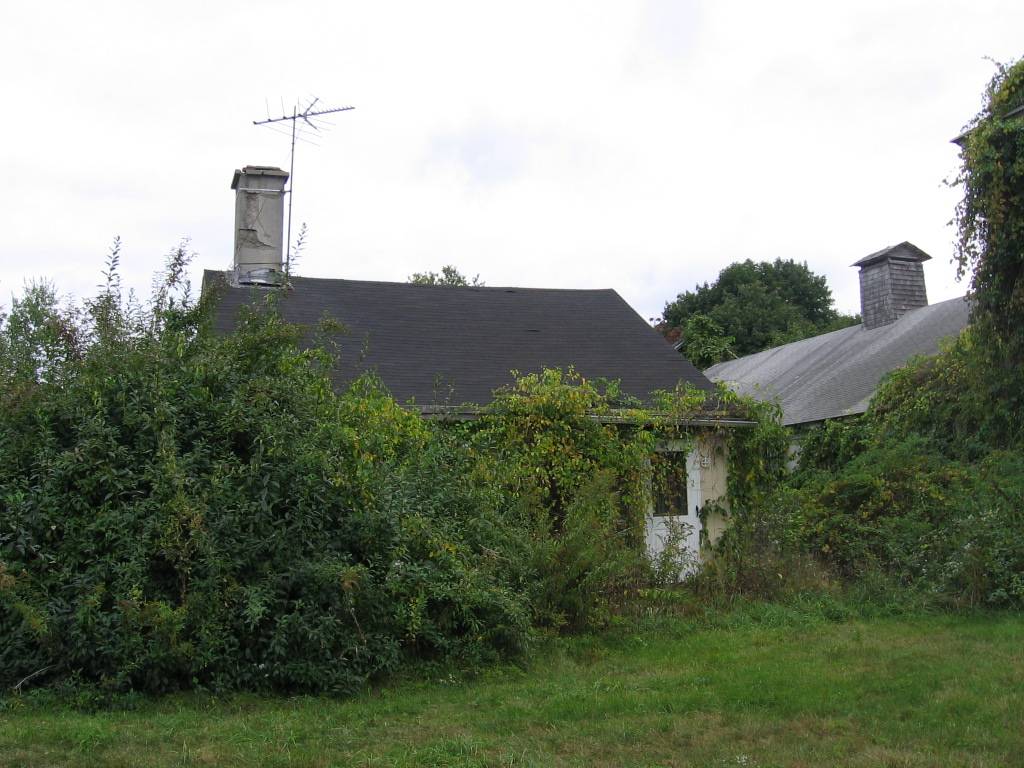
This building consists of two sections: the main cottage, oriented with its gable ends to the north and south, and the one-story milk house, which intersects on the east side, and is set gable end to the east. The west side of the cottage is extended with a lean-to, thus creating a saltbox profile; the door is located on the west façade, which is clad in board-and-batten siding. The gable ends of the stucco cottage building are notable for an exterior cladding of yellow-painted shiplap siding and the pronounced cornice returns.
Historical significance:
This structure is significant as part of the complex of barns built for Edward W. Simons by the S. B. Church Co. of Seymour, CT., for Simons’ dairy operation in 1908. Later in the century the farm was owned and operated by the Ascolese family. Although overgrowth obscures some of the features, it is still possible to see how the complex had a unified design with considerable thought given to such detailing as the stucco finishes, wood-clad gables and deep cornice returns, all features of the Colonial Revival design of the era. This building was converted to a small apartment and now stands vacant.
Colonial Revival style.
S. B. Church Company was a manufacturer of suburban water works and agricultural equipment with offices in Seymour, CT, and Boston. The firm was established by Stephen Betts Church, who made a fortune in the business and left it to the Seymour Trust, which financed several civic buildings in that town.
Field Notes
This structure stands to the north of the milking barn. The building is overgrown. A house, largely destroyed by fire, stands to the northwest, and beyond that, further to the northwest, is the creamery, unapproachable because of overgrowth. Shiplap board was used. Historic use: Milk house/cottage. Current use: Vacant.
- Use & Accessibility
- Environment
Related features
Environment features
Relationship to surroundings
Part of the Edward W. Simons barn complex, this structure stands to the north of the milking barn. The building is overgrown. A house, largely destroyed by fire, stands to the northwest, and beyond that, further to the northwest, is the creamery, unapproachable because of overgrowth.
- Typology & Materials
-
Building Typology
Materials
Structural System
Roof materials
Roof type
Approximate Dimensions
1 1/2 stories
- Source
-
Date Compiled
10/07/2008
Compiled By
Rachel Carley
Sources
Litchfield Tax Assessor Records
Interview with Ellen Ascolese Hamill 9/2007
Andrews and Ransom, “Historical and Architectural Survey of Litchfield, CT: Bantam/Milton Area, 1987” - PhotosClick on image to view full file
-