Barn Record Litchfield
RETURN TO ‘FIND BARNS’- Building Name (Common)
- Cattey Farm (1 of 2)
- Building Name (Historic)
- Cattey Farm- Silo
- Address
- 306 Campville Road, Litchfield
- Typology
- Overview
-
Designations
Historic Significance
Architectural description:
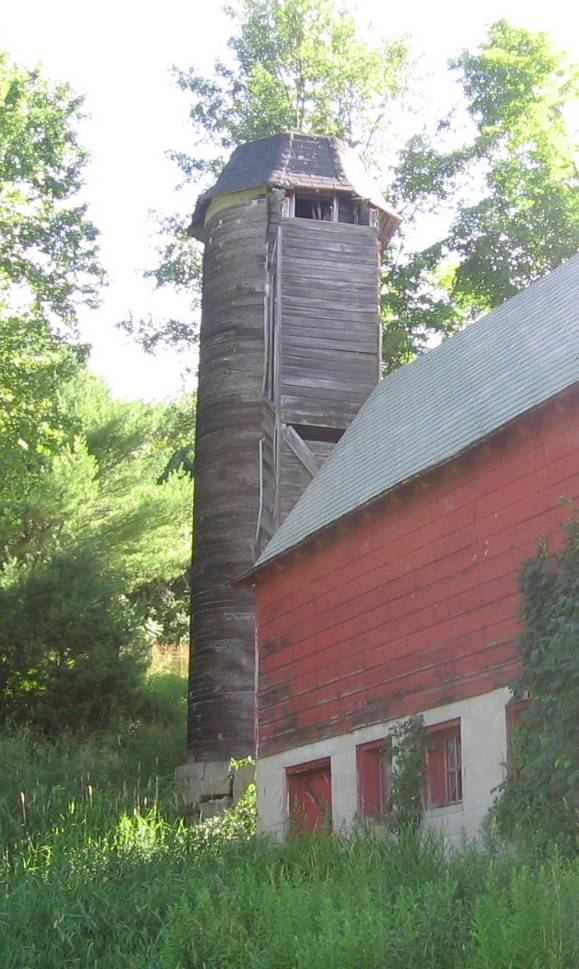
This corn silo is significant as one of the few surviving wood silos in Litchfield. It is one of two second-hand silos moved to the Catty property after the cow barn was built in the 1940s. The other silo, since taken down, stood opposite this one on the south side of the barn. The Cattys raised all of their own cattle feed in a combination of hay, stored on the upper level of the barn, and corn, which was stored in the two silos. The hay was cultivated on the Catty property, which stretched to the Naugatuck River. Mr. Catty grew most of his cow corn in rented fields in Harwinton. The corm crop was harvested in late summer, stalks and all, and shot to the top of the silo. When the silage level fell below the chute opening, it was necessary to climb directly into the silo to shovel it up and out.
The wooden silo, which stands at the southeast corner (upper level) of the cow barn, measures about 10 feet in diameter and rises about 40 feet. The structure is circular in section and is mounted on a concrete foundation. The main body is sheathed with horizontal bands of wood, soaked and bent into shape to follow the circular form of the structure. Each joint, at a point where the ends meet, is secured with a square patch of galvanized metal, marked with a patent number and date: August 4, 1914. A three-sided silo chute, rectangular in section, is located on the north (barn) side of the silo, where it contains a ladder. At a point about 4 feet off the ground, the chute entered the barn; an area of unpainted siding on the barn indicates where the chute bottom, now removed, entered the building.
Historical significance:When chopped cornstalks are compressed to prevent their exposure to the air, the silage ferments instead of spoiling, providing nutritious food for the dairy herd and allowing them to produce milk through the winter. Early silos were built inside the barns, but by the 1890s free-standing silos were being built outside dairy barns. Constructed much like a very large wooden barrel, with adjustable steel hoops holding the vertical grooved staves together, the round wooden stave silo was widely accepted by dairy farmers in New England from the 1890s through the 1930s. Conical roofs are most common on wooden stave silos, usually covered with composition sheet roofing and topped with a metal ventilator. Removable wooden access doors extend up one side. The hoops were loosened in fall to accommodate the swelling of the wood as it absorbed moisture from the silage, and tightened over the winter as the silage dried.
Field Notes
Threat to building: deterioration. Historic use: Silo. Current use: Vacant.
- Use & Accessibility
Use (Historic)
Use (Present)
Exterior Visible from Public Road?
Yes
Demolished
n/a
Location Integrity
Moved
- Environment
Related features
Environment features
Relationship to surroundings
The silo stands at the southeast corner of the Catty cow barn. This lawn to the west and woodland to the south and southeast. The Rte. 8 entrance ramp is located immediately to the south.
- Typology & Materials
-
Building Typology
Materials
Structural System
n/a
Roof materials
Roof type
Approximate Dimensions
10' diameter
- Source
-
Date Compiled
06/07/2009
Compiled By
Rachel Carley
Sources
Litchfield Tax Assessor Records
Interview with Shirley and Ken Naylor 6/07Sexton, James, PhD, Survey Narrative of the Connecticut Barn, Connecticut Trust for Historic Preservation, Hamden, CT, 2005, http://www.connecticutbarns.org/history.
Visser, Thomas D., Field Guide to New England Barns and Farm Buildings, University Press of New England, 1997.
- PhotosClick on image to view full file
-