Barn Record Litchfield
RETURN TO ‘FIND BARNS’- Building Name (Common)
- Perkins Place - Barn (Part 1 of 2)
- Building Name (Historic)
- Perkins Place
- Address
- 89 Clark Road, Litchfield
- Typology

- Overview
-
Designations
Historic Significance
Architectural description:
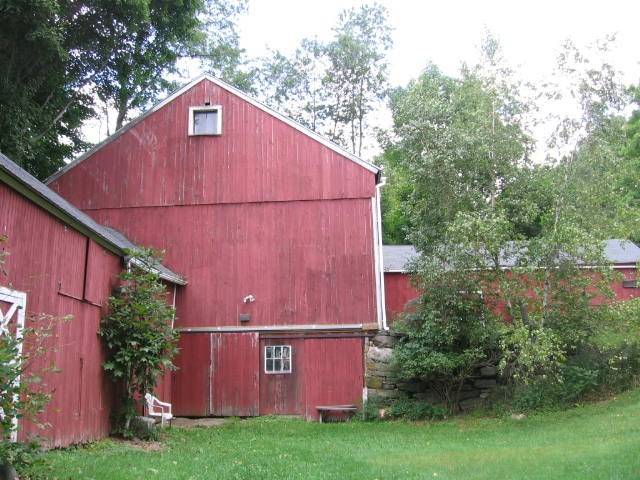
This structure is significant as a well-preserved complex of 19C Litchfield farm buildings, most notable for the central cow and hay barn. This central banked section of the barn, forming the three-bay English barn that is the core of the complex, is one of the most substantial and intact square-rule designed barns in Litchfield. The height of the ridge board gives the barn its remarkable proportions and capacity to hold prodigious amounts of hay storage.
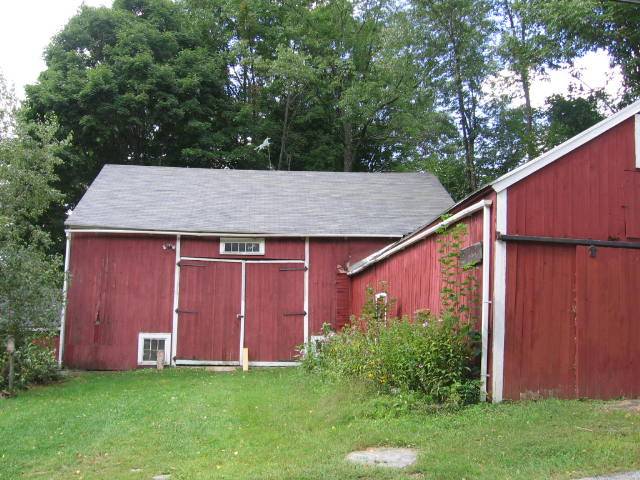
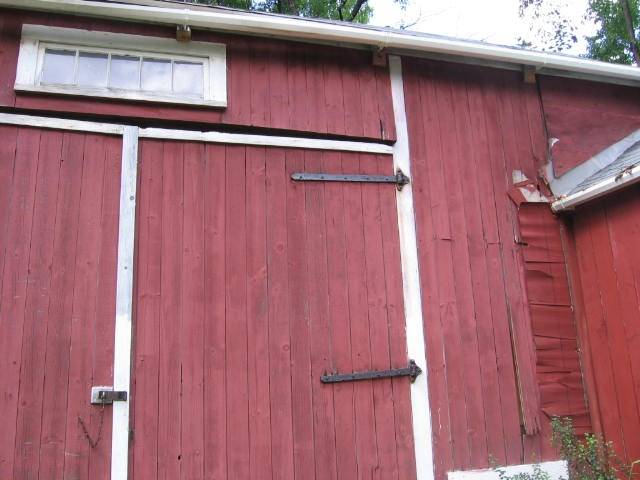
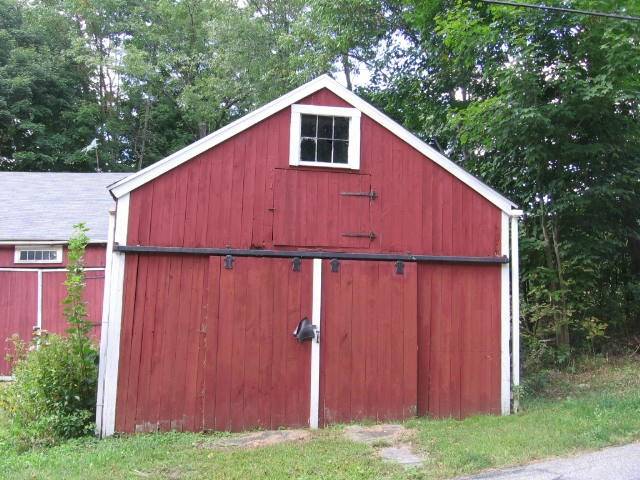
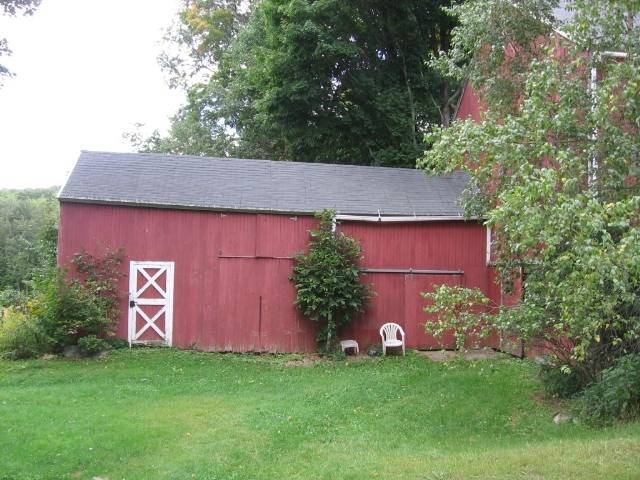
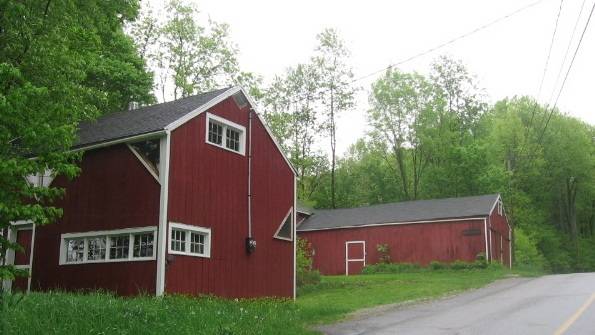
This rambling red-painted structure consists of three sections. At the center is the former hay and cow barn, which stands with its gable ends to the north and south. The south gable end adjusts to the sloping grade so that the lower-level cow barn is entered from that end; on the interior, the fieldstone foundation runs about 8 feet deep. Wooden stanchions were removed c. 1970 to accommodate the present horse stalls. The floor is concrete. Full log joists hold up the wood plank floor of the hay barn above, which is visible through the hay chute. The upper level appears to retain the original hinged doors with iron strap hinges. The interior reveals a traditional three-bay design; the pegged post-and-beam frame (square rule) is crafted with milled timbers. The gable ends reveal a queen-post truss construction with center posts to support the substantial plates. The rafters rise to a ridge board about 42 feet high. Matching tenons indicate that a haymow once covered the central threshing bay. A timber-framed horse barn (34 x 12) with tack room extends from the southwest corner of the south gable end and thus stands at the same level as the central cow barn. The east façade is entered by two sets of rolling doors. The north wing extends eastward from the northwest corner of the barn. This section is a two-bay post-and-beam barn that, possibly moved here, has been attached to the central barn; the portion west of the door is of much newer construction. The east corner posts and other timbers are hand hewn. The floor is concrete; this section of the barn most recently served as a tractor shed.
Historical significance:The oldest barns still found in the state are called the “English Barn,” “side-entry barn,” “eave entry,” or a 30 x 40. They are simple buildings with rectangular plan, pitched gable roof, and a door or doors located on one or both of the eave sides of the building based on the grain warehouses of the English colonists’ homeland. The name “30 by 40” originates from its size (in feet), which was large enough for 1 family and could service about 100 acres. The multi-purpose use of the English barn is reflected by the building’s construction in three distinct bays - one for each use. The middle bay was used for threshing, which is separating the seed from the stalk in wheat and oat by beating the stalks with a flail. The flanking bays would be for animals and hay storage.
The 19th century saw the introduction of a basement under the barn to allow for the easy collection and storage of a winter’s worth of manure from the animals sheltered within the building. The bank barn is characterized by the location of its main floor above grade, either through building into a hillside or by raising the building on a foundation. This innovation, aided by the introduction of windows for light and ventilation, would eventually be joined by the introduction of space to shelter more animals under the main floor of the barn.
Field Notes
Materials: Vertical board (tongue and groove). Historic use: Hay and cow barn; horse barn. Current use: Vacant. English bank barn with wings.
- Use & Accessibility
Use (Historic)
Use (Present)
Exterior Visible from Public Road?
Yes
Demolished
n/a
Location Integrity
Unknown
- Environment
Related features
Environment features
Relationship to surroundings
Barn is part of a complex on the west side of Clark Road; the structure is set back and fronted by the former barnyard. Site is wooded to the north; pasture spreads to the west and south. The center section is banked to the south. A small barn stands to the south (see related form).
- Typology & Materials
-
Building Typology
Materials
Structural System
Roof materials
Roof type
Approximate Dimensions
30 x 36; 34 x 12; 38 x 16 1 story plus lower level
- Source
-
Date Compiled
09/07/2008
Compiled By
Rachel Carley
Sources
Litchfield Tax Assessor Records
Interview with Brock Putnam II 9/07Sexton, James, PhD, Survey Narrative of the Connecticut Barn, Connecticut Trust for Historic Preservation, Hamden, CT, 2005, http://www.connecticutbarns.org/history.
Visser, Thomas D., Field Guide to New England Barns and Farm Buildings, University Press of New England, 1997.
- PhotosClick on image to view full file
-