Barn Record Litchfield
RETURN TO ‘FIND BARNS’- Building Name (Common)
- Livingston Ripley Wildfowl Sanctuary (support complex) 3/3
- Building Name (Historic)
- Kilravock Farm- Hay Barn
- Address
- 10 Duck Pond Road, Litchfield
- Typology

- Overview
-
Designations
Historic Significance
Architectural description:
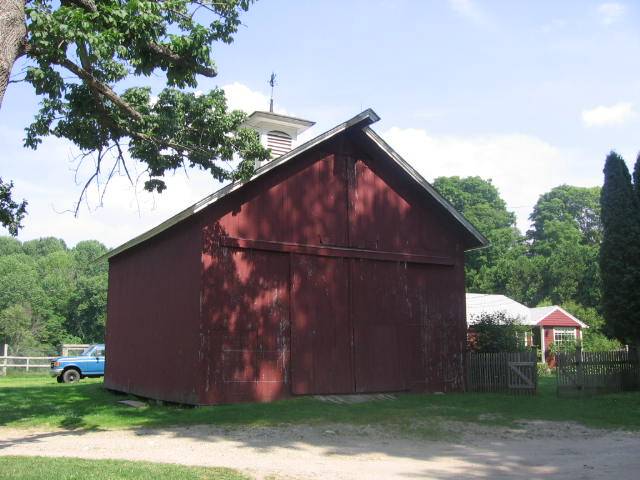
This structure, used for hay storage, is an important survivor of a larger complex that stood on this site and served the Kilravock Dairy operation of the Louis R. Ripley family.
This red-painted peak-roofed hay barn stands with its gable ends oriented to the north and south. The eaves overhang on all sides and the front, west gable end features a triangular hood extension at the roof peak. Double hinged rolling doors are centered at the ground level. The barn is raised slightly on granite blocks and approached by a drive on the west. The framework is built of milled lumber.
Historical significance:The New England barn or gable-front barn was the successor to the English barn and relies on a gable entry rather than an entry under the eaves. The gable front offers many practical advantages. Roofs drain off the sides, rather than flooding the dooryard. With the main drive floor running parallel to the ridge, the size of the barn could be increased to accommodate larger herds by adding additional bays to the rear gable end. Although it was seen by many as an improvement over the earlier side-entry English Barn, the New England barn did not replace its predecessor but rather coexisted with it, as both types continued to be built.
Rather than hurriedly carting large loads of hay from distant fields to the main barn at harvesttime, farmers often found it easier to store New England’s leading crop near its source. Field barns were used to store hay until it was needed during the winter. By waiting until a good snow cover, farmers often found it easier to draw the hay by sled to the main barn to replace that consumed by the herd. During the second half of the nineteenth century, farmers occasionally converted their older, obsolete English barns into field barns by moving them into fields. Some of these field barns had formerly served as sheep barns during the sheep boom of the early nineteenth century.
Field Notes
Style: Gable-front barn. Materials: Vertical board siding. Historic use: Hay barn.
- Use & Accessibility
- Environment
Related features
Environment features
Relationship to surroundings
The hay barn stands on the east side of Duck Pond Road, to the west of the Kilravock Dairy barn. A driveway enters in front and loops north to the machine shop and calf barn. The Livingston Ripley Waterfowl Sanctuary offices are located to the southeast.
- Typology & Materials
-
Building Typology
Materials
Structural System
Roof materials
Roof type
Approximate Dimensions
28 x 32 1 story plus loft
- Source
-
Date Compiled
07/07/2008
Compiled By
Rachel Carley
Sources
Litchfield Tax Assessor Records
Interview with Laurel Ripley Galloway 7/07Sexton, James, PhD, Survey Narrative of the Connecticut Barn, Connecticut Trust for Historic Preservation, Hamden, CT, 2005, http://www.connecticutbarns.org/history.
Visser, Thomas D., Field Guide to New England Barns and Farm Buildings, University Press of New England, 1997.
- PhotosClick on image to view full file
-