Barn Record Litchfield
RETURN TO ‘FIND BARNS’- Building Name (Common)
- Lt. Thomas Catlin House/ Middle Ridge Farm (Part 4 of 4)
- Building Name (Historic)
- Lt. Thomas Catlin House/ Middle Ridge Farm- Horse Barn
- Address
- 125 East Chestnut Hill Road, Litchfield
- Typology

- Overview
-
Designations
Historic Significance
Architectural description:
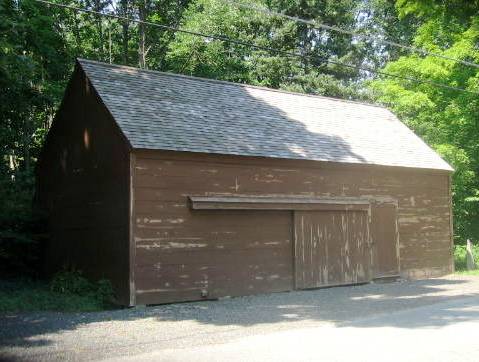
This barn is likely one of the oldest extant colonial farm buildings in Litchfield. It is important for its association with the Catlin family and as part of a well-preserved 19C farmstead. Most of the framing appears to be original and the lack of a ridgepole is notable. At the end of the 20th century, it was used as a horse barn.
This barn has a traditional English format with the wagon door roughly centered on the east façade; a door with strap hinges is set adjacent to the north; another located at the southwest corner in the rear. The south end of the structure rests on a low fieldstone foundation, laid dry, and reinforced in some places with cement blocks. The framework is a hand-hewn, pegged, post-and-beam structure with studs at two-foot intervals, intermediate girt and a braced plate. A tie beam supports the end rafters; the rafters are framed without a ridge pole. Massive cross beams support a haymow over half the space. The floor is dirt.
Historical significance:The oldest barns still found in the state are called the “English Barn,” “side-entry barn,” “eave entry,” or a 30 x 40. They are simple buildings with rectangular plan, pitched gable roof, and a door or doors located on one or both of the eave sides of the building based on the grain warehouses of the English colonists’ homeland. The name “30 by 40” originates from its size (in feet), which was large enough for 1 family and could service about 100 acres. The multi-purpose use of the English barn is reflected by the building’s construction in three distinct bays - one for each use. The middle bay was used for threshing, which is separating the seed from the stalk in wheat and oat by beating the stalks with a flail. The flanking bays would be for animals and hay storage.
Field Notes
Materials: Clapboard siding at gable ends; Horizontal board with vertical tongue-and-groove barn
- Use & Accessibility
Use (Historic)
Use (Present)
Exterior Visible from Public Road?
Yes
Demolished
n/a
Location Integrity
Unknown
- Environment
Related features
Environment features
Relationship to surroundings
Barn stands on the west side of East Chestnut Hill Road, across from, and slightly south of, the main house. Wooded to the rear. Fronts directly onto the road.
- Typology & Materials
-
Building Typology
Materials
Structural System
Roof materials
Roof type
Approximate Dimensions
44 x 20 1 story
- Source
-
Date Compiled
09/07/2008
Compiled By
Rachel Carley
Sources
Litchfield Tax Assessor Records
Interview with Carol Bramley 9/07Sexton, James, PhD, Survey Narrative of the Connecticut Barn, Connecticut Trust for Historic Preservation, Hamden, CT, 2005, http://www.connecticutbarns.org/history.
Visser, Thomas D., Field Guide to New England Barns and Farm Buildings, University Press of New England, 1997.
- PhotosClick on image to view full file
-