Barn Record Litchfield
RETURN TO ‘FIND BARNS’- Building Name (Common)
- Kalmia Acres Farm
- Building Name (Historic)
- Kalmia Acres Farm
- Address
- 373 East Litchfield Road, Litchfield
- Typology

- Overview
-
Designations
Historic Significance
Architectural description:
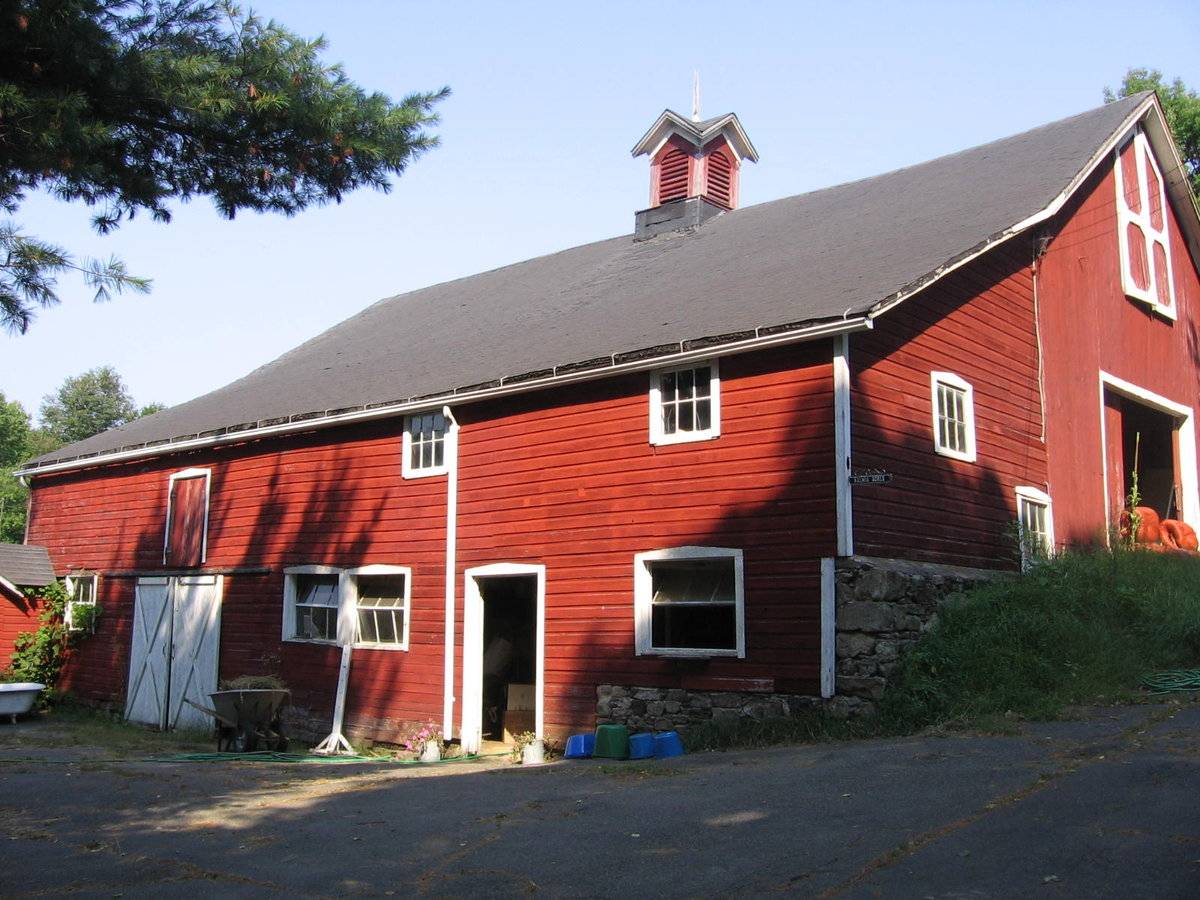
This building is a well-preserved example of a pegged, timber-framed English barn built with dimensional millwork, probably in the late 1800s. The milk room (for cooling milk) and the lean-to were added by George Sawyer in the late 1930s or early 1940s, when he was establishing his Kalmia Acres dairy. (Pete Naser of East Litchfield built the substantial stone foundation at the southeast corner of the barn that supports the lean-to addition; the rest of the foundation is original.) An ice house stood to the southeast of the milk room. Three wells supplied the farm, bringing water to the cow barn first, then to the house.
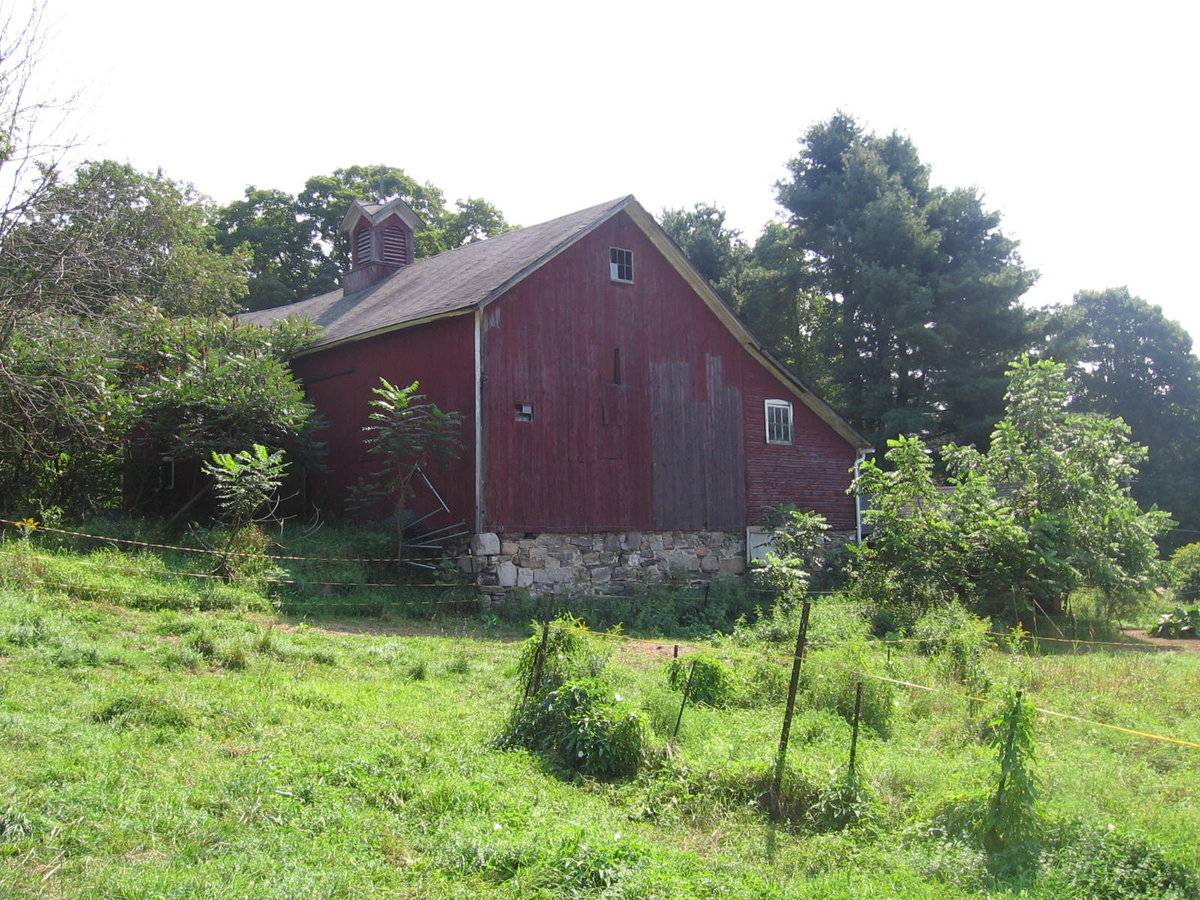
This bank barn stands on a fieldstone foundation with its gable ends oriented to the east and west. A lean-to (15’ deep) runs along the south façade, and a one-story peak-roofed milk room is attached to the southwest corner. These parts of the barn are clad in drop siding, painted red. The western half of the lower lean-to is fitted out as a stanchion barn with iron stanchions. The most significant part of the barn is the original section—that is, the section of the barn standing to the north of the lean-to. This main section is a timber-framed (square-rule) sturcutre built with dimensional millwork. The structure adjusts to the sloping site and shut has a lower level to the south. The interior foundation is a remarkable fieldstone structure that rises about 10” at its highest point. At the west gable end the fieldstone foundation rises above ground about 5 feet. The design is a traditional English barn format of three bays, entered on the long façade. The original wagon entrance (rolling doors) is centered on the north façade. A four-sided cupola with intersecting roofs and arched louvers rises from the roof peak. The loft at the east end of the barn originally extended from gable to gable. A notable feature are the iron tie rods, which enabled the farmers to open the space to the rafters for hay storage with minimal post support.
Historical significance:The oldest barns still found in the state are called the “English Barn,” “side-entry barn,” “eave entry,” or a 30 x 40. They are simple buildings with rectangular plan, pitched gable roof, and a door or doors located on one or both of the eave sides of the building based on the grain warehouses of the English colonists’ homeland. The name “30 by 40” originates from its size (in feet), which was large enough for 1 family and could service about 100 acres. The multi-purpose use of the English barn is reflected by the building’s construction in three distinct bays - one for each use. The middle bay was used for threshing, which is separating the seed from the stalk in wheat and oat by beating the stalks with a flail. The flanking bays would be for animals and hay storage. The 19th century saw the introduction of a basement under the barn to allow for the easy collection and storage of a winter’s worth of manure from the animals sheltered within the building. The bank or side-hill barn is characterized by the location of its main floor above grade, either through building into a hillside or by raising the building on a foundation. This innovation, aided by the introduction of windows for light and ventilation, would eventually be joined by the introduction of space to shelter more animals under the main floor of the barn.
Before the 1880s, cheese and butter making were usually done on the farm. The milk room or dairy room was often located in an ell between the kitchen and the woodshed. Some farms had separate milk rooms and dairy rooms. In the milk room, the fresh milk was poured into shallow pans placed on shelves or racks. After the cream rose to the surface, it was skimmed off the milk and then churned to make butter. Cooperative creameries were being established throughout New England in the 1880s. Usually located next to the railroad line in villages, these creameries processed the milk of dozens of farmers, who shipped the liquid from the farm to the creamery by wagon in metal cans. Single-story milk houses are typically attached to [20th-century] ground-level stable barns for preparation of the milk to be sent to the creamery. Designed to comply with state and local ordinances intended to minimize the potential for milk contamination, many are now fitted with large, electrically cooled stainless steel bulk storage tanks.
Historical background:In the upper level of the old barn, hay was stored in the loft, or mow, that originally ran the full length. The west end of this level housed the farm’s two workhorses. Sawyer took out most of the loft c. 1949 and removed the horse partitions in order to use the entire upper barn for hay storage; it was loaded up to the rafters. (A horse barn was built to the north) The farmers loaded the hay using a trolley system with claws. The hay wagon stood at the east gable and a workhorse pulled a rig from the west end to operate the claws; five loads in a day was a good day. Before the barn was converted to the full-scale dairy operation, the lower level of the older, original section held manure in the west end; cider was stored in the east end. The upper level of the new lean-to was used for hay storage and for drying straw; there were calf stalls below. A wooden silo (no longer standing) was built to hold corn grown in the back lot. Later Sawyer changed to grass silage.
Sawyer sold his milk to a New Haven dairy, delivering the raw milk in cooled cans to a stand on the old Rte. 8 every three days. The cows were milked by hand until about the last three years of the dairy operation (1940s) when a vacuum system was installed.
Field Notes
Materials: Drop siding; Vertical board.
- Use & Accessibility
Use (Historic)
Use (Present)
Exterior Visible from Public Road?
Yes
Demolished
n/a
Location Integrity
Unknown
- Environment
Related features
Environment features
Relationship to surroundings
Barn stands about 100 feet to the north of the house; site slopes north to south; horse pasture to the west.
- Typology & Materials
-
Building Typology
Materials
Structural System
Roof materials
Roof type
Approximate Dimensions
24 x 50; 15' lean-to on south side 1 and 2 stories
- Source
-
Date Compiled
09/07/2008
Compiled By
Rachel Carley
Sources
Litchfield Tax Assessor Records
Interview with Richard Healy 8/07Sexton, James, PhD, Survey Narrative of the Connecticut Barn, Connecticut Trust for Historic Preservation, Hamden, CT, 2005, http://www.connecticutbarns.org/history.
Visser, Thomas D., Field Guide to New England Barns and Farm Buildings, University Press of New England, 1997.
- PhotosClick on image to view full file
-