Barn Record Litchfield
RETURN TO ‘FIND BARNS’- Building Name (Common)
- Charles S. Wheeler Farm- Hay Barn (Part 2 of 2)
- Building Name (Historic)
- Charles S. Wheeler Farm- Hay Barn
- Address
- 55 Hutchinson Parkway, Litchfield
- Typology

- Overview
-
Designations
Historic Significance
Architectural description:
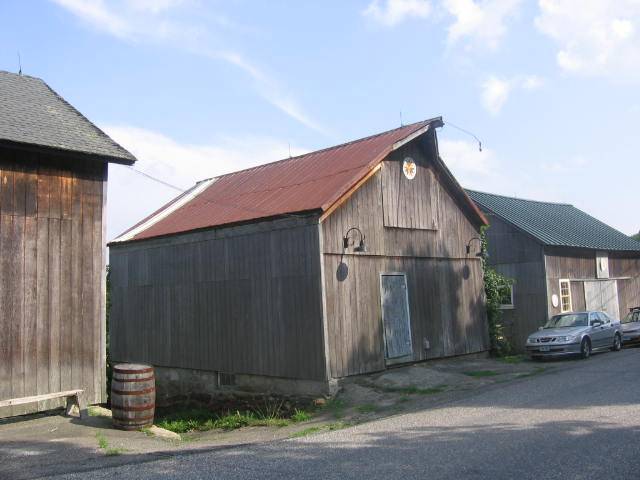
Part of the Charles D. Wheeler barn complex, this bank barn is the south structure of the two barns indicated on the 1859 Clark map; it is illustrated in the 1881 Lewis History of Litchfield County. Two smaller outbuildings stood to the east. The barn contained a two-story hayloft on the upper level and lower level animal runs for sheep and pigs, as well as birthing stalls for cows. The building was also used for barn dances.
A peak-roofed barn oriented with its gable ends to the east and west. The structure banks to the east to adjust to the grade. The roof peak terminates in a projecting hood that overhangs the loft door centered in the west gable end. A single hinged door is located below. The structure is particularly notable for the immense foundation stones at the northeast corner; at the east end, the barn foundation rises about 6 feet high.
Historical significance:The New England barn or gable front barn was the successor to the English barn and relied on a gable entry rather than an entry under the eaves. The gable front offered many practical advantages. Roofs drained off to the sides, rather than flooding the dooryard. With the main drive floor running parallel to the ridge, the size of the barn could be increased to accommodate larger herds by adding additional bays to the rear gable end. Although it was seen by many as an improvement over the earlier side-entry English Barn, the New England barn did not replace its predecessor but rather coexisted with it; both types continued to be constructed.
The 19th century also saw the introduction of a basement under the barn to allow for the easy collection and storage of a winter’s worth of manure from the animals sheltered within the building. The bank barn is characterized by the location of its main floor above grade, either through building on a hillside or by raising the building on a foundation. This innovation, aided by the introduction of windows for light and ventilation, would eventually be joined by the introduction of space to shelter more animals under the main floor of the barn.Rather than hurriedly carting large loads of hay from distant fields to the main barn at harvesttime, farmers often found it easier to store New England’s leading crop near its source. Field barns were used to store hay until it was needed during the winter. By waiting until a good snow cover, farmers often found it easier to draw the hay by sled to the main barn to replace that consumed by the herd. During the second half of the nineteenth century, farmers occasionally converted their older, obsolete English barns into field barns by moving them into fields. Some of these field barns had formerly served as sheep barns during the sheep boom of the early nineteenth century.
Field Notes
Other materials: Vertical board. Other roof materials: Seamed metal (rusted). Historic use: Hay/sheep/cow barn. Style: Gable-front bank barn.
- Use & Accessibility
- Environment
Related features
Environment features
Relationship to surroundings
This barn is the center structure of three adjacent barns fronting on the east side of Hutchinson Parkway, across from the Charles D. Wheeler house. The site slopes to the east. Fields to east, north and south.
- Typology & Materials
-
Building Typology
Materials
Structural System
n/a
Roof materials
Roof type
Approximate Dimensions
24 x 32 1 story plus loft and lower level
- Source
-
Date Compiled
10/07/2008
Compiled By
Rachel Carley
Sources
Litchfield Tax Assessor Records
Interview with Harvey Hubbell 9/07
J. W. Lewis, History of Litchfield County, 1881Sexton, James, PhD, Survey Narrative of the Connecticut Barn, Connecticut Trust for Historic Preservation, Hamden, CT, 2005, http://www.connecticutbarns.org/history.
Visser, Thomas D., Field Guide to New England Barns and Farm Buildings, University Press of New England, 1997.
- PhotosClick on image to view full file
-