Barn Record Litchfield
RETURN TO ‘FIND BARNS’- Building Name (Common)
- David M. Wheeler House/Butternut Brook Farm (Part 1 of 3)
- Building Name (Historic)
- David M. Wheeler House/Butternut Brook Farm- Bull Barn
- Address
- 162 Hutchinson Parkway, Litchfield
- Typology

- Overview
-
Designations
Historic Significance
Architectural description:
In the Butternut Brook Farm era, the bull barn housed three bulls, which enjoyed outdoor runs with heavy cables used for fencing. The complex of buildings is an attractive addition to the farm and the design is notable for the design treatment of the stepped stone foundation.
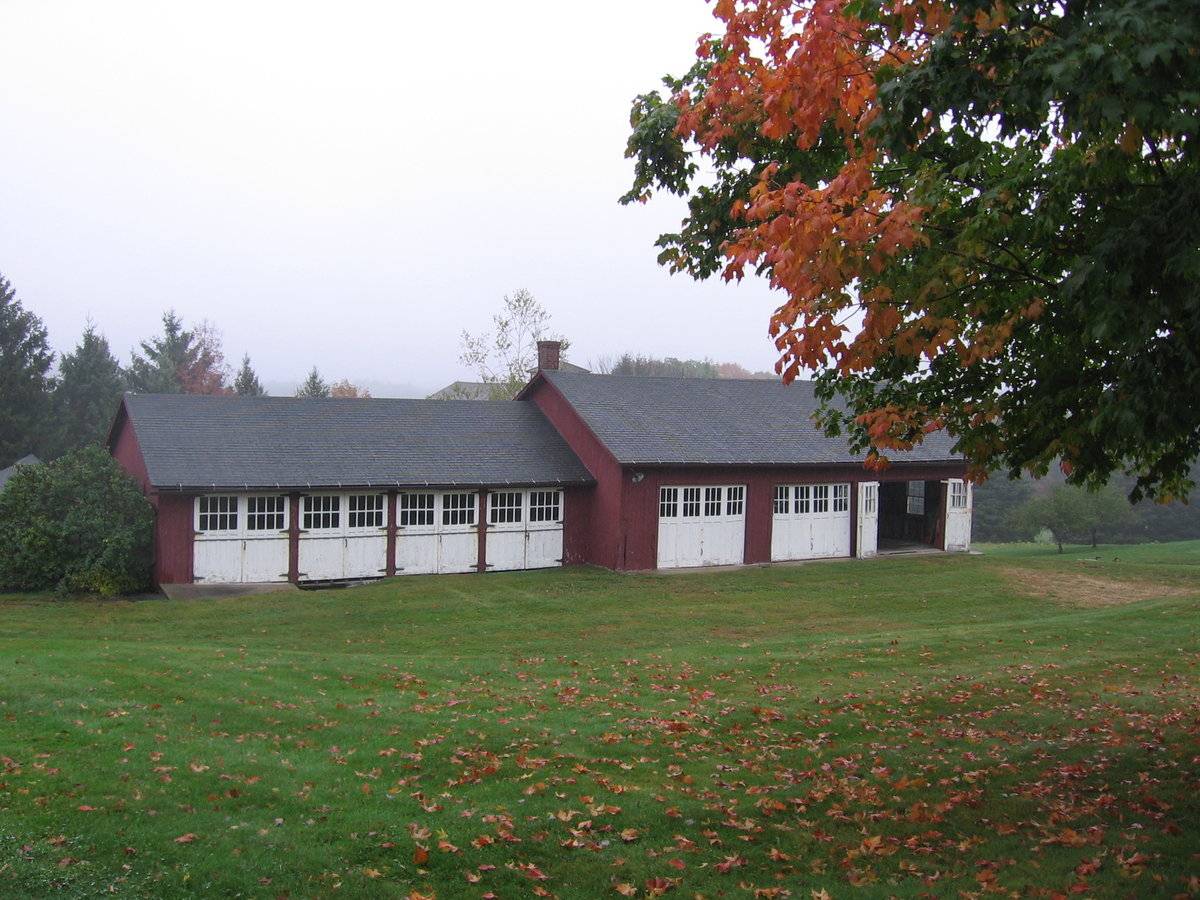
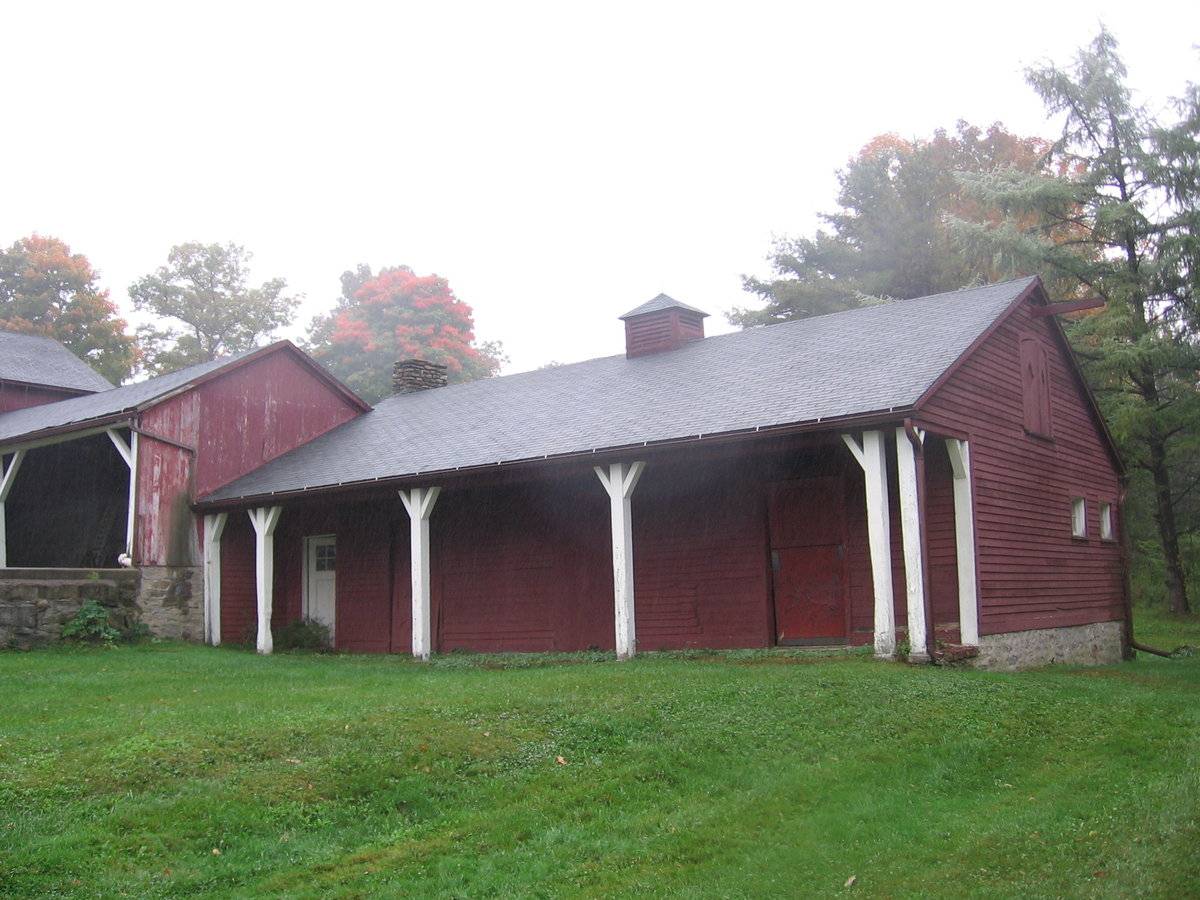
A trim, red-painted complex of connected structures that adapts to the east-sloping grade; the overall layout is an L-plan. The upper level, facing Seherr-Thoss Drive to the west, consists of two telescoping peak-roofed structures set on a substantial fieldstone foundation with decorative raised pointing that banks to the east. The larger, southern portion (equipment shed and shop) is fronted by three garage bays, fitted with folding hinged barn doors with upper lights; four pairs of doors are located in the northern portion. A brick chimney rises near the north gable end of the south section. The interior framework is of milled lumber and the floors are wood plank. An east ell comprising two telescoping sections intersects with the northeast corner of the garage; a cobblestone chimney is located at the juncture of the two sections, and a hip-roofed ventilator rests on the roof ridge of the lower bull barn. The east ell, which banks down the hill, served as the Butternut Brook farms bull barn. Among the notable interior features is a floor paved with dry-set brick; stalls open to the south, and there is a hayloft above. There are open sheds in the upper section of the ell and on the east side of the equipment barn, forming a partially enclosed barnyard that is terraced to the east at two levels.
Historical significance:The oldest barns still found in the state are called the “English Barn,” “side-entry barn,” “eave entry,” or a 30 x 40. They are simple buildings with rectangular plan, pitched gable roof, and a door or doors located on one or both of the eave sides of the building based on the grain warehouses of the English colonists’ homeland. The name “30 by 40” originates from its size (in feet), which was large enough for 1 family and could service about 100 acres. The multi-purpose use of the English barn is reflected by the building’s construction in three distinct bays - one for each use. The middle bay was used for threshing, which is separating the seed from the stalk in wheat and oat by beating the stalks with a flail. The flanking bays would be for animals and hay storage.
Field Notes
Other materials: Vertical board. Style: Bank barn. Historic use: Equipment shed/bull barn. Present use: Garage/storage.
- Use & Accessibility
- Environment
Related features
Environment features
Relationship to surroundings
Barn/garage stands to the north of the house and pony barn, on the east side of Seherr-Thoss Drive. Site slopes to the east; surround by open lawn. Hay barn is to the southeast.
- Typology & Materials
-
Building Typology
Materials
Structural System
Roof materials
Roof type
Approximate Dimensions
46 x 28; 40 x 22; 40 x 22; 86 x 32; 43 x 25 1 story plus lower level
- Source
-
Date Compiled
10/07/2008
Compiled By
Rachel Carley
Sources
Litchfield Tax Assessor Records
Information from Wendy Victor 10/07Sexton, James, PhD, Survey Narrative of the Connecticut Barn, Connecticut Trust for Historic Preservation, Hamden, CT, 2005, http://www.connecticutbarns.org/history.
Visser, Thomas D., Field Guide to New England Barns and Farm Buildings, University Press of New England, 1997.
- PhotosClick on image to view full file
-