Barn Record Litchfield
RETURN TO ‘FIND BARNS’- Building Name (Common)
- David M. Wheeler House/Butternut Brook Farm (Part 2 of 3)
- Building Name (Historic)
- David M. Wheeler House/Butternut Brook Farm- Hay Barn
- Address
- 162 Hutchinson Parkway, Litchfield
- Typology
- Overview
-
Designations
Historic Significance
Architectural description:
This large barn is an excellent example of the Wisconsin dairy barn type, a gambrel-roofed loft barn type developed by the Wisconsin Agricultural Experiment State around 1915. The structure was used as a hay barn by the Seherr-Thosses, who raised cattle on this property from 1948 to the 1966. At the height of their operation they had 120 head of Jerseys and milked 66 cows. Hans Seherr-Thoss removed the tie beams and loft of this barn to open up the space up to the rafters and improve the building’s capacity for drying hay, which was loaded here green and dried with blowers (since removed). The lower level provided additional space for milking cows; a large concrete milking barn to the north was torn down c. 1970.
The exterior of the barn shows considerable attention to design and detailing in the combination of vertical board and shingles, which suggest the influence of the Colonial Revival. The flared eaves are a distinctive touch.
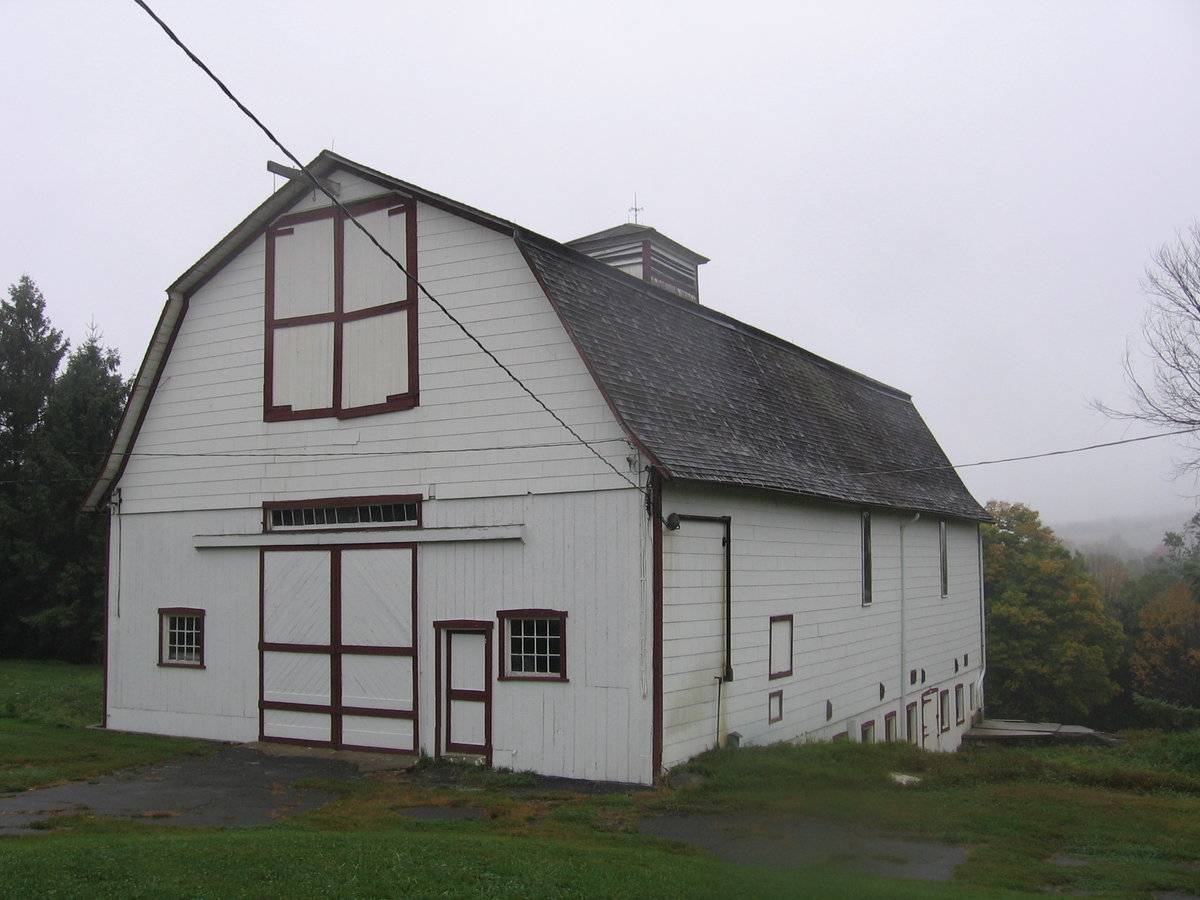
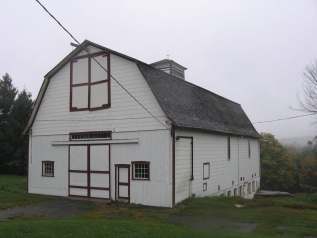
A traditionally styled gambrel-roofed barn with flared eaves painted white with dark red trim. The building is banked to adjust to the eastward sloping site and thus gains a lower level. Double rolling wagon doors laid up with diagonal boards are centered in the west gable end. A multi-pane transom is located above and 12-pane windows flanking; a single hinged door to the south and hinged loft doors centered above. Dwarf foundation buttresses of stone on the north side. Twelve-pane windows are trimmed with simple board frames and topped by pointed lintels. The building is a plank-frame barn with a braced rafter system that forms a series of trusses. Much of the board floor is original. The lower level contains a milking parlor with metal stanchions and a concrete floor. A hip-roofed ventilator is centered on the ridge.
Historical significance:The New England barn or gable front barn is the successor to the English barn and relies on a gable entry rather than an entry under the eaves. The gable front offers many practical advantages. Roofs drain off the side, rather than flooding the dooryard. With the main drive floor running parallel to the ridge, the size of the barn could be increased to accommodate larger herds by adding additional bays to the rear gable end. Although it was seen by many as an improvement over the earlier side entry English Barn, the New England barn did not replace its predecessor but rather coexisted with it as both types continued to be constructed. The gambrel roof enclosed a much greater volume than a gable roof did, and its shape could be formed with trusses that did not require cross beams, which would interfere with the movement and storage of hay. Also known as the curb roof, the double slopes of the gambrel offer more volume in the hayloft without increasing the height of the side walls. The 19th century would see the introduction of a basement under the barn to allow for the easy collection and storage of a winter’s worth of manure from the animals sheltered within the building. The bank barn is characterized by the location of its main floor above grade, either through building on a hillside or by raising the building on a foundation. This innovation, aided by the introduction of windows for light and ventilation, would eventually be joined by the introduction of space to shelter more animals under the main floor of the barn.
Field Notes
Other materials: Vertical board. Historic use: Hay and cow barn. Present use: Vacant. Style: Bank barn.
- Use & Accessibility
Use (Historic)
Use (Present)
Exterior Visible from Public Road?
Yes
Demolished
n/a
Location Integrity
Original Site
- Environment
Related features
Environment features
Relationship to surroundings
Barn stands in a hollow to the east of the calf barn, amid open lawn. House is to the southwest. Site slopes to the east.
- Typology & Materials
-
Building Typology
Materials
Structural System
Roof materials
Roof type
Approximate Dimensions
40 x 80 1 story plus lower level
- Source
-
Date Compiled
10/07/2008
Compiled By
Rachel Carley
Sources
Litchfield Tax Assessor Records
Sexton, James, PhD, Survey Narrative of the Connecticut Barn, Connecticut Trust for Historic Preservation, Hamden, CT, 2005, http://www.connecticutbarns.org/history.
Visser, Thomas D., Field Guide to New England Barns and Farm Buildings, University Press of New England, 1997.
- PhotosClick on image to view full file
-