Barn Record Eastford
RETURN TO ‘FIND BARNS’
- Overview
-
Designations
n/a
Historic Significance
Architectural description:
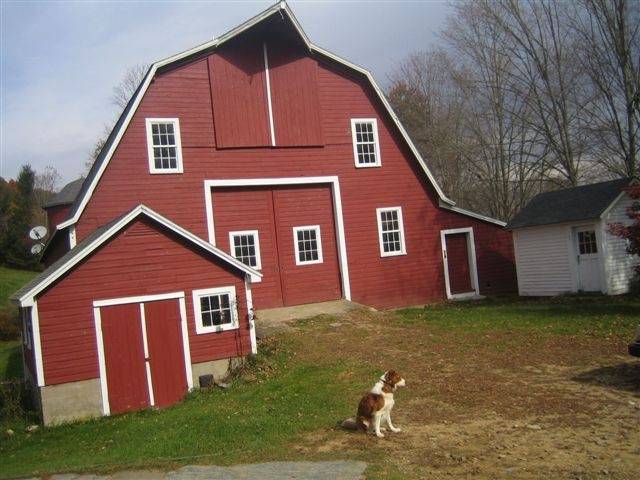
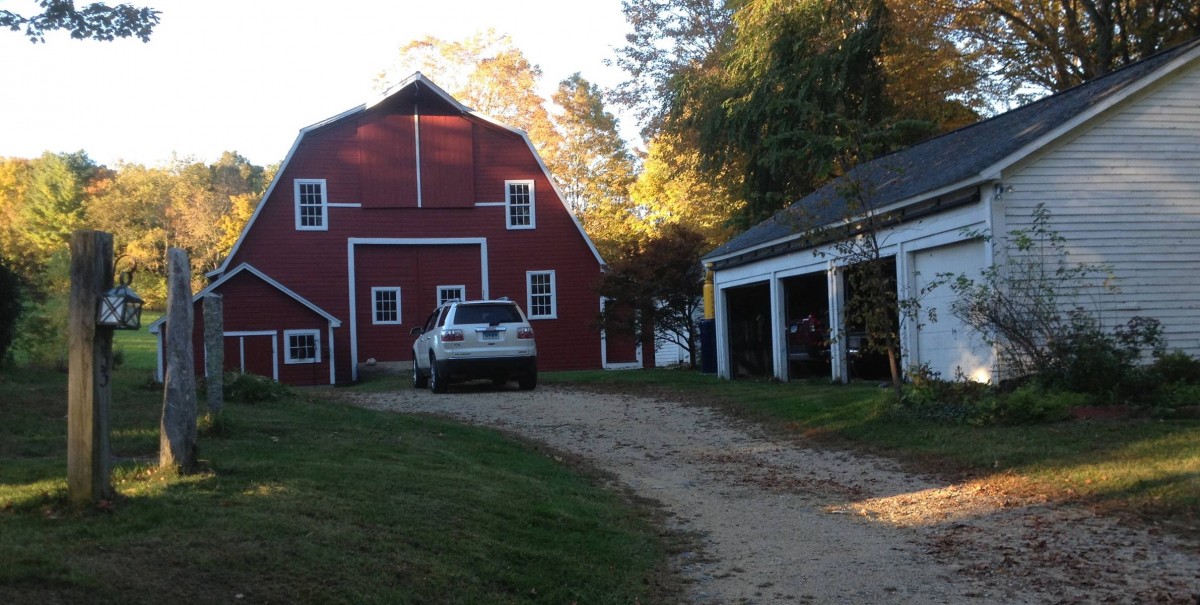
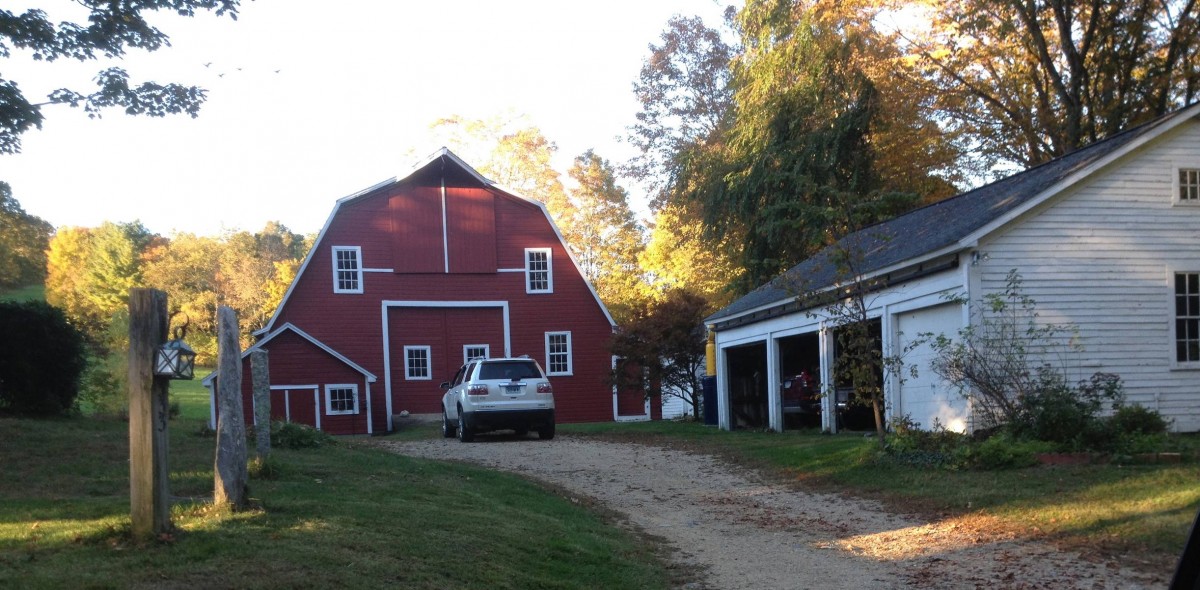
This is a 2-story gable-entry gambrel-roof barn with an attached gable-roof and shed-roof additions, as well as a pair of attached silos. The main facade faces south and the ridge-line is perpendicular to Old Colony Road, which at this point runs approximately east to west.
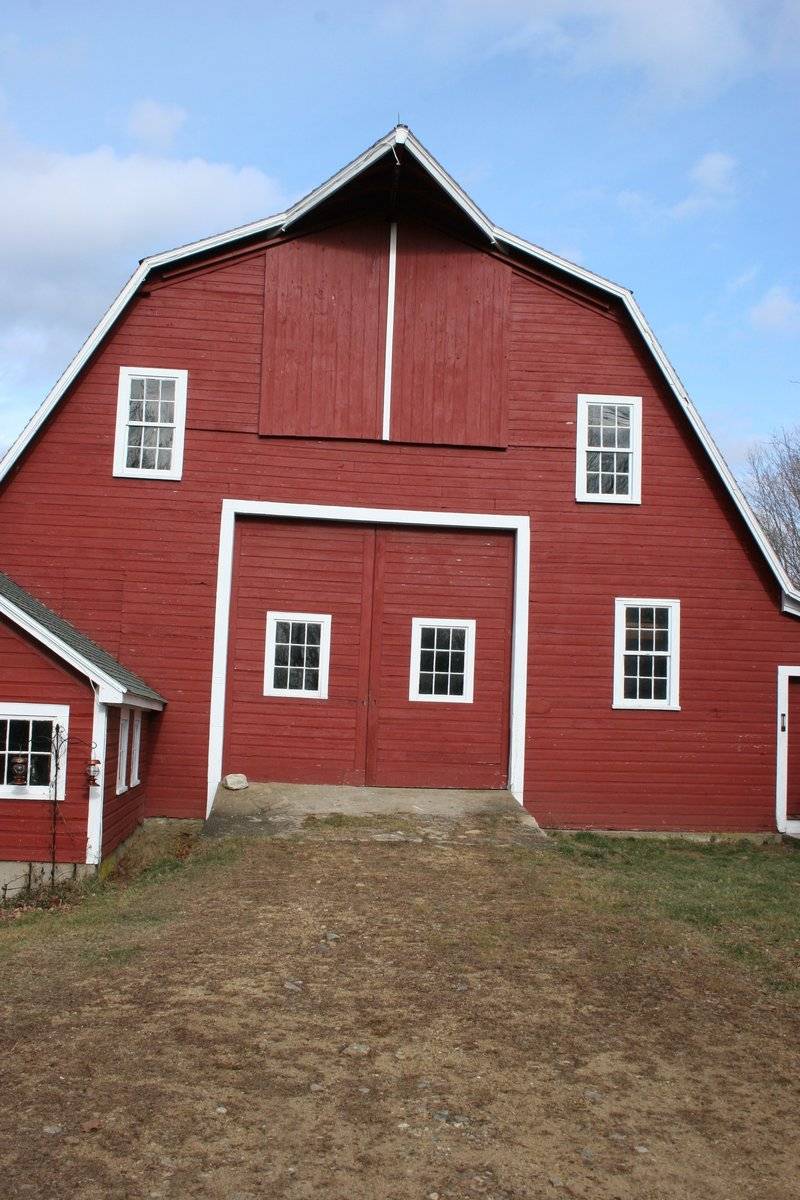
The main entry is centered on the south gable-end of the barn and has an above grade ramp leading to a pair of interior sliding doors, each with a fixed nine-pane window. To the east of the doors is a six-over-six double-hung window; to the west, a gable-roof addition, possibility a milk room. Below the apex of the extended hay hood in the roof is a double hay door, flanked by six-over-six double-hung windows.
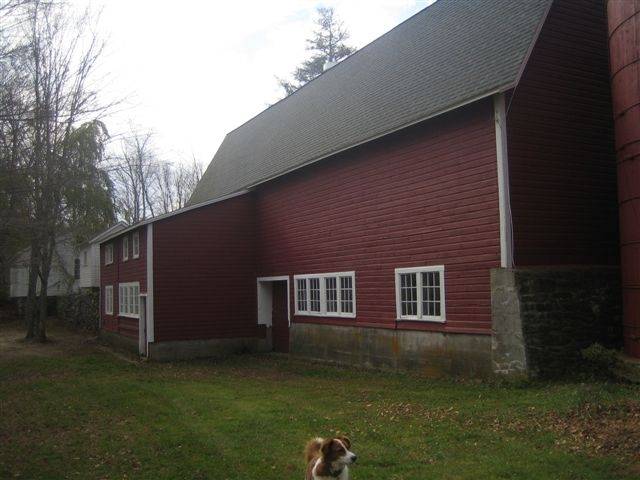
The west eave-side of the barn has a series of fifteen fixed nine-pane windows and a pass-through door at the north corner. The concrete foundation is visible along this side.
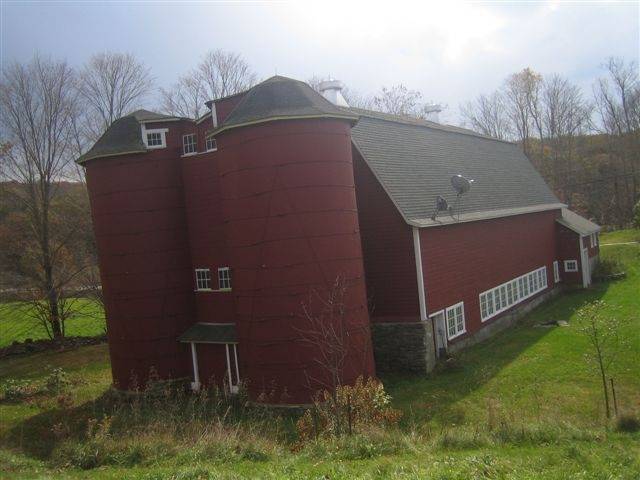
The north gable-end of the barn has two attached poured concrete silos. This side also features a mortared field-stone foundation. Centered on the north gable-end is a entryway with a shed-roof hood. Above this, between the silos are two, six-pane windows with trim. Found in the gable-attic of the north gable-end are two, six-pane windows with trim. Protruding from the roof of each of the silos is a shed-roof dormer with a six-pane window with trim.
Along the east eave-side of the barn are six, fixed nine-pane windows and a pass-through door next to a shed-roof addition. The concrete foundation is also visible along this side.
The gable-roof addition is attached to the west corner of the south gable-end of the barn and has two, six-pane windows with trim on the east side. A pair of side-hinged doors are centered on the south side of the addition. Near the east corner is a six-pane window with trim. A vent is found in the gable of the addition. There appear to be three windows with trim and a pass-through door along the west side of the gable-roof addition. Just above the windows, near the south corner are two windows with trim. On the north side of the gable-roof addition is a six-pane window with trim.
The shed-roof addition is attached to the south corner of the east eave-side of the barn. A pass-through door is found on the south side of the shed-roof addition. Along the east side of the addition are a series of six, nine-pane windows with trim. A pass-through door is found on the north corner of the east side of the shed-roof addition. Located above the windows are four windows with trim. There are no openings found on the north side of the shed-roof addition.
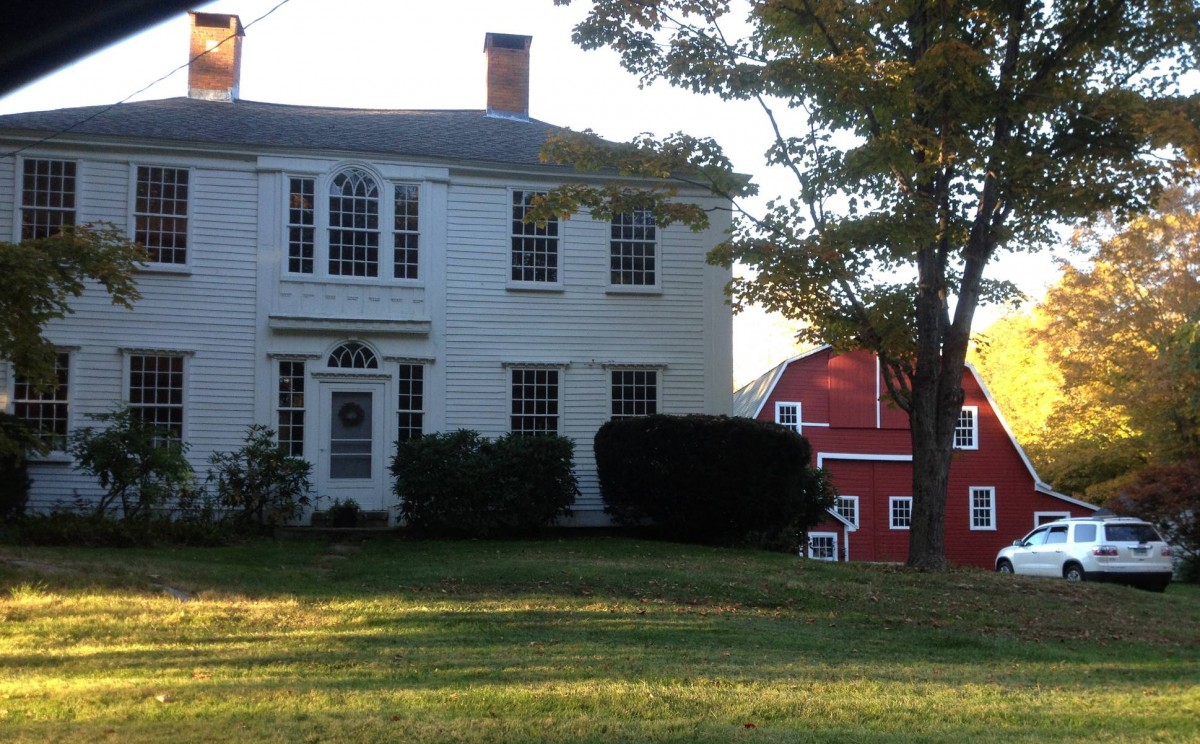
The gambrel roof has a pair of metal ventilators atop the ridge-line, and asphalt shingles. The barn is sheathed in beveled novelty horizontal siding and is painted red with white trim.
Historical significance:The New England barn or gable front barn was the successor to the English barn and relies on a gable entry rather than an entry under the eaves. The gable front offers many practical advantages. Roofs drain off the side, rather than flooding the dooryard. With the main drive floor running parallel to the ridge, the size of the barn could be increased to accommodate larger herds by adding additional bays to the rear gable end. Although it was seen by many as an improvement over the earlier side-entry English Barn, the New England barn did not replace its predecessor but rather coexisted with it.
The gambrel roof design was universally accepted for ground-level stable barns as it enclosed a much greater volume than a gable roof did, and its shape could be formed with trusses that did not require cross beams, which would interfere with the movement and storage of hay. Also known as the curb roof, the double slopes of the gambrel offer more volume in the hayloft without increasing the height of the side walls.
Some were poured in place in forms in one piece, but the more common practice was to pour large interlocking rings that were then stacked. As with wooden stave silos, the structures are held together with adjustable steel hoops, spaced about fifteen inches apart. Since concrete does not expand and contract with changes in moisture levels, the hoops on concrete stave silos were usually tightened only once after the structure was built. Inside, these silos are coated with a cement wash.
The first ventilators were simple wooden louvered boxes with gable roofs, mounted near the ridge of the barn. The object of the cupola [or ventilators] is to protect the opening of the flue from the elements, keep out birds, prevent backdrafts as far as possible, and assist in drawing the foul air from the barn. Later, metal ventilators were introduced to offer more efficient ventilation with less maintenance. By the early twentieth century, prefabricated galvanized-steel ventilators were being marketed across the country. Despite sometimes being ornamented with finials or weathervanes, they lacked the romantic feel of the wooden cupola. The factory-produced steel ventilator symbolized a step in the movement towards an industrial approach to farming.
Field Notes
Where the red barn stands today stood the other old barn, which blew down in the 1938 hurricane, killing the farm owner, Orlo Carpenter, who was trying to rescue his horses. The red barn was built in 1940. The Carpenters had the Devon Dairy Farm, and owned Pond Hill for 100 years. The sign reads: “Pond Hill Farm: Devons of Quality. O. B. Carpenter Mgr. Eastford CT.” The stanchions on the bottom floor are wide enough for the horns of the devon cows. It is to some degree a hill barn, since the front entrance [toward the road] is actually the 2nd floor, and there is a loft above it—with two silos out back. The roadside shed, open on one side, is also farm-related. Gambrel- c. 1948 sheep barn. c. 1980 outbuildings c. 1925
- Use & Accessibility
- Environment
Related features
Environment features
Relationship to surroundings
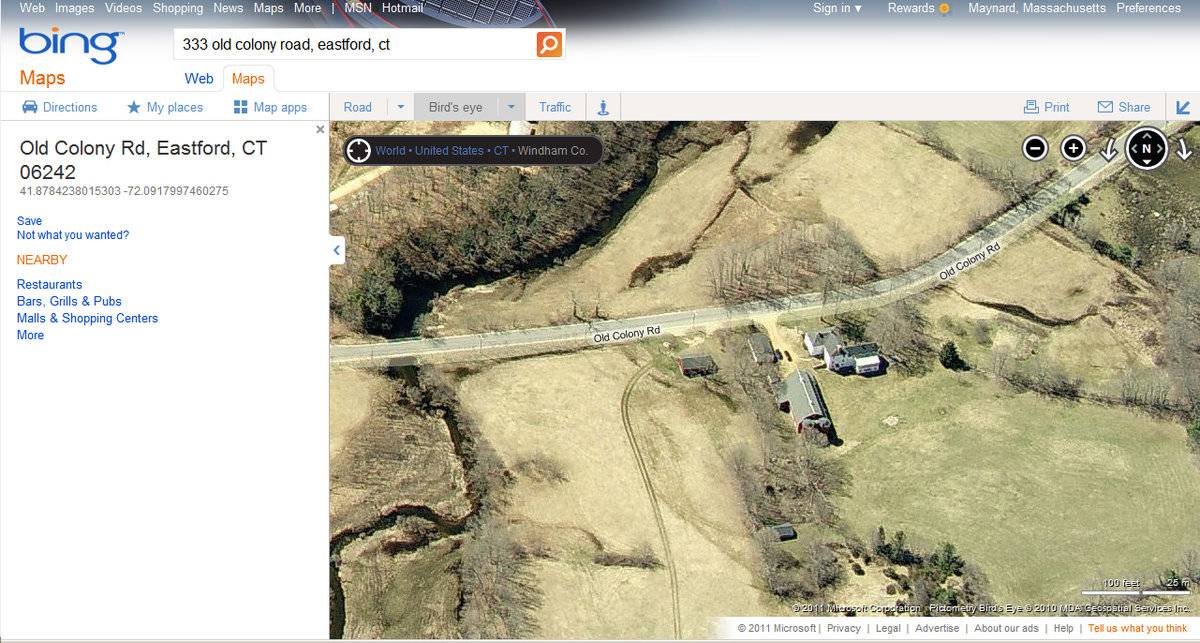
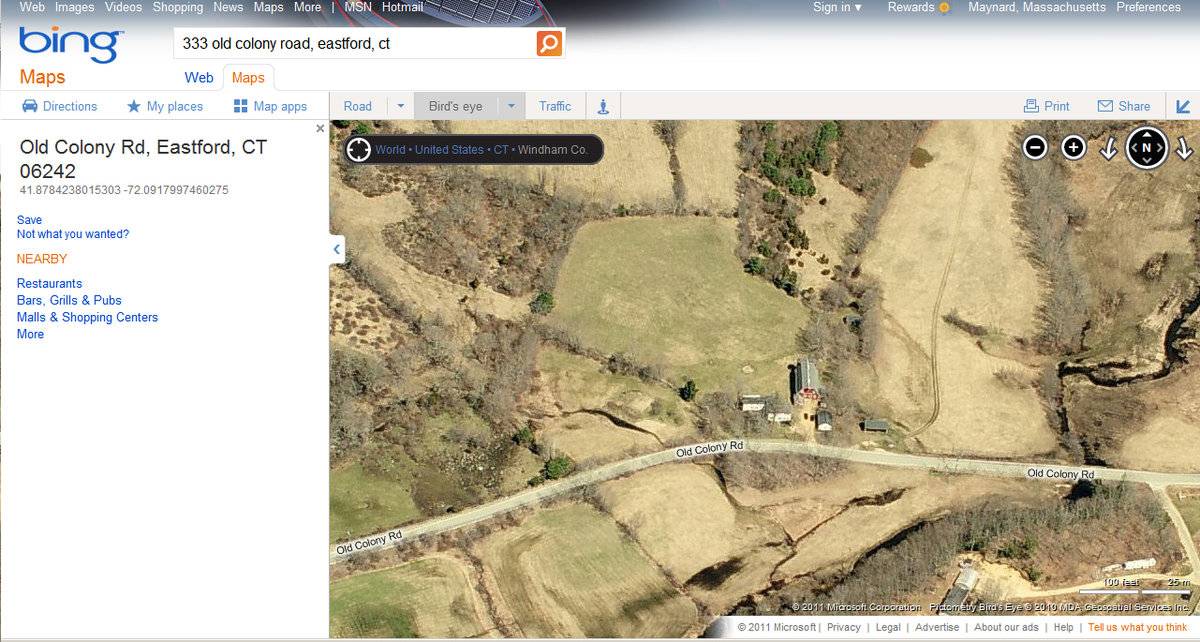
This barn is to the northeast of the house with which it is associated. The house faces south and the ridge-line is parallel with Old Colony Road. A smaller barn and a shed are to the east of the house. This property sits to the east of the intersection of Old Colony Road and Mill Bridge Road. The driveway extends to the north off Old Colony Road and leads to the large gambrel-roof barn. Directly to the east and south of the property are small streams. Directly to the northeast is a small pond. To the west of the property is the center of Eastford, where Eastford Road, County Road, Old Colony Road, and Westford Road all meet. Further to the west is Old Cemetery, and to the southwest are Eastford Public Library and Bowen Ballfield. To the northwest are open tracts of land and woodland. To the north, south and east are open tracts of land and woodland.
- Typology & Materials
-
Building Typology
Materials
Structural System
n/a
Roof materials
Roof type
Approximate Dimensions
6,622 sq. ft.
- Source
-
Date Compiled
02/05/2010
Compiled By
Todd Levine, reviewed by the Connecticut Trust
Sources
Photographs and field notes from Kathleen Healey: 08/12/2009.
Aerial Mapping: Eastford Maps
http://www.bing.com/maps - accessed 6/30/2011.Sexton, James, PhD, Survey Narrative of the Connecticut Barn, Connecticut Trust for Historic Preservation, Hamden, CT, 2005, http://www.connecticutbarns.org/history.
Visser, Thomas D.,Field Guide to New England Barns and Farm Buildings, University Press of New England,1997.
- PhotosClick on image to view full file
-