Barn Record Ashford
RETURN TO ‘FIND BARNS’- Building Name (Common)
- Alapi Chicken Coop
- Building Name (Historic)
- Alapi Chicken Coop
- Address
- 45 Kennerson Reservoir Road, Ashford
- Typology

- Overview
-
Designations
n/a
Historic Significance
Architectural description:
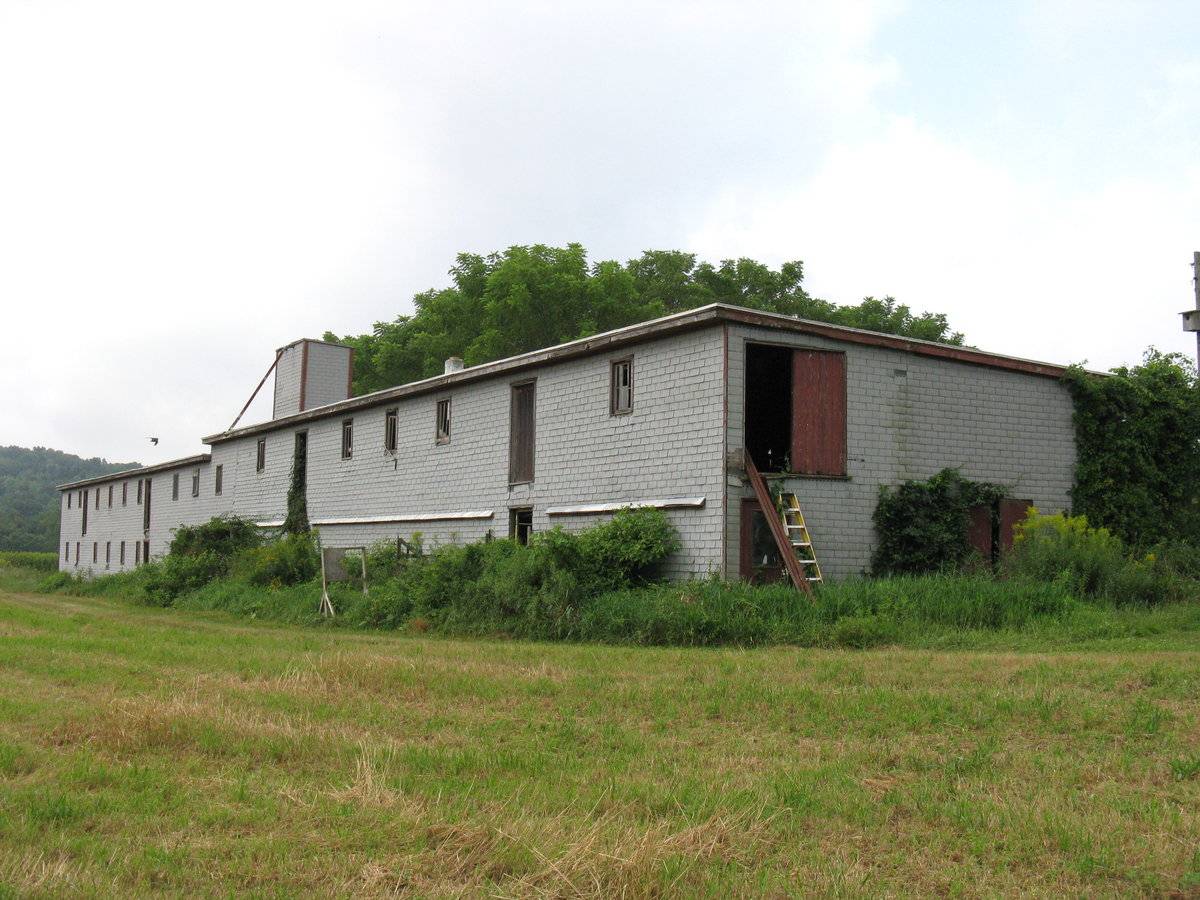
This is a 2-story structure with a nearly flat shed roof, oriented north-south. The long east facade contains on each level a series of small windows alternating with doorway openings. The north end façade has a door on each level. The photographic view appears likely to be of the rear of the building, as it has fewer windows than the typical south or west front of a chicken coop which would be lined with continuous windows.
Siding is asbestos shingle siding. The roof is roll roofing.
Historical significance:By the 1930s, large two-and three-story poultry barns were being built for raising broilers and capons for meat and pullets for eggs. These often have a shallow-pitched gable or shed roof and many windows on the south side, which are often covered with wire mesh. Mineral-surfaced asphalt paper or shingles typically cover the roof and walls. Housing thousands of birds, these large structures became virtual factories, with automatic, clock-activated feeders and waterers to reduce labor.
Historical background:The town of Ashford was incorporated in 1714 and for its first century had the typical scattered settlement on upland ridges which characterized nearly all of Connecticut. The economy was community-subsistence agriculture. Industry was limited to the mills of the agricultural economy – grist, saw, fulling mills.
In the early 19th century, turnpikes and improved roads, along with limited market-oriented agriculture, resulted in some local wealth and settlement nuclei at the major crossroads. Ashford Center, Westford, and Warrenville date from this period. So do the fancy Federal-style houses in these villages and along Route 89 (Mansfield Road) south of Warrenville. Also in this period there existed a short-lived glass factory at Westford.
In the 19th century, the lack of significant waterpower and railroad connections led to stagnation. Its peak population, 1820 (2,778) which had declined to 668 by 1910, was not exceeded until 1980.
In the early 20th century, the declining farms of Ashford were abandoned by their Yankee owners and sold to East European immigrants, notably Slovaks, Bohemians, and Hungarians (Magyars). This transformation of the rural countryside is one of the great stories of modern Connecticut. Today a large portion of the town is descended from these people.
Today Ashford remains a beautiful, scenic town. All roads are mostly scenic, with wooded, overgrown pastures (stone walls, young hardwoods) predominating (Clouette, Ashford survey).Field Notes
This coop, on the south side of Kennerson Reservoir Road, is the last of several coops and barns that once graced this property and it will be demolished when the owners are ready to absorb the cost of disposing of its asbestos-shingle siding. The family also once owned and operated coops in South Windham, CT. The egg production operation began in the early years of the great depression when the paternal grandfather of the present owners sold his New York property, bought the subject property, and told his daughter-in-law "Now we will never have to go begging. We will always be able to grow something."
- Use & Accessibility
- Environment
Related features
Environment features
Relationship to surroundings
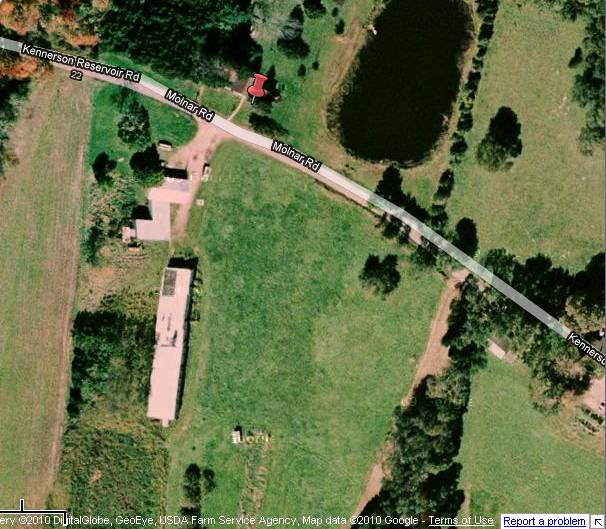
This area in southeastern Ashford has a number of old poultry farms, many no longer in operation, along with old pastures, second growth woodlands, and scattered houses. This farm is a 125-acre property, consisting of a mix of open fields, woodlands, and wetlands. There is a 1-story ranch-style house to the north of the chicken coop, facing the road.
- Typology & Materials
-
Building Typology
Materials
Structural System
Roof materials
Roof type
Approximate Dimensions
7560 square feet
- Source
-
Date Compiled
03/17/2010
Compiled By
Charlotte Hitchcock, reviewed by CT Trust
Sources
Field notes and photographs by Joseph Szalay - 9/18/2009
Town of Ashford Assessor’s Record: 41/ E/ 9, (125 acres, poultry house 7560 s.f.)
< http://www.connecticutgenealogy.com/windham/ashford.htm >
Bayles, Richard M.; History of Windham County, Connecticut, New York: W.W. Preston, 1889. excerpts available at.
Clouette, Bruce, National Register of Historic Places, Church Farm, Nomination #270921, 1988. Item No. 88002650 NRIS (National Register Information System) http://pdfhost.focus.nps.gov/docs/NRHP/Text/88002650.pdf
< http://pdfhost.focus.nps.gov/docs/NRHP/Photos/88002650.pdf >Clouette, Bruce, Ashford Township Survey, handwritten manuscript, Connecticut Trust for Historic Preservation, 199x.
Cunningham, Janice, and Ransom, David; Back to the Land: Jewish Farms and Resorts in Connecticut 1890-1945, State of Connecticut Historical Commission and Jewish Historical Society of Greater Hartford, 1998,186 pages.
Sexton, James, PhD, Survey Narrative of the Connecticut Barn, Connecticut Trust for Historic Preservation, Hamden, CT, 2005, http://www.connecticutbarns.org/history.
Visser, Thomas D., Field Guide to New England Barns and Farm Buildings, University Press of New England, 1997.
- PhotosClick on image to view full file
-