Barn Record East Windsor
RETURN TO ‘FIND BARNS’- Building Name (Common)
- n/a
- Building Name (Historic)
- n/a
- Address
- 55 Rockville Road, East Windsor
- Typology
- Overview
-
Designations
n/a
Historic Significance
Architectural description:
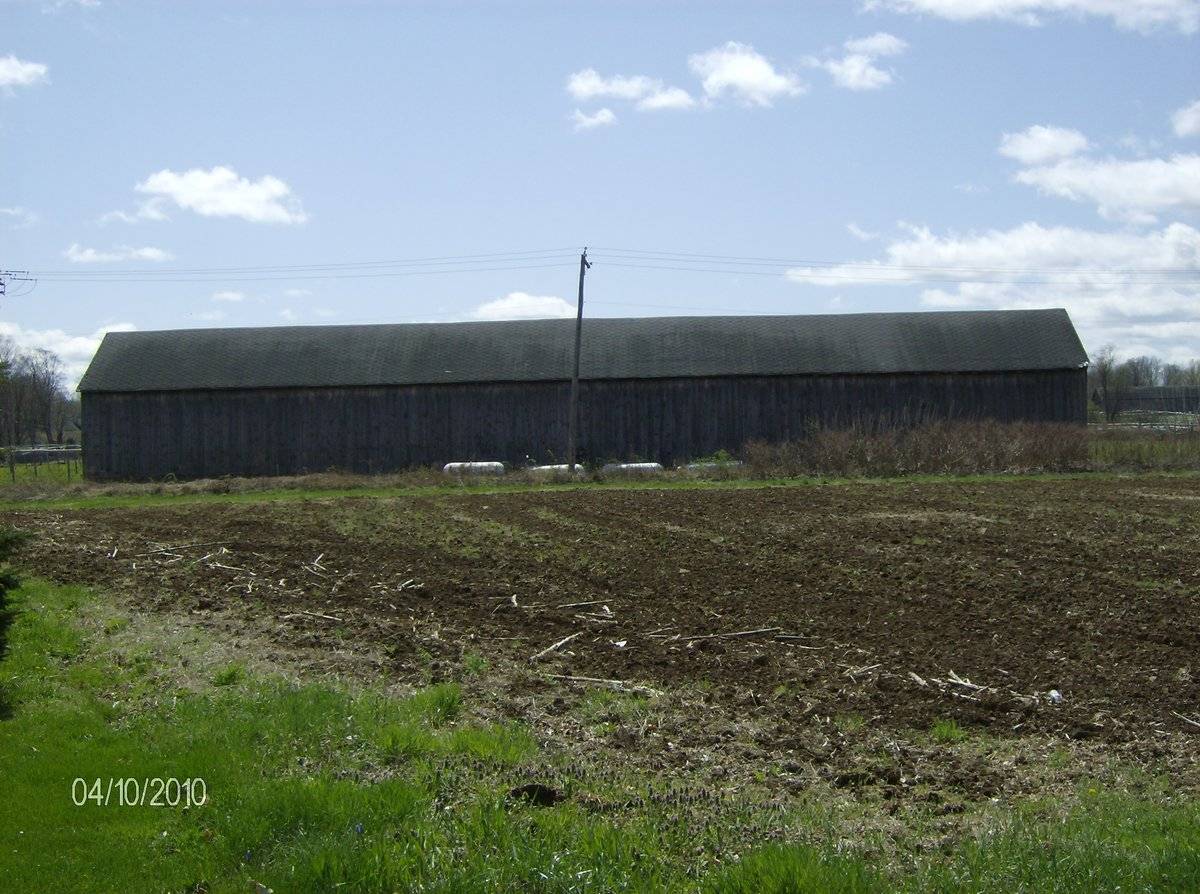
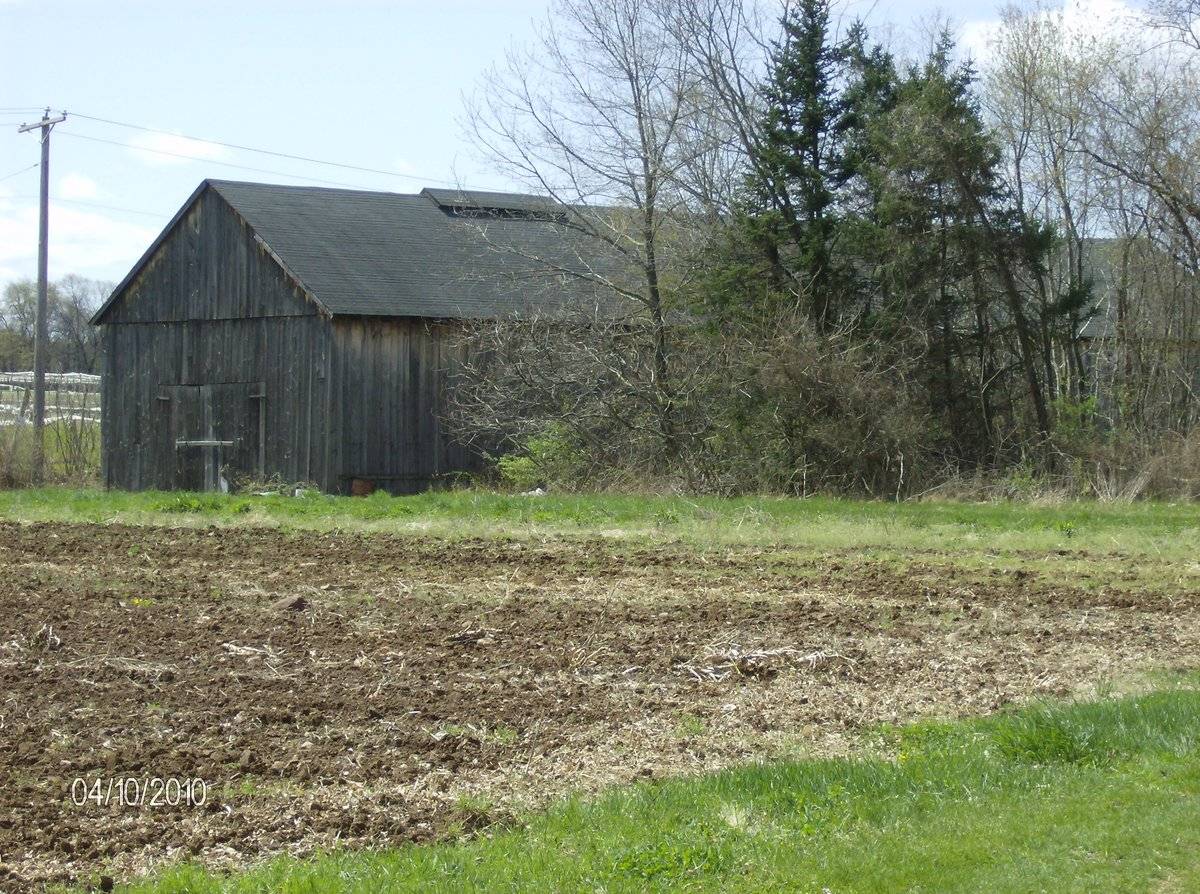
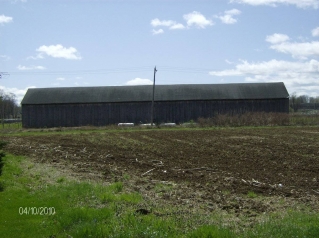
This is a set of two 1 1/2-story gable-entry tobacco sheds. The ridge-line of the shed closest to Rockville Road (shed I) runs roughly east-west while Rockville Road runs approximately southeast-northwest. To the west of shed I is shed II, which has a parallel ridge-kine and is adjacent to shed I, gable-to-gable. Shed I has eleven bents and three aisles with one pair of hinged doors in the gable-sides. Shed I has an asphalt shingled roof. Shed II has nine bent and three aisles with one pair of hinged doors in the gable-sides. Shed II has an asphalt shingled roof with two ridge vents. Both sheds have the standard tobacco shed arrangement; one or two pairs (in this case one pair) of hinged swinging doors in the gable-facades and a ventilation system in the eave-facades. The ventilation system for the tobacco sheds is vertical siding where every second board is hinged at the top and tilted out at the bottom by means of a horizontal cleat, that lifts many boards at once, and metal prop hooks to hold the boards in place.
Historical significance:
The tobacco barn, or shed as it is called in the Connecticut River Valley, is one of the most distinctive of the single-crop barns. They tend to be long, low windowless buildings with pitched roofs. They are characterized by vented sides to regulate air flow and allow harvested tobacco to cure at the appropriate rate. Derived initially from the design of the English barn, the shed is composed of a fixed skeleton consisting of two- or three-aisle bents repeated at intervals of 15 feet to the desired length. The wood-framed bents sit on piers of stone or concrete and the bents are connected by girts and diagonal braces. Typically there are two doors at each end, making the shed a “drive-through,” although some sheds are accessed through doors on the sides. The interior structural framework serves a second purpose in addition to supporting the walls and roof of the building; it provides a framework for the rails used to hang the tobacco as it cures.
Tobacco shed ventilation is accomplished using one of four different systems (more than one method may be utilized in a single shed):
a) Vertical siding in which every second board is hinged at the top and tilted out at the bottom by means of a horizontal cleat, that lifts many boards at once, and metal prop hooks to hold the boards in place;
b) Vertical siding in which alternate boards are hinged along the sides to open like tall narrow doors;
c) Less commonly, horizontal siding in which alternate boards are hinged along the top edge and open like long narrow awnings;
d) A series of large doors along one of the long sides of the building with the other sides of the building vented by one or more of the other methods.
Field Notes
Two tobacco sheds perpendicular to Rockville Rd on south side.
- Use & Accessibility
- Environment
Related features
Environment features
Relationship to surroundings
These two tobacco sheds are towards the north end of the 11.48 acre site named by both the Capitol Region Council of Governments GIS website and the Town of Windsor’s official website have the site listed as simply ‘BARBER HILL’. Towards the south end of the site are three more sheds, each with eleven bents and three aisles (21139). Large tracks of open space used for tobacco cultivation is to the west. Open space is between the south set of sheds and the north set of sheds. The area surrounding the site is residential, active agriculture, open space and woodland.
m/b/p=42 68 011
- Typology & Materials
-
Building Typology
Materials
Structural System
n/a
Roof materials
Roof type
Approximate Dimensions
n/a
- Source
-
Date Compiled
08/27/2010
Compiled By
Todd Levine, reviewed by the Connecticut Trust
Sources
Photographs and field notes by John Harmon.
Map of East Windsor, CT, retrieved on August 27, 2010 from website www.zillow.com.
O’Gorman, James F., Connecticut Valley Vernacular: the Vanishing Landscape and Architecture of the New England Tobacco Fields, University of Pennsylvania Press, 2002, 144 pages.
Sexton, James, PhD; Survey Narrative of the Connecticut Barn, Connecticut Trust for Historic Preservation, Hamden, CT, 2005, http://www.connecticutbarns.org/history.
Visser, Thomas D.,Field Guide to New England Barns and Farm Buildings, University Press of New England, 1997, 213 pages.
The Capitol Region Council of Governments website. http://www.crcog.org/gissearch/
eQuality Valuation Services, LLC Database. http://www.eastwindsor-ct.gov/Public_Documents/EWindsorCT_Assessor/index.
- PhotosClick on image to view full file
-