Barn Record Hebron
RETURN TO ‘FIND BARNS’- Building Name (Common)
- Tarca’s Hebron Automotive/Hebron Quick Lube
- Building Name (Historic)
- n/a
- Address
- 24 Wall Street, Hebron
- Typology
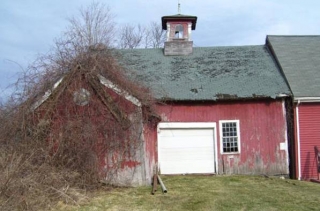
- Overview
-
Designations
Historic Significance
Architectural description:
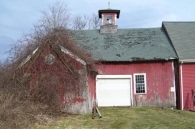
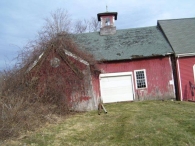
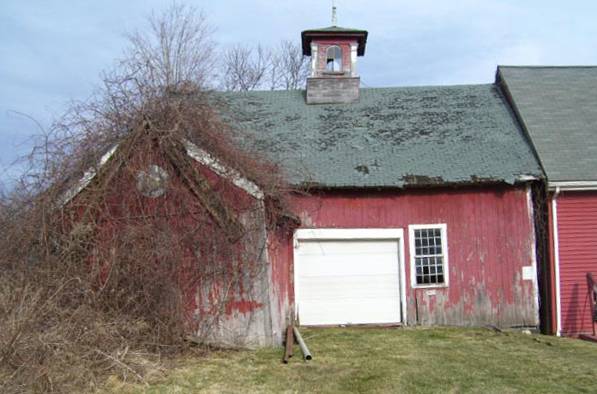
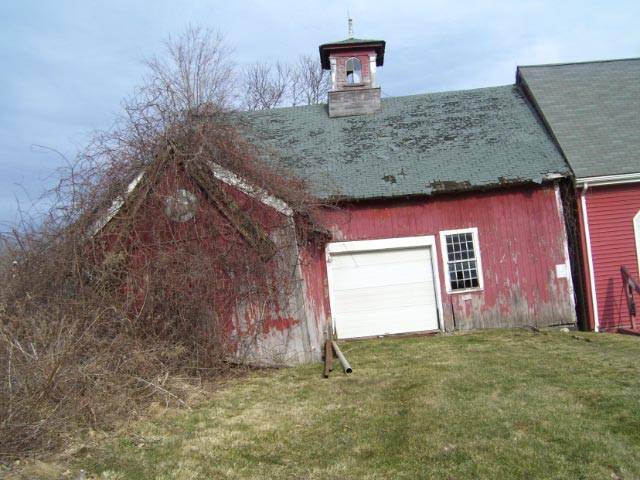
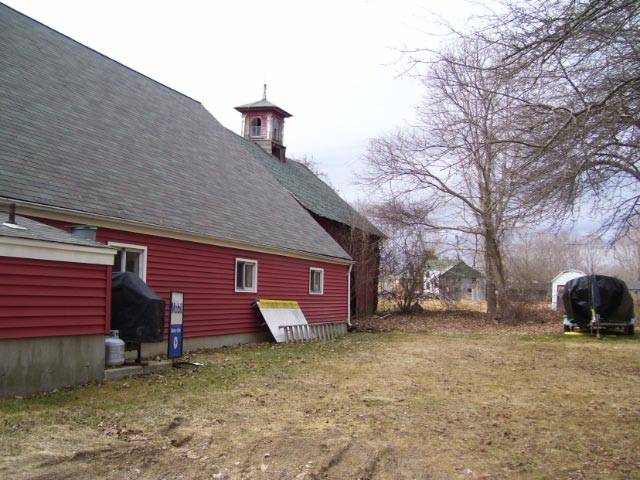
This is a three-bay 1 ½-story gable-roofed structure with its ridge-line oriented north-south. The main entry is an overhead door in the center bay of the west eave-side. To the right is a twelve-over-twelve double hung window. Projecting westward from the left (north) bay is a 1-story gable-roofed wing.
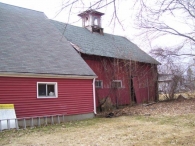
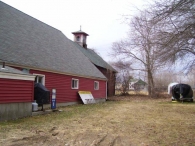
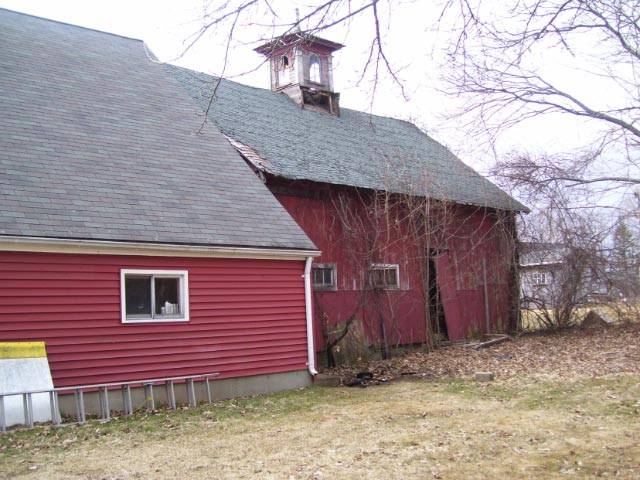
The north gable-end has a stable window close to each corner in the ground floor level and a square window in the attic near the peak. The east eave-side has a three-pane stable-type window in the left (south) and center bays, and a hinged door in the right (north) bay. The south gable-end abuts the new building to the south.
The projecting wing appears to be blank on the north eave-side, which is flush with the north gable-end of the main block. The west gable-end has a round window in the peak. The south eave-side of the wing has a series of three hinged doors.
Siding is vertical boards painted red with white window trim. The roof is asphalt shingles, with overhangs at the eaves and rakes. There is a cupola at the center of the ridge, which has a hipped roof with overhangs and arched four-pane windows and corner pilaster trim on all four sides. There is a wooden finial at the peak.
Historical significance:
Until the 1830s, the horses used for riding and driving carriages were often kept in the main barn along with the other farm animals. By the 1850s, some New England farmers built separate horse stables and carriage houses. Early carriage houses were built just to shelter a carriage and perhaps a sleigh, but no horses. The pre-cursor to the twentieth-century garage, these outbuildings are distinguished by their large hinged doors, few windows, and proximity to the dooryard. The combined horse stable and carriage house continued to be a common farm building through the second half of the nineteenth century and the first decade of the twentieth century, until automobiles became common. Elaborate carriage houses were also associated with gentlemen farms and country estates of the late 19th and early 20th centuries. Another form of carriage barn, the urban livery stable, served the needs of tradespeople.
The detailing of the cupola, the round window on the wing, and the stable windows, are stylistically consistent with the date of c. 1880 given for the now-demolished house, suggesting a contemporary date and use as a carriage barn. The layout of the building is the traditional English barn configuration.
Historical background:Hebron, incorporated as a town in 1708, grew slowly as families from other areas bought tracts of land and settled. Farms were spread out throughout the town, with only the area around the town common and meetinghouse as a focal
point. There were few houses there in the 18th century, but the crossroads at the center also provided the core for a small commercial nucleus in the form of a tavern and store.After the Revolutionary War Hebron began to grow and many more buildings were constructed, forming a small village at the town center. The main road through the village, present-day Route 66, was improved as the Hebron and Middle Haddam Turnpike, further contributing to the village’s prosperity. Church Street also began to expand and develop. The 19th century saw an increase in religious diversity, and as other denominations formed, they built their meeting places at the town center. In the 20th century, the process was repeated: United Brethren synagogue reflects the settlement of East European Jews in Hebron in the early 20th century. Taking up egg and dairy farming, they gave new life to the town’s farmlands.
Hebron’s growth tapered off in the middle of the 19th century. Several buildings were destroyed by the great fires of 1882 and 1888, but it is a testimony to the continuing importance of the center that most were rebuilt. As part of the reconstruction, the Victorian Gothic Congregational Church at 1 Main Street was dedicated in 1883, and a new parsonage was built nearby a few years later. The district school, 18 Main Street, was also replaced in a more Victorian style. New public buildings continued to be built at the center as need arose: a small Queen Anne-style building was erected for a public library at 22 Main Street, on the south side of the green, in 1898, and in 1909, the town built a small brick structure to house town records and to commemorate Hebron’s 200th anniversary (Clouette, Section 8).
Field Notes
An automobile repair shop was built adjacent to this disused barn just off Main in the center of town. Contributing resource in Hebron Center Historic District, although the c.1880 house listed appears to have been demolished and replaced by the new automotive repair business.
- Use & Accessibility
Use (Historic)
Use (Present)
Exterior Visible from Public Road?
Yes
Demolished
n/a
Location Integrity
Original Site
- Environment
Related features
Environment features
Relationship to surroundings
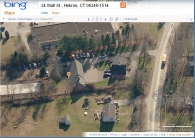
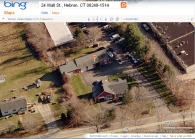
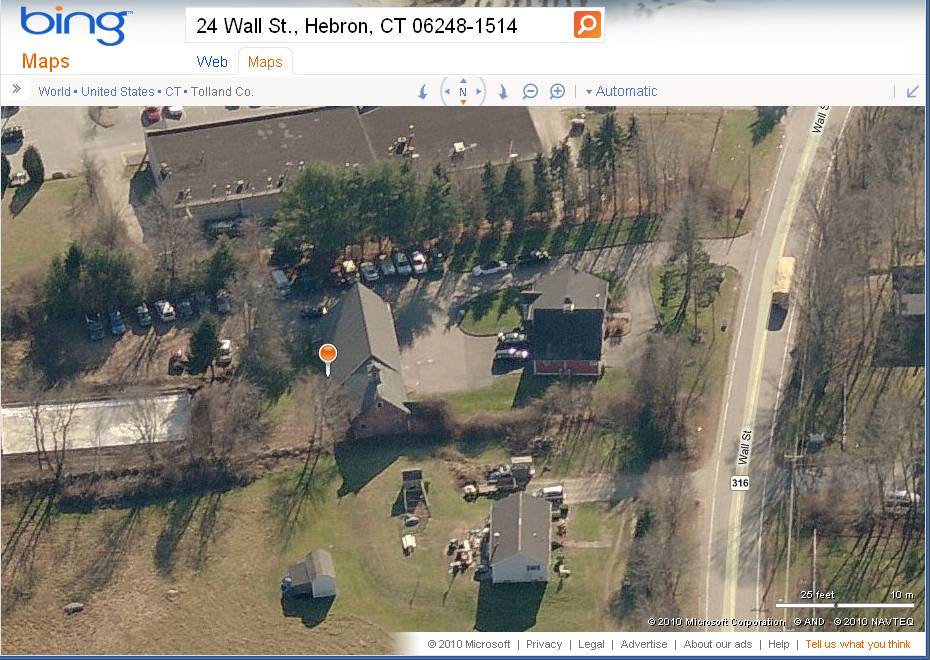
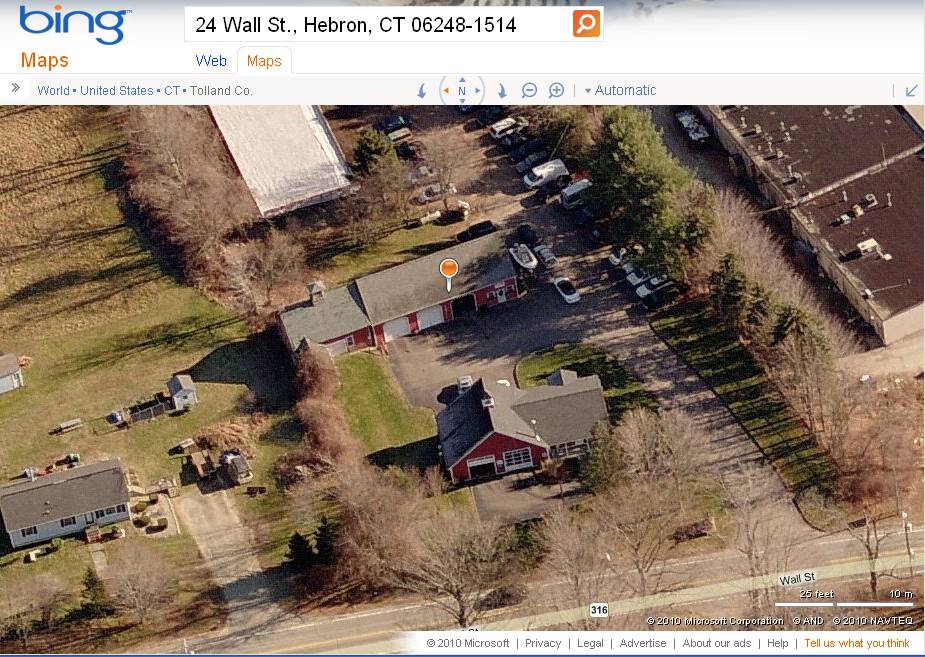
This property is located on the east side of Wall Street, which runs north from Main Street (Route 66) in Hebron Center. The site abuts the rear of a commercial property facing Main Street. The original 19th-century house identified in the Hebron Center Historic District nomination has been replaced by a commercial use (automotive) at the front of the lot. It consists of a gable-to-street block with an eave-to-street wing extending southward. A second new commercial structure has been constructed toward the rear of the lot, abutting the historic barn and to its south; the two structures have their ridge-lines aligned in a north-south orientation.
- Typology & Materials
-
Building Typology
Materials
Structural System
Roof materials
Roof type
Approximate Dimensions
30 x 30 feet
- Source
-
Date Compiled
12/31/2010
Compiled By
Charlotte Hitchcock, reviewed by CT Trust
Sources
Field notes and photographs by Judy Brown and Deena Watson 6/14/2010.
Town of Hebron Assessor’s Record http://www.prophecyone.us/index_prophecy.php?town=Hebron
Parcel ID: 70/12 – 1.24 acre with commercial garage building 1992
Aerial Mapping:
http://maps.google.com
http://www.bing.com/maps accessed 1/02/2011.Clouette, Bruce, Cronin, Maura, Hebron Center National Register District Nomination, National Park Service, 1993.
Sexton, James, PhD, Survey Narrative of the Connecticut Barn, Connecticut Trust for Historic Preservation, Hamden, CT, 2005, http://www.connecticutbarns.org/history.
Visser, Thomas D., Field Guide to New England Barns and Farm Buildings, University Press of New England, 1997. - PhotosClick on image to view full file
-