Barn Record New Hartford
RETURN TO ‘FIND BARNS’- Building Name (Common)
- n/a
- Building Name (Historic)
- n/a
- Address
- 35 Country Lane, New Hartford
- Typology
- Overview
-
Designations
n/a
Historic Significance
Architectural description:
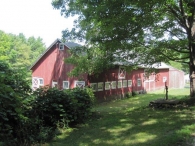
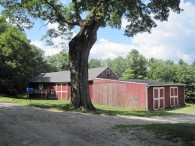
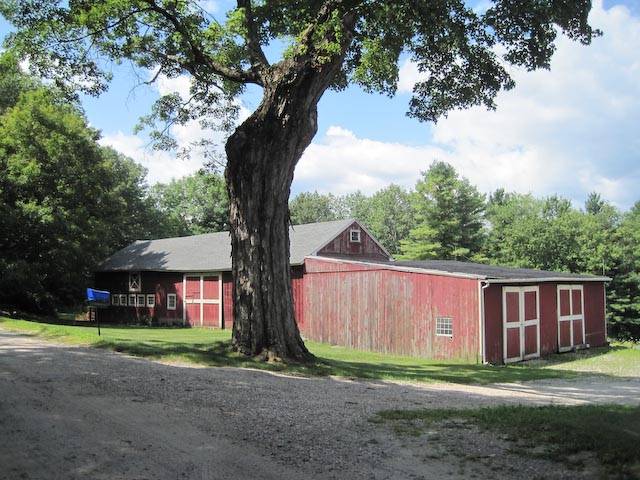
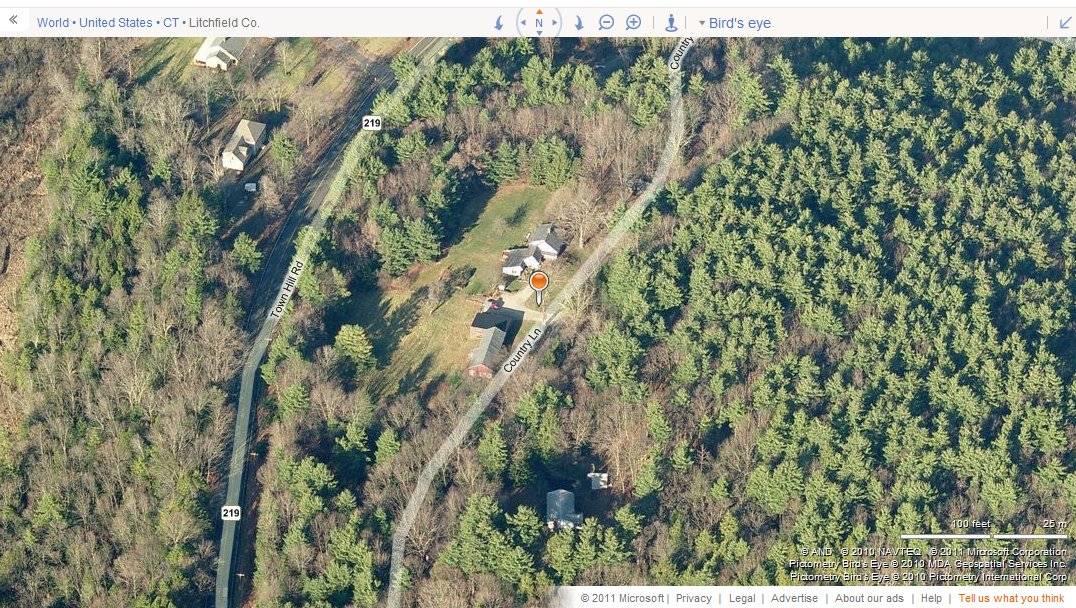
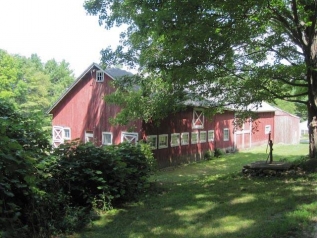
This is a 1 ½-story eave-entry barn with a gable roof. Several additions have been attached to the central main barn. Addition I is a gable-roof structure attached gable-end to gable-end, to the south gable-end of the main barn. Addition II is a 1-story bank shed-roof addition which attaches to the north gable-end of the main barn, oriented perpendicular to it. The complex is located at an acute angle to Country Line Road, which passes this property at a southwest to northeast angle.
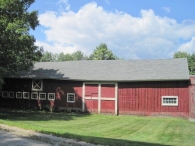
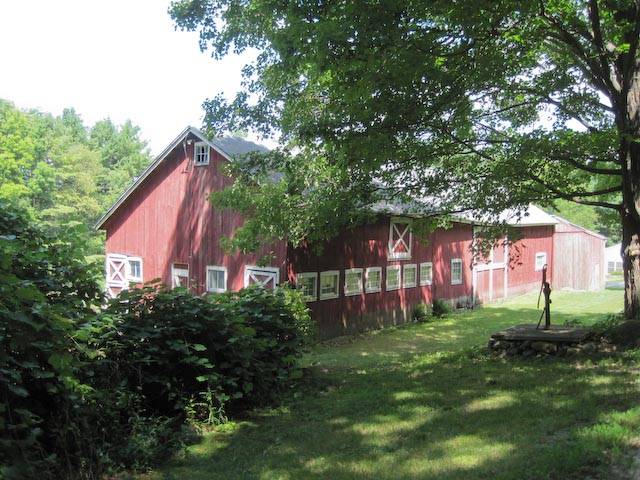
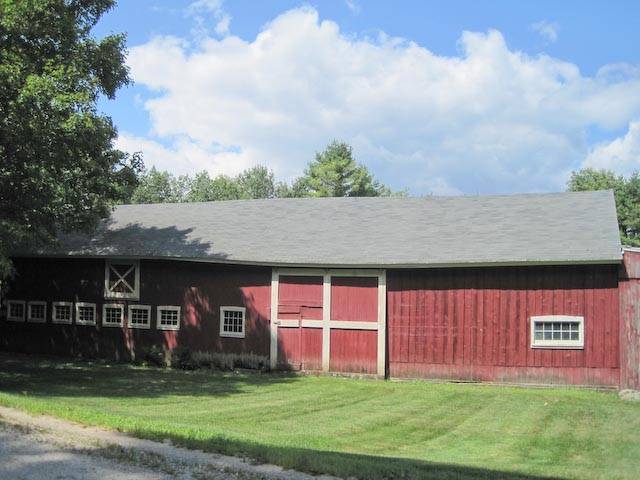
The primary façade of the main barn is the east eave-side, which faces Country Lane. The main entry on the façade is an off-center over-size door, divided into four panels. A horizontal rectangular window with ten panes and trim is located in the northeast corner on the façade. A nearly-square window with twelve panes and trim is located in the southeast corner on the façade. The south gable-end is attached to Addition I. The west eave-side contains a square window opening near the southwest corner and appears to contain a horizontal rectangular opening near the northwest corner. Only the upper portion of the north gable-end is visible over the shed-roof of Addition II. This gable-end contains a single square window opening centered beneath the roof ridgeline.
Addition I is a 1 ½-story gable-roof structure attached gable-end to gable-end to the south end of the main barn. The east eave-side is flush with the façade of the main barn, and the roof ridgeline is also continuous. The east eave-side contains seven evenly-spaced six-pane windows along its full length. A square hay door with X bracing is located just beneath the eave in the northern half of this side. The south gable-end of Addition I contains a Dutch door with X bracing at each corner. Between these two doors are two two-pane horizontal windows, which unequally bracket a slightly off-center past-through door. A six-pane window is mounted beneath the roof ridgeline. As Addition I is slightly wider than the main barn, the west facing eave of the roof is lower than the east eave. The west eave-side contains a small shed-roof projecting from its northwest corner. A row of window openings appears to stretch the length of the main west eave-side wall. The shed-roof projection appears to be blank.
Addition II is a large 1-story bank shed-roof addition set perpendicular to the rest of the structure, with the roof ridgeline set against the north gable-end of the main barn, projecting to the west. The grade slopes down to the west, revealing the raised nature of the main level of this addition. No basement level is apparent. The south side of this addition appears to be blank. The west gable-end of Addition II also appears to be blank. The north eave-side of this addition contains two pairs of hinged panel entry doors, asymmetrically placed. The east gable-end contains a single twelve-pane window near the northeast corner.
Each of the three structures (Main Barn, Addition I, Addition II) are faced in a different width vertical wooden siding, painted red. Window and door trim on all structures is painted white. The main barn and Addition I appears to have a unified roof treatment. Addition II’s shed-roof appears to have an asphalt laid roof.
Historical significance:The oldest barns still found in the state are called the “English Barn,” “side-entry barn,” “eave entry,” or a 30 x 40. They are simple buildings with rectangular plan, pitched gable roof, and a door or doors located on one or both of the eave sides of the building based on the grain warehouses of the English colonists’ homeland. The name “30 by 40” originates from its size (in feet), which was large enough for 1 family and could service about 100 acres. The multi-purpose use of the English barn is reflected by the building’s construction in three distinct bays - one for each use. The middle bay was used for threshing, which is separating the seed from the stalk in wheat and oat by beating the stalks with a flail. The flanking bays would be for animals and hay storage.
Field Notes
This property is one of the oldest farms in town, dating to the late 1700s. The barn is an English style structure with additions.
- Use & Accessibility
Use (Historic)
Use (Present)
Exterior Visible from Public Road?
Yes
Demolished
n/a
Location Integrity
Unknown
- Environment
Related features
n/a
Environment features
Relationship to surroundings
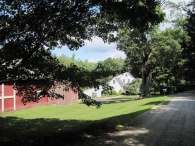
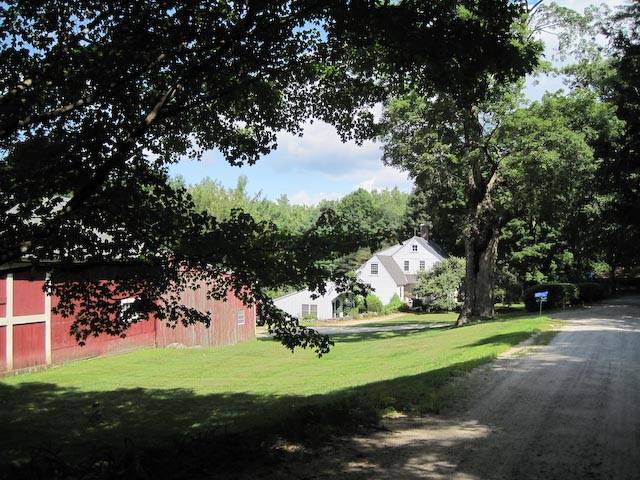
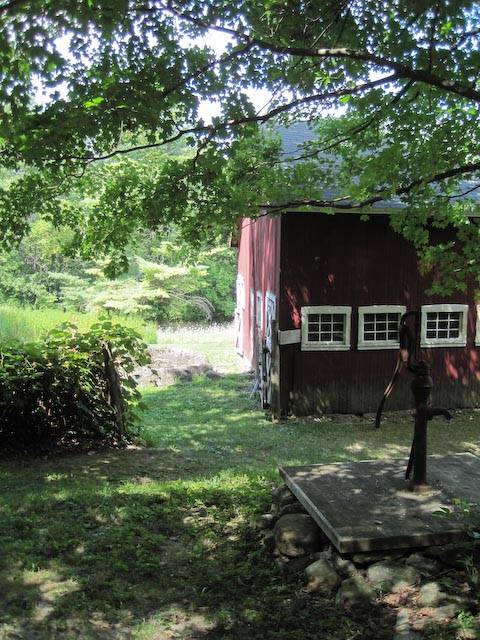
This series of barns is set back slightly from Country Lane, and set at an offset to the angle of the road. The east eave-side of the main barn faces Country Lane, and is the primary façade. However, the actual primary entry of this barn consists of the two paired door entries on the north eave-side of Addition II. These face the farmhouse which is associated with this property, which is located to the immediate north. A gravel driveway enters the property to the northeast of the barn and ends in a wide parking area stretching between the north side of Addition II and the south end of the house. A small hand-pump is located on a fieldstone foundation near the southeast corner of Addition I. The farmhouse and barn are surrounded on all sides by a grassy field, with scattered trees near the structures. Scattered trees also line the west side of Country Lane. Aside from this grassy field and lawn, the entire property is surrounded on all sides by dense deciduous and coniferous mixed woodland. To the west of this property, beyond a narrow line of trees, is Town Hill Road (CT Route 219), which is an important route through this area. Few scattered residences dot Country Lane and Town Hill Road in the area.
- Typology & Materials
-
Building Typology
Materials
Structural System
n/a
Roof materials
Roof type
Approximate Dimensions
Barn 1st w/Loft 1716 S.F. (Unified main barn + Addition I), Barn 1 Story 1200 S.F. (Addition II)
- Source
-
Date Compiled
05/30/2011
Compiled By
N. Nietering & T. Levine, reviewed by CT Trust
Sources
Photographs by Anne C. Hall.
Sexton, James, PhD; Survey Narrative of the Connecticut Barn, Connecticut Trust for Historic Preservation, Hamden, CT, 2005, http://www.connecticutbarns.org/history.
Visser, Thomas D.,Field Guide to New England Barns and Farm Buildings, University Press of New England, 1997, 213 pages.
Map of New Hartford, CT, retrieved on May 26, 2011 from website www.bing.com.
New Hartford Assessor’s Records - Vision Appraisal online - http://data.visionappraisal.com/NewHartfordCT
- PhotosClick on image to view full file
-