Barn Record Kent
RETURN TO ‘FIND BARNS’- Building Name (Common)
- Iron Mountain Farm Part 1 of 2
- Building Name (Historic)
- Judd Farm
- Address
- 140 Geer Mountain Road, Kent
- Typology

- Overview
-
Designations
n/a
Historic Significance
Architectural description:
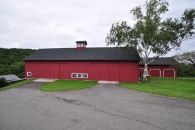
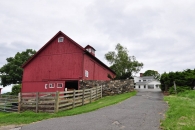
The barn is a 1 &½-story, gable-roofed, rectangular structure built on an embanked site. The roof is aligned east to west, set at an approximately perpendicular angle to the course of the public road. The building may have been doubled in size at a relatively early date, a possibility suggested by the position of the entries on the north wall—each is in the center of its respective half—as well as by the spacing of the rafters, which are spaced closely in the east half of the barn and farther apart in the west half. (No break in the foundation wall is readily visible, however.) This bank barn features a forebay or saltbox section that extends on the “downbank” side. A 1-story, gable-roofed equipment shed addition, also embanked (thus with entries on two levels), extends to the west from the SW corner of the barn. This later addition is probably of 20th-century date.
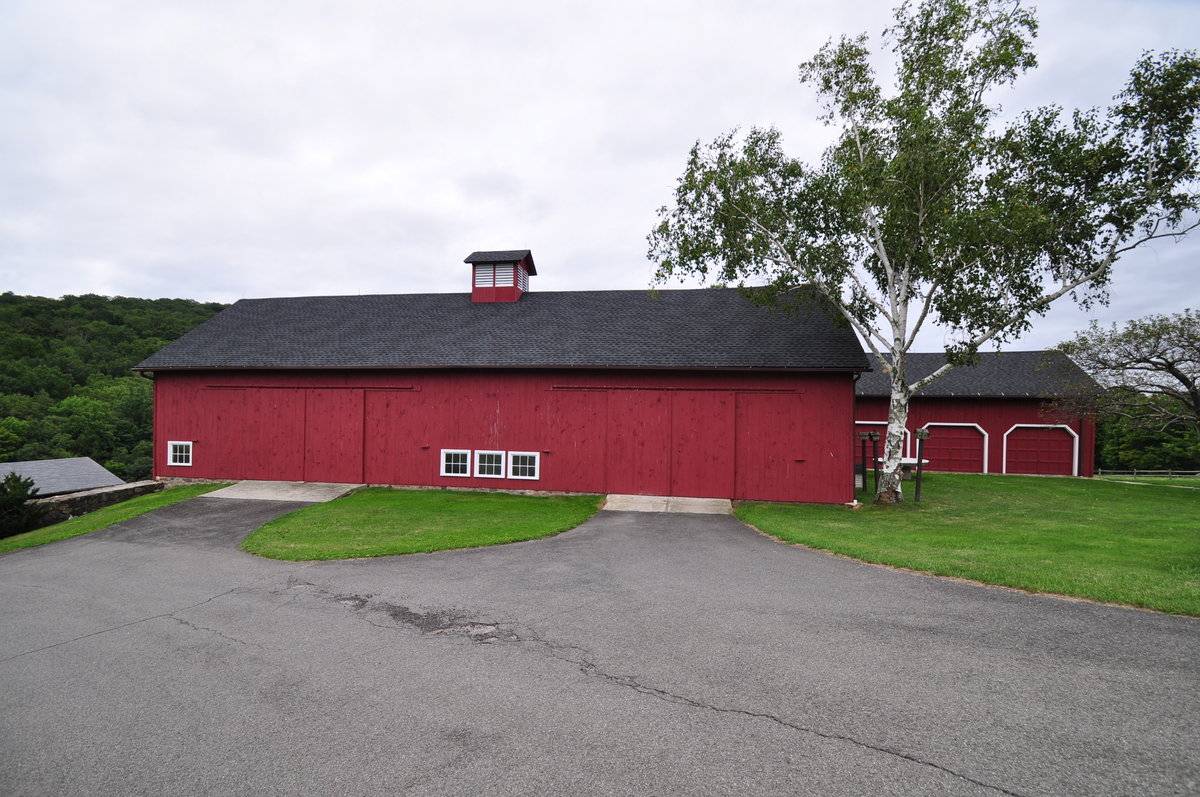
The principal façade is the north eaves wall. This elevation, the “upbank” side of the barn, presents two double-height, double-leaf entries of identical form. The entries are positioned so that each one is central to its half of the building. The exterior sliding doors are hung on open tracks. Three six-pane sash are located on the center between the entries and one more is sited at the east corner of the wall.
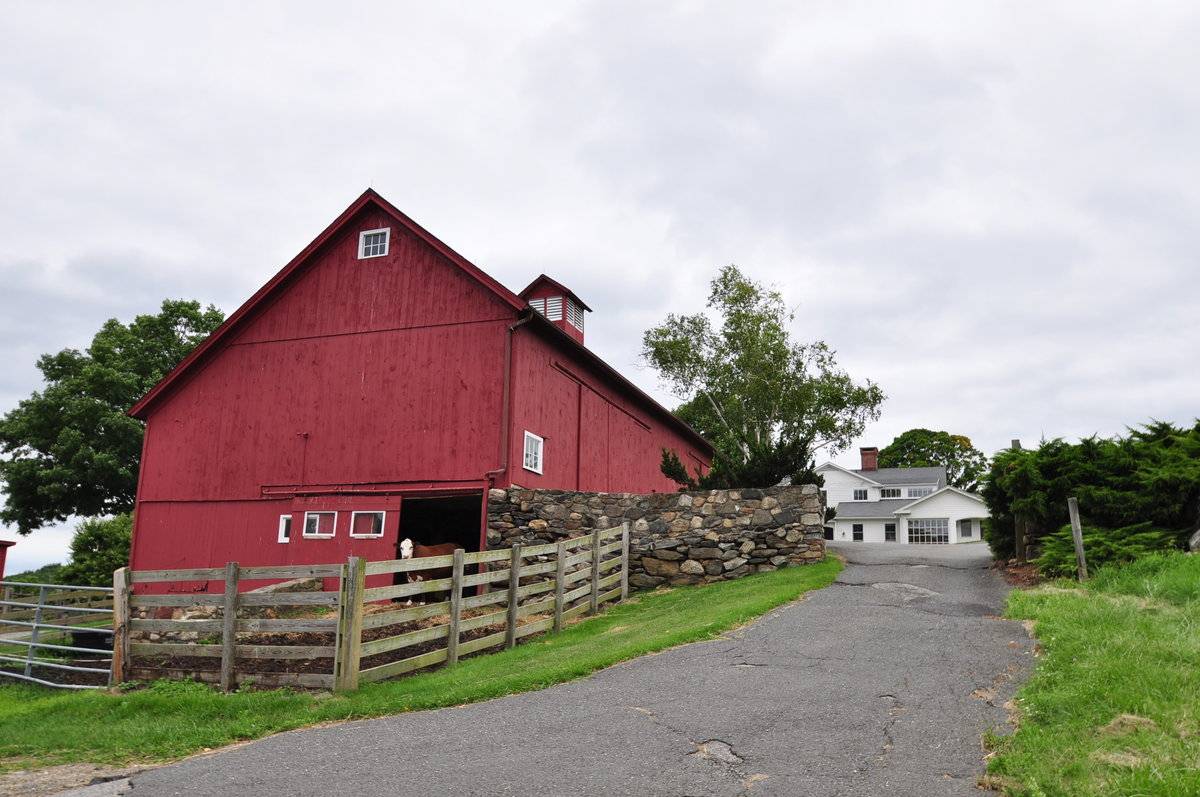
The west gable-end wall is fully exposed at the basement level. A single-leaf entry is located at the north corner of the wall, consisting of an exterior sliding door mounted on an open track. The door holds two one-pane windows. A one-pane window is sited at the center of the wall. A six-pane sash is located in the gable attic.
The south or downbank wall has a one-bay vehicle entry located at the east corner of the basement (nature of door unknown). There are one-pane hopper windows on the basement level and eight-pane sash on the 1st story (number unknown).
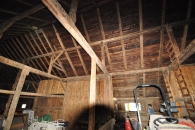
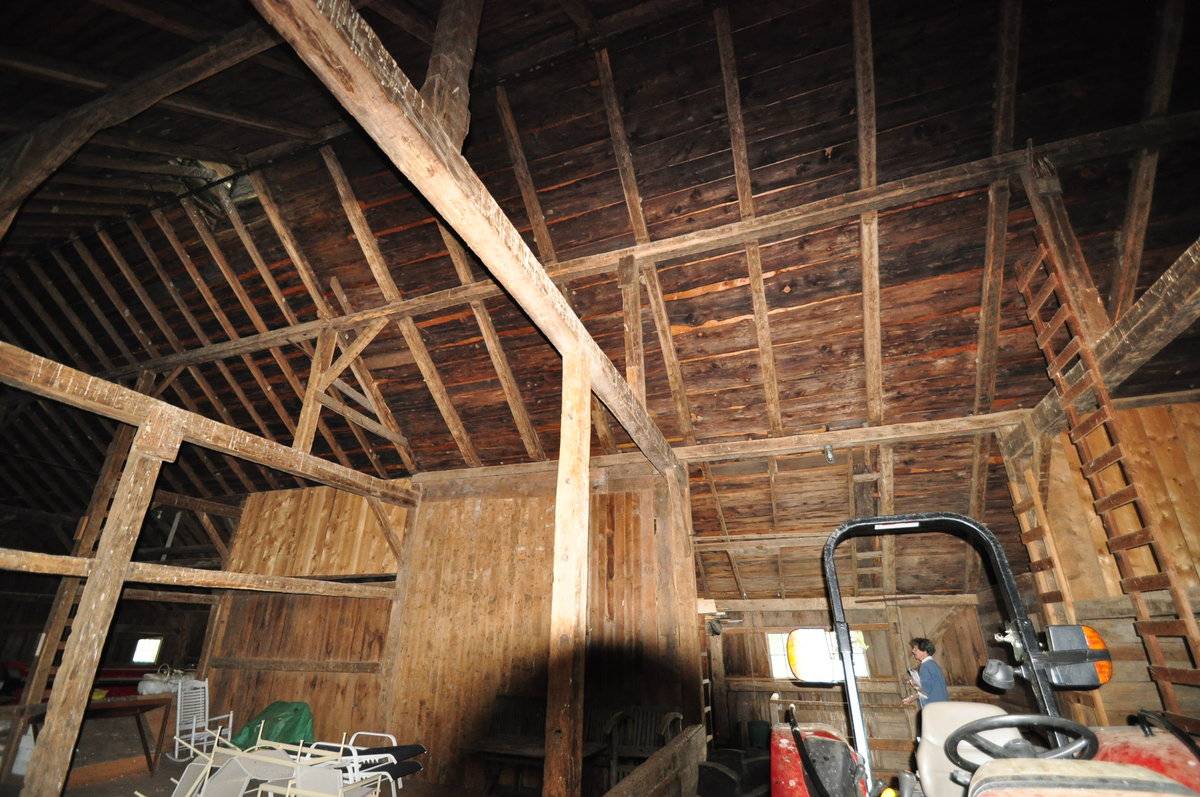
The interior of the barn presents a post and beam frame for both halves, composed largely of handhewn timbers. The roof is supported by through purlins carrying common rafters, with the purlins resting on braced queen posts.
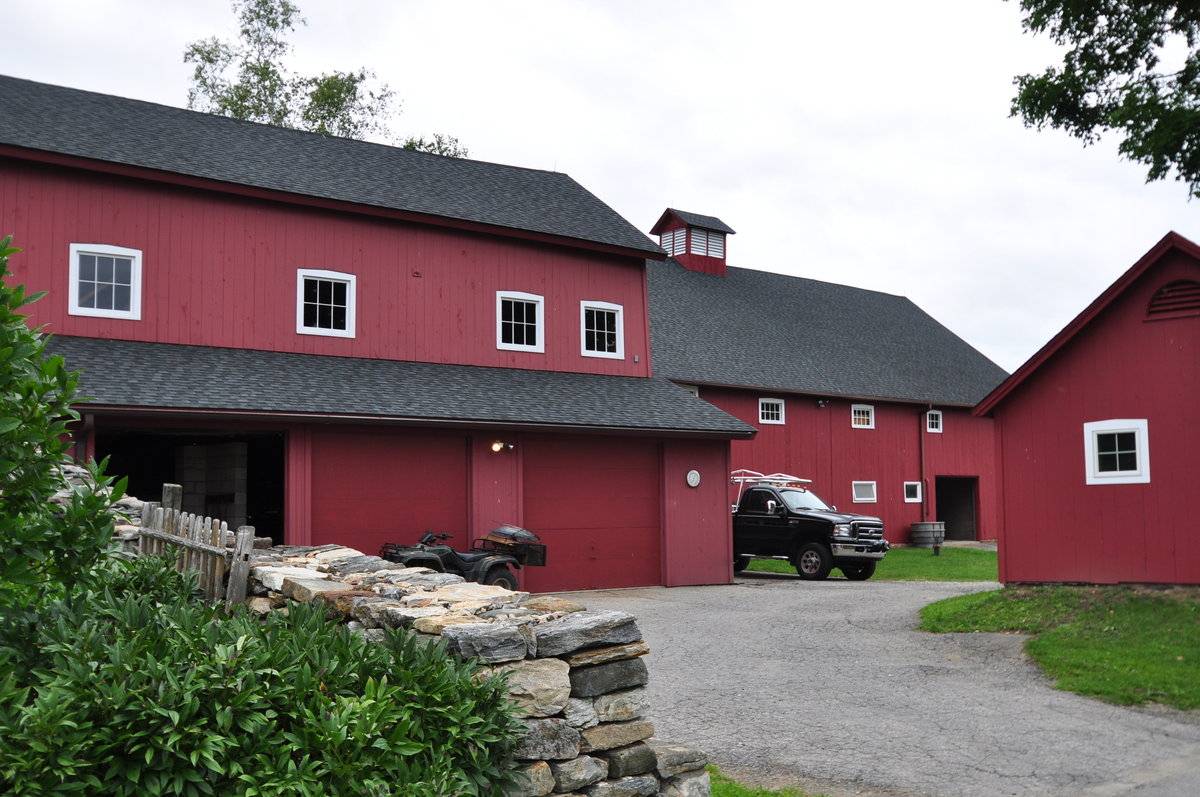
The equipment shed addition has three garage bay entries on the north or upbank wall, each fitted with a metal overhead garage door. The south or downbank wall has three more garage bay entries with overhead garage doors on the basement level and four six-pane sash in an unevenly spaced arrangement on the 1st story.
The barn is built on a fieldstone foundation, the addition apparently on poured concrete. The overall building is clad in vertical flush board, painted red, and roofed with asphalt shingle. The roof on all sections overhangs the eaves. The barn has a gabled cupola on the center of the roof ridge, with each side holding a pair of louvered events.
Historical significance:
The oldest barns still found in the state are called the “English Barn,” “side-entry barn,” “eave entry,” or a 30 x 40. They are simple buildings with rectangular plan, pitched gable roof, and a door or doors located on one or both of the eaves sides of the building, based on the grain warehouses of the English colonists’ homeland. The name “30 x 40” originates from its size (in feet), which was large enough for 1 family and could service about 100 acres. The multi-purpose use of the English barn is reflected by the building’s construction in three distinct bays – one for each use. The middle bay was used for threshing, which is separating the seed from the stalk by beating the stalks with a flail. The flanking bays would be for animals and hay storage.
The 19th century saw the introduction of a basement under the barn to allow for the easy collection and storage of a winter’s worth of manure from the animals sheltered within the building. The bank barn is characterized by the location of its main floor above grade, either through building on a hillside or by raising the building on a foundation. This innovation, aided by the introduction of windows for light and ventilation, would eventually be joined by the introduction of space to shelter more animals under the main floor of the barn.
Field Notes
Main barn is an English Bank barn 79 X 36 with a 42 X 20 addition at the west end. It has 6 bays. Gable roof, asphalt shingles, Vertical siding. Post and beam frame. Original construction was probably late 1700s or early 1800s. See also 144 Geer Mountain Road - historically the same farm.
- Use & Accessibility
Use (Historic)
Use (Present)
Exterior Visible from Public Road?
Yes
Demolished
n/a
Location Integrity
Unknown
- Environment
Related features
Environment features
Relationship to surroundings
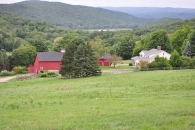
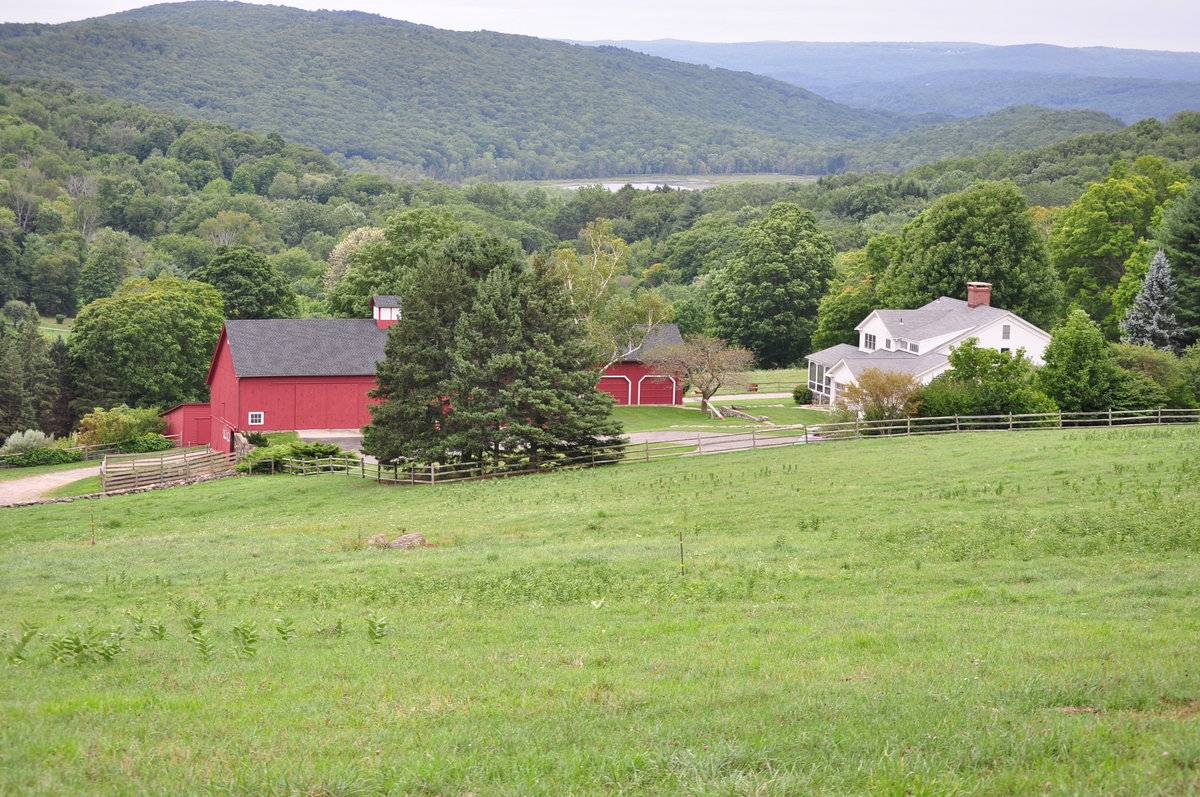
This farmstead is located on the east side of Geer Mountain Road, a township road in the vicinity of the village of South Kent. The property lies about 2 miles NE of the South Kent village center. The farmstead forms an historic architectural resource within the Iron Mountain Preserve property, a 300-acre tract of preserved open land owned by the Nature Conservancy. The general character of the near vicinity is rural with both active farms and exurban residences present.
The parcel is 10 acres in extent. Four buildings compose the farmstead’s architectural complex, including the historic barn with its addition, the dwelling house, a shed, and another large barn or equipment shed (date unknown). The house stands about 100 feet back from the road, surrounded by lawn with scattered hardwood trees. The lawn is flanked by asphalt driveways to north and south that meet in the farm building area to the rear. And additional crescent front driveway is joined at either end to the major drives near their entries from the public road. The farm buildings are grouped around a court formed at the east end of the south drive, with the historic barn about 50 feet east of the house, the shed on the south side of the court about 30 feet south of the barn, and the other large farm building on the east side about 40 feet east of the barn. The farmstead’s spacious pastureland extends to north, east, and south.
- Typology & Materials
-
Building Typology
Materials
Structural System
Roof materials
Roof type
Approximate Dimensions
80 x 36 feet
- Source
-
Date Compiled
03/03/2011
Compiled By
P. Pendleton & T. Levine, reviewed by CT Trust
Sources
Field notes and photographs by Dick Lindsey date 8/27/2010.
Town of Kent Assessor’s Record
Parcel ID; 11-34-4
Aerial Mapping:
http://www.bing.com/maps accessed 3/3/2010.Sexton, James, PhD, Survey Narrative of the Connecticut Barn, Connecticut Trust for Historic Preservation, Hamden, CT, 2005, http://www.connecticutbarns.org/history.
Visser, Thomas D., Field Guide to New England Barns and Farm Buildings, University Press of New England, 1997.
- PhotosClick on image to view full file
-