Barn Record Chester
RETURN TO ‘FIND BARNS’- Building Name (Common)
- Delaney Barn
- Building Name (Historic)
- Gorham House Barn, "Grandma's"
- Address
- 5 Gorham Road, Chester
- Typology
- Overview
-
Designations
Historic Significance
Architectural description:
Inventory of structures (C – contributing, NC – non-contributing):
House c. 1820 C
Barn 19th c. CBarn:
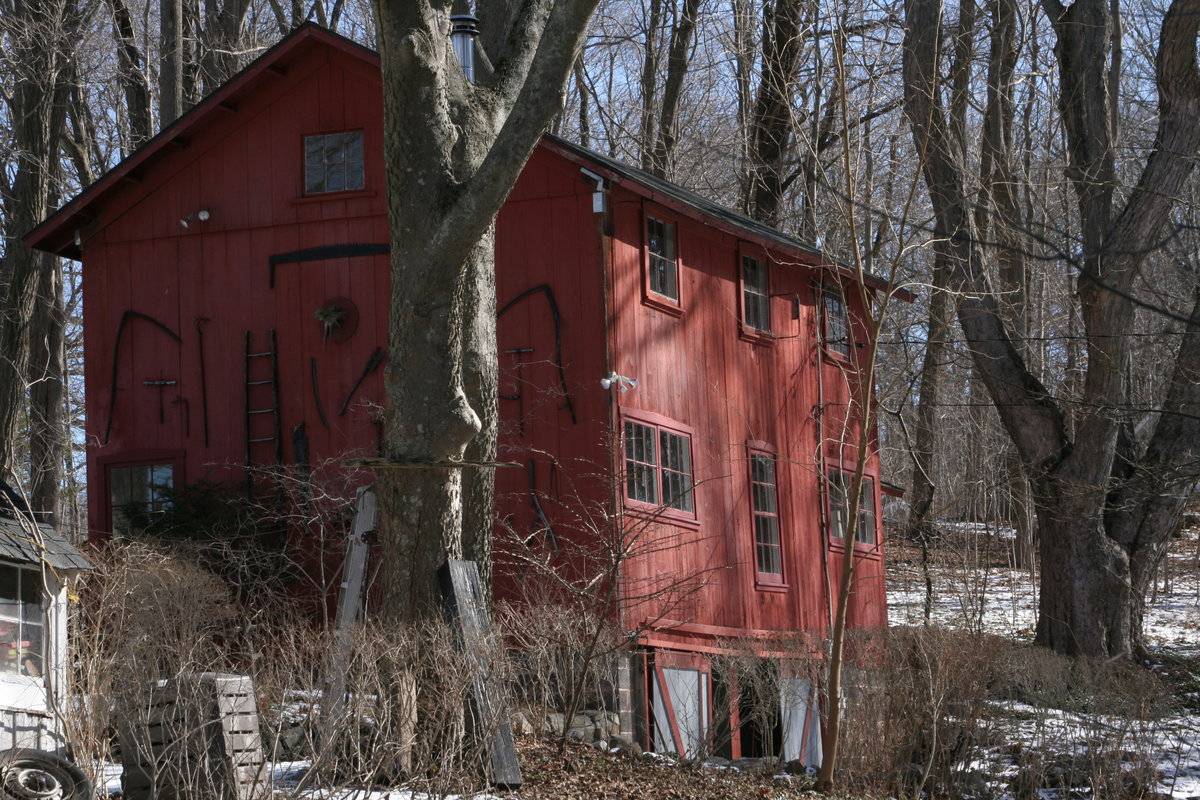
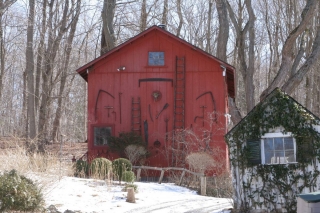
This is a 1 ½-story gable-roofed three-bay bank barn, 21 feet x 30 feet, with its ridge-line oriented north-south. The barn has been converted to residential use as a secondary living space or guest house. The grade slopes down from east to west; the east eave-side has the main level at grade while the west eave-side has a fully-exposed basement level.
Exterior:
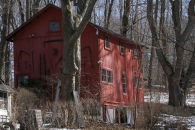
The original main level entry was in the center bay of the east eave-side where there a large picture window has replaced the barn door opening. Above at the attic level is another 20-pane picture window. To the right (north) is a modern single entry door with a small porch stoop. At the left (south) corner a small one-pane window is located at the main level, lighting a stair in the interior.
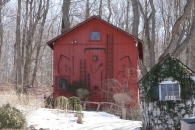
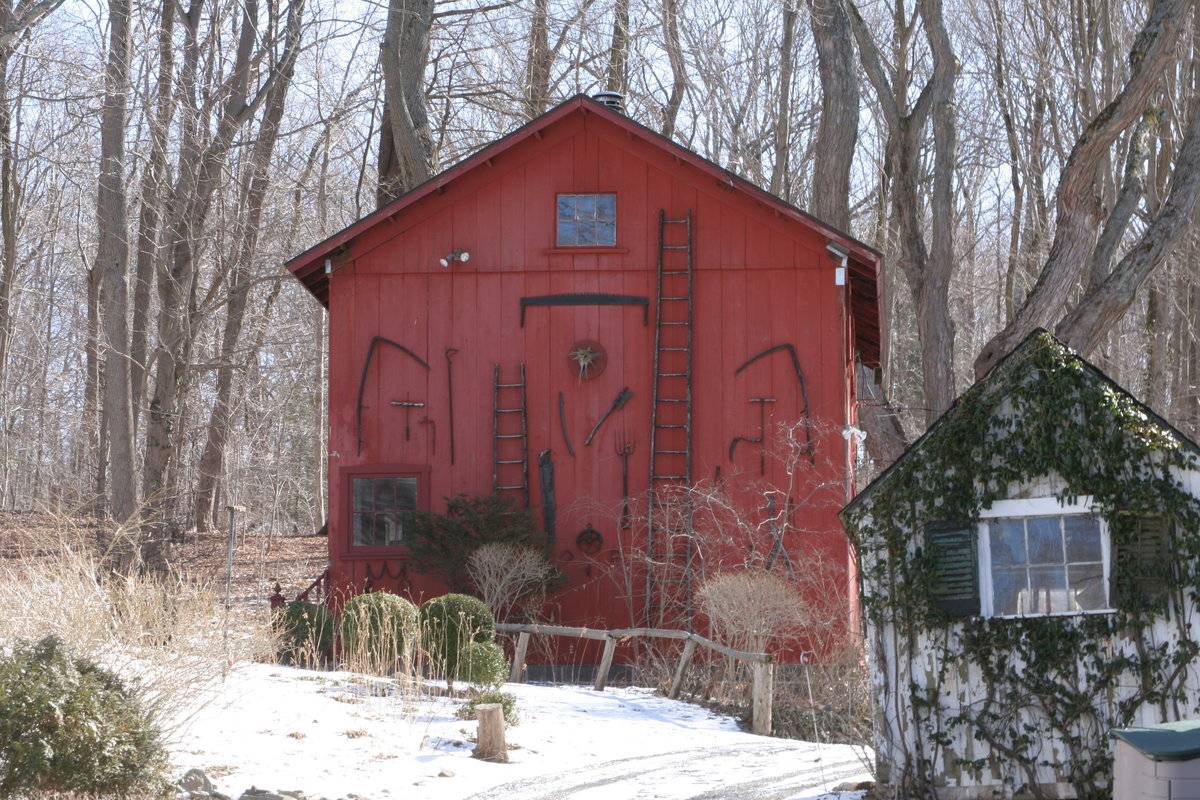
The north gable-end has a six-pane attic window and one six-pane awning window at the left (east) corner of the main level. A display of antique hand tools is mounted on the wall. As the grade declines toward the right (west) a concrete masonry foundation wall is partially exposed.
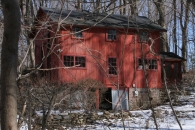
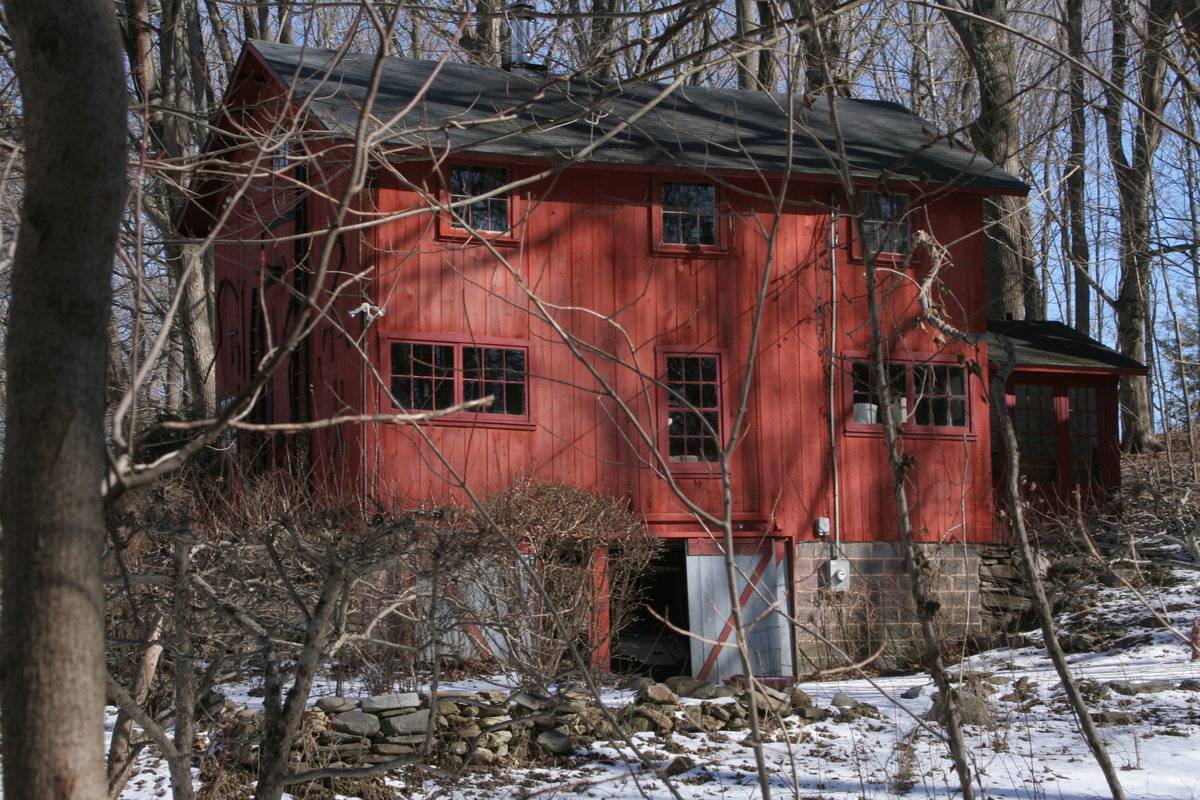
The west eave-side has a fully-exposed basement level. The left (north) and center bays have four exterior-mounted sliding doors with z-bracing on the outside face. The right (south) bay of the basement is a concrete block masonry wall with the end of a fieldstone masonry south wall visible at the extreme right. Above at the main level in the left and right bays is a pair of six-pane windows similar in scale to stable sash. The center bay has a six-over-six double-hung window. In the loft level there are three six-pane windows, one in each bay.
The south gable-end has a small attached 9 foot x 14 foot 1-story gable-roofed addition. This was originally a porch structure relocated from a nearby house. Its west eave-side has three fixed windows with twelve panes, which appear to have been storm door panels. The south side of the addition is blank, while the south gable-end of the main barn has a panel of four six-pane windows at the loft level. The east side of the addition has a wide horizontal twelve-pane window and to its right a single entry door.
Walls are wood vertical siding painted red. The roof has overhangs at the rakes and eaves, and asphalt shingles.Interior:
The main structure is a post and beam frame which incorporates a variety of materials that appear to have been re-used. There are a few angle braces with Roman numeral marriage marks but lacking their mates the framing can not be confirmed as scribe rule, and the majority of the joinery is square rule construction. The cross- or tie-girts are framed in a position just below the plates. A loft floor has been constructed in the south and center bays, with an open-riser wood stair inserted at the southeast corner running north along the east wall. Walls between the framing members have been insulated and finished with white painted surfaces, leaving the exposed wood framing stained dark.
The addition at the south end contains a small bath and kitchenette. Interior flooring is painted plywood, probably over the original plank floor.
Basement level has exposed un-mortared fieldstone walls at the east and south, and concrete block masonry at the north and west. Wood posts sit on stones at two interior post locations. Girders and floor joists are mostly hand hewn and partially squared. Insulation added between the joists obscures the floor construction.• Historical or Architectural importance:
Applicable Connecticut State Register Criteria:
1. Associated with the lives of persons significant in our past;
2. Embodying the distinctive characteristics of a type, period, or method of construction.The site is significance for its ownership by the Reverend George Gorham in the second half of the 19th century and by Barbara Snow and Edmund Delaney in the 20th century. The house is significant as an excellent example of its type, a traditional center-chimney Colonial building ornamented in Federal style detailing. The barn is a typical example of an English bank barn, likely constructed on a pre-existing foundation and later adaptively-reused by the Delaneys.
Historical background:
In 1815 Pomeroy Watrous inherited the property from his father Gideon; the house probably dates to shortly after. The house appears on early maps and along with Federal-style detailing, contains an iron mantel and bake-oven door by local iron workers Russell and Beach. Watrous owned a grist- and saw-mill on Pattaconk Brook slightly upstream from the home site.
Pomeroy’s daughter Emily married George Gorham in 1853. He came from New Haven to Chester as a minister in 1852, and boarded with the Watrous family when he first arrived. Following their marriage, George and Emily lived in this house, as did their daughter Mary Elizabeth (Maime). George served as a chaplain in the Union army during the Civil War, and died of consumption in 1875, leaving Emily and her children.
Family letters were found in the house when it was sold out of the family in the 1960s, including correspondence from George during his service in North Carolina, and with granddaughters Bertha and Alice Clark, both of whom were college-educated.
Given George Gorham’s occupation as a minister, the extent of the family’s agricultural activity is unclear, although the barn’s basic layout is as a traditional English bank barn. The barn is supported on un-mortared fieldstone retaining walls which, along with its construction using a variety of unmatched timbers, suggests a piecemeal construction with re-used materials in the 19th century. The concrete block masonry portions and the fairly deep roof overhangs seem to point toward late 19th- or early 20th-century construction or alterations. The extant structure could have replaced an earlier one on the same location, reusing the foundation walls and some materials.
The property was purchased by Barbara Snow in 1964 and following her marriage to Edmund Delaney (1914-2000) the family vacationed in Chester. They moved to the property full-time in the 1970s. They added onto the southeast corner of the house and converted the barn to living space. Barbara and Edmund Delaney contributed much time and energy to the Chester Historical Society and to the establishment of the Connecticut Trust for Historic Preservation. They also authored books on local history and nominations to the National Register.
Architectural significance:
This barn is significant as a typical example of an outbuilding associated with an early 19th-century village home where agriculture may not have been the primary source of livelihood. The barn represents a traditional type, the English bank barn. Its location to the rear of the house is a typical carriage barn configuration seen often in a built-up town or urban setting. The barn appears to retain much of its historic fabric, which is of interest for its apparent re-use of older materials mixing bits of scribe rule frame re-worked into a square rule frame.
The barn shows adaptive re-use both in the early 20th century when the concrete masonry was added at the basement level, and in the third quarter of the 20th century when the Delaney family finished it as a living space or guest house. The house and barn gain significance from their known history as documented by the collection of Gorham family letters and also from the custodianship of Barbara and Edmund Delaney, prominent historic preservation advocates from the 1970s on.
Field Notes
Listed on the State Register of Historic Places 4/03/2013 c. 1815-29 Documented in a book published by the Chester Historical Society
- Use & Accessibility
Use (Historic)
Use (Present)
Exterior Visible from Public Road?
Yes
Demolished
n/a
Location Integrity
Original Site
- Environment
Related features
Environment features
Relationship to surroundings
The site is a 1.4-acre parcel on the southeast corner of Gorham Road and Bokum Road in Chester. Gorham Road is a short street, hardly more than a driveway, extending east-west to connect Bokum Road, at its west end, with Spring Street to the east. Spring Street runs roughly east-west parallel to Pattaconk Brook along its south bank. Pattaconk Brook was the site of numerous water-powered industrial sites from about 1800 on, and the main road paralleled the brook on the north bank, leading east to the town center.
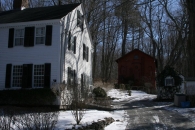
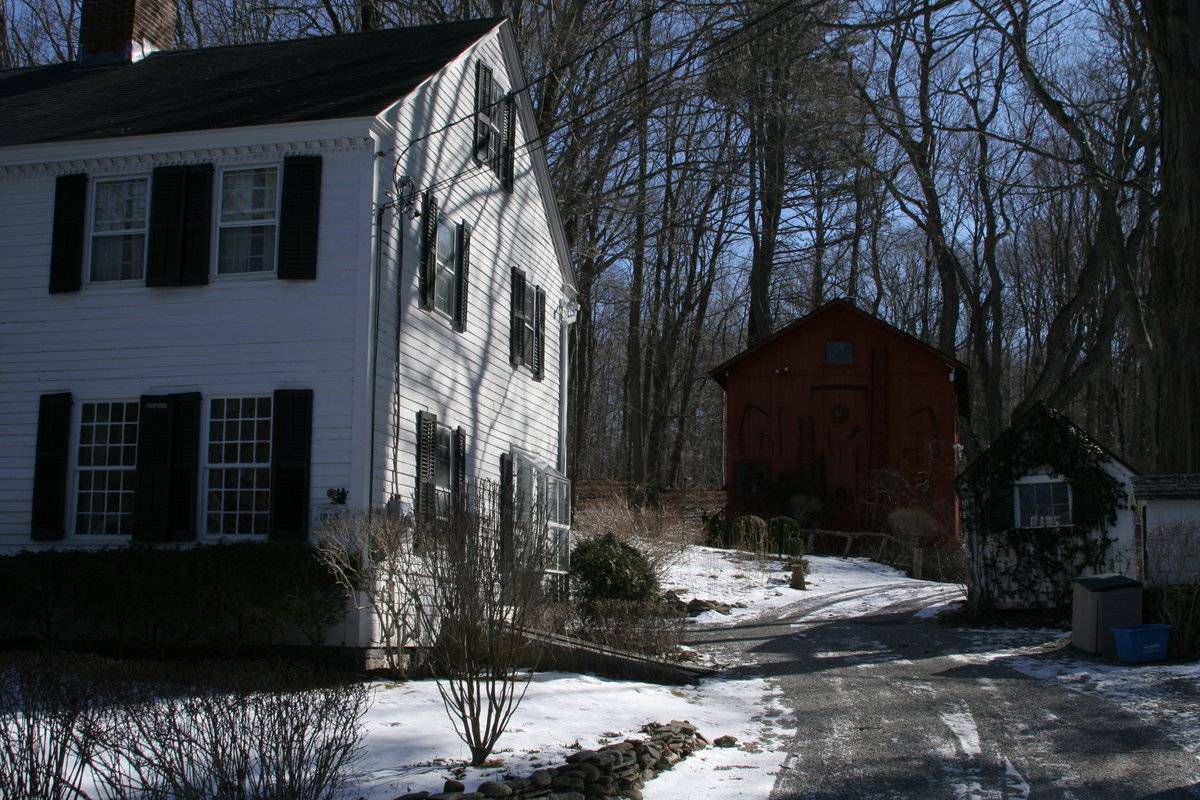
The property at 5 Gorham Road is on a north-facing slope above the brook. The site is now wooded, though would have been cleared in the 19th century. The house is a c. 1820 2 ½-story center-chimney gable-roofed structure with its ridge-line oriented east-west. The five-bay north eave-side faces the road. The ground floor has a central entryway with a six-panel door, a three-pane transom, square pilasters and an entablature with a frieze and cornice ornamented with Federal style classical trim including scroll-like modillions and a row of dentils or guttae below. The entry is flanked by twelve-over-twelve double-hung windows, two on each side. The second floor has five twelve-over-twelve double-hung windows. The eave cornice echoes the elaborate detail of the entry surround. Siding is horizontal clapboards with corner board trim. The roof has small cornice returns at the gable-ends, and asphalt shingle roofing.
The interior has two front rooms, each with a fireplace with Georgian style mantel, flanking a stair hall or porch with a three-run stair to the upper floor. A kitchen fireplace backs up to the stair on the rear south side, and has a cooking hearth and bake-oven with a cast iron door.
Additions in the 20th century have been attached to the southeast corner of the house, extending the kitchen and creating a dining room. A second stair to the upper floor is a straight run from the back door in the south wall, arriving in the southeast room of the second floor.
Two second floor bedrooms in the north side of the house have fireplaces and open to the front stair hall as well as to the rear part of the house. A third bedroom is in the southwest corner, and the remainder of the second floor has been opened to the southeast addition which includes bathrooms and a small residential lift for disability access. The attic has been insulated but the post and beam framework is visible, including a chalked signature of the first owner, Pomeroy Watrous.
The gable-roofed bank barn is located south and slightly west of the house, somewhat uphill toward the rear of the property. It has its ridge-line oriented north-south.
A driveway enters the site to the west of the house and extends uphill to the rear of the lot, passing the west side of the barn and providing access to the basement level. The drive continues on southward to a second lot under the same ownership. Two small sheds are located along the west side of the driveway. A garden area is to the east and south; the remainder of the lot is second-growth woodland.- Typology & Materials
-
Building Typology
Materials
Structural System
n/a
Roof materials
Roof type
Approximate Dimensions
n/a
- Source
-
Date Compiled
09/08/2010
Compiled By
John Bellows - CH
Sources
Photographs and field notes by Charlotte Hitchcock 3/22/2012.
Interview with Barbara Snow Delaney, 3/22/2012, at the site.
Map resources:
Town of Chester Assessor’s Records and GIS Viewer http://www.mainstreetmaps.com/CT/Chester/
Parcel ID: Map 14/Lot 242.Aerial views from:
http://maps.google.com/ and http://www.bing.com/maps/ accessed 10/04/2011.Historical aerial photography and maps accessed at UConn MAGIC:
http://magic.lib.uconn.edu/mash_up/1934.html
http://magic.lib.uconn.edu/historical_maps_connecticut_towns.html .USGS Historical Maps accessed 6/22/2012 at http://historical.mytopo.com/ .
UTM coordinates: http://itouchmap.com/latlong.html
Print and internet resources:
Connecticut Trust for Historic Preservation, Historic Barns of Connecticut Resource Inventory, 2010,
http://www.connecticutbarns.org/45382 .Delaney, Barbara S., Introduction to the Gorham Collection 1843-1964, Chester Historical Society Archives, 2010.
The Houses and History of Chester, Chester Historical Society, Inc., 1984.
Sexton, James, PhD; Survey Narrative of the Connecticut Barn, Connecticut Trust for Historic Preservation, Hamden, CT, 2005, http://www.connecticutbarns.org/history.
U.S. Federal Census, accessed at http://persi.heritagequestonline.com/hqoweb/library/do/census/search/basic .
Visser, Thomas D., Field Guide to New England Barns & Farm Buildings, University Press of New England, 1997.
- PhotosClick on image to view full file
-