Barn Record New Hartford
RETURN TO ‘FIND BARNS’- Building Name (Common)
- Torringford East Farm
- Building Name (Historic)
- n/a
- Address
- 906 Torringford East Street, New Hartford
- Typology
- Overview
-
Designations
n/a
Historic Significance
Architectural description:
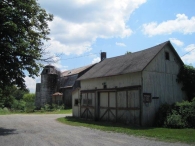
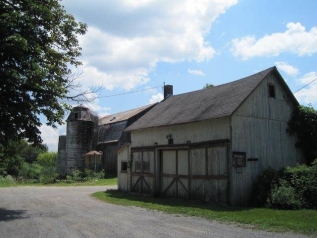
The agricultural buildings at this property consist of an eave-entry barn near Torringford East Street, with a long Quonset Hut addition projecting to the southwest, and a larger gable-entry barn with a gambrel roof, with two attached shed-roof additions and two silos. Both main barns are set perpendicular to Torringford East Street, which passes this property on a nearly north to south alignment.
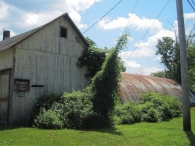
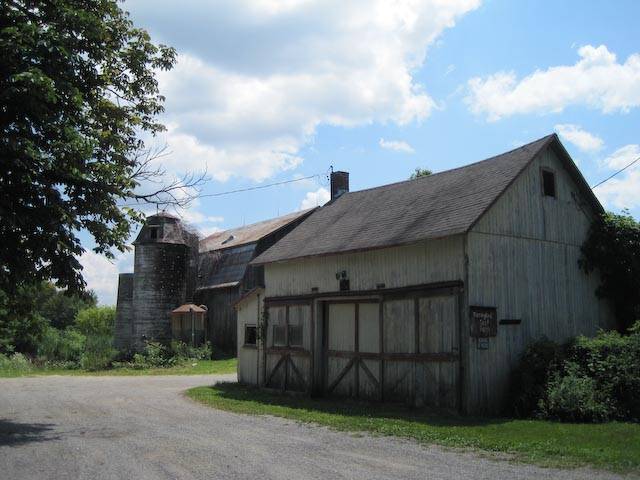
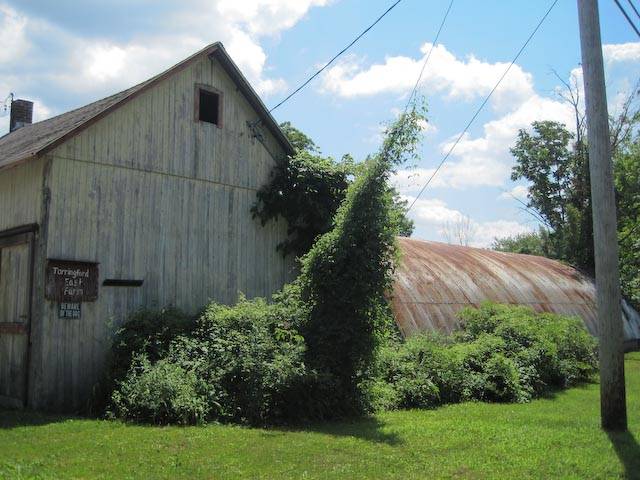
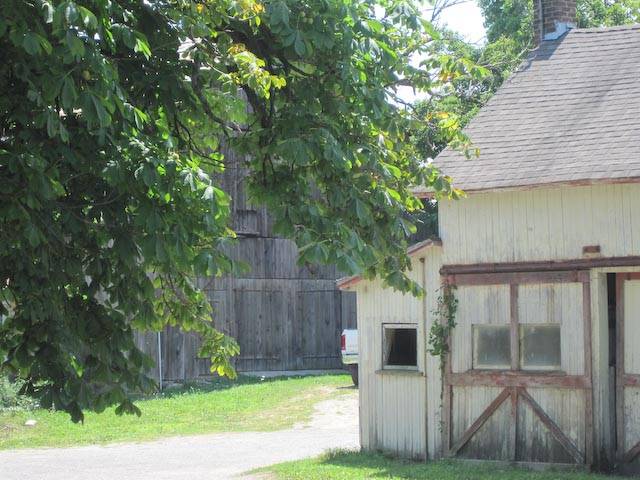
Barn I is a 1 ½-story eave-entry barn with a gable-roof. The primary façade of this barn is the north eave-side, which contains the primary entries. These entries consist of three oversize sliding doors of wood panel construction, which occupy the length of the façade. Each door is divided into four panels. The upper panels are blank, while each of the lower panels feature a single diagonal brace. The east-most of these doors has a window pane located in each of the two upper panels. The remainder of this façade appears blank. The west gable-end of this barn fronts Torringford East Street. A sign reading “Torringford East Farm” is mounted on the first story at the northwest corner. A rectangular window opening is centered in the gable-attic beneath the roof ridgeline. No other openings appear present on this gable-end.
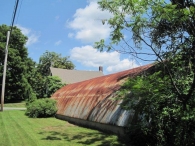
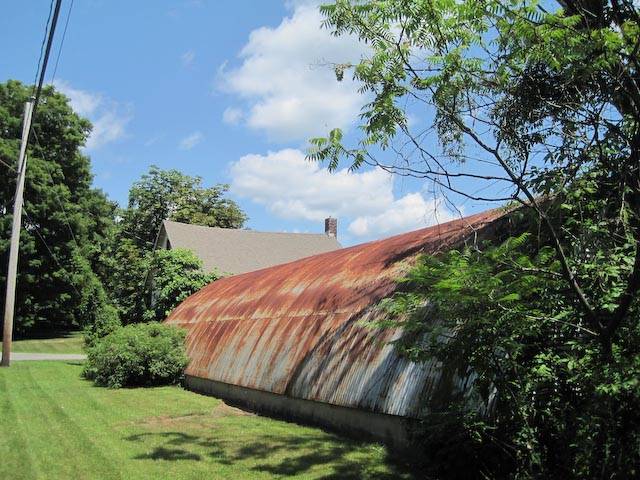
The south eave-side of Barn I is entirely occupied by a lengthy utility Quonset Hut addition, which projects to the south. This Quonset Hut is Addition I. In typical Quonset Hut fashion, the rounded side (facing west) is blank. The south end of Addition I appears to have a centered window opening, and a pass-through door located in the eastern half. The east side of Addition I is not rounded, but has a wall was created abbreviating the full semi-circular profile. This wall contains a number of entries which allow access to the interior. The southern half of the addition includes one window opening and an oversize sliding door. The northern half contains a pair of sliding doors. This addition stretches most of the full-width of the south eave-side of Barn I, but the remainder of this side of the barn is blank.
The east gable-end of Barn I also contains an addition, Addition Ia. This is a shallow shed-roof addition located in the northern half of the first story on this end. The south end of this addition appears to contain a single window opening. The east eave-side of the addition contains a pass-through door. The north end contains only a square window opening. The east-eave side of the barn itself also contains window openings. One is located on the first story in the southern half. Two other window openings are located in the gable-attic, symmetrically spaced.
The exterior of Barn I is faced in vertical wooden flush-board siding. The roof is covered in asphalt shingles. A small brick chimney projects from the roof ridgeline at the east end. Addition I is constructed of traditional Quonset Hut materials: corrugated galvanized steel panels. Addition Ia appears to be constructed of vertical wooden siding.
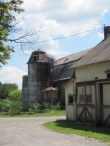
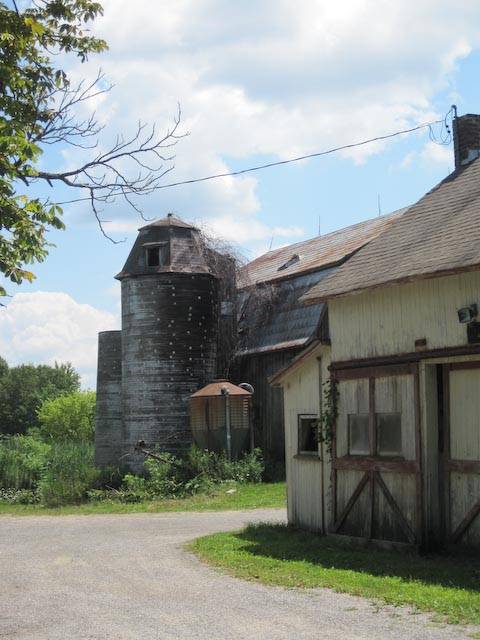
Barn II is a large 1 ½-story gable-entry barn with a gambrel roof. The primary façade of this barn is the west gable-end, which faces Torringford East Street. The main entry on the façade consists of a centered pair of oversize hinged wooden doors. A wooden plank pass-through door is located to the immediate north of this main entry on the first floor. A large wooden hay door is located in the gable-attic on the façade. A small window opening is located just above this hay door, beneath the roof ridgeline.
The north eave-side appears to be blank. Two silos are located along this side. The western silo is of concrete construction. It is topped by a conical hipped roof, divided into six faces. A small shed-roof dormer is present on this roof, facing northwest. The eastern silo also appears to be of concrete construction, but has no roof. The east gable-end is completely occupied on the first story by a full-width shed-rood addition. The gable-attic of the main barn is visible and contains a large hay door, centered. The shed-roof addition on this gable-end is Addition IIa. The north gable-end of this addition appears to contain a single square window opening, centered. The east eave-side appears to contain three long rectangular windows, oriented horizontally. The south eave-side of Barn II consists of Addition IIb, a large shed-roof addition that extends the full length of the main barn plus the width of attached Addition IIa. The southern portion of Addition IIb appears to be open and only supported by a series of posts along the eave. Four large skylights are equally-spaced along the shed roof.
The exterior walls of Barn II are clad in vertical wooden siding. Addition IIa may also be of wood construction. Addition IIb appears to be of metal construction. The roof of Barn II is covered in asphalt shingles. A series of four lightening rods are equally-spaced along the roof ridgeline. The roofs of both Additions IIa and IIb appear to be of sheet metal construction.
Historical significance:Barn I:
The oldest barns still found in the state are called the “English Barn,” “side-entry barn,” “eave entry,” or a 30 x 40. They are simple buildings with rectangular plan, pitched gable roof, and a door or doors located on one or both of the eave sides of the building based on the grain warehouses of the English colonists’ homeland. The name “30 by 40” originates from its size (in feet), which was large enough for 1 family and could service about 100 acres. The multi-purpose use of the English barn is reflected by the building’s construction in three distinct bays - one for each use. The middle bay was used for threshing, which is separating the seed from the stalk in wheat and oat by beating the stalks with a flail. The flanking bays would be for animals and hay storage.
Barn II:
The New England barn or gable front barn is the successor to the English barn and relies on a gable entry rather than an entry under the eaves. The gable front offers many practical advantages. Roofs drain off the side, rather than flooding the dooryard. With the main drive floor running parallel to the ridge, the size of the barn could be increased to accommodate larger herds by adding additional bays to the rear gable end. Although it was seen by many as an improvement over the earlier side entry English Barn, the New England barn did not replace its predecessor but rather coexisted with it as both types continued to be constructed.
The gambrel roof enclosed a much greater volume than a gable roof did, and its shape could be formed with trusses that did not require cross beams, which would interfere with the movement and storage of hay. Also known as the curb roof, the double slopes of the gambrel offer more volume in the hayloft without increasing the height of the side walls.
Field Notes
This farm is one of the most unusual properties in the town. In addition to the two barns: the old English style one immediately beside the road, and the larger gambrel roofed cow barn beyond; the farm has a silo similar to those found on Burdick and Stedman roads. However, its most interesting addition is the genuine Quonset hut that was attached to the barn next to the road. The farm has been subdivided and the property is for sale, so development and removal is an immediate threat.
- Use & Accessibility
Use (Historic)
Use (Present)
Exterior Visible from Public Road?
Yes
Demolished
n/a
Location Integrity
Unknown
- Environment
Related features
Environment features
Relationship to surroundings
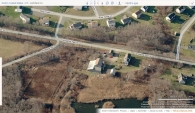
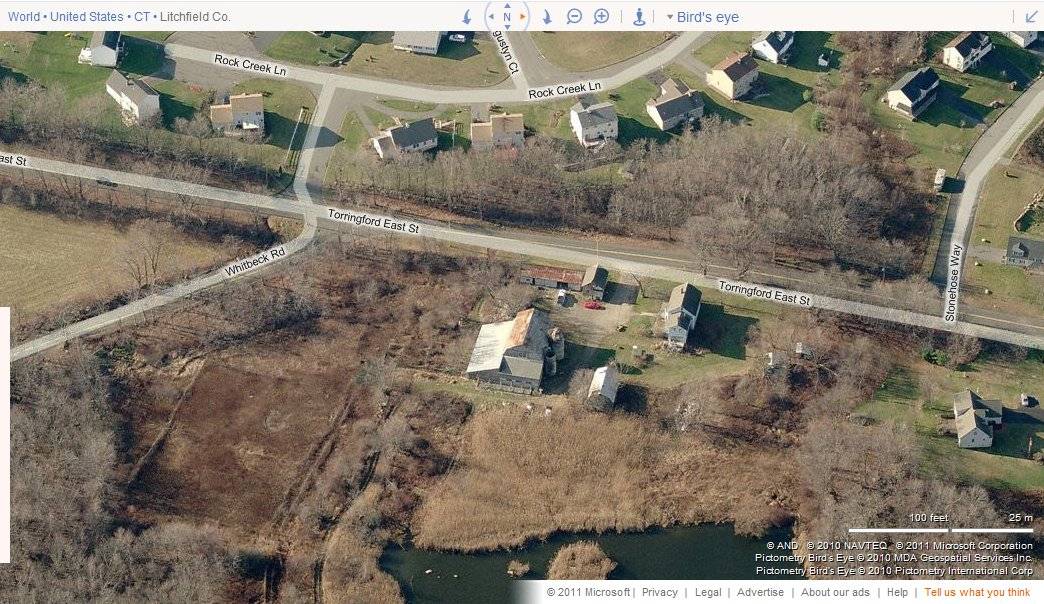
The agricultural structures documented here are two of the four structures on this property. Barn II is to the immediate east of Addition I and Barn I. To the north of Barn II is a smaller gambrel-roofed structure. To the north of Barn I is the house that is associated with this property. All four of the main structures are oriented perpendicular to Torringford East Street. A gravel driveway enters the property between Barn I and the house. It wraps around the east side of Barn I and Addition I and creates a wide parking area. The driveway also continues to the east passing along the north side of Barn II. A grassy lawn surrounds all of these structures, dotted with occasional trees. A pond and marshland are located to the immediate east, beyond which is open space. Whitbeck Road diverges from Torringford East Street to the south, beyond which is a mix of open land, active agricultural fields, and woodland. A small grove of trees is located across Torringford East Street to the west, beyond which is a subdivision of new houses. Additional new homes are also on the land to the northwest and north of this site. New development is also prolific in the larger surrounding area.
- Typology & Materials
-
Building Typology
Materials
Structural System
n/a
Roof materials
Roof type
Approximate Dimensions
BARN I: 864 square feet, ADDITION I: 1416 square feet, BARN II: 1800 square feet, ADDITION IIa: 480 square feet, ADDITION IIb: 1450 square feet.
- Source
-
Date Compiled
05/27/2011
Compiled By
N. Nietering & T. Levine, reviewed by CT Trust
Sources
Photographs by Anne C. Hall.
Sexton, James, PhD; Survey Narrative of the Connecticut Barn, Connecticut Trust for Historic Preservation, Hamden, CT, 2005, http://www.connecticutbarns.org/history.
Visser, Thomas D.,Field Guide to New England Barns and Farm Buildings, University Press of New England, 1997, 213 pages.
Map of New Hartford, CT, retrieved on May 26, 2011 from website www.bing.com.
New Hartford Assessor’s Records - Vision Appraisal online - http://data.visionappraisal.com/NewHartfordCT
- PhotosClick on image to view full file
-