Barn Record Scotland
RETURN TO ‘FIND BARNS’- Building Name (Common)
- The Bass Farm; National Bicentennial Farm (Part 1 of 2)
- Building Name (Historic)
- The Bass Farm
- Address
- 86 Bass Road, Scotland
- Typology

- Overview
-
Designations
n/a
Historic Significance
Architectural description:
There are two structures of note:
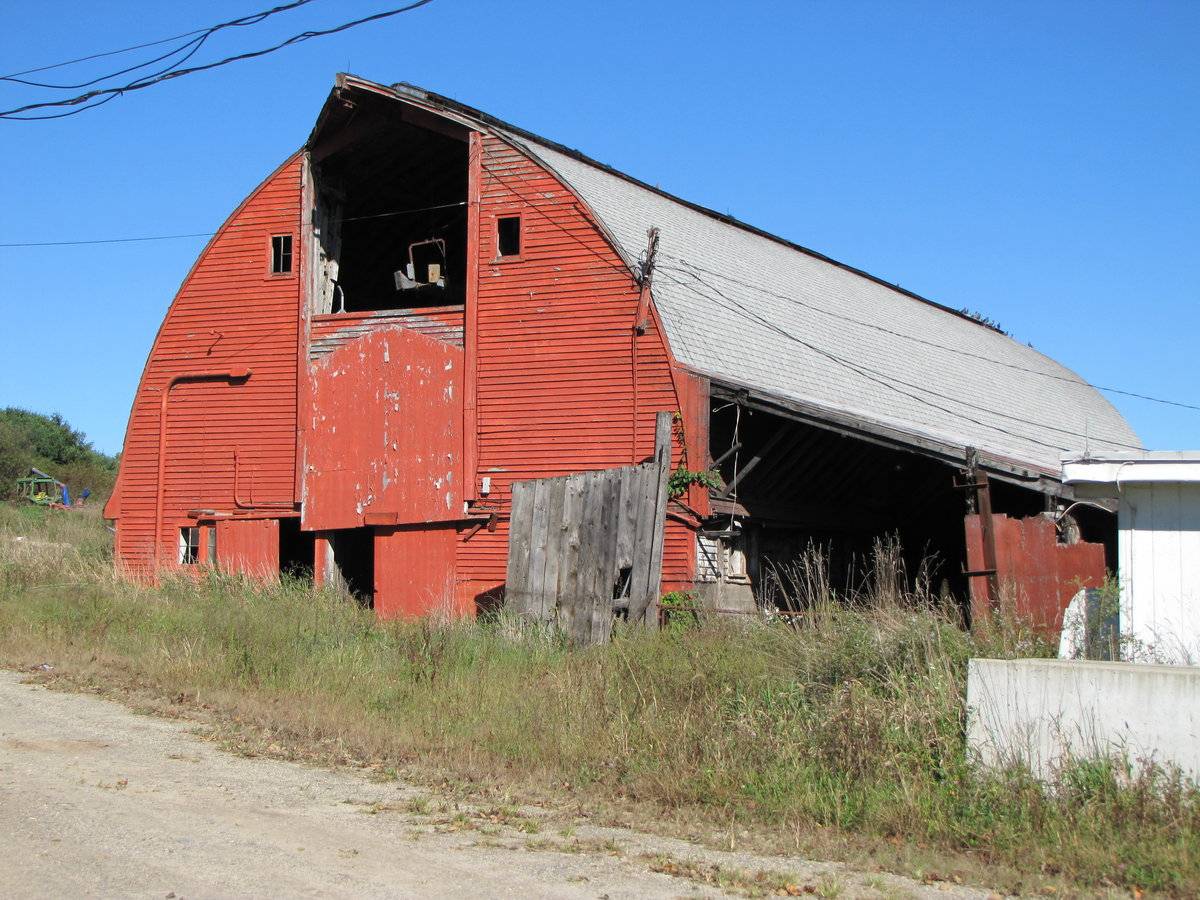
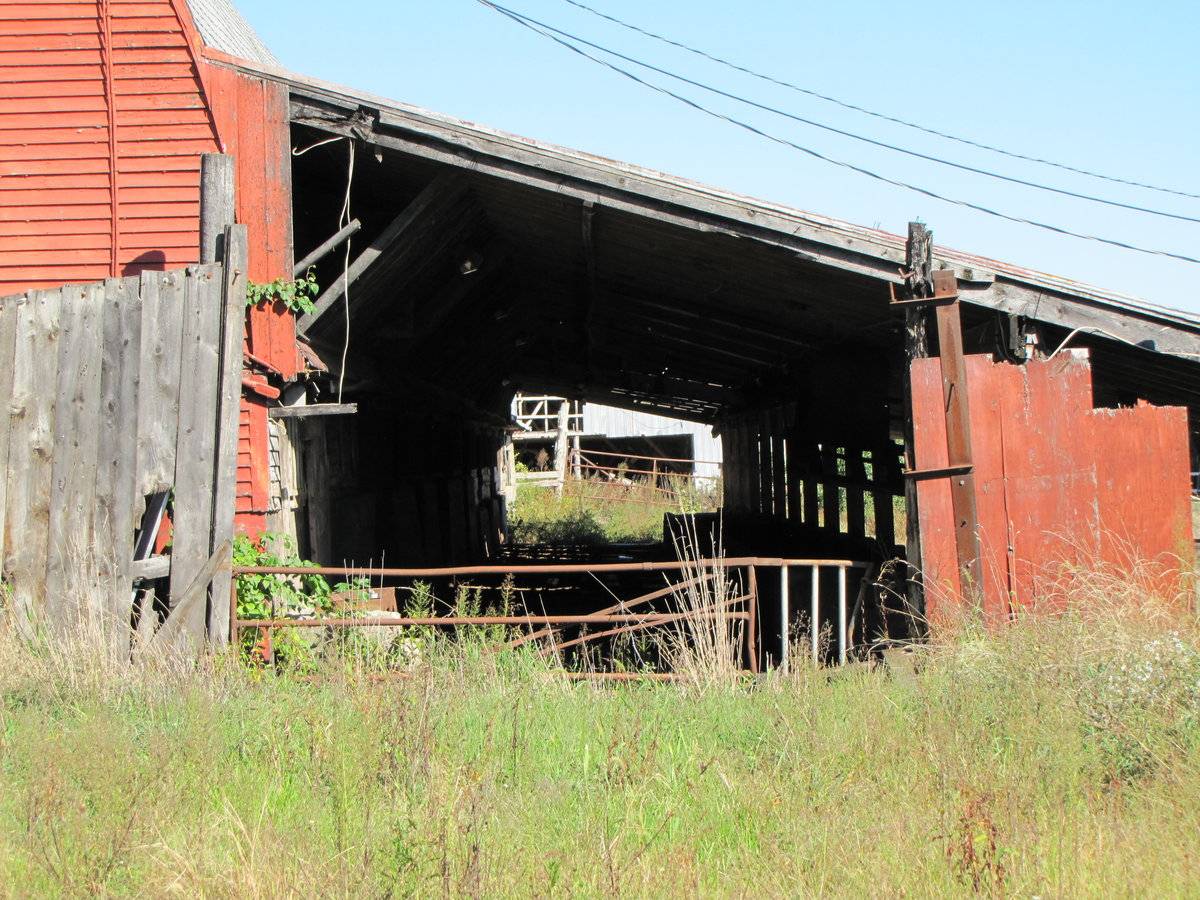
Barn I is a 2 ½-story gable-entry barn with a Gothic-roof with flared eaves and two additions. The main façade faces west and its ridge-line runs east-west, perpendicular to Bass Road, which lies to the west. The first addition is a 1 ½-story gable-roof addition that extends eastward from the northern half of the east gable-end of the original barn. Its ridge-line runs parallel to that of the original structure. The second addition is a shed-roof addition along the south eave-side of the barn. This addition begins at the southwest corner of the main façade, and running eastward, ends in the center of the south eave-side on the gable-roof addition. The principal entry is provided by a pair of sliding doors mounted on an external track located just north of the center on the main façade. These doors are constructed of vertical boards. To the north of the doors are twinned four-pane stable windows with trim. To the south of the sliding doors at the southern corner of the main façade is a pair of window openings. Immediately below the apex of the roof is a large vertically sliding hay door constructed of vertical wood boards and mounted on external tracks. This door is flanked by two four-pane stable windows with trim. Above the door at the apex of the gable is a triangular projection that flares outward, forming a hay-hood. Proceeding further south to the main façade of the shed-roof addition there is a large open-bay extending from the southwest corner of the original structure to a few hastily constructed vertical boards at the southeast corner of the main façade of the addition. Along the north eave-side of the barn are two shed-roof dormers that appear to feature hay doors. The lower exterior walls of the main façade and north eave-side of the barn appear to be constructed of masonry covered with plaster, painted red. The upper exterior walls of the main facade are covered in clapboards painted red. The Gothic and gable roofs are covered with asphalt shingles, while the shed-roof is metal. The foundation appears to be concrete.
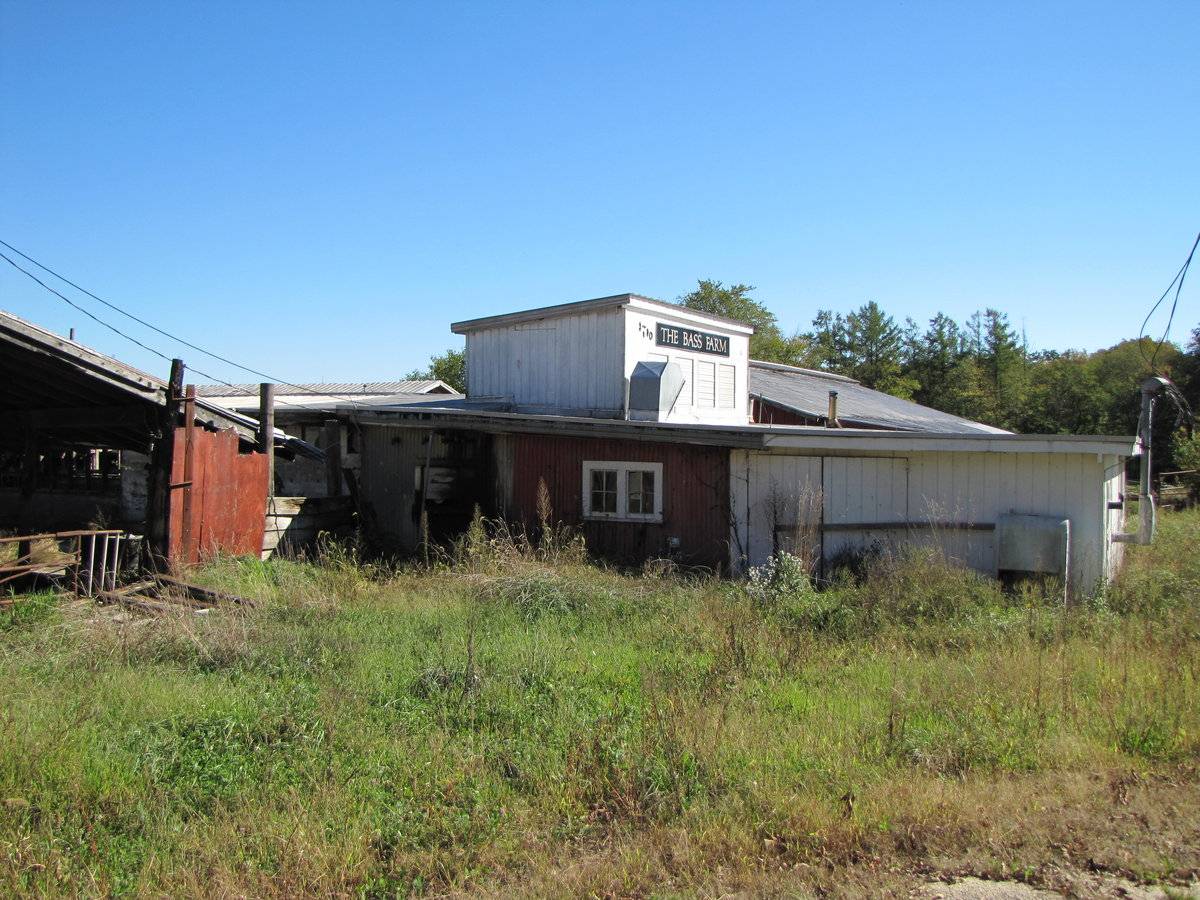
Barn II is located to the south of Barn I. This is a 1 ½-story, gable-entry barn with a rectangular plan and a low-pitch gable-roof and several additions. The main façade faces west, and the ridge-line runs east-west. Along the main façade is a single-story addition with a flat roof. This addition features a prominent projection on its northern half, forming an L-shaped plan when viewed from above. On the southern half of this addition is a small rectangular-shaped second-story addition with a flat-roof that is recessed slightly east away from the walls of the main façade. On the east gable-end of the barn is a 1 ½-story gable-roof addition. The principal entry appears to be through a paneled pass-through door and screen-door located just south of the center of the main facade. Directly south of the main-entrance are three one-over-one double-hung windows with trim. To the north of the main entrance on the northern half of the main façade is a window opening, followed by a two-pane window with trim. On the second story of the main façade are four window openings, now covered with what appears to be corrugated metal. On the south eave-side of the barn, beginning with the flat-roof addition on the main façade, there is a two-pane stable window with trim. There appears to be two stable windows at the western corner of the south eave-side of the barn below the eave. On the western corner of the north eave-side of the barn is a pair of hinged doors constructed of vertical wood boards followed by a twinned four-pane stable window with trim to its east. Proceeding further east to the north eave-side of the original structure there appears to be a horizontal band of strip windows. The walls of the barn are covered in clapboard siding painted white interspersed with what appears to be corrugated metal panels on the north eave-side. There is a metal ventilator and two smokestack chimneys on the roof.
Historical significance:By the early 20th century agricultural engineers developed a new approach to dairy barn design: the ground-level stable barn, to reduce the spread of tuberculosis bacteria by improving ventilation, lighting, and reducing the airborne dust of manure. A concrete slab typically serves as the floor for the cow stables. Many farmers converted manure basements in older barns into ground-level stables with concrete floors. Some older barns were jacked up and set on new first stories to allow sufficient headroom. With the stables occupying the entire first story, the space above serves a a hayloft. By the 1920s most ground-level stable barns were being constructed with lightweight balloon frames using two-by-fours or two-by-sixes for most of the timbers. Novelty or tongue-and-groove beveled siding is common on the walls, although asbestos cement shingles also were a popular sheathing. Some barns have concrete for the first-story walls, either poured in place or built up out of blocks. The gambrel roof design was universally accepted as it enclosed a much greater volume than a gable roof did, and its shape could be formed with trusses.
A shed is typically a simple, single-story structure in a back garden or on an allotment that is used for storage, hobbies, or as a workshop. Sheds vary considerably in the complexity of their construction and their size, from small open-sided tin-roofed structures to large wood-framed sheds with shingled roofs, windows, and electrical outlets. Sheds used on farms or in industry can be large structures.
Field Notes
The farm, on the east side of the road, comprises a multitude of buildings, attached and unattached to the main barn. A drying barn, off to the left of the basic farm and farmhouse, seems to be part of the farm as well. A sign said "1710", and the farm was marked as a National Bicentennial Farm. This set of pictures is of the red main barn.
- Use & Accessibility
- Environment
Related features
Environment features
Relationship to surroundings
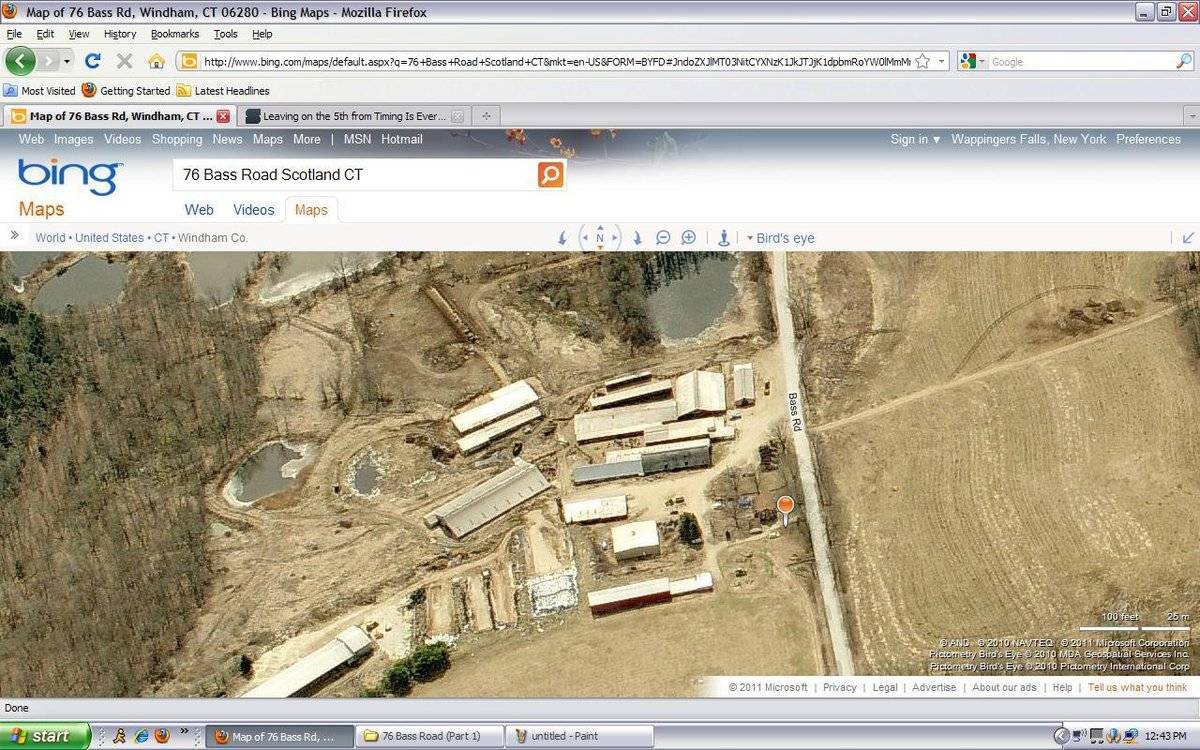
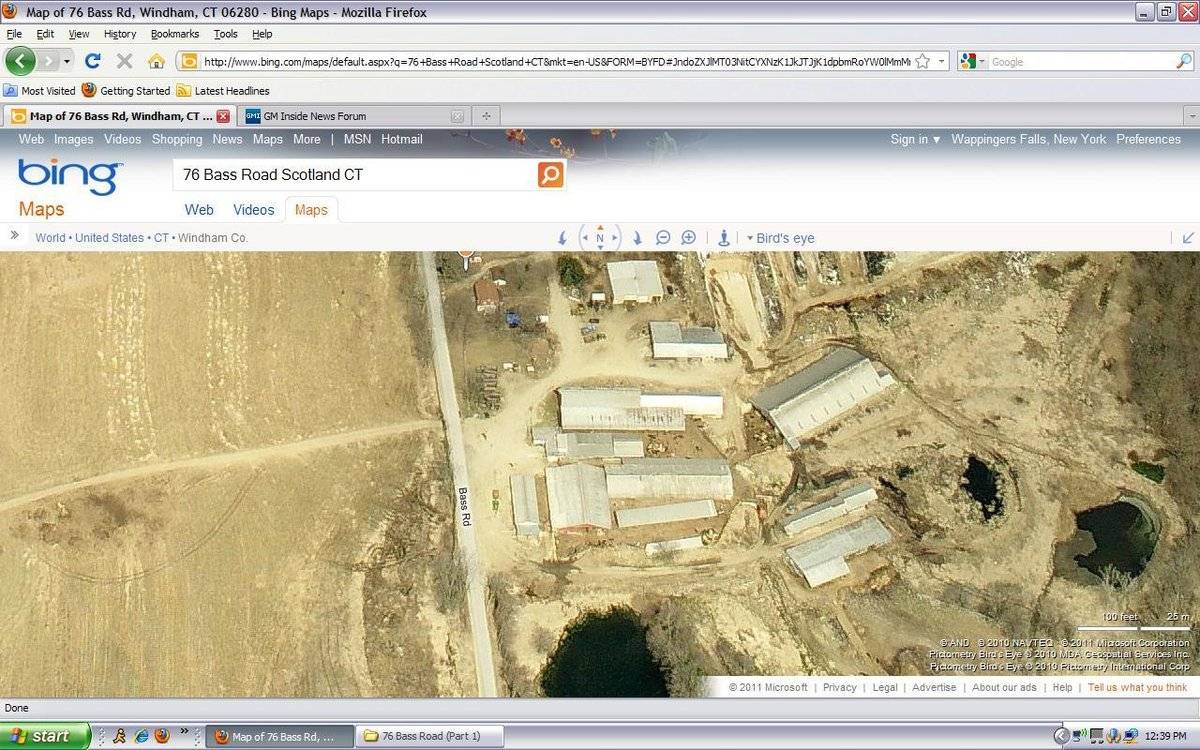
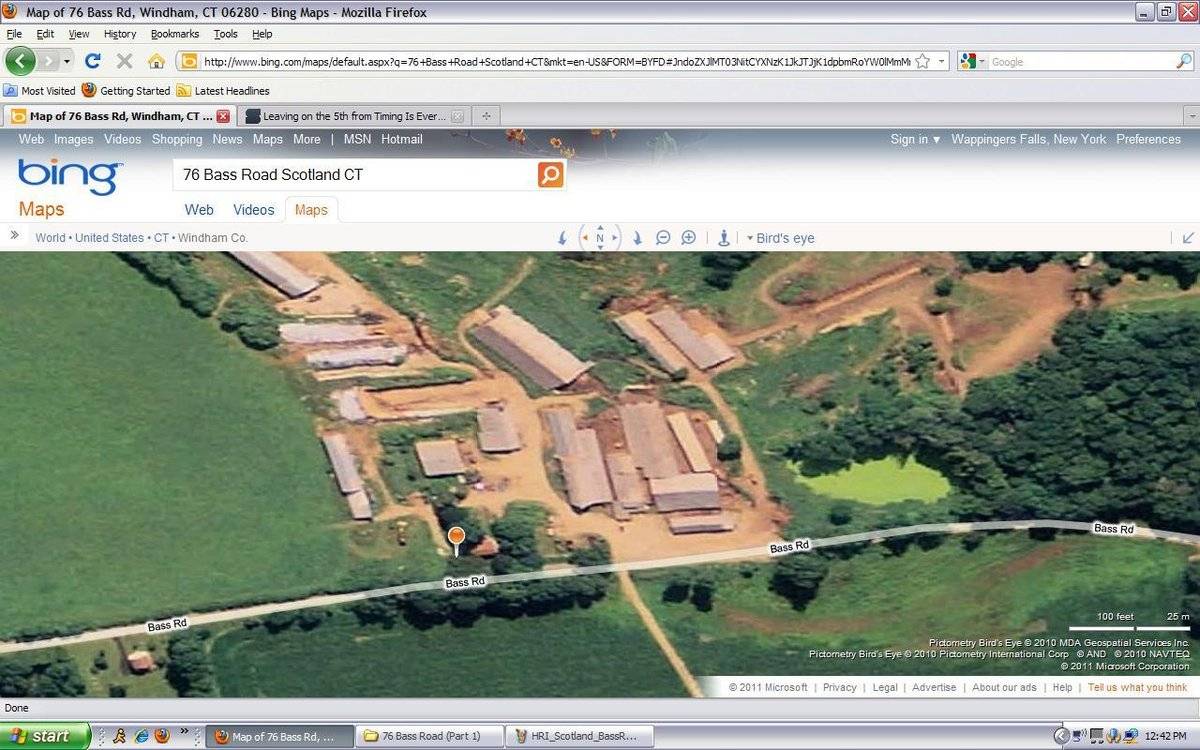
This property, which is known as Bass Farm, is a large commercial farm located on the west border of the Town of Scotland, within close proximity of the Windham town line. The farm consists of 950 acres of cultivated land broken down into scattered parcels in the vicinity of Bass Road. The barns are located on a 120.58-acre parcel that serves as the epicenter of Bass Farm’s holdings. The parcel is bordered by Bass Road to the west and Huntington Road (CT. 14) to the north.
The property is dominated by a large complex of barns and other agricultural structures of an undetermined nature and origin. These structures are located roughly in the center of the property, adjacent to Bass Road, and are surrounded by a network of dirt roads. To the north of this cluster, there is a large agricultural field that stretches to the northern boundary of the property (Huntington Road). To the south, there are several open fields interspersed with tracts of woods, and half-dozen ponds. The eastern portion of the property is heavily wooded.
The Gothic and flat-roof barns described above are located in the center of the barn complex. To their south, from west to east, is a series of barns. The first is a 1 ½-story gable-entry barn. Its main façade appears to face north, and there is a single-story shed-roof addition spanning the entire length of its south gable-end. To its immediate east is a large, 1 ½-story gable-entry barn with a low-pitched roof, its main façade facing north and its ridge-line running north-south. Further east are three barns with rectangular plans and east-west orientations. The northernmost barn is a large barn with a low-pitched gable roof. To its south are two flat-roof barns.
Further east appears to be two gable-roof barns with ridge-lines running southwest-northeast. On the western half of the south eave-side of the southern barn appears to be a shed-roof addition.
To the east of the Gothic-roof barn is a large, 1 ½-story gable-entry barn with a low-pitched roof. Its main façade faces southwest, and its ridge-line runs southwest-northeast. There are two small additions, a shed-roof addition on the western corner of the south eave-side, and a gable-roof addition on the east gable-end, its ridge-line running parallel to that of the main structure.
To the north of the Gothic-roof barn are three additional structures. The first appears to be a gable-entry structure with a low-pitched roof, the north pitch of the roof running longer than the south pitch. The main façade appears to face east, and the ridge-line runs east-west. To its north is a gable-entry structure with three bays and a low-pitch gable roof. Its main façade faces south. Further north appears to be a 1 ½-story, eave-entry wagon shed, with five bays and a gable-roof. Its main façade faces south. Along the west gable-end are two additions, the first being a gable-roof addition, its ridge-line running parallel to that of the primary structure. Along the west gable-end of the gable-roof addition appears to be a single-story flat-roof addition with an L-shaped plan. To the east of this structure there appears to be a 1-½ story pole barn with gable-entry. The main façade faces southwest, and its ridge-line runs southwest to northeast.
To the east of the parcel is a 209.7 acre tract consisting of several agricultural fields separated by tracts of woods. Further to the southeast, there is a non-contiguous 121.0-acre parcel that is bordered by Gager Hill Road to the north and Bass Road to the west.
To the west of the Bass Road the farm encompasses an additional 377.5 acres of woods and farmland, of which 296.0 acres are located in the neighboring Town of Windham, the Scotland-Windham town line running just to the west of Bass Road. To the northwest of the parcel, just north of the intersection of Bass and Huntington roads, there is an additional 130.8-acre parcel.
- Typology & Materials
-
Building Typology
Materials
Structural System
Roof materials
Roof type
Approximate Dimensions
Barn I: 14,200 sq. ft. Barn II: 5,240 sq. ft.
- Source
-
Date Compiled
03/20/2011
Compiled By
E. Reisman & T. Levine; reviewed by CT Trust
Sources
Field notes and photographs by Joan Tomasewski 10/17/2010.
Town of Scotland’sGIS Viewer:
http://www.wincog-gis.org/ags_map/default.asp?town=Scotland
(Parcel ID # 20/19/21: 120.58 acres)Aerial Mapping:
http://www.bing.com/maps accessed 03/20/2011.Sexton, James, PhD, Survey Narrative of the Connecticut Barn, Connecticut Trust for Historic Preservation, Hamden, CT, 2005, http://www.connecticutbarns.org/history.
Visser, Thomas D., Field Guide to New England Barns and Farm Buildings, University Press of New England, 1997. - PhotosClick on image to view full file
-