Barn Record Scotland
RETURN TO ‘FIND BARNS’- Building Name (Common)
- Skye Acres
- Building Name (Historic)
- Skye Acres
- Address
- 92 Cemetery Road, Scotland
- Typology
- Overview
-
Designations
n/a
Historic Significance
Architectural description:
There are two barn structures of note on this site.
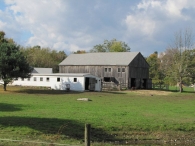
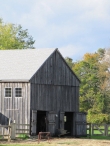
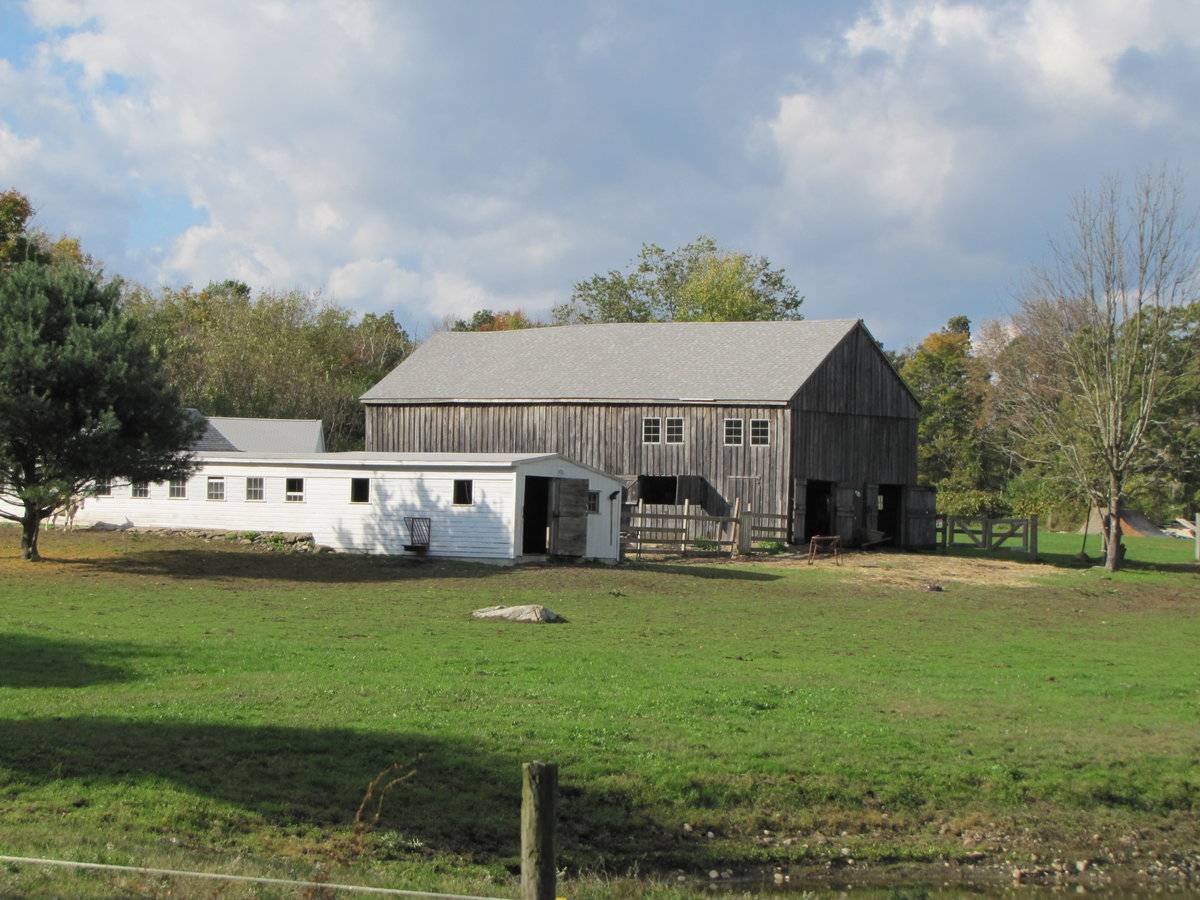
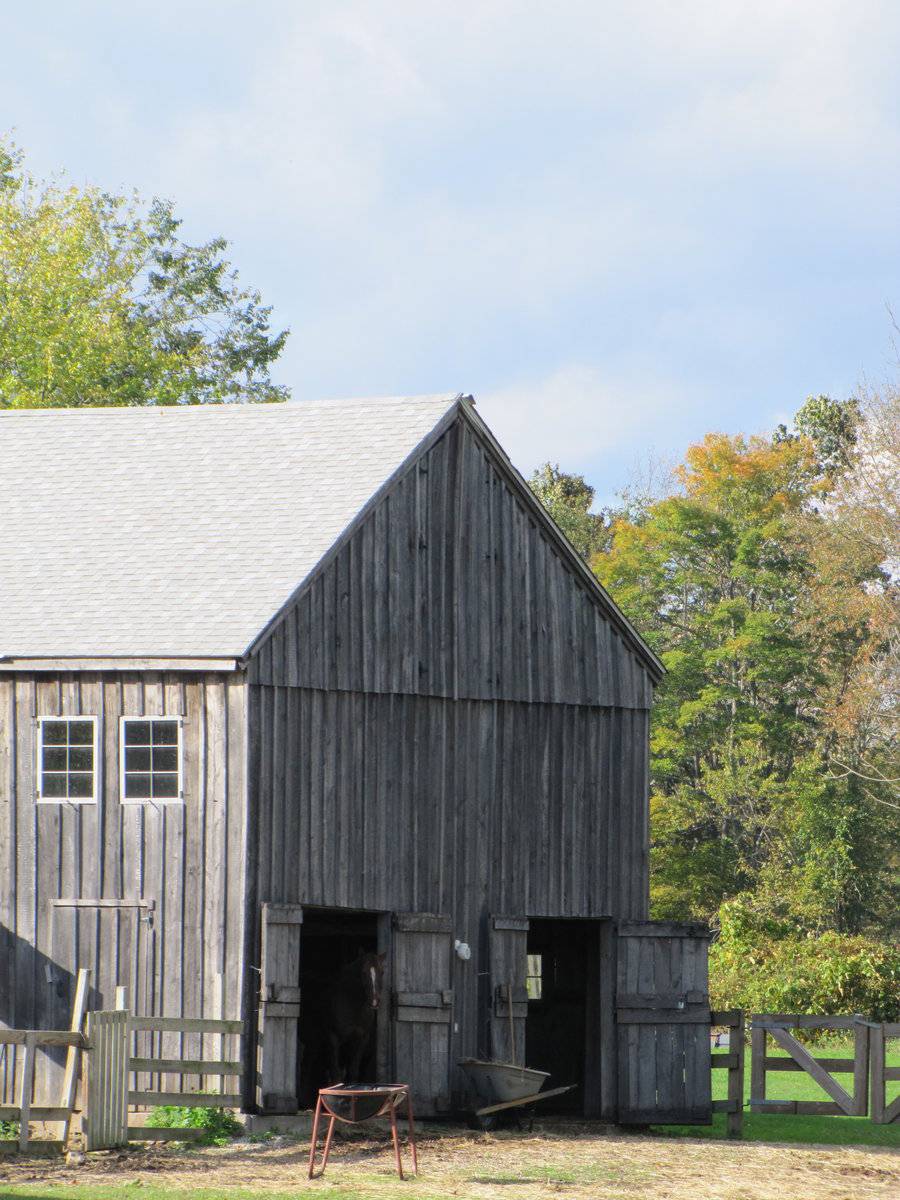
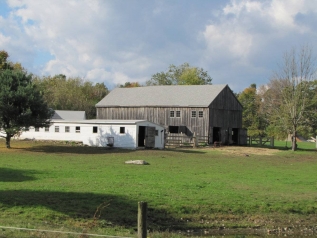
Barn I is a 2 ½-story gable-entry barn with a gable roof. The main façade faces east, and the ridge-line runs east-west. The principal entry is through two pairs of hinged stable doors, one at the south half and the other at the north half of the main façade. These doors are constructed of vertical wood boards with horizontal bracing. The remainder of the main façade is blank. Extending southward from the southeast corner of the barn is a post and board fence that connects with the northeast corner of Structure II. On the eastern corner of the south eave-side of the barn is a hinged pass-through door constructed of boards and battens. Above this door is a pair of six-pane stable windows with trim in the second level. Directly to the west of the pass-through door is a rectangular shaped window opening with hinged shutters constructed of vertical boards reinforced with diagonal bracing. Above the large window opening is a pair of six-pane stable windows with trim in the second level. Further west in the center of the south eave-side of the barn appears to be another pass-through door followed by what appears to be a rectangular-shaped window opening to its west. The exterior walls of the barn are covered with unpainted board-and-batten siding. The roof is covered with asphalt shingles. The foundation appears to be a concrete slab.
Barn II lies just to the south of Barn I. This is a 1 ½-story gable-entry chicken coop with a rectangular plan and a low-pitched gable-roof, the north pitch running longer than the south pitch. The main façade faces east. Principal entry is through a hinged pass-through door located at the southern corner of the main façade. This door appears to be constructed of horizontal wood boards. To its north is a six-pane stable window. On the south eave-side of the barn, from east to west, are two window openings followed by twelve six-pane stable windows. The walls appear to be covered with clapboard siding on the south eave-side and vertical siding on the main façade, both painted white. The roof appears to be covered with asphalt shingles. The foundation appears to be a concrete slab on the eastern half of the structure, and mortared fieldstone on the western half.
Historical significance:The New England barn or gable front barn was the successor to the English barn and relies on a gable entry rather than an entry under the eaves. The gable front offers many practical advantages. Roofs drain off the side, rather than flooding the dooryard. With the main drive floor running parallel to the ridge, the size of the barn could be increased to accommodate larger herds by adding additional bays to the rear gable end. Although it was seen by many as an improvement over the earlier side-entry English Barn, the New England barn did not replace its predecessor but rather coexisted with it, as both types continued to be built.
Poultry farming grew in popularity during the second half of the 19th century, and by the early 20th century most farms had small chicken coops. These lightly-built structures often feature a gabled or shed roof and large windows on the south side. Often chicken coops have a small stove and chimney for heat to protect young chicks during cold weather. Small openings near the ground provide the fowl with access to the yard. Inside are nesting boxes for the laying hens. During the 1930s and 1940s, poultry farming was adopted by many
farmers in New England as a replacement for dairy farming.Field Notes
North side of Cemetery Road west of Hanover Road.
- Use & Accessibility
Use (Historic)
Use (Present)
Exterior Visible from Public Road?
Yes
Demolished
n/a
Location Integrity
Unknown
- Environment
Related features
Environment features
Relationship to surroundings
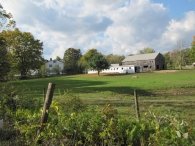
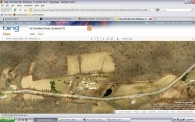
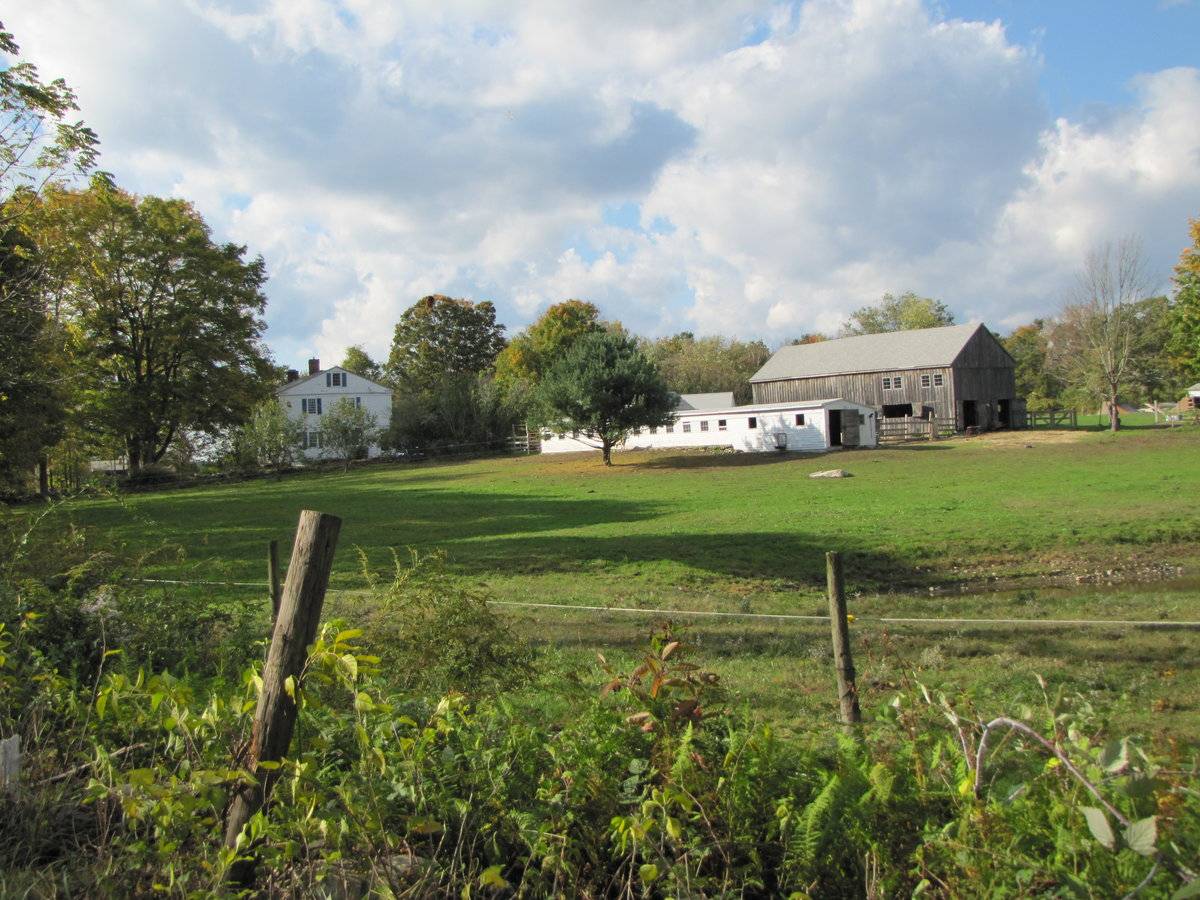
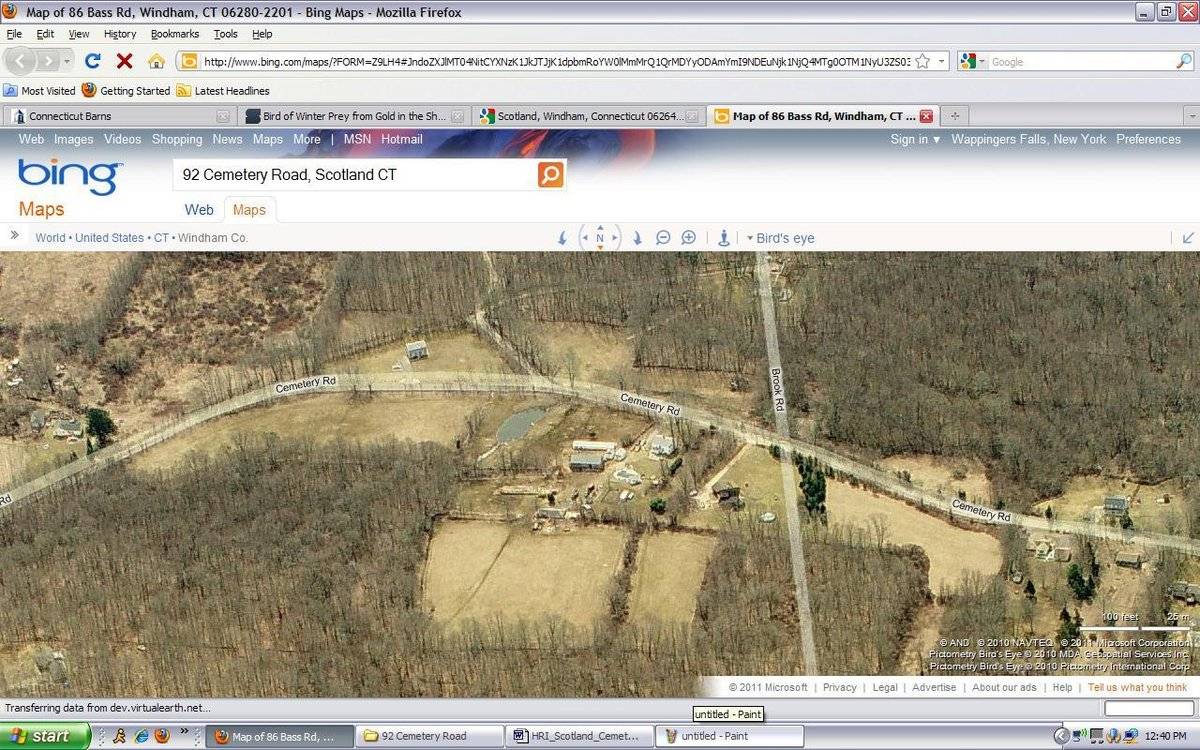
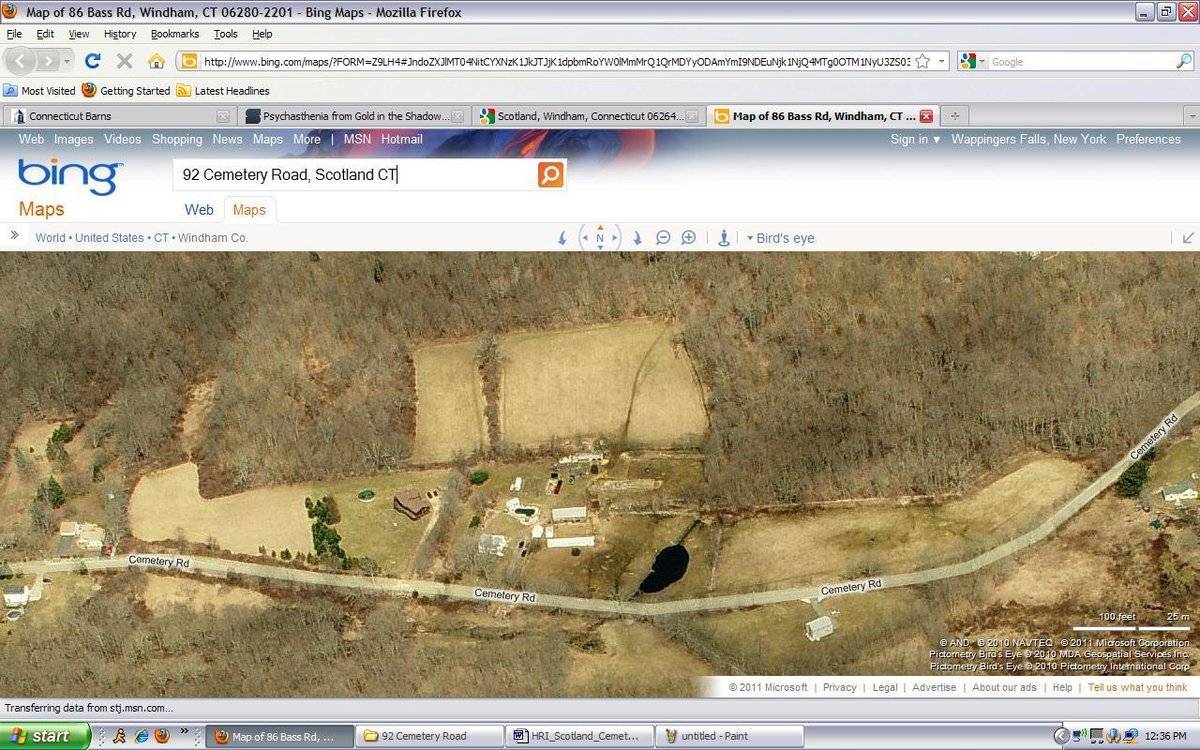
This property is located to the south of the Town of Scotland, in a rural residential area. The barns are located on a 21.78-acre parcel on the north side of Cemetery Road that consists of a c. 1775 house with Georgian design details, an in-ground pool, and what appears to be two sheds or outbuildings. The property is surrounded by dense forest to the north, east, and west.
The c. 1775 house and in-ground pool lie to the west of the barns and a paved drive that begins at Cemetery Road and heads north. This is a 2 ½-story, eave-entry house with five bays, a rectangular plan and a gable-roof. Its ridge-line runs east-west, parallel to Cemetery Road. The main façade originally faced south, where the principal entrance was a wood-paneled pass-through door located in the center bay. Above the door is a transom with twelve panes. Flanking the main entry on both sides are two, twelve-over-twelve double-hung windows with shutters and trim. Above the first story is a horizontal stringcourse. On the second story of the main façade are five identical twelve-over-twelve double-hung windows with shutters and trim. On the first story of the east gable-end of the house is a twelve-over-twelve double-hung window with trim and shudders followed by a projecting bay window at the northern corner. The second story of the east gable-end features two identical twelve-over-twelve double-hung windows with trim and shudders. Beneath the apex of the roof on the east gable-end is a twelve-pane window with trim and shudders. On the center of the north eave-side of the house is a single-story addition that appears to function as the current entrance. The house is covered in clapboard siding painted white. The roof appears to be covered with asphalt shingles. There are two brick chimneys with decorative corbelling, one in the center of the roof at the ridgeline, the other at the west gable-end. The foundation appears to be stone.
To the east of the main house and driveway, just to the north of Structure II, appears to be two gable-entry sheds, their ridge-lines running north-south.
To the north of the grouping of agricultural buildings is a large open field followed by a dense expanse of woods that contains a visible wetland at the northern corner of the property. To the east of the barns, is an open field with a large pond, followed by a large rectangular-shaped open field that extends to the east.- Typology & Materials
-
Building Typology
Materials
Structural System
Roof materials
Roof type
Approximate Dimensions
Barn I: 62 x 29 feet; Barn II: 83 x 15 feet
- Source
-
Date Compiled
03/21/2011
Compiled By
E. Reisman & T. Levine; reviewed by CT Trust
Sources
Field notes and photographs by Joan Tomaszewski, 10/17/2010.
Town of Scotland’s GIS Viewer:
http://www.wincog-gis.org/ags_map/default.asp?town=Scotland
(Parcel ID # 26/21/10+11: 21.78 acres: c. 1775 house)
Aerial Mapping:
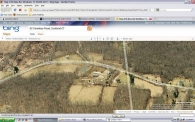
http://www.bing.com/maps accessed 03/21/2011.Sexton, James, PhD, Survey Narrative of the Connecticut Barn, Connecticut Trust for Historic Preservation, Hamden, CT, 2005, http://www.connecticutbarns.org/history.
Visser, Thomas D., Field Guide to New England Barns and Farm Buildings, University Press of New England, 1997.
- PhotosClick on image to view full file
-