Barn Record Stonington
RETURN TO ‘FIND BARNS’- Building Name (Common)
- Stone Acres Farm Carriage barn I (Part 2 of 4)
- Building Name (Historic)
- Phelps, Dr. Chares & Charles H., Farmstead
- Address
- 389 North Main Street, Stonington
- Typology
- Overview
-
Designations
Historic Significance
Architectural description:
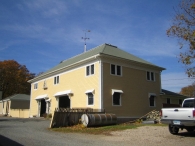
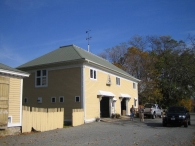
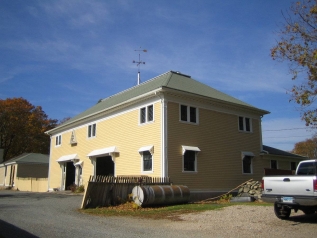
This is a 2 ½-story eave-entry carriage barn with a hipped roof. It is located on the property of a large estate along the east side of North Main Street, just north of Route US-1. The primary façade of the carriage house is the south eave-side. It is oriented perpendicular to Main Street. A 1-story hipped-roof addition projects north from the eastern half of the north eave-side.
The primary façade of this carriage house is the south eave-side. The main entries on this side consist of two single-car-width entries, each with a pair of internal sliding doors, located asymmetrically on the façade. Each of these entries are capped by a hipped roof overhang, supported by decorative end-brackets. A wooden pass-through door is located between these two car-width doors, immediately alongside the western door. This has a decorative shed-roof overhang above, also with corner end brackets. A two-over-two double-hung window is located near the southeast corner, also with a decorative shed-roof overhang above. The second-story façade contain three evenly-spaced pairs of vertical windows, each with leaded glass within. A large triangular decorative piece is mounted to the exterior of the second-story, above the western car-door on the first-story.
The east gable-end contains symmetrically-mounted windows on both levels. The first-story contains two two-over-two double-hung windows, each with a decorative shed-roof overhang above. The second-story contains two pairs of vertical windows, each with leaded glass within. The eastern half of the north gable-end contains the projecting hipped-roof addition. The east eave-side of this addition is flush with the east gable-end of the main structure. Two evenly-spaced window openings are located on this side of the addition. The north gable-end of the addition also contains two symmetrically-mounted window openings, located near the center of this wall. The west eave-side of the addition contains two evenly-spaced window openings.
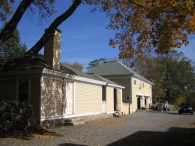
The remainder of the north eave-side of the main structure includes a small first-story projection, roughly centered, which appears to contain two window openings. The second story appears to includes nearly-centered paired window opening, a small square window to the west, and a larger window opening near the northwest corner. The west gable-end contains five small window openings on the first-story, unevenly spaced. The second opening from the north has been blanked out and a ventilation fan pipe installed in its place. The second-story contains a single vertical pair of split windows, off-center, just beneath the eave.
The exterior walls of this carriage house are clad in horizontal wooden clapboard siding, painted yellow. Decorative cornerposts add an architectural element to this structure, and are painted white, along with all window frames and door trim. The roof is a hipped design, with a flat ridgeline. It is covered with gray asphalt shingles. A small chimney protrudes from the north roofline, slightly off-center to the west, and other smaller ventilation pipes protrude from the flat ridgeline of the roof. An iron weathervane is also mounted atop the roof, roughly centered.
Historical significance:Until the 1830s, the horses used for riding and driving carriages were often kept in the main barn along with the other farm animals. By the 1850s, some New England farmers built separate horse stables and carriage houses. Early carriage houses were built just to shelter a carriage and perhaps a sleigh, but no horses. The pre-cursor to the twentieth-century garage, these outbuildings are distinguished by their large hinged doors, few windows, and proximity to the dooryard.
The combined horse stable and carriage house continued to be a common farm building through the second half of the nineteenth century and the first decade of the twentieth century, until automobiles became common. Elaborate carriage houses were also associated with gentlemen farms and country estates of the late 19th and early 20th centuries.
Field Notes
Listed on the State Register of Historic Places, June 2013.
- Use & Accessibility
Use (Historic)
Use (Present)
Exterior Visible from Public Road?
Yes
Demolished
n/a
Location Integrity
Unknown
- Environment
Related features
Environment features
Relationship to surroundings
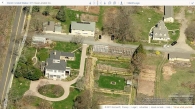
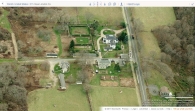
This carriage house is located on the property of a very large historic estate, among many outbuildings. The main house is located to the south and slightly west of the carriage house, and faces south. A rear wing and attached ell complete the house structure. A series of outbuildings line a straight driveway which connects to Main Street north of the house, and goes to the east. The carriage house fronts this driveway, as do at least two sheds, two greenhouses, a wagon-shed, and a smaller dwelling. A formal garden is located to the immediate east of the house, south of one of the greenhouses fronting the driveway. To the immediate north of the carriage house are several plots of fenced off land, possibly small gardens. Several large trees line a stone wall to the east of the barn, which runs north to south and divides the barn from the neighboring smaller dwelling. Beyond the small plots to the north are two large agricultural fields. Additional agricultural fields lie to the south and southwest of the main house. Surrounding land appears to be primarily woodland and swampy, given this property’s location not too far from Quannaduck Cove, which leads to Long Island Sound.
63.90 acres, ID 81-1-2
- Typology & Materials
-
Building Typology
Materials
Structural System
n/a
Roof materials
Roof type
Approximate Dimensions
n/a
- Source
-
Date Compiled
06/26/2011
Compiled By
N. Nietering & T. Levine, reviewed by CT Trust
Sources
Photographs by Lynn Friedman.
Sexton, James, PhD; Survey Narrative of the Connecticut Barn, Connecticut Trust for Historic Preservation, Hamden, CT, 2005, http://www.connecticutbarns.org/history.
Visser, Thomas D., Field Guide to New England Barns and Farm Buildings,
University Press of New England, 1997, 213 pages.Map of Stonington, CT, retrieved on June 26, 2011 from website www.bing.com.
Stonington Assessor’s Records - Southeastern Connecticut Council of Governments online - http://host.appgeo.com/sccog/Map.aspx
- PhotosClick on image to view full file
-