Barn Record Southington
RETURN TO ‘FIND BARNS’- Building Name (Common)
- Frank N. Wells House and Barn
- Building Name (Historic)
- Frank N. Wells House and Barn
- Address
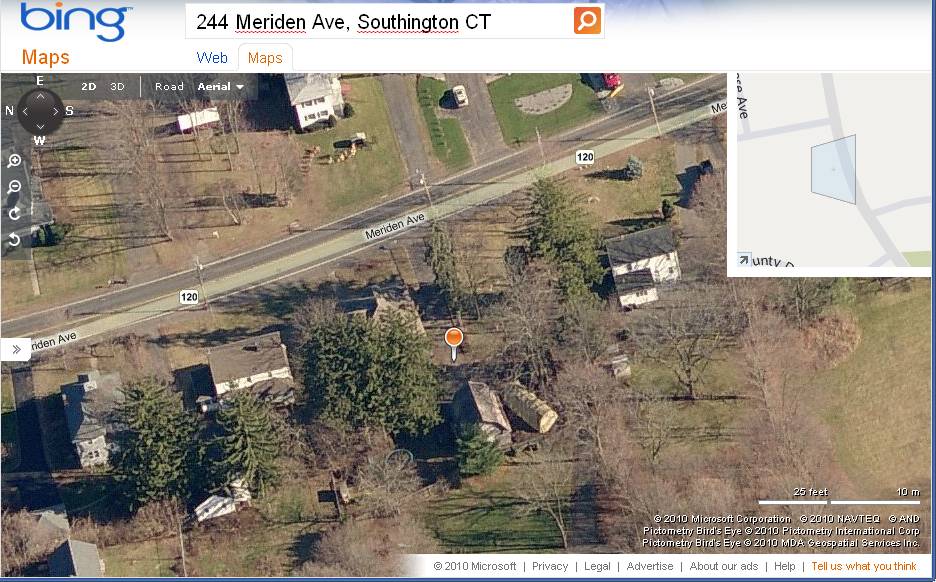
- 244 Meriden Avenue (Rte 120), Southington
- Typology

- Overview
-
Designations
Historic Significance
Architectural description:
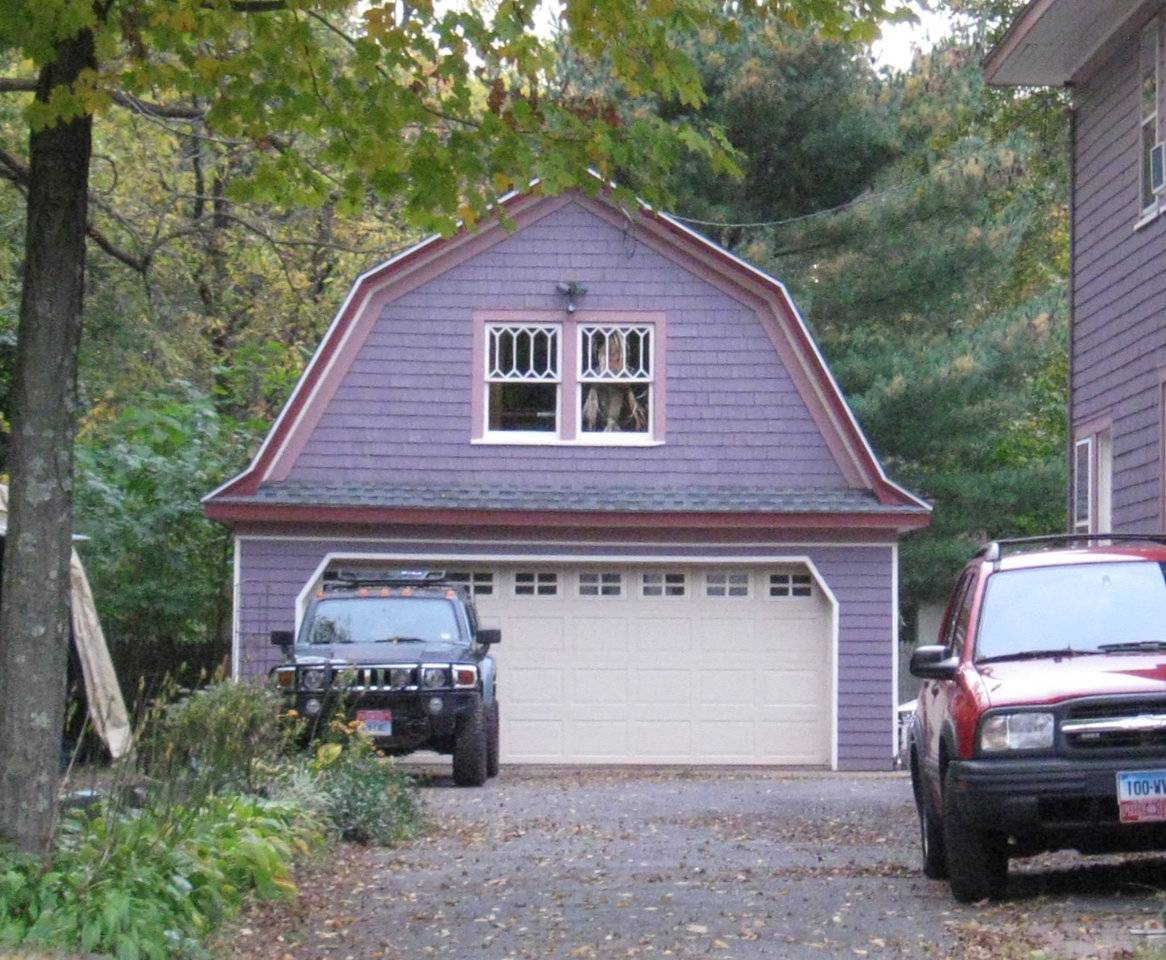
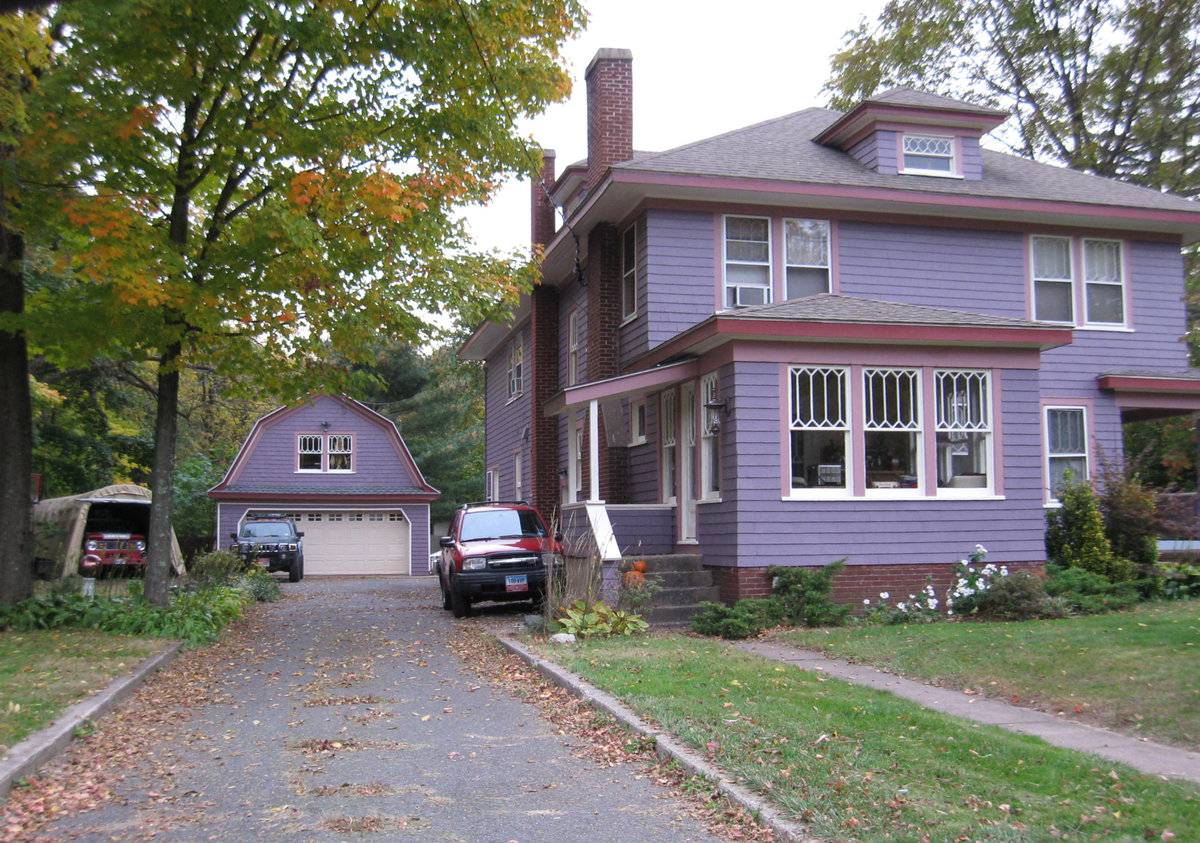
This is a 2-story Dutch gambrel-roofed structure with its ridge-line oriented east-west perpendicular to the street. The gable-end facing east toward the house and street, has at grade a wide modern door opening with chamfered top corners and a full-width overhead garage door. Above it, the Dutch gambrel’s flared eaves return across the façade, creating a hood over the door. In the upper gable under the gambrel, two double-hung windows match those of the house’s enclosed front porch. Each window has a single-pane sash below an ornamental upper sash with lancet-arched muntins framing narrow lozenge- and triangular-shaped panes.
Siding is wood shingles matching the siding of the house and painted a lavender color with cream and plum trim. Roofing is asphalt shingles.
Historical significance:Until the 1830s, the horses used for riding and driving carriages were often kept in the main barn along with the other farm animals. By the 1850s, some New England farmers built separate horse stables and carriage houses. Early carriage houses were built just to shelter a carriage and perhaps a sleigh, but no horses. The pre-cursor to the twentieth-century garage, these outbuildings are distinguished by their large hinged doors, few windows, and proximity to the dooryard.
The combined horse stable and carriage house continued to be a common farm building through the second half of the nineteenth century and the first decade of the twentieth century, until automobiles became common. Elaborate carriage houses were also associated with gentlemen farms and country estates of the late 19th and early 20th centuries. Another form of carriage barn, the urban livery stable, served the needs of tradespeople.
Historical background:Originally part of the town of Farmington, Southington’s first settlement occurred in 1598. While most of the early settlers farmed the land, the soil was relatively poor. The earliest homes are documented in the “Colonial Houses of Southington Thematic Resource.” In 1779 Southington incorporated. The town continued to grow, thanks to increased travel and prosperity along the New Haven Path, although population remained moderate. Farming was the basis of the Southington economy throughout the 19th century, leaving its mark in the remaining barns scattered throughout the town. As the soil became exhausted, farming diminished, with the exception of orchards in the hills in the east side of the town, and industry began to increase.
Waterpower provided by the Quinnipiac River, gave the town the means to process its agricultural goods. Gristmills and sawmills provided milling needs for the town. By the end of the 18th century, the mills were producing other products, such as buttons, combs, paper, and a variety of metal objects. The industrial transformation of Southington brought an increase in the population between 1850 and 1880. The prosperity brought on by new enterprises is reflected in Italianate and Queen Anne-style houses, many of which were built by the founders and officers of the manufacturing companies. Carriage barns associated with a number of these remain extant, often converted to use as garages.
The coming of the 20th century did not dampen Southington’s prosperity. The industrial demands of the two World Wars increased the population. Many of the old homes and barns are closely hemmed in by 20th-century development as the large acreages were sold off for residential building.
Field Notes
Contributing resource in the Meriden Avenue-Oakland Road Historic District. Excerpt from Historic District Nomination: Two styles predominated in the twentieth century: the American Four Square and the Bungaloid. Many unaltered examples of the American Four Square can be found on both streets in the district. All can be identified by the essential cube form, hip roof, and truncated gabled dormers associated with this Colonial Revival style. Examples range in size from the smaller stylized version at 244 Meriden Avenue on the south end of the district to the more massive buildings such as 98 Meriden Avenue and 40 Oakland Road. The first example has an unusual enclosed front porch apparently original construction, as it has the same fenestration as the main block and the contemporary barn/garage one-over-one sash with lancet-arched muntins in the upper sash. (Cunningham, Sec. 7, p. 2)
- Use & Accessibility
Use (Historic)
Use (Present)
Exterior Visible from Public Road?
Yes
Demolished
n/a
Location Integrity
Unknown
- Environment
Related features
Environment features
Relationship to surroundings
The Meriden Avenue/Oakland Road Historic District is a historic residential community located just to the south of Southington’s central business district. Meriden Avenue (Route 120), a busy thoroughfare, runs almost due north and south from Route 10 to Route 66, with the historic properties concentrated in the northern end.
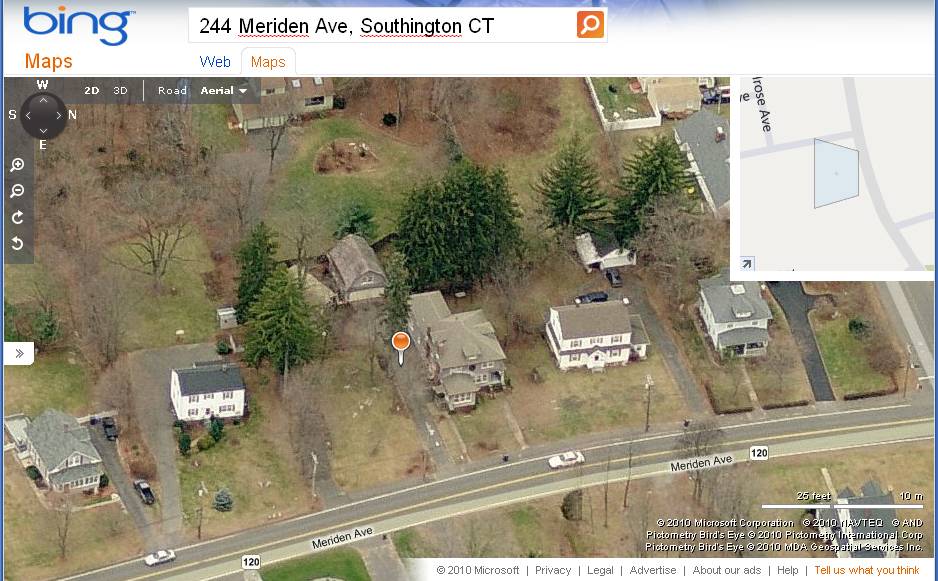
The historic properties date from 1860 to 1936 with most of the nineteenth-century houses located on Meriden Avenue. All of the historic houses are wood frame construction with a variety of foundations: brick, stone, and rusticated concrete block. Except for the east side of Meriden Avenue, where the buildings are larger and set well back from the street, the houses are generally modest in scale with a uniform setback. Mature trees and sidewalks throughout the district add to its historic residential character. The majority of properties contain outbuildings, barns, garages, and sheds, many of which are contemporary with the houses. An unusual number have retained their barns, a common nineteenth-century component in urban residential areas but rarely found today. The older barns or stables have been converted to garages. (Cunningham, p. 3)This half-acre property is located on the west side of Meriden Avenue and is one of the later buildings in the district, dating from 1908, when the carriage house was giving way to the garage as an accessory building. The house, a hip-roofed Four-square style with some Neo-classical detailing, faces the street across a lawn. The barn is set back behind the house at the end of a driveway, and gives the ensemble a slightly rustic Shingle-style character.
- Typology & Materials
-
Building Typology
Materials
Structural System
Roof materials
Roof type
Approximate Dimensions
24 feet x 30 feet
- Source
-
Date Compiled
11/09/2010
Compiled By
Charlotte Hitchcock, reviewed by CT Trust
Sources
Field notes and photographs by Charlotte Hitchcock date 10/21/2010.
Town of Southington Assessor’s Record & GIs Viewer http://www.southingtongis.com/ags_map/default.htm?MBL=088080
PARCEL ID: 076091
24 x 30 feet, .55 acre, date 1908Aerial Mapping:
http://maps.google.com
http://www.bing.com/maps accessed 11/09/2010.Andrews, Gregory, Sherrow, Doris, Colonial Houses of Southington Thematic Resource National Register Nomination, National Park Service, 1987.
Cunningham, Jan, Meriden Avenue-Oakland Road National Register District Nomination No. 88000580, National Park Service, 1988.
Ransom, David, Johnson, Lisa Fern, Southington Center National Register District Nomination No. 88002961, National Park Service, 1988.
Sexton, James, PhD, Survey Narrative of the Connecticut Barn, Connecticut Trust for Historic Preservation, Hamden, CT, 2005, http://www.connecticutbarns.org/history.
Visser, Thomas D., Field Guide to New England Barns and Farm Buildings, University Press of New England, 1997. - PhotosClick on image to view full file
-