Barn Record Cornwall
RETURN TO ‘FIND BARNS’- Building Name (Common)
- Gunn Brook Farm
- Building Name (Historic)
- n/a
- Address
- 226 Kent Road (Rte 7), Cornwall
- Typology
- Overview
-
Designations
n/a
Historic Significance
Architectural description:
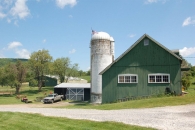
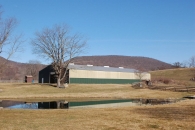
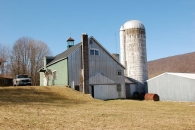
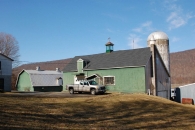
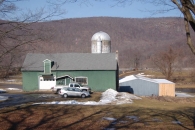
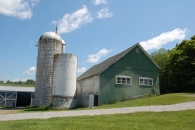
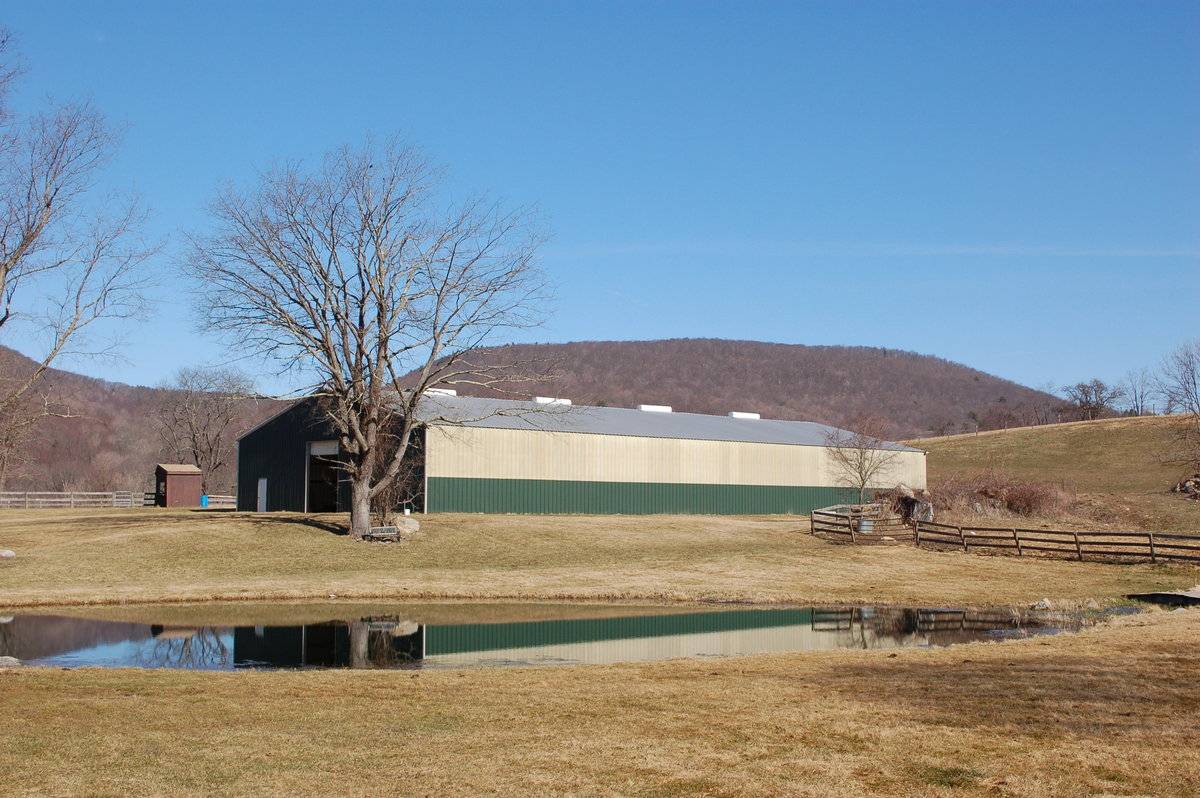
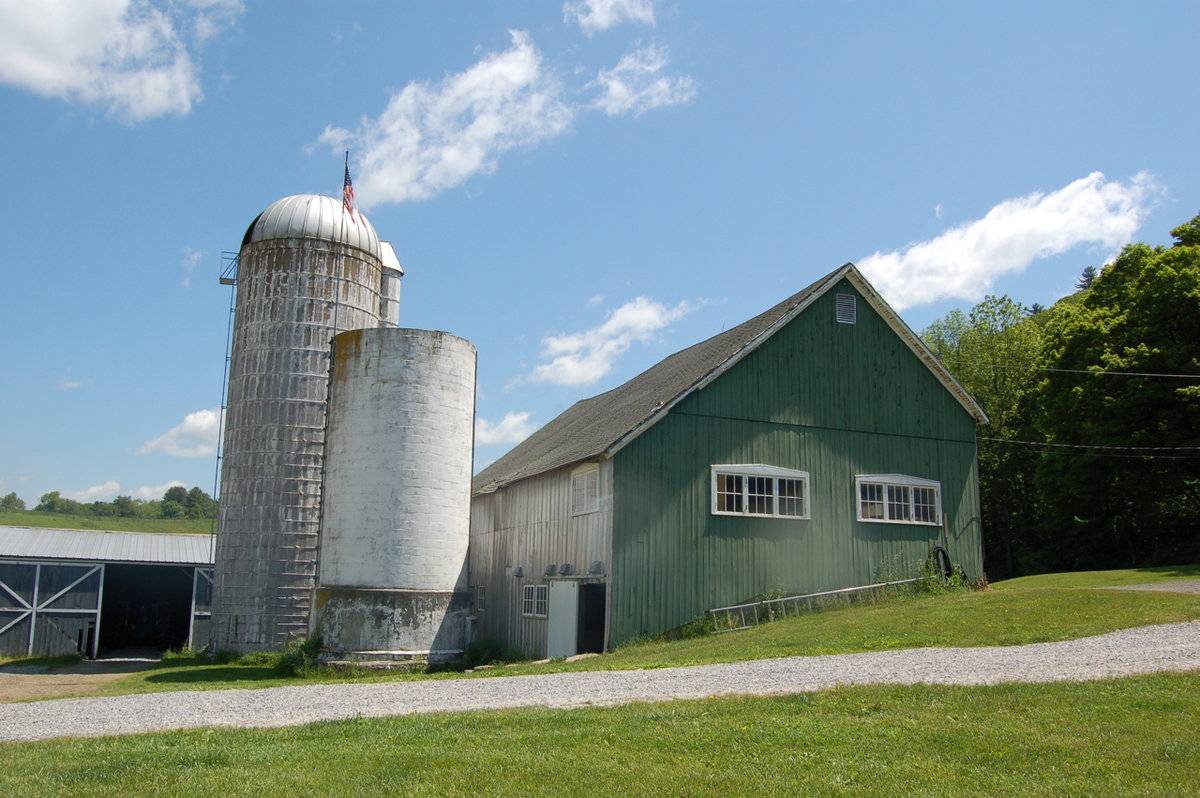
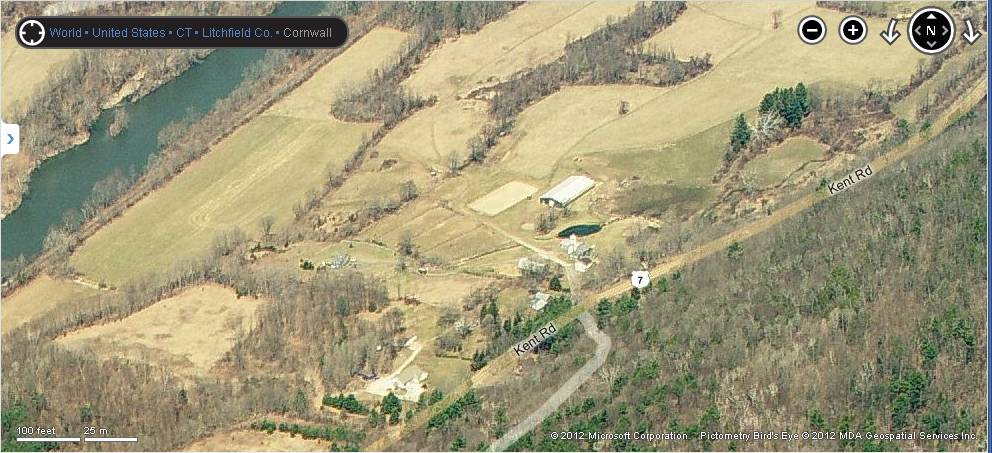
Three large green barns constitute the agricultural buildings on this site. Barn I is a 1 ½-story eave-entry bank barn with an off-set gable-roof. Barn II is a 1 ½-story gable-entry bank barn with a gambrel roof. Barn III is a 1-story gable-roof wagon shed with a rear addition. A fourth barn of modern pole construction is also present on this site, but is not documented in detail in this Inventory. This collection of barns is located on the northwest side of Kent Road (US-7), between the road and the Housatonic River.
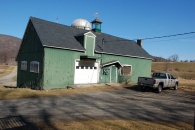
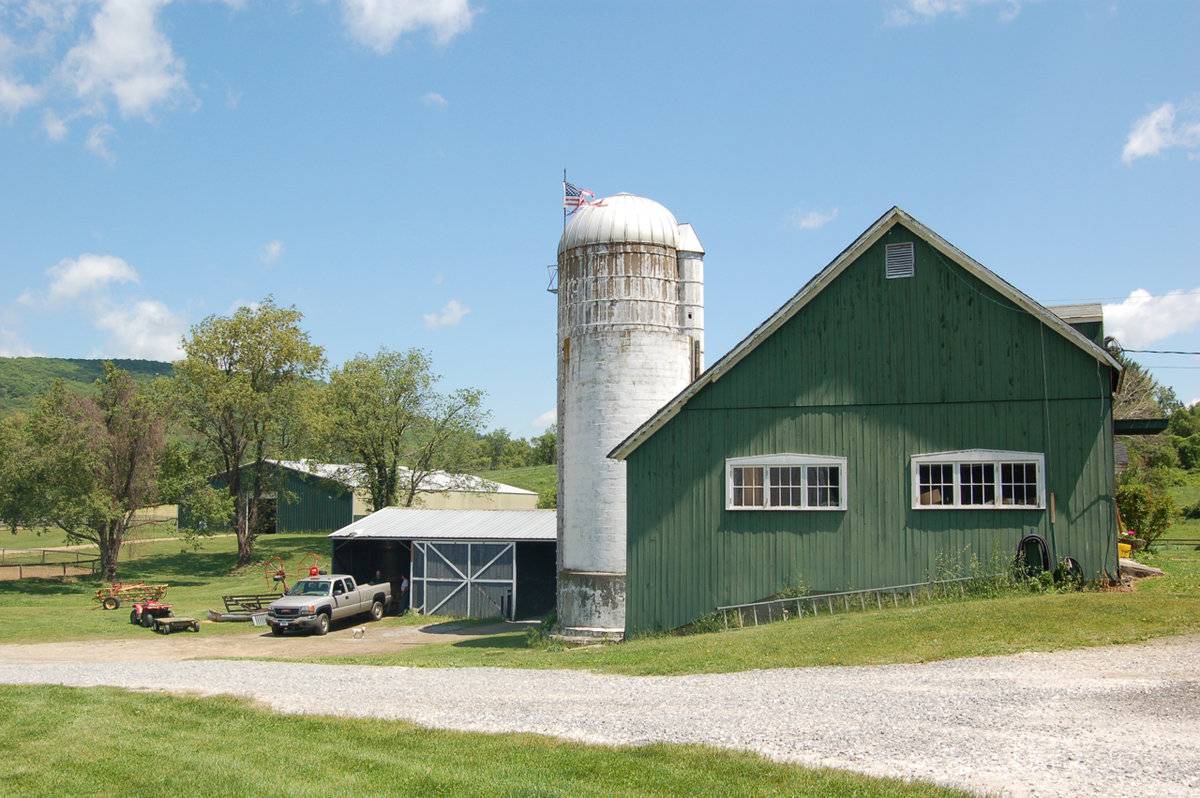
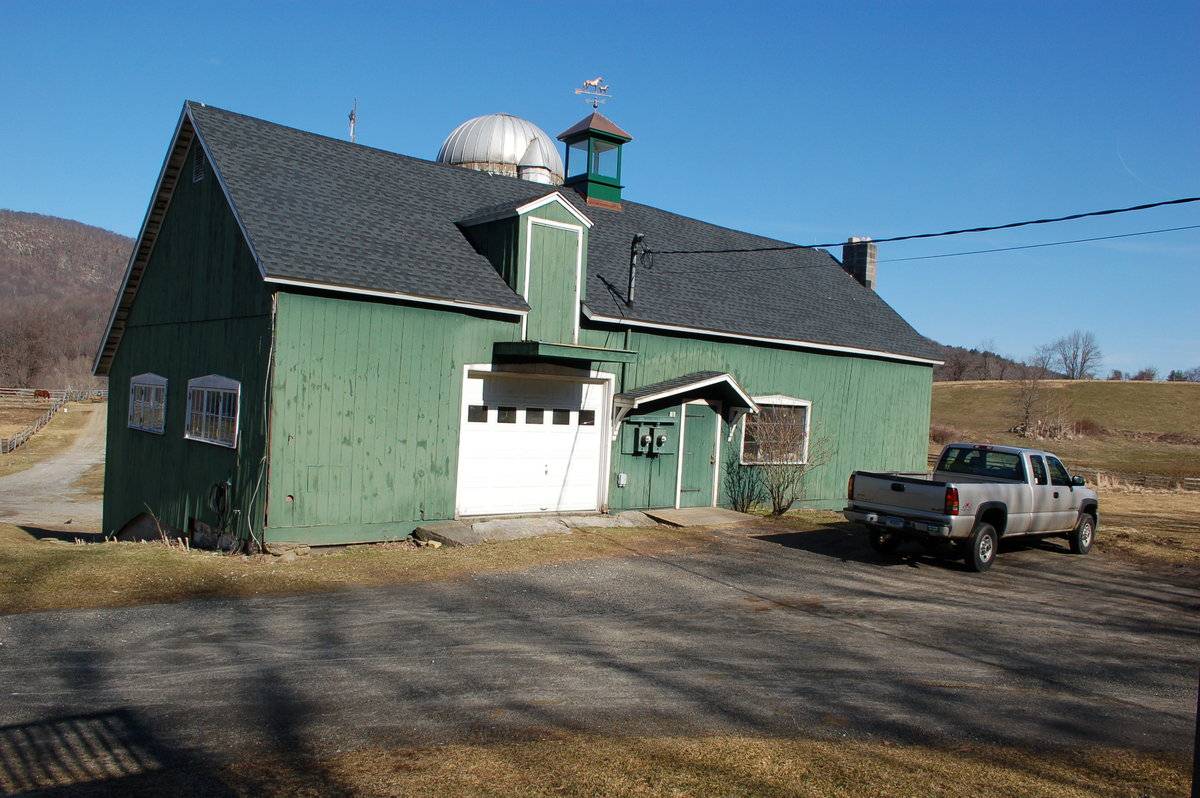
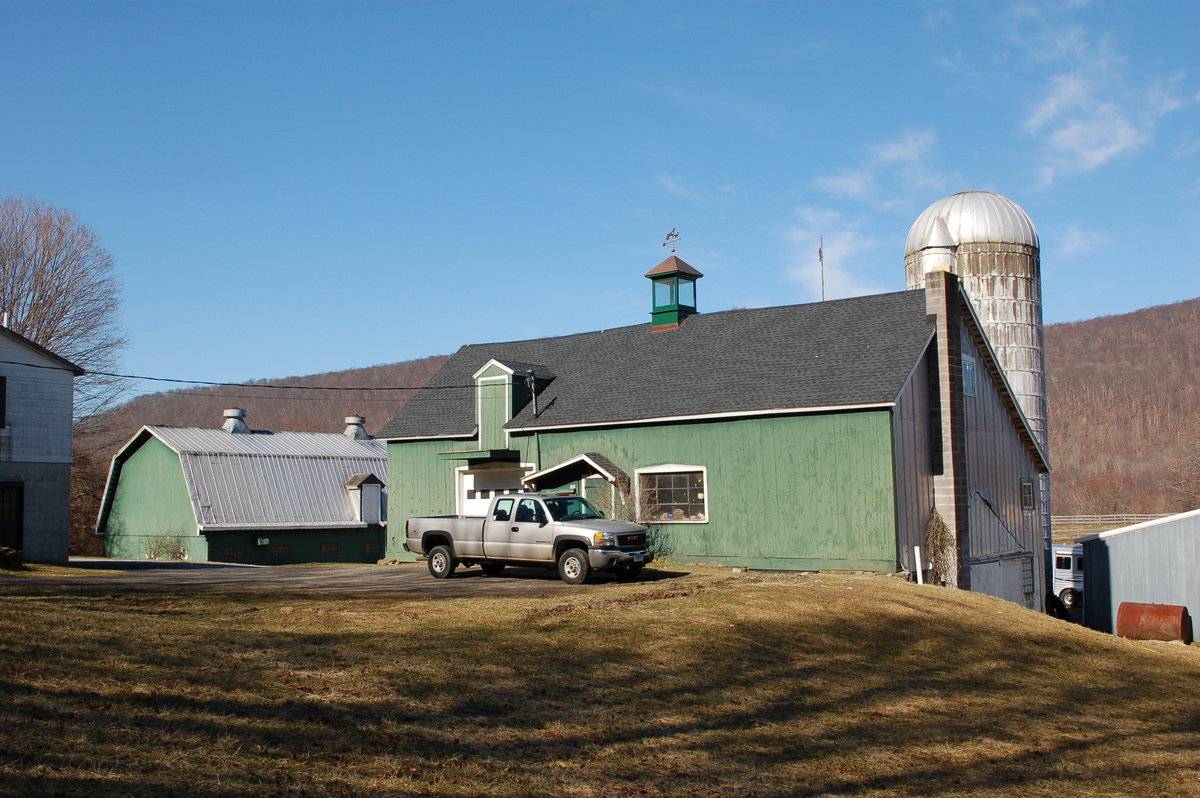
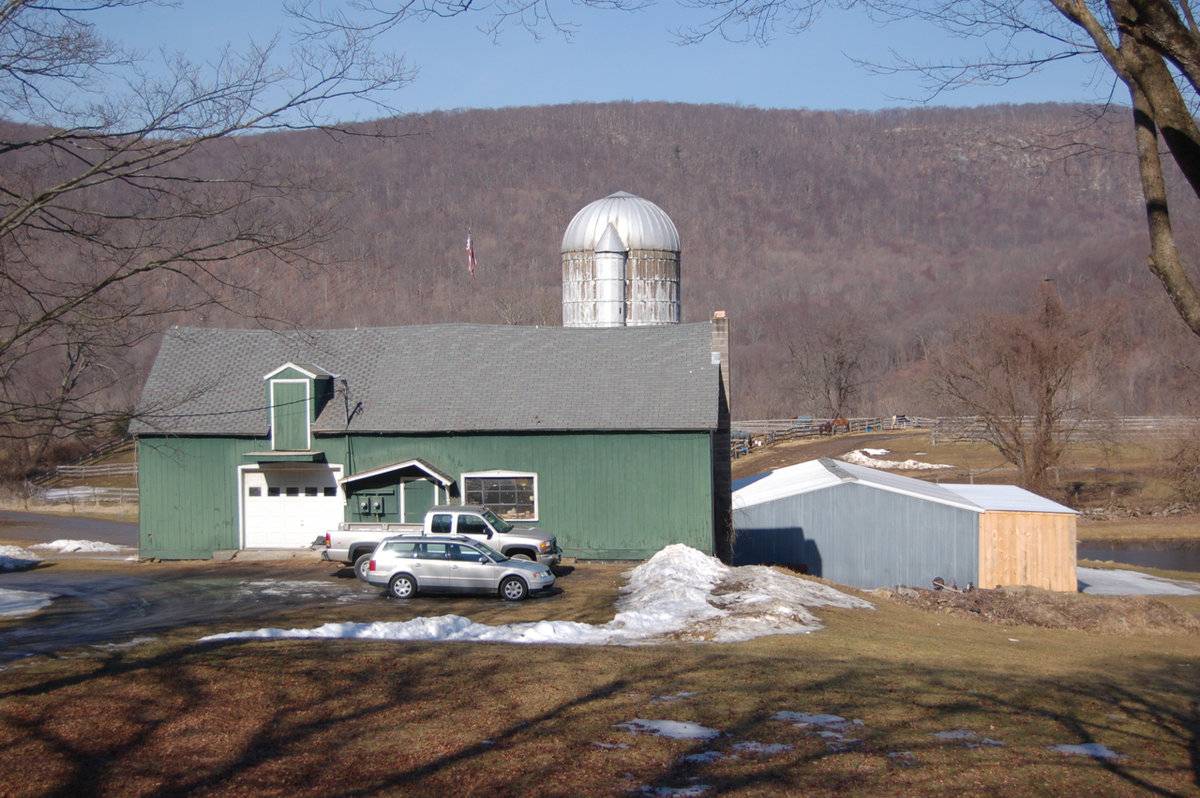
Barn I is a 1 ½-story eave-entry bank barn with an offset gable-roof. It is roughly parallel to Kent Road. The primary façade of this barn is the southeast eave-side. The main entry on this side is an over-head panel garage door located in the west half of this side. This door is accessed by a small concrete ramp. A hinged wooden plank pass-through door is centered on this façade. It is beneath a small off-set projecting gable roof, which also covers two electrical meters, located between the two doors. A rectangular twelve-pane window with trim is located to the immediate east of the pass-through door. A small porch projects out over the over-head garage door. Centered above it is a gable wall dormer, containing a wood pass-through door. This door provides access to the attic. The remainder of this side is blank.
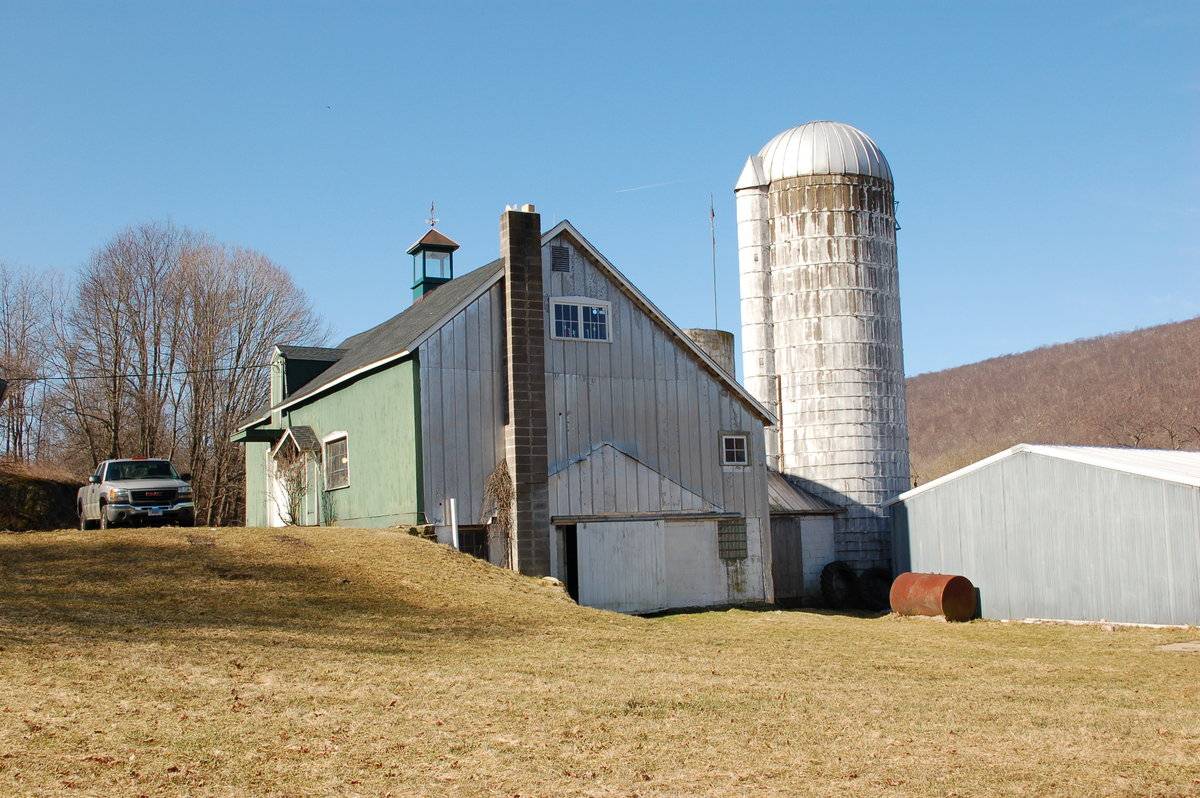
The grade slopes down from south to north toward the Housatonic River throughout this property. This is evident on the southwest gable-end, which partially reveals the basement level below. Two pairs of triple six-pane windows with trim are symmetrically placed on the first story on this end. A rectangular louvered vent is located just beneath the roof ridgeline in the gable-attic. The northwest eave-side exposes the full basement level. An over-size sliding door is located near the west corner on this side. Beside this door, to the east, is a pair of six-pane windows, with trim, followed by a single six-pane window near the center of this side. A small gable-roof L projects off this basement level at the north corner to the northwest, which connects to one of two grain silos located on this side of the barn. The first story contains a paired six-pane window near the west corner. The remainder of this side appears blank.
The northeast gable-end of this barn reveals the shadow of a 1-story gable-roof structure which used to adjoin it at the basement level. A six-pane window is located near the east corner. An external concrete-block chimney is located to the south of the roof ridgeline on this end. An over-width sliding wooden door is located to the north of the chimney at the basement level. A rectangular window opening containing fifteen glass window blocks is located near the north corner. The first level contains a single square four-pane window opening above the glass-block window below. A paired six-pane window with trim is located off-center to the north in the gable-attic. A louvered vent is centered above this window, beneath the roof ridgeline.
The exterior walls of this barn are clad in vertical wooden flush-board siding, except the northeast gable-end, which is clad in vertical metal siding. The roof is covered in black asphalt shingles. A new cupola has been constructed at the center of the roof ridgeline of Barn I. It is topped by a pyramidal roof and contains four large square windows, one on each side. A decorative metal weathervane is located at the apex of this roof. Two silos are located near this barn. One, as previously mentioned, is connected to the barn by way of a small gable-roof L. It is topped by a metal dome. The other is located to the immediate southwest of this silo, is of concrete construction, and has no roof.
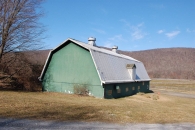
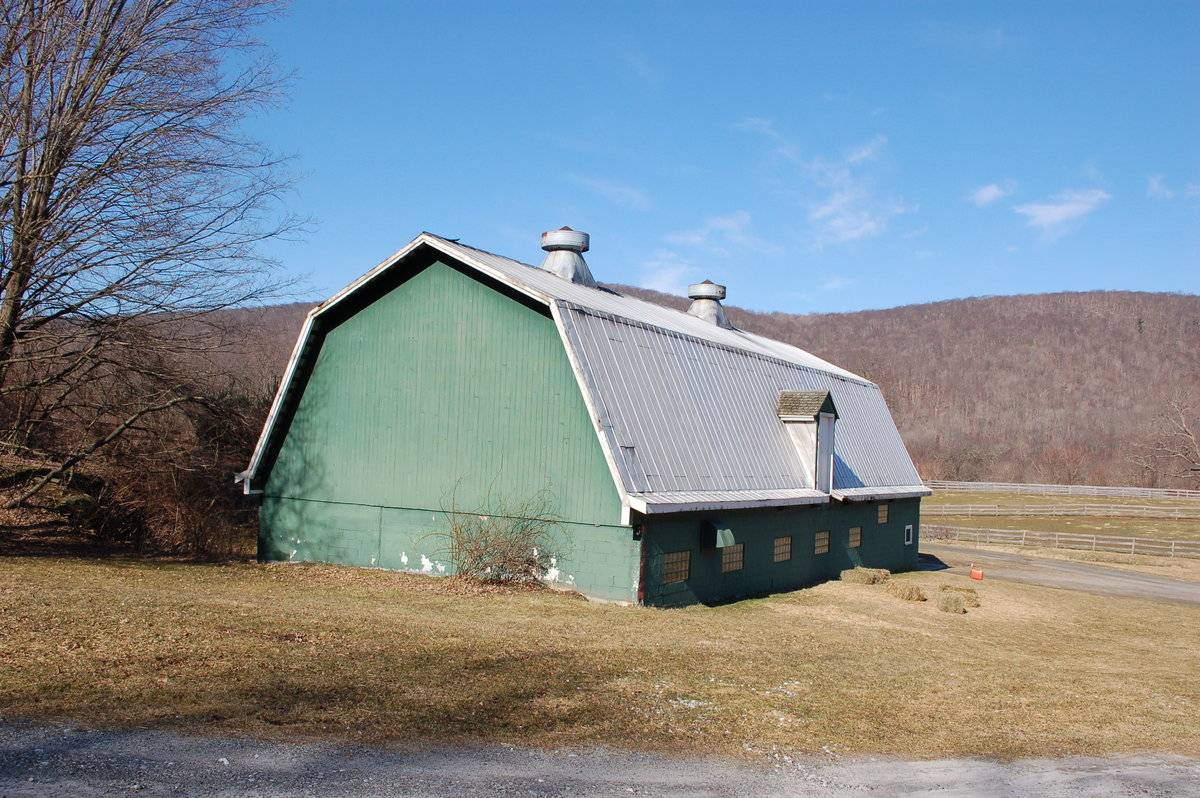
Barn II is a 1 ½-story gable-entry bank barn with a gambrel roof. This barn is situated perpendicular to Kent Road. The primary façade of this barn is the northwest gable-end. The main entry appears to consist of a pair of over-size sliding doors, centered on this façade. No other openings are apparent. The northwest eave-side of this barn is seven bays in length. First-story rectangular window openings filled with glass block are located in the first five bays from the east corner northward on this side. The sixth bay contains a similarly-sized glass-block window, but this one is located immediately beneath the eave. A small square window opening is located in the seventh bay, nearest the north corner. A large blower vent hood projects from the side of this barn between the first and second window openings, near the east corner. Centered on this eave-side is a gable wall dormer, which contains a pass-through door. This is used to access the attic. The southeast gable-end is blank. The southwest eave-side is not visible for the purposes of an Historic Resource Inventory.
The entire first story of this barn is constructed of concrete cinder-blocks. The gable-attic is clad in vertical wooden flush-board siding. The roof is covered in rolled metal panels. Two large circular steel ventilators are evenly-spaced along the roof ridgeline.
Barn III is a four-bay 1-story gable-roof wagon shed with a rear addition. The primary façade of this barn is the southwest eave-side. It is perpendicular to Kent Road and parallel to Barn II. The main entries on this side consist of four oversize sliding doors, each with decorative bracing, stretching the length of this side. The farthest south bay is partially obstructed by the silo connected to Barn I. The southeast gable-end is blank. The northeast eave-side is joined to a full-length shed-roof addition of wood plank construction. The exposed northeast exterior side is not visible. The northwest gable-end of Barn III is not visible for the purposes of an Historic Resource Inventory.
The external walls of the Barn III and its addition are clad in vertical wooden flush-board siding. The roof is covered in modern metal sheathing. Barns I, II & III are arranged in a U-shape layout around a central driveway and parking area.
Historic Significance:
Barn I:
The oldest barns still found in the state are called the “English Barn,” “side-entry barn,” “eave entry,” or a 30 x 40. They are simple buildings with rectangular plan, pitched gable roof, and a door or doors located on one or both of the eave sides of the building based on the grain warehouses of the English colonists’ homeland. The name “30 by 40” originates from its size (in feet), which was large enough for 1 family and could service about 100 acres. The multi-purpose use of the English barn is reflected by the building’s construction in three distinct bays - one for each use. The middle bay was used for threshing, which is separating the seed from the stalk in wheat and oat by beating the stalks with a flail. The flanking bays would be for animals and hay storage.
The 19th century saw the introduction of a basement under the barn to allow for the easy collection and storage of a winter’s worth of manure from the animals sheltered within the building. The bank barn is characterized by the location of its main floor above grade, either through building into a hillside or by raising the building on a foundation.
This innovation, aided by the introduction of windows for light and ventilation, would eventually be joined by the introduction of space to shelter more animals under the main floor of the barn.
Barn II:
The New England barn or gable front barn is the successor to the English barn and relies on a gable entry rather than an entry under the eaves. The gable front offers many practical advantages. Roofs drain off the side, rather than flooding the dooryard. With the main drive floor running parallel to the ridge, the size of the barn could be increased to accommodate larger herds by adding additional bays to the rear gable end. Although it was seen by many as an improvement over the earlier side entry English Barn, the New England barn did not replace its predecessor but rather coexisted with it as both types continued to be constructed.
The gambrel roof enclosed a much greater volume than a gable roof did, and its shape could be formed with trusses that did not require cross beams, which would interfere with the movement and storage of hay. Also known as the curb roof, the double slopes of the gambrel offer more volume in the hayloft without increasing the height of the side walls.
Barn III:
Distinguished by the long shed or gable roof and the row of large openings along the eave side, the typical wagon shed was often built as a separate structure or as a wing connected to the farmhouse or the barn. These open-bay structures protect farm vehicles and equipment from the weather and provide shelter for doing small repairs and maintenance.
Field Notes
Multiple barns - English, Gambrel, prefab metal, working equestrian farm. http://www.gunnbrookfarm.com/index.html Across from the intersection with Whitcomb Hill Road.
- Use & Accessibility
Use (Historic)
Use (Present)
Exterior Visible from Public Road?
Yes
Demolished
n/a
Location Integrity
Unknown
- Environment
Related features
Environment features
Relationship to surroundings
The agricultural buildings at this site are set back from Kent Road and are partially hidden behind the associated farmhouse and a row of trees, making them difficult to be seen from the road. The property is located immediately across the street from where Whitcomb Hill Road intersects Kent Road in an acute T intersection from the south. Barns I, II & III are laid out in a U shape, with Barn I along the bottom. The associated farmhouse is located to the immediate south of Barn I. The three Barns together surround a small parking and staging area. This is accessed via a gravel driveway which passes along the west side of the house between the road and the parking lot. The driveway continues northwest from this area, reaching back toward the modern pole barn, which is located to the north of this complex. A separate driveway diverges to the west to the main entry of Barn II. The surrounding area to the west, north and northeast is primarily occupied by fields of active agriculture. Beyond these fields to the northwest is a single track railroad line owned by the Housatonic Railroad, which is located on the east bank of the Housatonic River. Lines of trees edge each field and the riverbank. To the southeast, across Kent Road, is Whitcomb Hill, which is heavily forested.
- Typology & Materials
-
Building Typology
Materials
Structural System
n/a
Roof materials
Roof type
Approximate Dimensions
n/a
- Source
-
Date Compiled
05/14/2011
Compiled By
N. Nietering & T. Levine, Reviewed by CT Trust
Sources
Field notes by Alec Frost, from “Cornwall Barns 2011” calendar published by The Cornwall Historical Society < cornwallhistoricalsociety.org >Photographs by Alec Frost.
Sexton, James, PhD; Survey Narrative of the Connecticut Barn, Connecticut Trust for Historic Preservation, Hamden, CT, 2005, http://www.connecticutbarns.org/history.
Visser, Thomas D.,Field Guide to New England Barns and Farm Buildings, University Press of New England, 1997, 213 pages.
Map of Cornwall, CT, retrieved on May 6, 2011 from website www.bing.com.
Cornwall Assessor’s Records - Town of Cornwall Assessor’s Office site visit - April 21, 2011.
- PhotosClick on image to view full file
-