Barn Record Brooklyn
RETURN TO ‘FIND BARNS’
- Overview
-
Designations
Historic Significance
Architectural description:
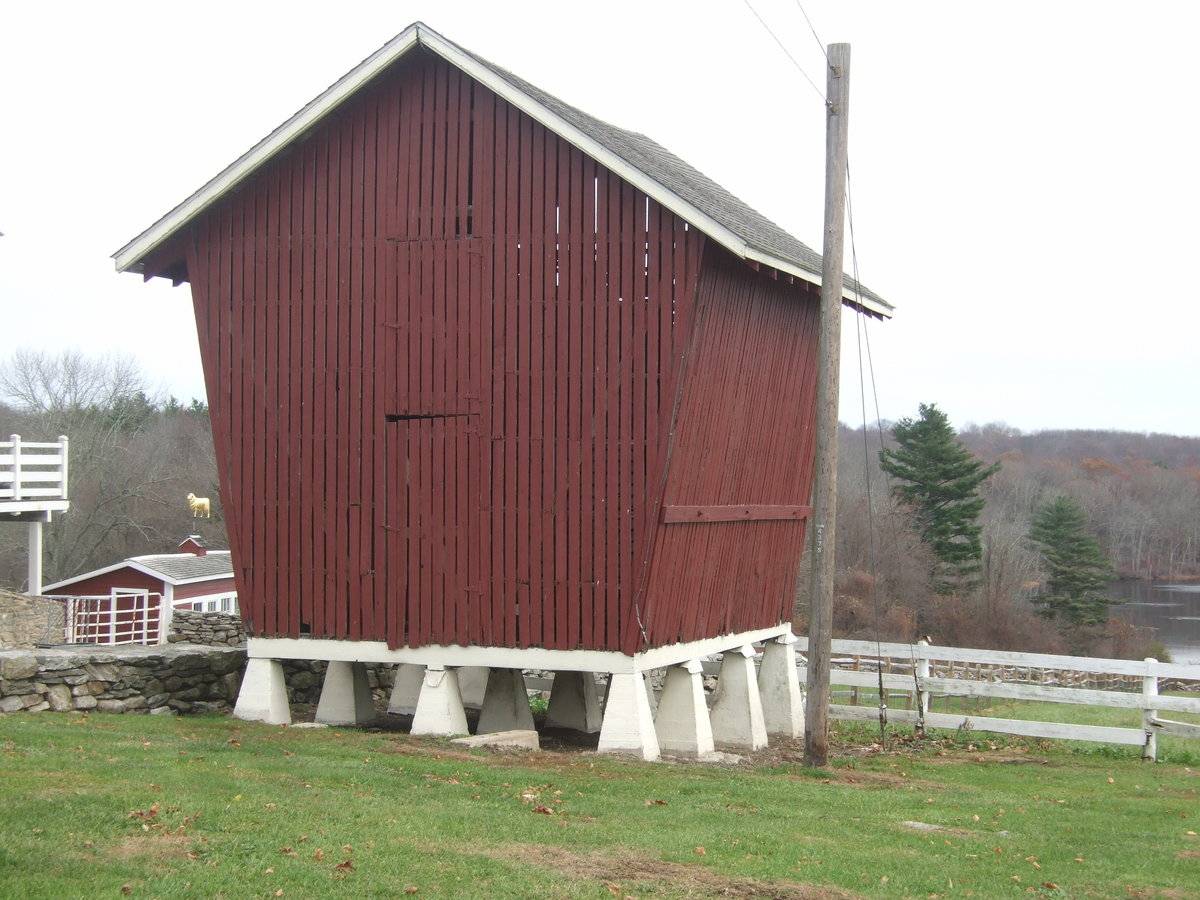
This is a 1 story gable-entry corn crib. The main facade faces west and the ridge-line of the crib is perpendicular to this portion of Wolf Den Road, which runs approximately north-south. The gable-ends are vertical, but the eave-sides slant outwards from bottom to top. The main entry is two single exterior-swinging doors in the center of the gable-end, one above the other. The south, east and west sides of the crib appear to be blank, apart from a horizontal beam running the length of the eave-sides of the crib. The crib is raised on concrete block piles and the ground slopes gently towards the east. The crib has vertical spaced wooden slats, painted red. The roof has overhanging eaves and is covered with asphalt shingles.
Historical significance:In the middle of the 19th century, growing “Indian” corn became popular. Storing the corn on the cob in well-ventilated corn cribs allowed the kernels to dry without spoiling. The distinctively shaped corn crib, with slanted side walls built of spaced wooden slats, became common by the 1860s. The overhanging eaves and slanted walls helped prevent rain from splashing inside. Vertical side walls are also common. Corn cribs are typically set high above the ground on wooden or stone posts.
Historical background:Bush Hill Historic District is significant because of its unusually high concentration of well-preserved 18th century farmhouses and because it retains the open fields, stone walls, and tree lined roads which provide an appropriate setting for the houses, one which recalls the area’s historical development as an outlying farming district. The district’s houses exemplify rural 18th century Connecticut domestic architecture: they embody the distinctive characteristics of that period’s form and method of construction (Clouette).
Field Notes
Corn Crib for drying ear corn harvested with a corn picker. Located in the Bush Hill National Register Historic District and appears to be a contributing resource within the district.
- Use & Accessibility
- Environment
Related features
Environment features
Relationship to surroundings
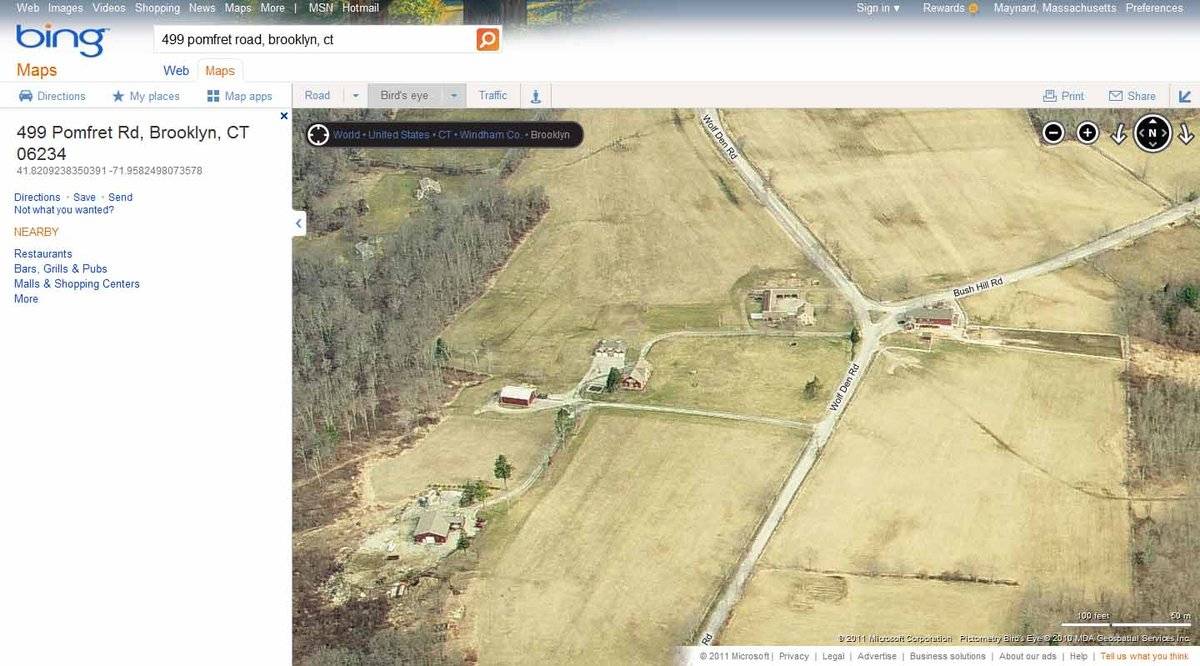
The crib is directly across Wolf Den Road from the house it is associated with. The ridge-line of the house is perpendicular to the ridge-line of the crib. The house, built in c. 1770, has five bays and a gabled roof. The crib has grassed open land on its west, south, and east sides. Adjacent to the north eave-side of the barn there is a fieldstone wall and a driveway that leads from Bush Hill Road. Beyond this there is a 2½ story gable-entry bank barn (See Part 1), which fronts Wolf Den Road and is on the corner of Wolf Den Road and Bush Hill Road. There is a parking area in front of the main facade of the barn. There is a Victorian - period carriage house behind the barn and to the north-east of the crib. The area surrounding the 2.86-acre property is agriculture and woodland.
- Typology & Materials
-
Building Typology
Materials
Structural System
Roof materials
Roof type
Approximate Dimensions
240 sq. ft.
- Source
-
Date Compiled
03/05/2011
Compiled By
L. Mackintosh & T. Levine, reviewed by CT Trust
Sources
Field notes and photographs by Joyce Meader date 12/10/2010.
Town of Brooklyn Assessor’s Record or GIS Viewer: http://data.visionappraisal.com/BrooklynCT
Parcel ID: 19/ / 18B-2/ /Aerial Mapping:
http://maps.google.com accessed 3/5/2010
http://www.bing.com/maps accessed 3/5/2010.Clouette, Bruce and Roth, Matthew, Bush Hill Historic National Register District Nomination No. 87000012, National Park Service, 1987.
Sexton, James, PhD, Survey Narrative of the Connecticut Barn, Connecticut Trust for Historic Preservation, Hamden, CT, 2005, http://www.connecticutbarns.org/history.
Visser, Thomas D., Field Guide to New England Barns and Farm Buildings, University Press of New England, 1997.
Website of The Golden Lamb Restaurant. http://www.thegoldenlamb.com/
- PhotosClick on image to view full file
-