Barn Record Brooklyn
RETURN TO ‘FIND BARNS’- Building Name (Common)
- The Field House
- Building Name (Historic)
- The Field House
- Address
- 65 Providence Road (Rte 6), Brooklyn
- Typology
- Overview
-
Designations
Historic Significance
Architectural description:
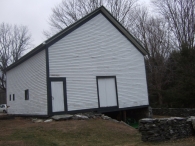
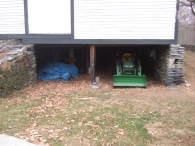
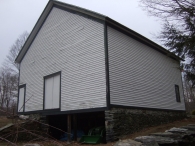
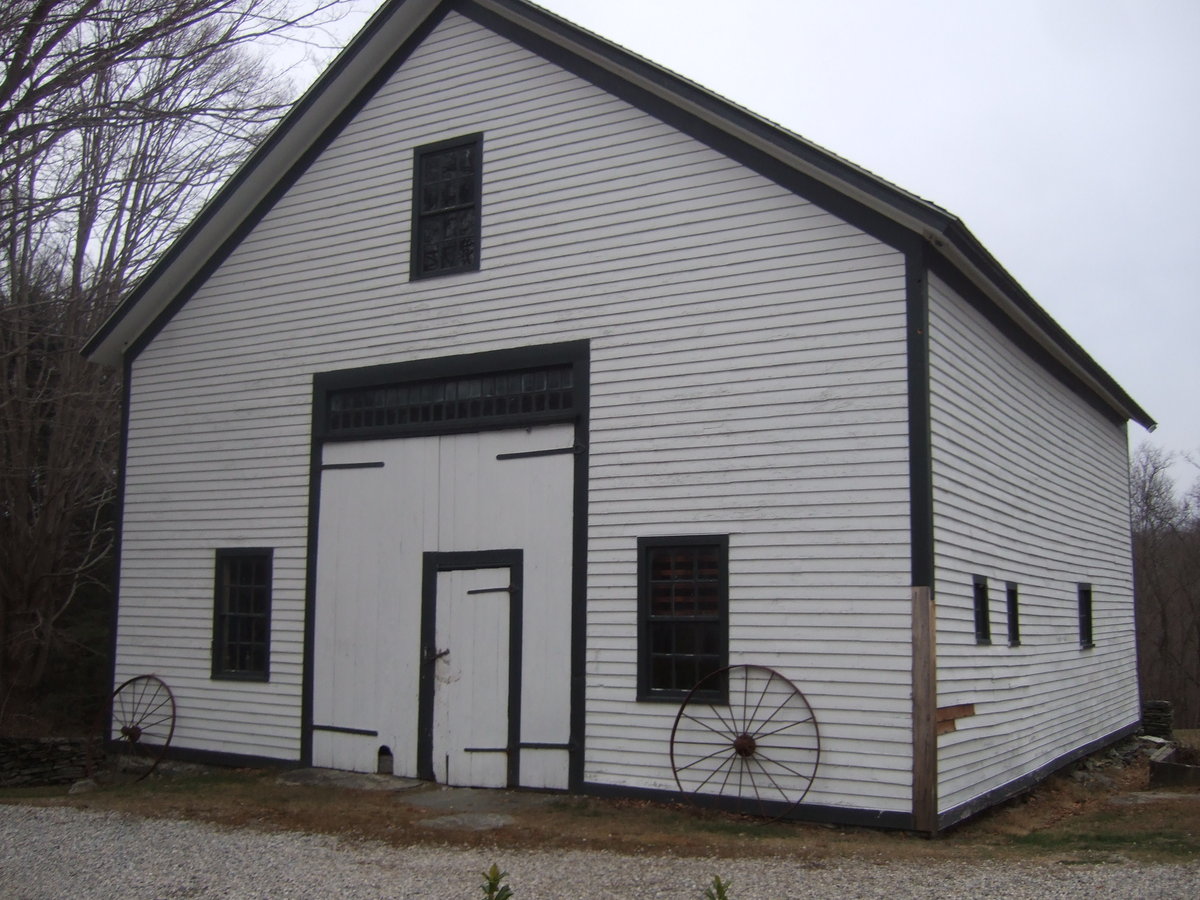
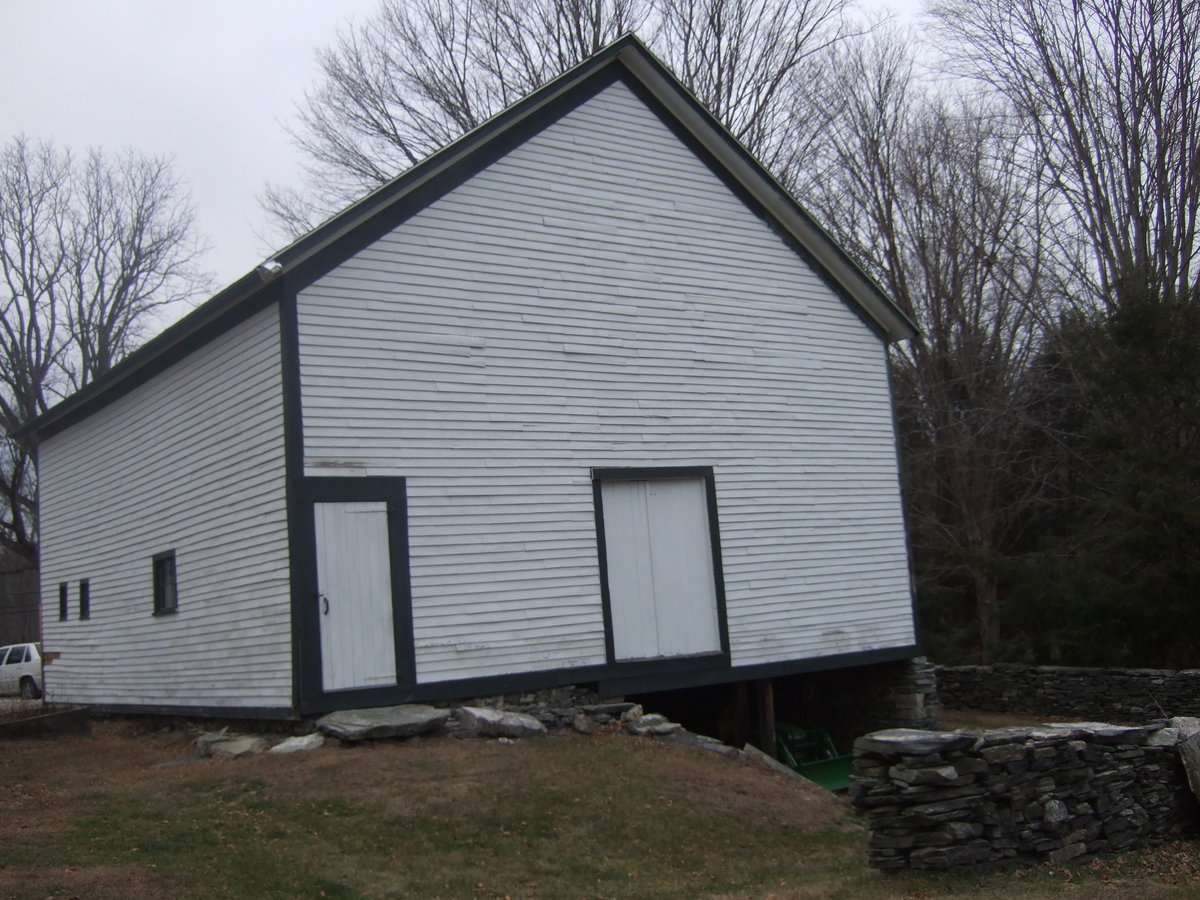
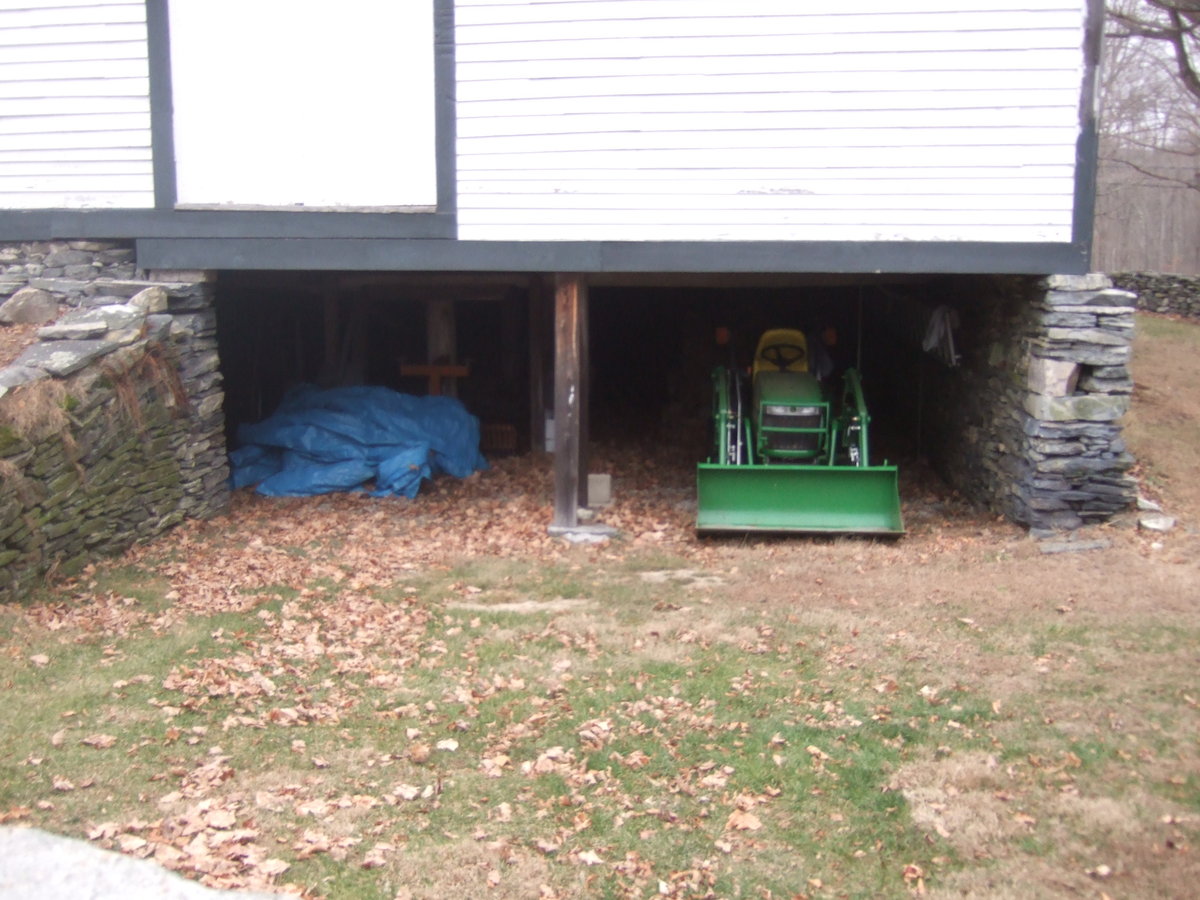
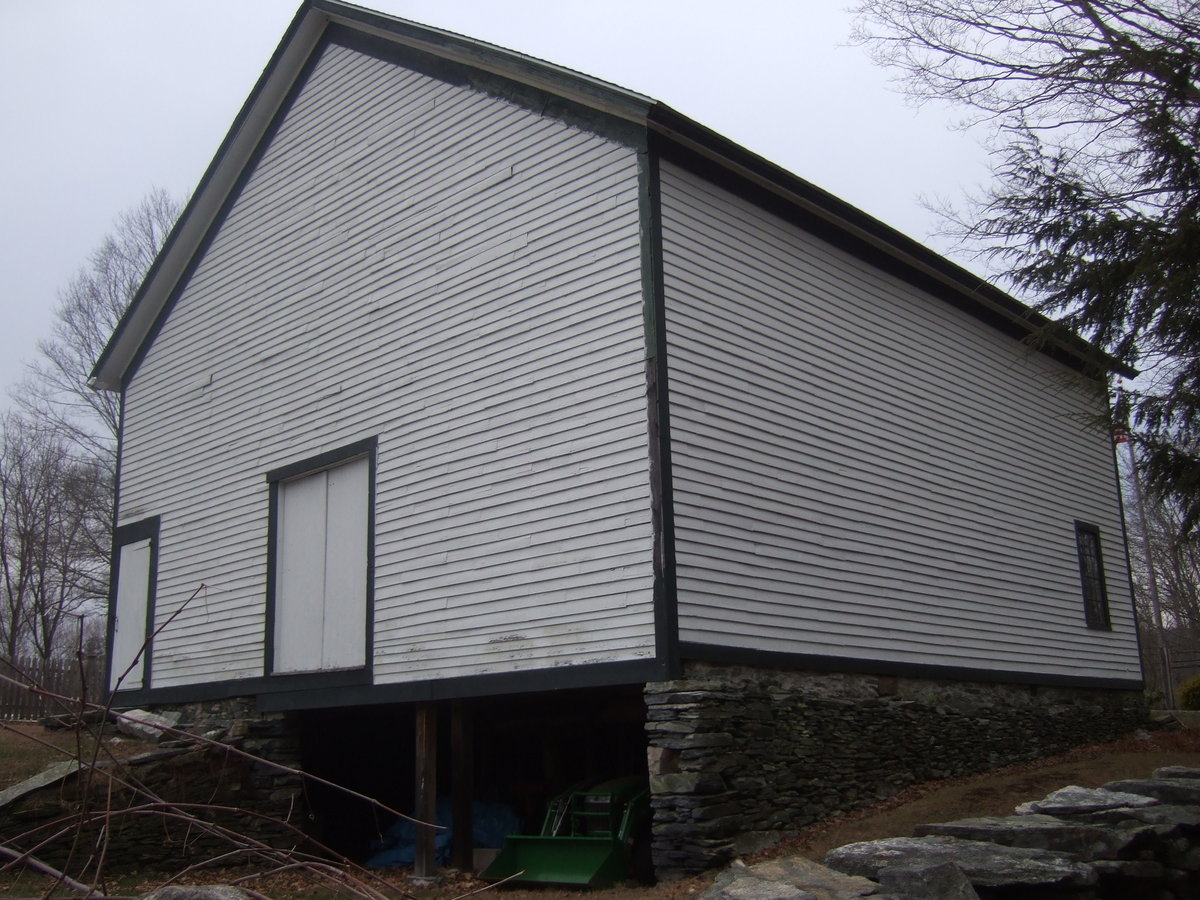
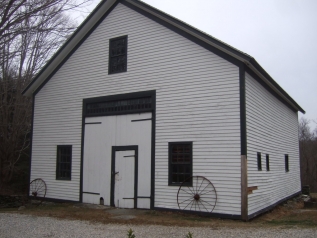
This is a 1 ½ story gable-entry bank barn. The main façade faces northwest and the ridge-line of the barn is perpendicular to this portion of Providence Road, which runs southwest-northeast. The main entry is a pair of centered exterior-swinging doors with an inset single door and a 40-pane double transom light above. There is a single six-over-six double-hung sash window either side of the main entry and one in the gable attic. The southwest eave-side has three windows with trim in the main story; a four-pane window in the center and what appears to be two single-pane windows towards the west corner. The southeast gable-end has a single exterior swinging door with wrought iron hardware at the south corner and a pair of recessed doors in the center. The ground slopes slightly towards the east, revealing a fieldstone foundation. At the center of the southeast gable-end of the barn, below the recessed doors, is a sharp decline in grade, resulting in a basement level. A stone retaining wall to the extending southeast. East of the retaining wall in the basement level are two open bays. The northeast eave-side of the barn has a fieldstone basement and a single fixed twelve-pane window in the north half. The barn has horizontal clapboard siding painted white with black trim. The roof has overhanging eaves and appears to be covered with asphalt shingles.
Historical significance:The New England barn or gable front barn was the successor to the English barn and relied on a gable entry rather than an entry under the eaves. The gable front offered many practical advantages. Roofs drained off the side, rather than flooding the dooryard. With the main drive floor running parallel to the ridge, the size of the barn could be increased to accommodate larger herds by adding additional bays to the rear gable end. Although it was seen by many as an improvement over the earlier side-entry English Barn, the New England barn did not replace its predecessor but rather coexisted with it; both types continued to be constructed.
The 19th century also saw the introduction of a basement under the barn to allow for the easy collection and storage of a winter’s worth of manure from the animals sheltered within the building. The bank barn is characterized by the location of its main floor above grade, either through building on a hillside or by raising the building on a foundation. This innovation, aided by the introduction of windows for light and ventilation, would eventually be joined by the introduction of space to shelter more animals under the main floor of the barn.
Historical background:“The Field House, c. 1740, rebuilt 1805, originally 1 ½ stories, now 2 ½ stories, rectangular (but many additions), frame, cut granite foundation, gable roof with ridge parallel and asphalt shingles, one central brick chimney, clapboards. Decorative features: corner boards have tiny molded capitals; cornice partially returned; 6-over-6 sash with flat molded window hoods; central main entrance has panelled pilasters and transom light, above which are an entablature with a pulvinated frieze and a projecting flat cap; Victorian porch on west side has squared columns with small brackets and a flat roof. Outbuildings: a large barn with an excellent double transom light, and a smaller carriage house-garage. Note: this was originally a four-bay house; the fifth (north) bay is part of a 2-story addition which runs to the rear. (Fig. 15)” ((Brooklyn Green Historic District, National Register of Historic Places Register – Inventory Form, p. 20)
‘The Brooklyn Green National Register District possesses three areas of significance. First, the physical organization of this district, which reflects its particular historical development, illustrates several broader patterns of growth and change in the communities of eastern Connecticut from the mid-eighteenth to the early twentieth century (Criterion A), Second, many of the districts private residences and institutional buildings are architecturally significant; and, together, they form an impressive collection of eighteenth and nineteenth-century vernacular structures (Criterion C). Finally, several of the buildings and monuments within the district are associated with the lives of individuals important in state and national history (Criterion B)’. (Brooklyn Green Historic District, National Register of Historic Places Register – Inventory Form, p. 35)
Field Notes
New England styled bank barn used for hay storage. Located in the Brooklyn Green National Register Historic District and is a contributing resource within the district.
- Use & Accessibility
Use (Historic)
Use (Present)
Exterior Visible from Public Road?
Yes
Demolished
n/a
Location Integrity
Unknown
- Environment
Related features
Environment features
Relationship to surroundings
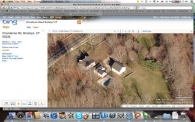
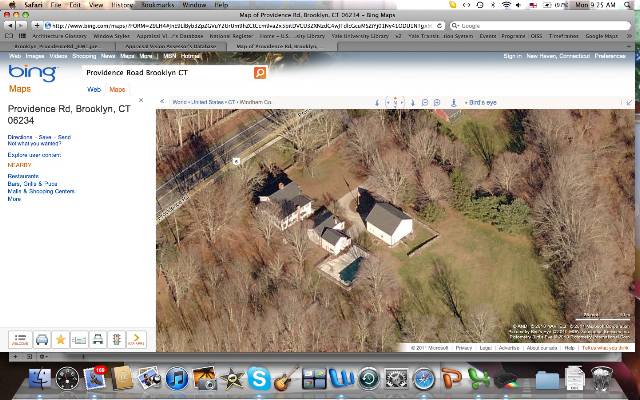
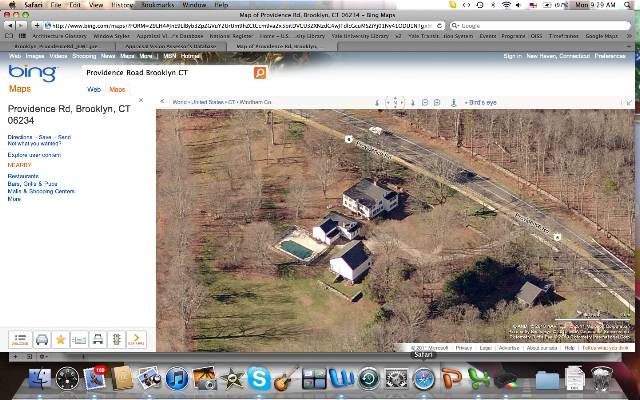
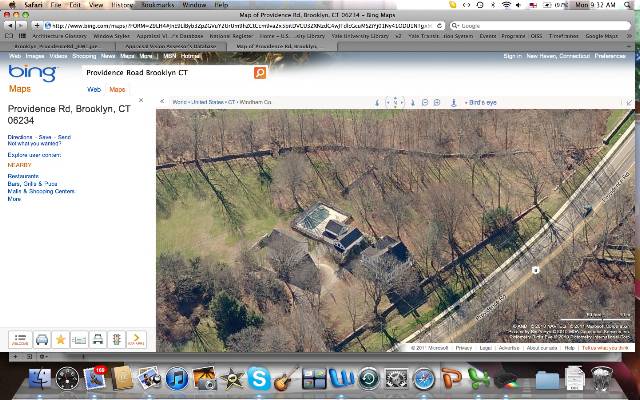
The barn is located to the southeast of the house with which it is associated. The ridge-line of the house is perpendicular to the ridge-line of the barn. The 2 ½ story house, built in c. 1740, has a gable roof with hip-roof additions on the south and west sides. A driveway runs south from Providence Road and then turns west to a parking area in front of the main façade of the barn. Adjacent to the southwest side of the barn and behind the house there is 2 story gable-roof building with a gable-roof addition. Behind the building there is a swimming pool. A fieldstone wall runs alongside the northeast and southeast sides of the barn, connecting to the stone retaining wall that extends from the southeast gable-end of the barn. The remainder of the 3.27-acre property has scattered trees and open land. The property is on the outskirts of the town of Brooklyn and the surrounding area is woodland, open land and residential.
- Typology & Materials
-
Building Typology
Materials
Structural System
Roof materials
Roof type
Approximate Dimensions
1188 sq. ft.
- Source
-
Date Compiled
02/28/2011
Compiled By
L. Mackintosh & T. Levine, reviewed by CT Trust
Sources
Field notes and photographs by Joyce Meader, date 12/22/2010.
Town of Brooklyn’s Assessor’s Record or GIS Viewer http://data.visionappraisal.com/BrooklynCT/
Parcel ID: 25/ / 50/ /
Aerial Mapping:http://www.bing.com/maps accessed 2/28/2010.
Keiner, Hal and Herzan, John, Brooklyn Green Historic District, National Register of Historic Places Register No. 82004401, 1979.
Sexton, James, PhD, Survey Narrative of the Connecticut Barn, Connecticut Trust for Historic Preservation, Hamden, CT, 2005, http://www.connecticutbarns.org/history.
Visser, Thomas D., Field Guide to New England Barns and Farm Buildings, University Press of New England, 1997.
- PhotosClick on image to view full file
-