Barn Record Bristol
RETURN TO ‘FIND BARNS’- Building Name (Common)
- n/a
- Building Name (Historic)
- n/a
- Address
- 1015 Hill Street, Bristol
- Typology

- Overview
-
Designations
n/a
Historic Significance
Architectural description:
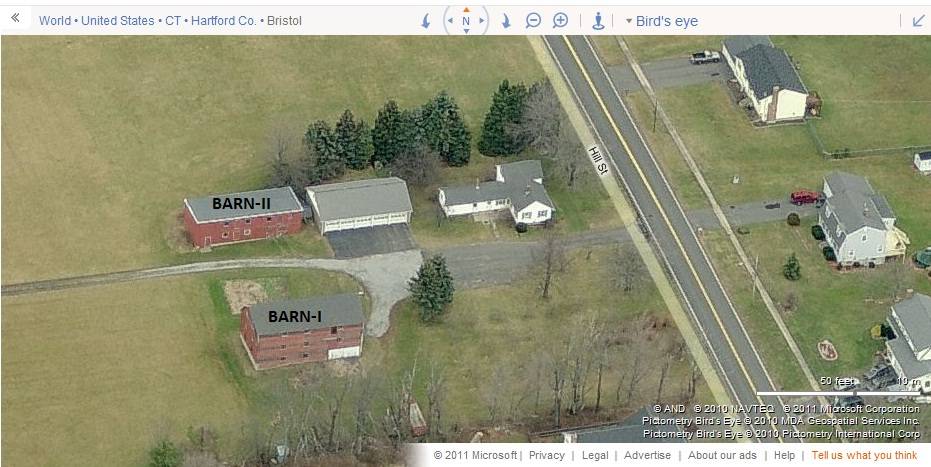
This is a two barn complex towards the west of Hill Street with a gambrel-roof barn, Barn-I towards the south and the shed-roof coop, Barn-II towards the north. The ridge line of Barn-I and the longer eave-side of Barn-II run east-west parallel to each other but perpendicular to this portion of Hill Street.
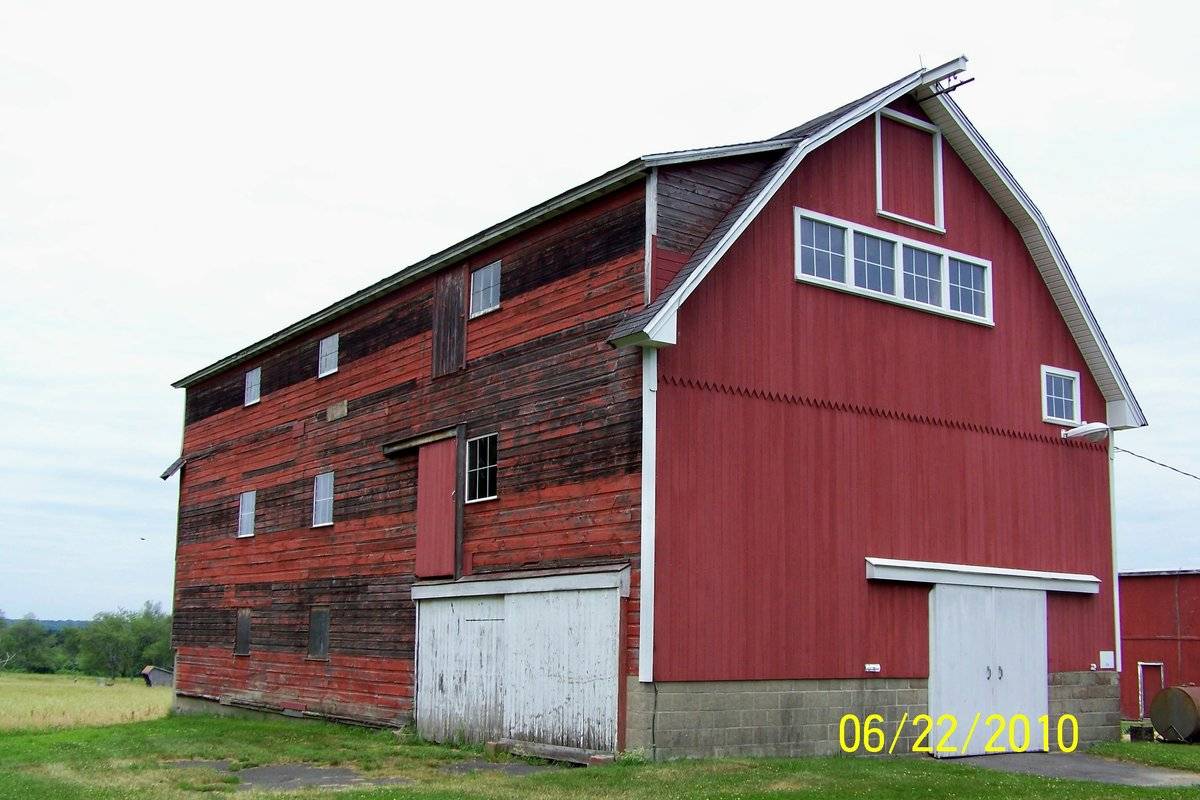
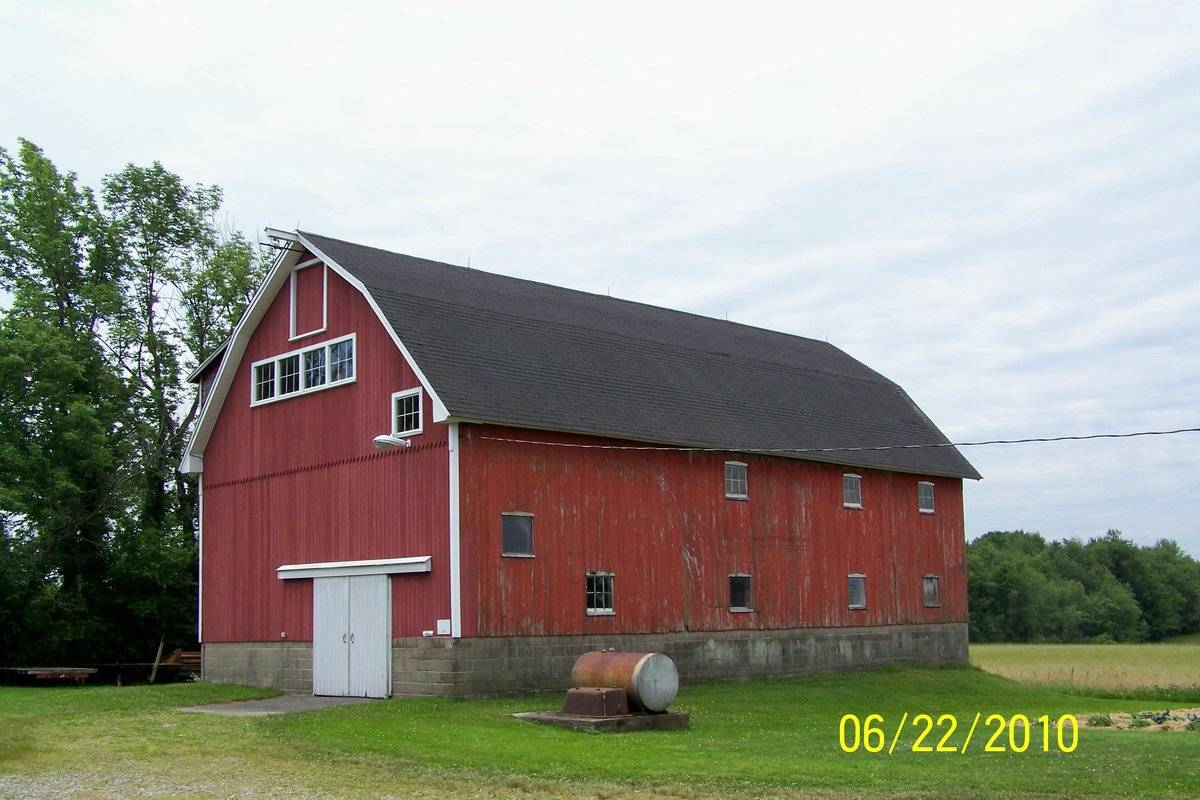
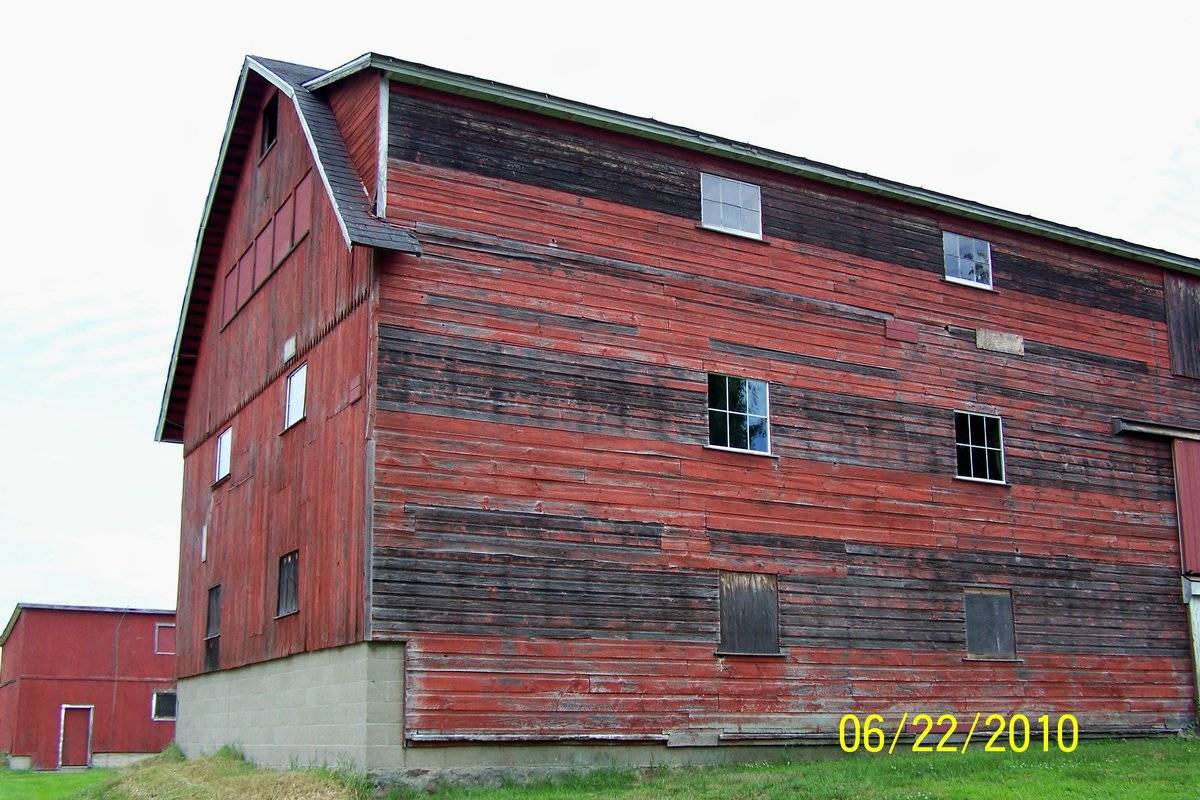
Barn-I: This is a 3 ½ - story gambrel-roof barn with entries from both the gable-end and the eave-side. The south eave-side of the barn has a wall-dormer encompassing its entire length. The east gable-end of the barn facing Hill Street is the main façade with the main entrance off-centered towards the north through a pair of exterior-hung hooded sliding wagon doors. The façade has a margin of concrete-block masonry foundation along the grade level while the gable attic is separated by a distinct dropped girt siding divide line finished off in saw tooth detail. The gable attic lined by deep soffit has a four-module window at the center with each module being six-pane. A framed hay door can be seen centered above the windows while the façade has a projecting hay track just below the apex of the roof. The south eave-side of the barn also has a main entrance towards the east through an exterior-hung hooded sliding wagon door and two windows with trim equally spaced towards the west. An exterior-hung hooded sliding hay door can be seen above the main wagon door entrance towards the west with a six-pane window towards its immediate east. Two six-pane windows can be seen equally spaced towards the west of the sliding hay door, above the windows at the first floor level. The third floor level of the barn which is the south eave-side of the wall dormer has a hinged hay door above the sliding hay door at the second floor level and also has a six-pane window towards its immediate east. The third floor level also has two six-pane windows equally spaced towards the west of the hinged hay door, in line with the windows at the second and the first floor. The west gable-end of the barn is almost symmetrical along the central axis through the apex of the roof and a margin of exposed concrete block masonry foundation along the grade The first and the second floor levels of the west gable-end have two windows with trim while the gable attic is separated by a distinct dropped girt siding divide line finished off in saw tooth detail. The gable attic lined by deep soffit has a series of five closely spaced windows at the center and another window opening just below the apex of the roof. The first floor level of the north eave-side of the barn also has a margin of concrete block masonry foundation along the grade and four six-pane windows with trim at the first floor level. The second floor level of the barn has a single-pane window with trim towards the extreme east while the third floor level has three six-pane windows with trim, above the first three windows from the west at the first floor level.
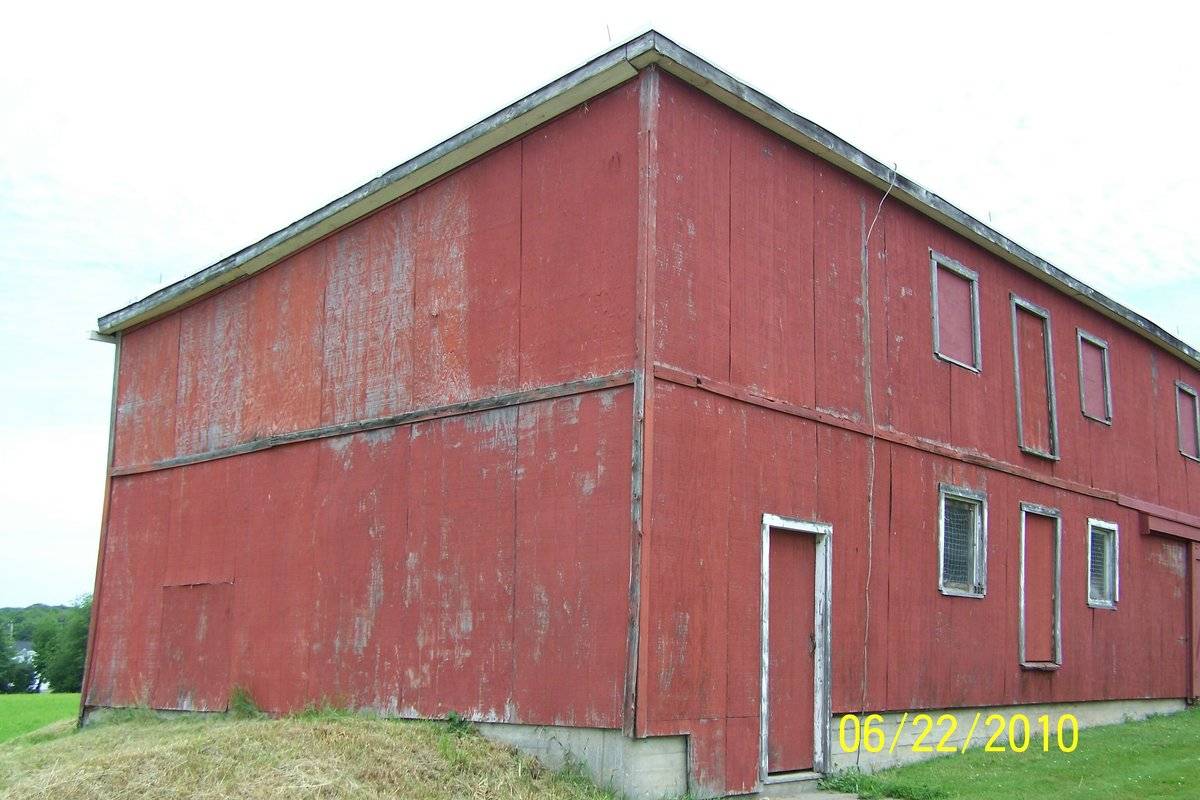
The wooden frame of the main barn is supported on concrete block masonry foundation. The barn has asphalt shingle roofing and red painted vertical siding with white corner boards apart from the south eave-side which has red painted horizontal clap board siding.Barn-II: This is a 2 – story shed-roof coop with its east side-wall facing Hill Street. The south eave-side of the coop with the higher eave-level is the main façade with the main entrance towards the east through a pair of double-height exterior-hung hooded Z-braced sliding wagon doors. The façade has a second entrance towards the west through a hinged pass-through door. A hinged hay door is centered between the two entrances flanked by a square window on either side, closed by wire mesh. The second level is separated by a continuous horizontal trim and also has a hinged hay door flanked by a window on either side above the hinged hay door at the first floor level. A similar arrangement of a hinged hay door at the center flanked by a window on either side can be seen above the main wagon door entrance. The grade level along the south eave-façade gradually slopes towards the west revealing the concrete block masonry foundation of the coop. The west gable-end of the shed has a continuous band separating the first floor level which appears to have a window towards the north.
The wooden frame of the coop is supported on concrete block masonry foundation. The coop appears to have concrete roofing and red painted ply-board siding with corner boards.
Historical significance:
The oldest barns still found in the state are called the “English Barn,” “side-entry barn,” “eave entry,” or a 30 x 40. They are simple buildings with rectangular plan, pitched gable roof, and a door or doors located on one or both of the eave sides of the building based on the grain warehouses of the English colonists’ homeland. The New England barn or gable front barn was the successor to the English barn and relies on a gable entry rather than an entry under the eaves. The gable front offers many practical advantages. Roofs drain off the side, rather than flooding the dooryard. Although it was seen by many as an improvement over the earlier side entry English Barn, the New England barn did not replace its predecessor but rather coexisted with it. In this case the two styles are combined; both a gable entry and an eave entry are used.
The gambrel roof enclosed a much greater volume than a gable roof did, and its shape could be formed with trusses that did not require cross beams, which would interfere with the movement and storage of hay. Also known as the curb roof, the double slopes of the gambrel offer more volume in the hayloft without increasing the height of the side walls.Poultry farming grew in popularity during the second half of the 19th century, and by the early 20th century most farms had small chicken coops. These lightly-built structures often feature a gabled or shed roof and large windows on the south side. Often chicken coops have a small stove and chimney for heat to protect young chicks during cold weather. Small openings near the ground provide the fowl with access to the yard. Inside are nesting boxes for the laying hens. During the 1930s and 1940s, poultry farming was adopted by many farmers in New England as a replacement for dairy farming.
Field Notes
The 3 story poultry house with Gambrel roof was built at the turn of the century. The farm house was built in 1890s. The large poultry house was moved back from the street to its current location. Adjacent is a smaller 2 story chicken coop constructed in the 1930s. The area is residential with open land surrounding the farm house and poultry houses.
- Use & Accessibility
Use (Historic)
Use (Present)
Exterior Visible from Public Road?
Yes
Demolished
n/a
Location Integrity
Unknown
- Environment
Related features
Environment features
Relationship to surroundings
The 0.57 acres property, Account number – 0010502 and Map-Lot-unit number - 64/ / 3A/ /, is located towards the west of Hill Street. The property is situated in a predominantly residential area with individual plots separated by woodland and open land. Residential plots flank the property towards the south and the east across the road while parcels of open land can be seen towards the north and the west.
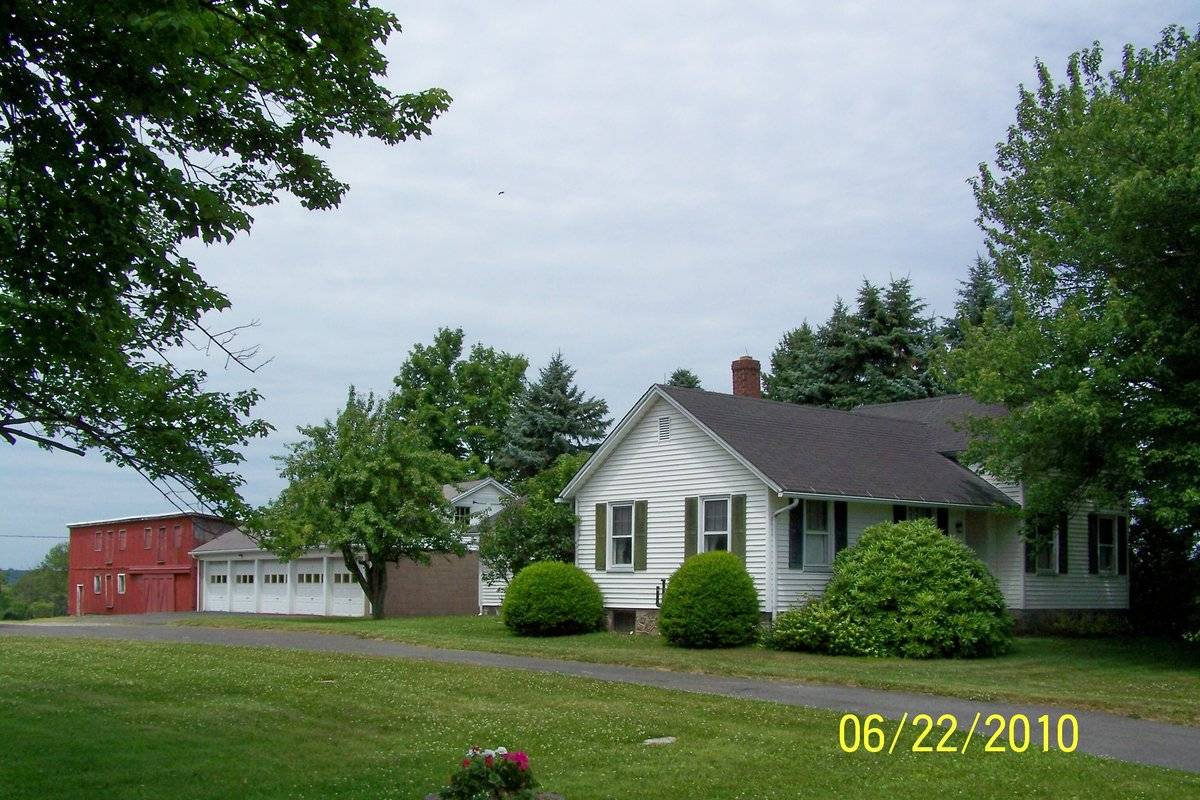
The two barns are located towards the western edge of the property with the gambrel-roof barn, Barn-I towards the south and the shed-roof coop, Barn-II towards the north. The ridge line of Barn-I and the longer eave-side of Barn-II run east-west parallel to each other but perpendicular to this portion of Hill Street. A 1 ½ - story eave-entry garage with parallel ridge line is located towards the immediate east of Barn-II while the circa 1860 ranch style main residence is located towards further east, abutting to the road. The property is acceded by a driveway towards the south of the main residence that continues west through the open land.
- Typology & Materials
-
Building Typology
Materials
Structural System
Roof materials
Roof type
Approximate Dimensions
Poultry house: 2400 SqFt; Shed: 1500 SqFt;
- Source
-
Date Compiled
03/05/2011
Compiled By
T. Levine and M. Patnaik, reviewed by CT Trust
Sources
Field notes and photographs provided by: Cherie Robinson, 03/25/2011.
Assessors’ records retrieved on May 9th, 2011 from website http://data.visionappraisal.com/BristolCT/DEFAULT.asp.
Photograph/Information retrieved on May 9th, 2011 from website http://www.google.com
Photograph/Information retrieved on May 9th, 2011 from website http://www.bing.com.
Photograph/Information retrieved on May 9th, 2011 from website http://www.zillow.com.
Sexton, James, PhD; Survey Narrative of the Connecticut Barn, Connecticut Trust for Historic Preservation, Hamden, CT, 2005, http://www.connecticutbarns.org/history.
Visser, Thomas D.,Field Guide to New England Barns and Farm Buildings, University Press of New England, 1997.
- PhotosClick on image to view full file
-