Barn Record Monroe
RETURN TO ‘FIND BARNS’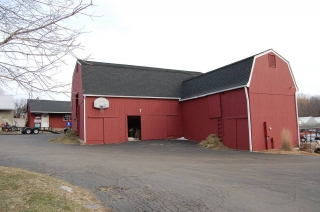
- Overview
-
Designations
n/a
Historic Significance
Architectural description:
This is a multi-unit building complex towards the north of Purdy Hill Road including an inverted L-shaped barn complex, a corn crib and other sheds and outbuildings. The following is the description of the L-shaped barn complex and the corn crib.
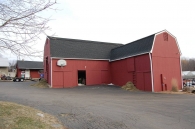
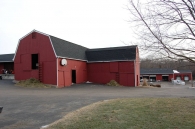
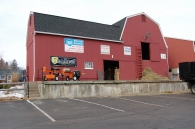
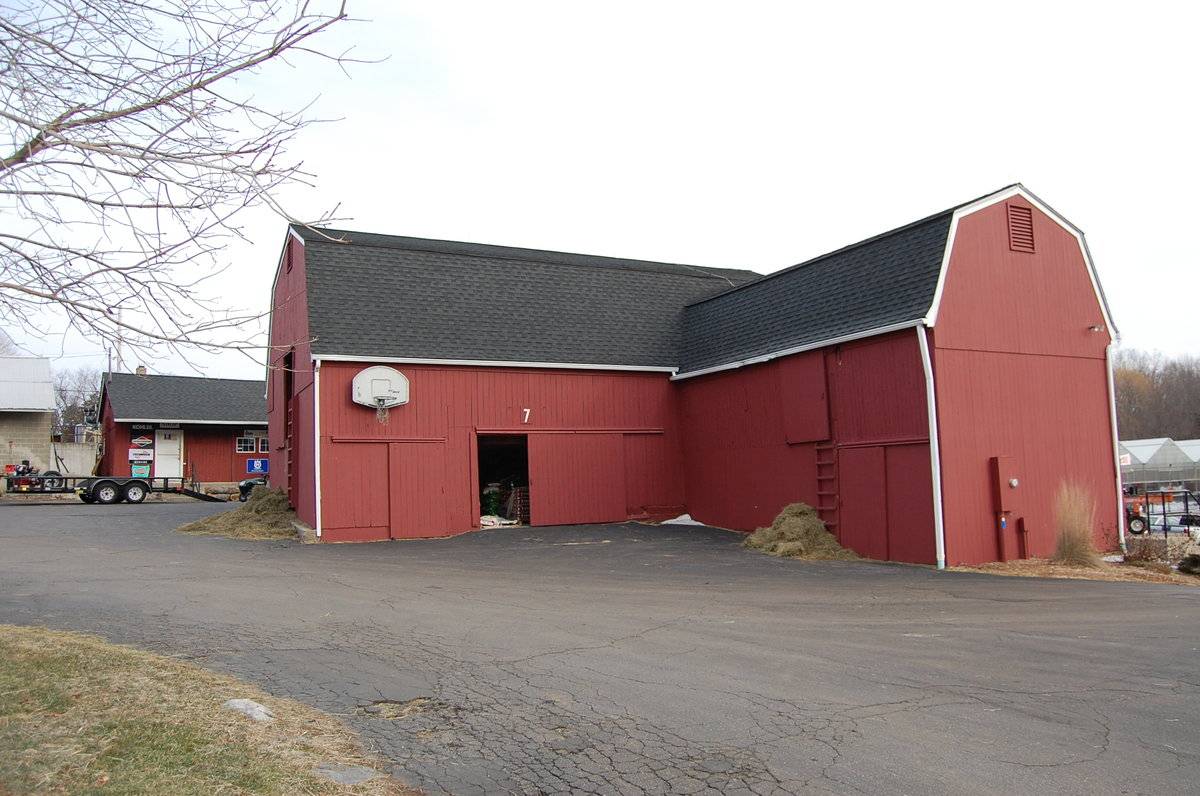
Barn complex: This is an inverted L-shaped barn complex comprising of a 2 ½ - story three-bay eave-entry gambrel-roof main barn with an intersecting 2 ½ - story eave-entry gambrel-roof on it south eave-side. The ridge line of the main barn runs east-west while that of the intersecting gambrel-roof barn runs north-south. The three-bay south eave-side of the barn with the intersecting barn on its first bay from the east is the main façade of the complex. The main facade has the main entrance in the middle bay towards the west through an exterior-hung hooded sliding wagon door with a signboard displaying the number ‘7’above it. The façade has a second entrance in the first bay from the west through an exterior-hung hooded sliding pass-through door. The west eave-side of the intersecting barn has an entrance towards the extreme south through an exterior-hung hooded sliding pass-through door. An exterior-hung sliding hay door can be seen above the pass-through door towards the north accessed by a wooden ladder. The south gable-end of the intersecting barn facing the road has a distinct dropped girt siding divide line separating the gable attic. The gable attic is lined by cornice board and has a louvered vent just below the apex of the roof. The east eave-side of the intersecting barn flush with the east gable-end of the main barn has an entrance towards the extreme north through an exterior-hung hooded sliding wagon door with a signboard displaying the number ‘6’ above it. An eight-pane window followed by numerous advertising boards can be seen towards the south of the wagon door entrance. The gable attic of the east gable-end of the main barn has a distinct dropped girt siding divide line intersected by an exterior-hung sliding hay door. The east gable-end of the barn has a wooden ladder to access the hay door while a louvered vent can be seen just below the apex of the roof. The west gable-end of the main barn has a margin of cement plastered masonry foundation along the grade level. The gable attic is separated from the rest of the gable-end by a distinct dropped girt siding divide line which is intersected by an exterior-hung sliding hay door at the center. The west gable-end of the barn has a louvered vent just below the apex of the roof and a wooden ladder leading to the sliding hay door.
The wooden frame of the L-shaped barn complex is supported on cement plastered masonry foundation. The barn complex has asphalt shingle roofing and red painted vertical siding.
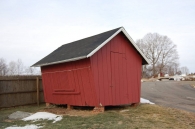
A 1 –story gable-roof corn crib is located towards the west of the barn with its ridge line running east-west The west gable-end of the crib is the main façade with the main entrance at the center through a hinged pass-through door. The crib has inclined walls supported on mortared brick masonry piers.
The corn crib has asphalt shingle roofing and red painted vertical siding.Historical significance:
The oldest barns still found in the state are called the “English Barn,” “side-entry barn,” “eave entry,” or a 30 x 40. They are simple buildings with rectangular plan, pitched gable roof, and a door or doors located on one or both of the eave sides of the building based on the grain warehouses of the English colonists’ homeland. The name “30 by 40” originates from its size (in feet), which was large enough for 1 family and could service about 100 acres. The multi-purpose use of the English barn is reflected by the building’s construction in three distinct bays - one for each use. The middle bay was used for threshing, which is separating the seed from the stalk in wheat and oat by beating the stalks with a flail. The flanking bays would be for animals and hay storage.
The gambrel roof design enclosed a much greater volume than a gable roof did, and its shape could be formed with trusses that did not require cross beams, which would interfere with the movement and storage of hay. Also known as the curb roof, the double slopes of the gambrel offer more volume in the hayloft without increasing the height of the side walls.
In the middle of the 19th century, growing “Indian” corn became popular. Storing the corn on the cob in well-ventilated corn cribs allowed the kernels to dry without spoiling. The distinctively shaped corn crib, with slanted side walls built of spaced wooden slats, became common by the 1860s. The overhanging eaves and slanted walls helped prevent rain from splashing inside. Vertical side walls are also common. Corn cribs are typically set high above the ground on wooden or stone posts.
Field Notes
Original barn circa 1838 was an English style bank cow barn. Barn has vertical siding and asphalt roof shingles. The add-on barn and the gambrel design roof was added in the mid 1900s for more room to store hay in the upper loft. The corn crib still stands behind the farm house. This is still a working farm with cows and exotic birds. The small building behind the original barn was a feed store in the 1950s for the Eastern States Farm Supply, today's AGWAY. Today there are many newer buildings that support the, continuously family owned, Benedict's Farm, Home & Garden Center.
- Use & Accessibility
Use (Historic)
Use (Present)
Exterior Visible from Public Road?
Yes
Demolished
n/a
Location Integrity
Unknown
- Environment
Related features
Environment features
Relationship to surroundings
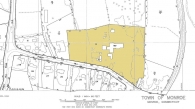
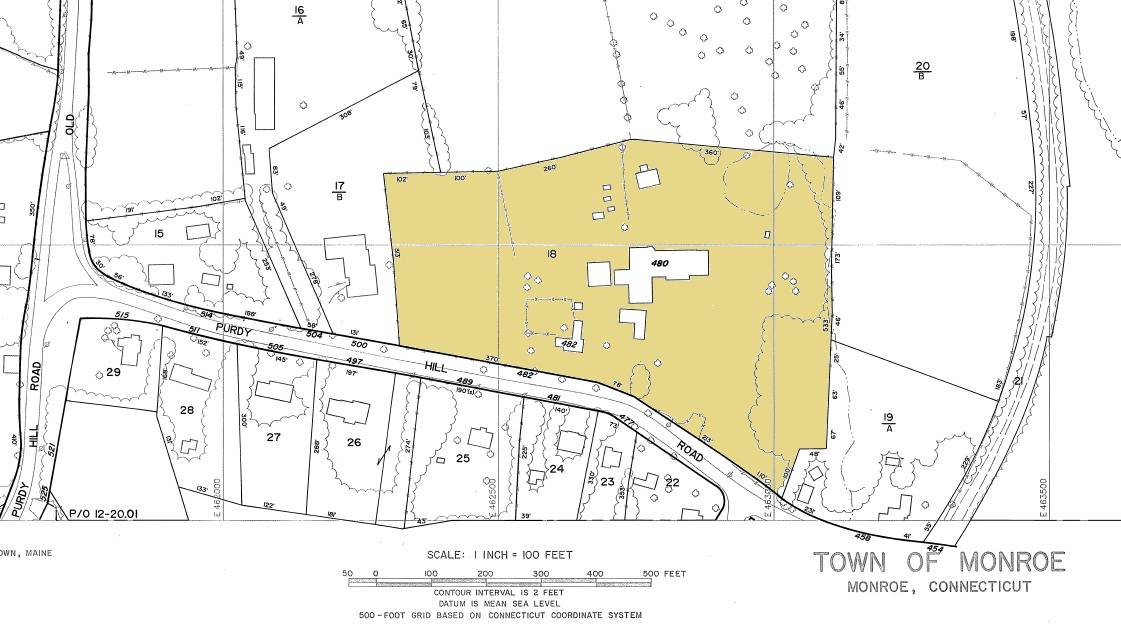
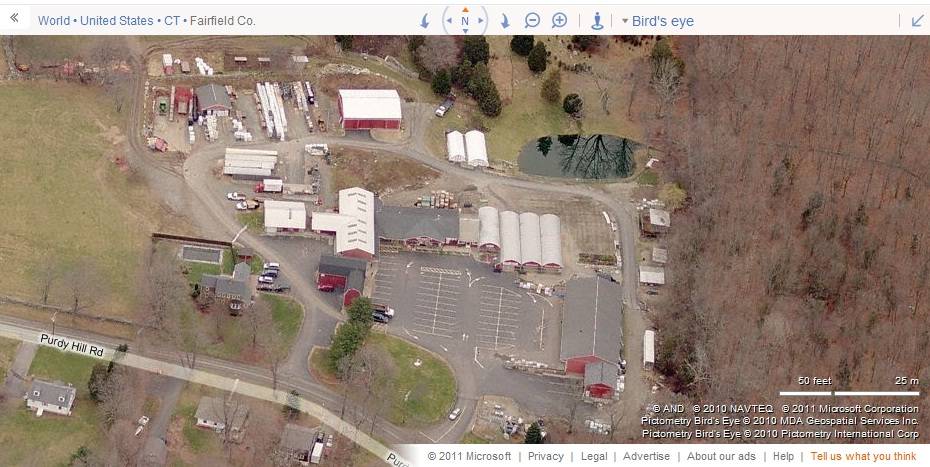
The 7.31 acres property, Account number – 01901801 and Map-Block-Lot number - 019 018 01, is towards the north of Purdy Hill Road, opposite to the intersection of Purdy Hill Road and the Maple Drive. The property is classified as small retail, < 10,000 SqFt. It is situated in a mixed-use area with individual plots separated by woodland. The main residence associated with the property is located at 482 Purdy Hill Road; 101 acres, Account number – 01901802 and Map-Block-Lot number - 019 018 02. Residential plots can be seen towards the south of the property across Purdy Hill Road while dense woodland covers the area towards the east. Open land with cluster of trees can be seen towards the north of the property.
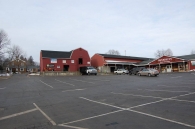
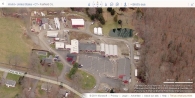
The L-shaped barn complex is located towards the southern edge of the plot while the circa 1980 mini-warehouse is located towards its north. A small corn crib is located towards the west of the barn while a gable-roof outbuilding is located towards the west of the ware house. Few green houses can be seen towards the immediate east of the warehouse while another gable-roof eave-entry building is located towards its north. A huge asphalt parking space covers the area towards the east of the barn. A second circa 1980 ware house is located towards the further east. The property includes few other sheds scattered all over the site while a small pond is located in the northeast corner of the plot. The circa 1807 colonial main residence is located towards the southwest of the barn with a rectangular pool towards its immediate northwest.
- Typology & Materials
-
Building Typology
Materials
Structural System
Roof materials
Roof type
Approximate Dimensions
Aluminum shed: 40 X 35 Sqft, Circa 1988; Aluminum shed: 36 X 36 Sqft, Circa 1988; Aluminum shed: 60 X 44 Sqft, Circa 1997; Asphalt parking: 30000 Sqft, Circa 1980; Pool: 18 X 36 Sqft, Circa 1969;
- Source
-
Date Compiled
04/16/2011
Compiled By
T. Levine and M. Patnaik, reviewed by CT Trust
Sources
Field notes and photographs provided by: Lee Hossler, 04/04/2011.
Assessors’ records retrieved on April 16th, 2011 from website http://monroe.univers-clt.com/ .
Assessors’ maps retrieved on April 16th, 2011 from website http://www.monroect.org/ .
Photograph/Information retrieved on April 16th, 2011 from website http://www.google.com
Photograph/Information retrieved on April 16th, 2011 from website http://www.bing.com.
Photograph/Information retrieved on April 16th, 2011 from website http://www.zillow.com.
Sexton, James, PhD; Survey Narrative of the Connecticut Barn, Connecticut Trust for Historic Preservation, Hamden, CT, 2005, http://www.connecticutbarns.org/history.
Visser, Thomas D.,Field Guide to New England Barns and Farm Buildings, University Press of New England, 1997.
- PhotosClick on image to view full file
-