Barn Record Roxbury
RETURN TO ‘FIND BARNS’
- Overview
-
Designations
n/a
Historic Significance
Architectural description:
Barn I:
This small barn was built to house four miniature donkeys. The donkey shed stands about ¼ mile down an incline drive running east off Botsford Hill Road at the intersection of Judge Road. It is enclosed within a paddock, and wooded to the east; otherwise the site is largely cleared. Paddock, turn out and outdoor arena are located to south with paddocks on hill to west, and the garage and horse barn to the east. Features include: 10 x 10; small peak-roofed shed stands with gable ends to the north and south; rolling door centered on north gable end; shed-roofed loft dormer projects from west roof plane; approached by wood ramp from driveway; gray stain.
Barn II:
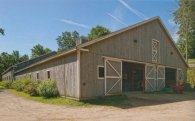
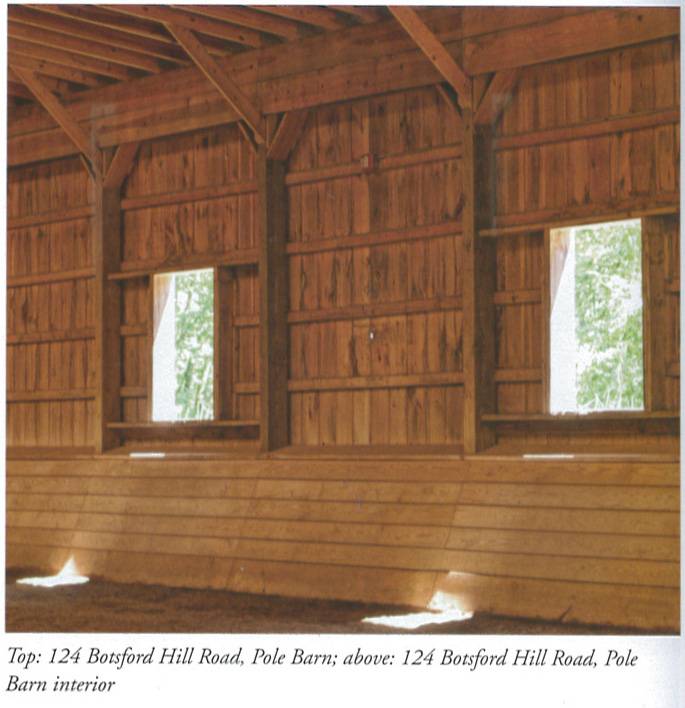
This immense pole barn, fabricated by the Amish barn company, King Construction, is the largest example of its type in Roxbury. The 16-stall barn is a horse boarding facility. The handsome barn is especially notable for its large indoor riding arena. The property encompasses a number of several hillside paddocks, which allow the horses to work their back muscles.
The barn stands about ¼ mile down an incline drive running east off Botsford Hill Road at the intersection of Judge Road. It is wooded to the east but otherwise the site is largely cleared. The paddock, turn out and outdoor arena are located to the south, with paddocks on a hill to west, and a garage to the east. The donkey barn is located up the driveway to the east. Features include: 60 x 220; peak-roofed pole barn stands with its gable ends to the north and south; building consists of two sections: the taller indoor riding arena (60 x 120) to the south, and the slightly lower stable section (60 x 100), telescoping to the north; hip-roofed louvered cupola centered on roof ridge of each block; north gable end symmetrically massed with two pairs of roller doors on exterior mounts; loft door with crossed stiles centered above; hinged window sash (16 panes); skylights; southern yellow pine frame set in concrete bases; pre-fabricated trusses; center-aisle plan; 8 stalls on each side for total of 16, plus office in stable section; vertical tongue-and-groove barn board; gray stained exterior with white painted trim.
Historical significance:Most ground-level stable barns and free-stall dairy barns built since the 1970s have no hayloft. Instead, the roofs are supported by prefabricated wooden trusses covered with metal roofing. While most single-story truss-roofed barns in New England are constructed with concrete foundations and stud-framed walls, pole barns with open sides are becoming popular, especially for sheltering large herds of dairy cows, heifers, and beef cattle. Many of these large truss-roofed structures are free-stall barns, introduced in the late 1940s.
Field Notes
Information from a survey of Roxbury by Rachel Carley. The property was part of Golden Harvest Farm, which was subdivided in the mid-1980s. The name Second Act is a reference to the owner’s first career as an actress.
- Use & Accessibility
Use (Historic)
Use (Present)
Exterior Visible from Public Road?
Yes
Demolished
n/a
Location Integrity
Unknown
- Environment
Related features
Environment features
Relationship to surroundings
n/a
- Typology & Materials
-
Building Typology
Materials
Structural System
Roof materials
Roof type
Approximate Dimensions
Barn I: 10 x 10, Barn II: 60 x 220.
- Source
-
Date Compiled
06/30/2011
Compiled By
Rachel D. Carley - CH
Sources
Carley, Rachel D., Barn Stories from Roxbury Connecticut, Roxbury Historic District Commission/Town of Roxbury/CT Commission on Culture & Tourism, 2010.
Cunningham, Jan, Roxbury, A Historic and Architectural Survey, Roxbury Historic District Commission, 1996-97.
Sexton, James, PhD; Survey Narrative of the Connecticut Barn, Connecticut Trust for Historic Preservation, Hamden, CT, 2005, http://www.connecticutbarns.org/history.
Visser, Thomas D.,Field Guide to New England Barns and Farm Buildings, University Press of New England, 1997, 213 pages.
- PhotosClick on image to view full file
-