Barn Record Roxbury
RETURN TO ‘FIND BARNS’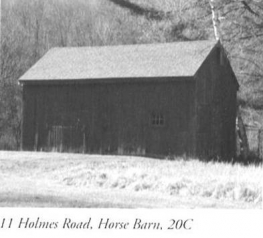
- Overview
-
Designations
n/a
Historic Significance
Architectural description:
Barn I:
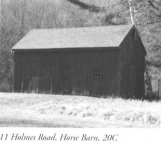
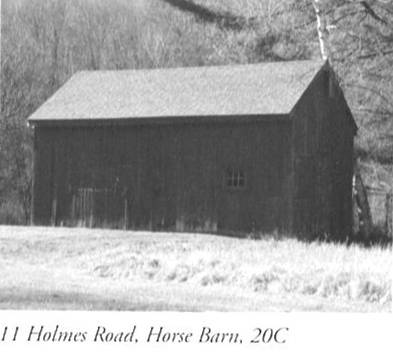
This low-slung outbuilding, probably a pole barn, was originally used as a horse barn. The west gable bay has been enclosed. During the 19th century, this farmstead was associated with the Newton and Hurd families, but neither barn here dates from that period. The barn stands on the west side of Holmes Road to the north of the c. 1770 house on this property. A smaller barn is located to the southwest. The site is open meadow. Features include: 1,800 square foot; peak-roofed barn stands with gable ends oriented to the north and south; low-pitched roof and broad gable ends; south gable end serves as main elevation; central open bay set under peak; open bay to right (east); west bay enclosed; shed-roof carport extends west from southwest corner.
Barn II:
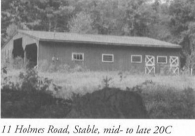
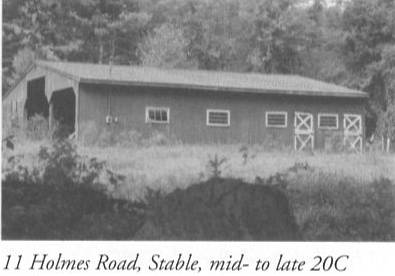
This barn was probably built in the second half of the 20th century, but its trim lines and simple profile evoke a traditional form and it contributes to the landscape. The barn stands on the west side of Holmes Road, to the north of the c. 1770 house. A larger horse barn is located to the northeast. It is fronted by lawn and wooded to the north. Features include: 28 x 16; peak-roofed barn stands with gable ends oriented to the east and west; primary elevation faces south; double (Dutch) door set off-center to the west; single 6-pane window to east; loft door in east gable end; flat-roofed, two-bay wing (open bays) extends north from northwest corner; wood frame; vertical tongue-and-groove barn board; red paint.
Historical significance:Most ground-level stable barns and free-stall dairy barns built since the 1970s have no hayloft. Instead, the roofs are supported by prefabricated wooden trusses covered with metal roofing. While most single-story truss-roofed barns in New England are constructed with concrete foundations and stud-framed walls, pole barns with open sides are becoming popular, especially for sheltering large herds of dairy cows, heifers, and beef cattle. Many of these large truss-roofed structures are free-stall barns, introduced in the late 1940s.
The oldest barns still found in the state are called the “English Barn,” “side-entry barn,” “eave entry,” or a 30 x 40. They are simple buildings with rectangular plan, pitched gable roof, and a door or doors located on one or both of the eave sides of the building based on the grain warehouses of the English colonists’ homeland. The name “30 by 40” originates from its size (in feet), which was large enough for 1 family and could service about 100 acres. The multi-purpose use of the English barn is reflected by the building’s construction in three distinct bays - one for each use. The middle bay was used for threshing, which is separating the seed from the stalk in wheat and oat by beating the stalks with a flail. The flanking bays would be for animals and hay storage.
Field Notes
Information from a survey of Roxbury by Rachel Carley.
- Use & Accessibility
Use (Historic)
Use (Present)
Exterior Visible from Public Road?
Yes
Demolished
n/a
Location Integrity
Unknown
- Environment
Related features
Environment features
Relationship to surroundings
n/a
- Typology & Materials
-
Building Typology
Materials
Structural System
Roof materials
Roof type
Approximate Dimensions
Barn I: 1800 square feet, Barn II: 28 x 16.
- Source
-
Date Compiled
06/30/2011
Compiled By
Rachel D. Carley - CH
Sources
Carley, Rachel D., Barn Stories from Roxbury Connecticut, Roxbury Historic District Commission/Town of Roxbury/CT Commission on Culture & Tourism, 2010.
Cunningham, Jan, Roxbury, A Historic and Architectural Survey, Roxbury Historic District Commission, 1996-97.
Sexton, James, PhD; Survey Narrative of the Connecticut Barn, Connecticut Trust for Historic Preservation, Hamden, CT, 2005, http://www.connecticutbarns.org/history.
Visser, Thomas D.,Field Guide to New England Barns and Farm Buildings, University Press of New England, 1997, 213 pages.
- PhotosClick on image to view full file
-