Barn Record Roxbury
RETURN TO ‘FIND BARNS’- Building Name (Common)
- John Pokrywka Farm
- Building Name (Historic)
- John Pokrywka Farm
- Address
- 35 Judge Road, Roxbury
- Typology
- Overview
-
Designations
n/a
Historic Significance
Architectural description:
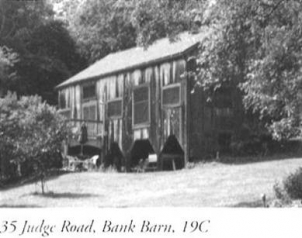
The barn originated as a hay and cow barn and was used as such by the Pokrywka family. The basic lines of the barn are intact; otherwise the building has been significantly altered, as the windows and chimney are not original. The building stands on an elevated site on the west side of a driveway forking south off Judge Road. The drive continues to 51 Judge Road. There is open land and private golf holes to the west. Features include: 58 x 24; building stands with gable ends oriented to the north and south; primary elevation faces east to drive; structure adjusts to sloping site so that it gains a lower level on the long, west side and north gable end; fieldstone foundation and chimney; open lower level to south paved with fieldstone and accessed by three beveled, arched bays; stone fireplace on north wall; one-story shed-roofed wing at north gable end; varied fenestration, including paired 6-pane sash; canted window lintels throughout; two doors, east elevation; deck, west elevation; post-and-beam; vertical tongue-and groove barn board.
Historical significance:The oldest barns still found in the state are called the “English Barn,” “side-entry barn,” “eave entry,” or a 30 x 40. They are simple buildings with rectangular plan, pitched gable roof, and a door or doors located on one or both of the eave sides of the building based on the grain warehouses of the English colonists’ homeland. The name “30 by 40” originates from its size (in feet), which was large enough for 1 family and could service about 100 acres. The multi-purpose use of the English barn is reflected by the building’s construction in three distinct bays - one for each use. The middle bay was used for threshing, which is separating the seed from the stalk in wheat and oat by beating the stalks with a flail. The flanking bays would be for animals and hay storage.
The 19th century saw the introduction of a basement under the barn to allow for the easy collection and storage of a winter’s worth of manure from the animals sheltered within the building. The bank barn is characterized by the location of its main floor above grade, either through building into a hillside or by raising the building on a foundation. This innovation, aided by the introduction of windows for light and ventilation, would eventually be joined by the introduction of space to shelter more animals under the main floor of the barn.Field Notes
Information from a survey of Roxbury by Rachel Carley. Charles Tyrell bought this farm from David Wheeler in 1871. This barn, remodeled as a residence, may date from the Tyrell ownership and was originally part of a property that included the farmhouse at 51 Judge Road (at the end of the drive). The Pokrywkas, who bought the farm in 1904, are among the best known farmers in recent memory in Roxbury. The family patriarch, John Pokrywka, and his wife Mary were Polish immigrants who came to America in the late 1800s. They raised corn and potatoes here before selling this property in 1919 and moving to 97 Botsford Hill Road.
- Use & Accessibility
Use (Historic)
Use (Present)
Exterior Visible from Public Road?
Yes
Demolished
n/a
Location Integrity
Unknown
- Environment
Related features
n/a
Environment features
Relationship to surroundings
n/a
- Typology & Materials
-
Building Typology
Materials
Structural System
Roof materials
Roof type
Approximate Dimensions
58 x 24
- Source
-
Date Compiled
06/30/2011
Compiled By
Rachel D. Carley - CH
Sources
Carley, Rachel D., Barn Stories from Roxbury Connecticut, Roxbury Historic District Commission/Town of Roxbury/CT Commission on Culture & Tourism, 2010.
Cunningham, Jan, Roxbury, A Historic and Architectural Survey, Roxbury Historic District Commission, 1996-97.
Sexton, James, PhD; Survey Narrative of the Connecticut Barn, Connecticut Trust for Historic Preservation, Hamden, CT, 2005, http://www.connecticutbarns.org/history.
Visser, Thomas D.,Field Guide to New England Barns and Farm Buildings, University Press of New England, 1997, 213 pages.
- PhotosClick on image to view full file
-