Barn Record Roxbury
RETURN TO ‘FIND BARNS’- Building Name (Common)
- n/a
- Building Name (Historic)
- n/a
- Address
- 122 North Street (Rte 199), Roxbury
- Typology

- Overview
-
Designations
n/a
Historic Significance
Architectural description:
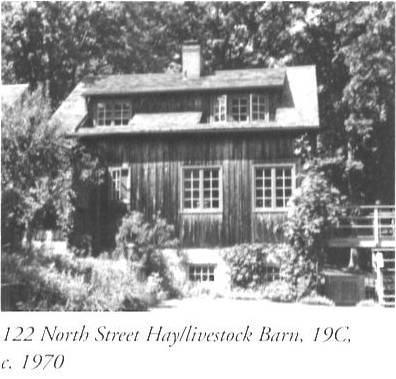
The southeast section of this interesting house was used as a rustic summer dwelling, or “camp,” beginning in the 1930s. Although the building’s history is uncertain, the hewn timber-frame construction suggests that it may have originated as a 19th-century barn, possibly part of the Alson Bradley farm (120 North Street), which abuts this property to the south. If that is the case, the stone fireplace, with a date of 1938 on the hearth, would have been added when the barn was converted for use as the camp. The existence of a rear shed-roof wing, which served as a simple kitchen, also suggests that this structure was a barn. The northeastern rear section, set perpendicular to the front section, originated as barn, which was dismantled by the interior designer Paul Leonard in Bethlehem, CT., and moved here and partially reconstructed using original framing members. This occurred in the 1960s, when Leonard was converting the old summerhouse into a year-round residence.
The house stands at the end of a long drive running up a gradual rise on the east side of North Street. It is a residential property with lawn, shade trees and gardens, wooded at the borders. A swimming pool is set into a lower, terraced garden area to south of the barn addition. Features include: 36 x 22; 24 x 12; 30 x 28; house consists of two perpendicular peak-roofed blocks with a hyphen connector joining them at their southwest and northeast corners. Northeastern block: set with gables to the east and west, is a timber-framed barn, moved to this site, connected to an existing structure and converted to use as a residential addition; east section stands on a foundation of dressed stone; adjusts to sloping site so that it banks to east and gains lower half story; shed dormers project on north and south roof planes; central brick chimney; fenestration primarily pairs of 8-pane casement window sash; hewn post-and-beam frame (square rule). Southwestern block: pre-existing structure set with its gable ends to the north and south; fieldstone chimney at south gable end; fenestration primarily pairs of 8-pane casement window sash; hewn post-and-beam frame (square rule); vertical tongue-and-groove barn board.
Historical significance:The oldest barns still found in the state are called the “English Barn,” “side-entry barn,” “eave entry,” or a 30 x 40. They are simple buildings with rectangular plan, pitched gable roof, and a door or doors located on one or both of the “eave” sides of the building based on the grain warehouses of the English colonists’ homeland. The New England barn or gable front barn was the successor to the English barn and relies on a gable entry rather than an entry under the eaves. The gable front offers many practical advantages. Roofs drain off the side, rather than flooding the dooryard. Although it was seen by many as an improvement over the earlier side entry English Barn, the New England barn did not replace its predecessor but rather coexisted with it. It this case, both an eave entry and a gable entry are used.
Field Notes
Information from a survey of Roxbury by Rachel Carley.
- Use & Accessibility
Use (Historic)
Use (Present)
Exterior Visible from Public Road?
Yes
Demolished
n/a
Location Integrity
Moved
- Environment
Related features
n/a
Environment features
Relationship to surroundings
n/a
- Typology & Materials
-
Building Typology
Materials
Structural System
Roof materials
Roof type
Approximate Dimensions
36 x 22, 24 x 12, 30 x 28
- Source
-
Date Compiled
06/30/2011
Compiled By
Rachel D. Carley - CH
Sources
Carley, Rachel D., Barn Stories from Roxbury Connecticut, Roxbury Historic District Commission/Town of Roxbury/CT Commission on Culture & Tourism, 2010.
Cunningham, Jan, Roxbury, A Historic and Architectural Survey, Roxbury Historic District Commission, 1996-97.
Sexton, James, PhD; Survey Narrative of the Connecticut Barn, Connecticut Trust for Historic Preservation, Hamden, CT, 2005, http://www.connecticutbarns.org/history.
Visser, Thomas D.,Field Guide to New England Barns and Farm Buildings, University Press of New England, 1997, 213 pages.
- PhotosClick on image to view full file
-