Barn Record Roxbury
RETURN TO ‘FIND BARNS’
- Overview
-
Designations
n/a
Historic Significance
Architectural description:
Barn I:
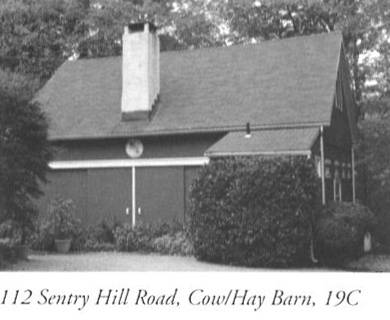
A good example of a barn remodeled for residential use; this one serves as additional living space on this property. The Davidsons were likely the builders of this barn, which stands on the south side of Sentry Hill Road, just to the northwest of the house on this property. A pond is located down a hill to the west. Features include: 24 x 33; peak-roofed barn stands with its gable ends oriented to the northeast and southwest; primary elevation faces northeast; exterior roller doors centered under brick chimney; one-story shed-roofed wing at north corner; new fenestration at gable ends and southwest elevation; post-and-beam; vertical tongue-and-groove barn board; green paint with white trim.
Barn II:
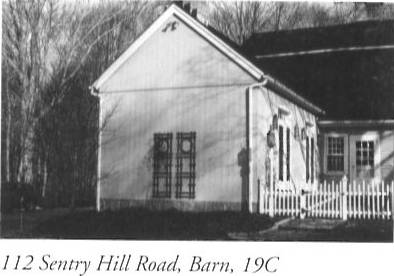
This barn may have been a backhouse, but was more likely moved to its current location for remodeling as living space. The barn extends from the rear, northwest corner of the house. A freestanding barn on this property stands to the west. Features include: 20 x 30; peak-roofed ell extends westward from the northwest corner of the house; simple rectangular silhouette; dressed granite foundation; two pair French doors centered on south elevation; pair of new double-hung windows (6-over-6) with canted lintels centered on north elevation; post-and-beam; vertical tongue-and-groove barn board; green paint with white trim.
Historical significance:The oldest barns still found in the state are called the “English Barn,” “side-entry barn,” “eave entry,” or a 30 x 40. They are simple buildings with rectangular plan, pitched gable roof, and a door or doors located on one or both of the eave sides of the building based on the grain warehouses of the English colonists’ homeland. The name “30 by 40” originates from its size (in feet), which was large enough for 1 family and could service about 100 acres. The multi-purpose use of the English barn is reflected by the building’s construction in three distinct bays - one for each use. The middle bay was used for threshing, which is separating the seed from the stalk in wheat and oat by beating the stalks with a flail. The flanking bays would be for animals and hay storage.
Connected barns tied all of the functions of a farmstead - home, hearth, workplace and barn - into a series of linked buildings. This is the “big house, little house, back house, barn” of nursery rhymes.
Field Notes
Information from a survey of Roxbury by Rachel Carley. The property is significant as the home to Remember Baker Jr., one of the Green Mountain Boys led by Ethan Allen and Seth Warner in a successful bid to capture Fort Ticonderoga and Crown Point on Lake Champlain in 1775. Among the later owners were Treat Davidson and his daughter Mary, who lived here for much of the 1800s.
- Use & Accessibility
Use (Historic)
Use (Present)
Exterior Visible from Public Road?
Yes
Demolished
n/a
Location Integrity
Unknown
- Environment
Related features
Environment features
Relationship to surroundings
n/a
- Typology & Materials
-
Building Typology
Materials
Structural System
Roof materials
Roof type
Approximate Dimensions
Barn I: 24 x 33, Barn II: 20 x 30.
- Source
-
Date Compiled
06/30/2011
Compiled By
Rachel D. Carley - CH
Sources
Carley, Rachel D., Barn Stories from Roxbury Connecticut, Roxbury Historic District Commission/Town of Roxbury/CT Commission on Culture & Tourism, 2010.
Cunningham, Jan, Roxbury, A Historic and Architectural Survey, Roxbury Historic District Commission, 1996-97.
Sexton, James, PhD; Survey Narrative of the Connecticut Barn, Connecticut Trust for Historic Preservation, Hamden, CT, 2005, http://www.connecticutbarns.org/history.
Visser, Thomas D.,Field Guide to New England Barns and Farm Buildings, University Press of New England, 1997, 213 pages.
- PhotosClick on image to view full file
-