Barn Record Roxbury
RETURN TO ‘FIND BARNS’- Building Name (Common)
- Azen Thomas Homestead
- Building Name (Historic)
- Azen Thomas Homestead
- Address
- 1006 Washington-Woodbury Road (Rte 47), Roxbury
- Typology

- Overview
-
Designations
n/a
Historic Significance
Architectural description:
Barn I:
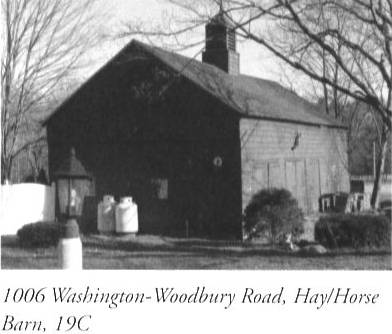
This barn is significant for its beautiful joinery; the hewn frame is particularly notable for the H-bent with its massive hewn free-span beam. The east end contains an old wooden box stall, probably for a workhorse; the main section to the west, clear from floor to rafters, was probably a hay barn. The cupola is not original. The barn may have been built by Azen Thomas.
The barn stands on the north side of the Washington-Woodbury Road (Rte. 47) and to the east of the c. 1790 house on this property; fronted by a parking area. Two sheds stand to the north and northwest. A pool is located to the north, just behind this barn. Features include: 46 x 28; peak-roofed barn stands with gable ends to the east and west; primary elevation faces south; three pair of hinged doors with strap hinges arranged to left of center; scattered single-paned windows; roller doors at east gable and northwest corner; loft door, north side; four-sided louvered cupola on shingled base, pagoda roof; deck at northeast corner; wood shingle; red paint. Interior: hewn post-and-beam frame (square rule); H-bent; king-post construction at west gable; wood stall at east end; loft above; concrete floor.
Barn II:
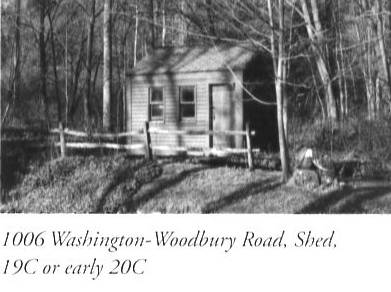
A contributing building to the farmstead, this shed is significant for its hewn post-and-beam frame. The shed stands on the north side of the Washington-Woodbury Road (Rte. 47) and to the north of the c. 1790 house on this property; reached by crossing a bridge spanning a brook. The site is wooded to the north. Features include: 14 x 12; peak-roofed shed stands with gable ends to the east and west; primary elevation faces south; vertical-board door on strap hinges set to right of two one-over-one double-hung windows; granite threshold stone; wood-plank floor; post-and-beam; clapboard.
Barn III:
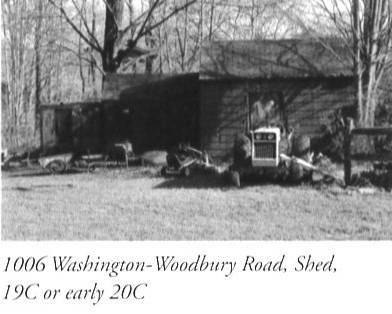
A contributing building to the farmstead, this shed is significant for its hewn post-and-beam joinery; it may have originated as a woodshed. The shed stands on the north side of the Washington-Woodbury Road (Rte. 47), to the north of the barn and pool. The site is wooded to the north. Features include: 12 x 18, 8 x 4, 16 x 4; peak-roofed shed stands with gable ends to the north and south; south gable end serves as primary elevation; vertical-board door to left (west) of one-over-one double-hung sash window; sealed door opening on west elevation; low, peaked-roof ell with single door projects from north gable end; wire-screened animal pen at north end; long, low ell projects to east; main interior has hewn post-and-beam frame with a log at each corner (rafters replaced); concrete floor; post-and-beam; wood shingle.
Historical significance:The oldest barns still found in the state are called the “English Barn,” “side-entry barn,” “eave entry,” or a 30 x 40. They are simple buildings with rectangular plan, pitched gable roof, and a door or doors located on one or both of the eave sides of the building based on the grain warehouses of the English colonists’ homeland. The name “30 by 40” originates from its size (in feet), which was large enough for 1 family and could service about 100 acres. The multi-purpose use of the English barn is reflected by the building’s construction in three distinct bays - one for each use. The middle bay was used for threshing, which is separating the seed from the stalk in wheat and oat by beating the stalks with a flail. The flanking bays would be for animals and hay storage.
A shed is typically a simple, single-story structure in a back garden or on an allotment that is used for storage, hobbies, or as a workshop. Sheds vary considerably in the complexity of their construction and their size, from small open-sided tin-roofed structures to large wood-framed sheds with shingled roofs, windows, and electrical outlets. Sheds used on farms or in industry can be large structures.
Field Notes
Information from a survey of Roxbury by Rachel Carley. Azen Thomas (b. 1798) was living at this farmstead by the time the 1840 census was recorded. By 1870 the farm, then owned by Horace Warner (1831-1911), was comprised of more than 100 acres.
- Use & Accessibility
Use (Historic)
Use (Present)
Exterior Visible from Public Road?
Yes
Demolished
n/a
Location Integrity
Unknown
- Environment
- Typology & Materials
-
Building Typology
Materials
Structural System
Roof materials
Roof type
Approximate Dimensions
Barn I: 46 x 28, Barn II: 14 x 12, Barn III: 12 x 18, 8x 4, 16 x 4.
- Source
-
Date Compiled
06/30/2011
Compiled By
Rachel D. Carley - CH
Sources
Carley, Rachel D., Barn Stories from Roxbury Connecticut, Roxbury Historic District Commission/Town of Roxbury/CT Commission on Culture & Tourism, 2010.
Cunningham, Jan, A Historic and Architectural Resource Survey of the Town of Roxbury, 1996-97.
Sexton, James, PhD; Survey Narrative of the Connecticut Barn, Connecticut Trust for Historic Preservation, Hamden, CT, 2005, http://www.connecticutbarns.org/history.
Visser, Thomas D.,Field Guide to New England Barns and Farm Buildings, University Press of New England, 1997, 213 pages.
- PhotosClick on image to view full file
-