Barn Record Bridgewater
RETURN TO ‘FIND BARNS’- Building Name (Common)
- Housatonic Valley View Farm - Part 2 of 2
- Building Name (Historic)
- The Hatch Homestead - Part 2 of 2
- Address
- 5 Hatch Road, Bridgewater
- Typology
- Overview
-
Designations
Historic Significance
Architectural Description:
Barn:
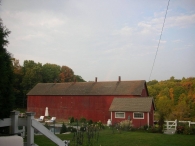
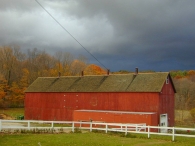
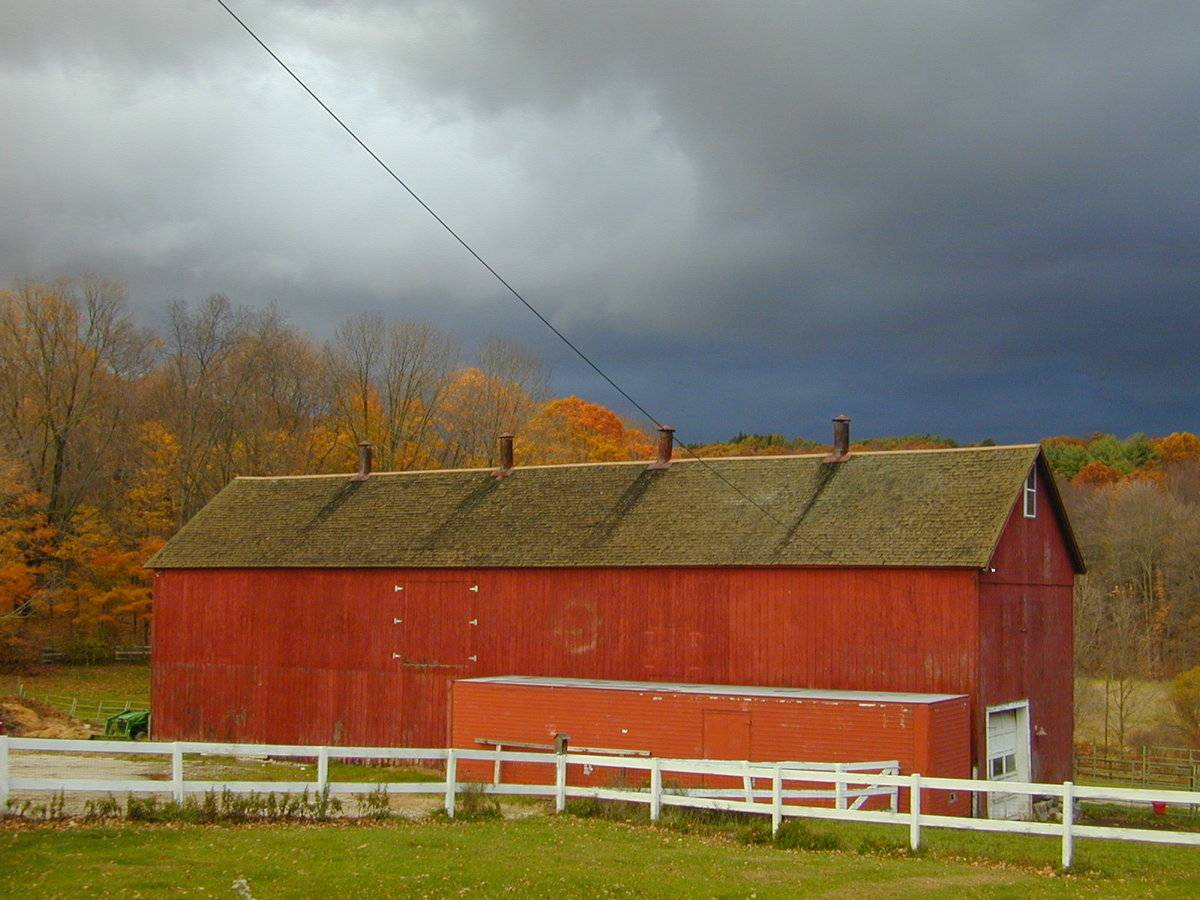
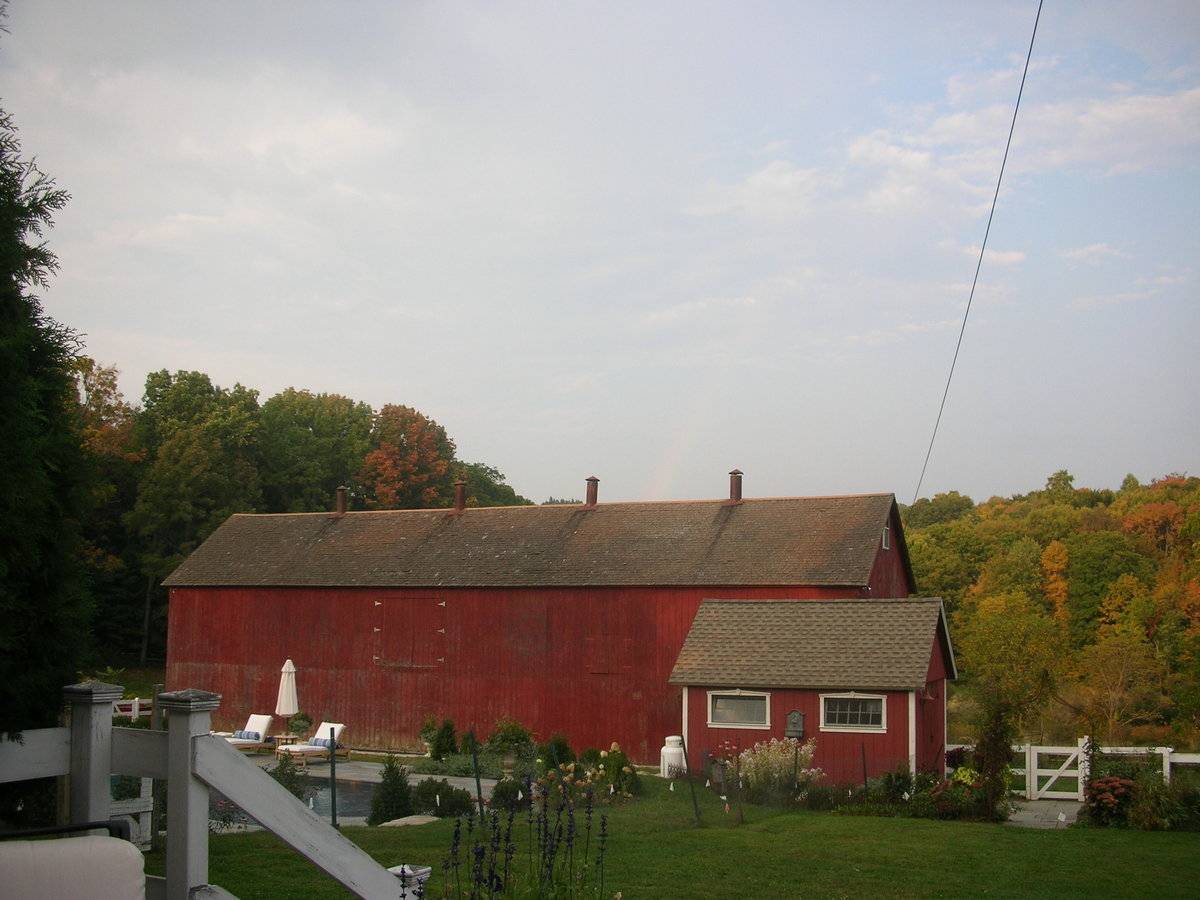
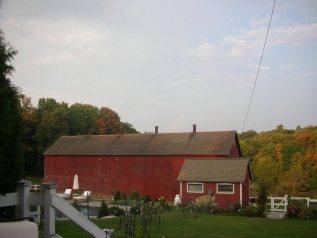
This is a 2 ½ -story three bay English barn measuring roughly 30’ x 40’. Its ridge-line is oriented north-south parallel to this section of Hatch Road. The frame building stands on concrete block piers, these visible on the eastern side of the barn where the grade of the property drops to the east. The siding consists of vertical wood boards, these painted dark red with white trim. The barn’s gable roof is sheathed in horizontally laid rough-sawn boards, plywood, and asphalt shingles.
Exterior:
The barn’s main entry consists of a large single-story height sliding door centered on the west eave-side. The door is mounted on an exterior track running to the north. The batten-style doors are framed on the interior. The bay north of the entry is blank and there is a single six-pane window centered in the southern bay. Above the entry there is a centered hay door on an exterior track running to the south. The northern bay of the upper level is blank while in the southern bay there is a single six-pane window offset towards the south.
The ground level of the south gable-end of the barn has three small high irregularly spaced four-pane stable-type windows. There is a sliding hay door centered on the upper level. This is mounted on an exterior track that runs to the west. A flat-arched girt-line siding divide runs along the attic level and there is a large hay door in the gable. The opening’s double doors swing outward on side hinges and there is a projecting hay track above.
The east eave-side of the barn is unbroken. As noted, concrete block piers support the building as the grade drops to the south, thus revealing the underside of the barn’s main floor level.
There is a single sliding door on the western side of the north gable-end of the barn. The door is mounted on an exterior track that runs to the east. There is a fixed, six-pane window east of the entry, and two evenly spaced six-pane windows in the upper level above. A flat-arched girt-line siding divide runs along the attic level. Another six-pane window is located in the gable.Interior:
The interior ground level of the barn consists of a center bay flanked to the south by an open bay used for storage, and to the north by an enclosed workshop bay. Two lateral girders run east-west, these supporting floor joists for an upper level loft running north-south in all three bays.
The interior of the upper level reveals two interior bents – a square rule post and beam frame with dropped tie-girts and diagonal bracing. The framing is a mix of hand-hewn and circular-sawn timbers, these with pegged mortise and tenon joinery. The interior bents are joined by end-girts on the north and south gable-ends. Four interior queen posts rise to purlin plates running north-south the length of the building. The plates are braced by cross-ties pegged to the queen posts, the latter likewise braced by to the exterior walls by tie members which sit above the rafter plates. This framing arrangement creates a center aisle flanked by side aisles running longitudinally north-south. The common rafters are circular-sawn and meet at a ridge board where they are nailed in place. A hay track with intact fork runs along the ridge board for the length of the building. In general, the majority of the main level framing appears to be of original construction, however, the flooring has been replaced with circular-sawn joists and tongue-and-groove boards. The dropped tie-girts below the level of the purlin plates appear to be repaired, as if they had been removed for convenience of using the hay fork, and then replaced in a modern repair.Tobacco shed:
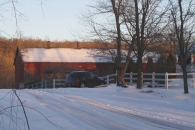
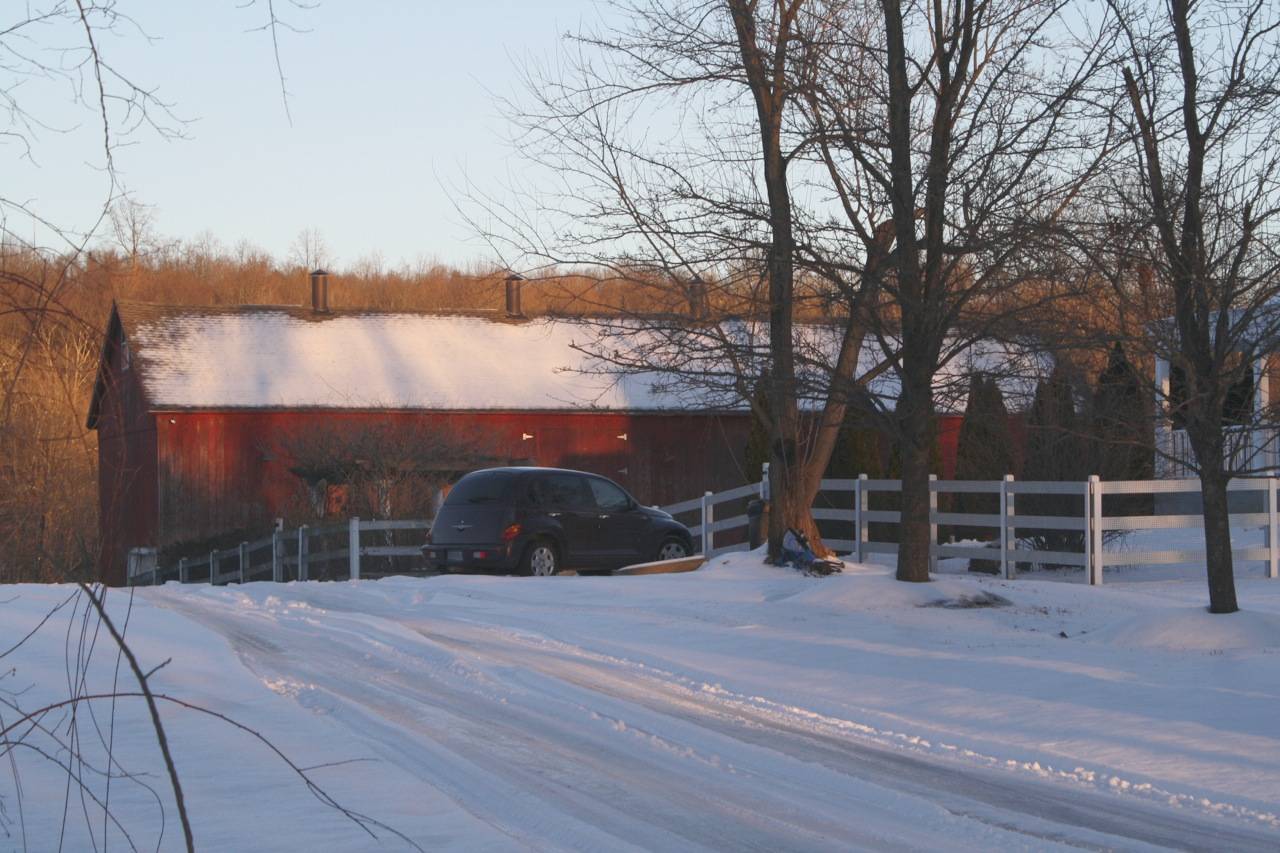
This is a 1 ½-story gable-roofed tobacco shed converted for use as a horse barn. The shed has seven bents and six bays and is approximately 25’ x 90’. The ridgeline of the shed runs north-south. The primary entry is located on the south gable-end. The entry door consists of an offset, one-bay, roll-up, garage-style door. The shed has a mortared and dry-laid fieldstone foundation and its siding consists of vertical wood boards overlain with a second layer variously of tongue-and-groove boards or grooved plywood siding, these painted dark red with white trim. The shed’s gable roof is sheathed in horizontally laid, rough-sawn boards, plywood, and asphalt shingles. Four copper ventilators with conical caps are evenly spaced along the shed’s roofline.
Interior:
The south and north gable-end roll-up doors and west eave-side pass-through door access the interior of the shed, which consists of a two-aisle tobacco shed layout, with the eastern aisle having been filled in with six horse stalls. The shed has a poured concrete floor throughout.The interior of the upper level reveals a seven-bent six-bay, square rule post and beam frame with dropped tie-girts and diagonal bracing. The framing is a mix of hand-hewn and circular-sawn timbers, these with pegged mortise and tenon joinery. Each of the seven bents has a center post, these joined to the exterior posts by a set of lower tie-girts, probably intended as supports for the loose poles on which tobacco was hung. Two of the tie-girts on the west side of the shed have been removed to facilitate movement in the center of the upper level. Additional horizontal rails have been added throughout the shed in order to assist in the support of hanging tobacco to cure. Slender queen posts rise from the five interior bents to the roof, but these do not support any purlin plates. The roof is comprised of common rafters butted at the ridge.
The original exterior sheathing has been covered with a layer of modern siding; however, from the interior it can be seen that three pairs of boards in each bay are nailed together with rectangular wood blocks, suggesting that the shed was ventilated via a system in which these pairs were hinged along either their sides or top edges and opened like long doors or narrow awnings.
• Historical or Architectural importance:
Applicable Connecticut State Register Criteria:
Housatonic Valley View Farm is significant for its two intact historic barns, its intact 19th-century Greek Revival farmstead house owned by an over 160-year lineage of one Bridgewater farming family, and by its preserved landscape setting. The barns include a 19th-century English barn and a 19th-century tobacco shed, both significant for their use of hand-hewn structural timbers.
Field Notes
Listed on the State Register of Historic Places 6/04/2014. significant for its two intact historic barns, its 19th-century Greek Revival-style farmstead house owned by a single Bridgewater farming family for over 160 years, and by its preserved landscape setting. The barns include a 19th-century English barn and a 19th-century tobacco shed, both significant for their use of hand-hewn structural timbers. See also Part I: Record No. 46506
- Use & Accessibility
- Environment
Related features
Environment features
Relationship to surroundings
The property, with its barn, tobacco shed, and associated house and outbuildings, is sited on a 500-foot high ridge that rises east of the Housatonic River, and west of the Shepaug River. The property is located approximately 1.25 miles northwest of the Bridgewater Center National Register Historic District, which is located along Clapboard Road, Hat Shop Hill, Main Street surrounding the Bridgewater Green.
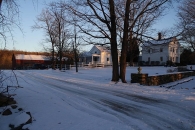
An English barn is located in proximity to the southern boundary of the property and is sited some 125’ east of Hatch Road, 150’ northeast of Route 67, roughly 60’ southeast of the Farmhouse, and 130’ southwest of a Tobacco shed. A gravel driveway runs west-east from the road and south of the Farmhouse before it splits into a parking area flanking the north gable-end and west eave-side of the Barn.
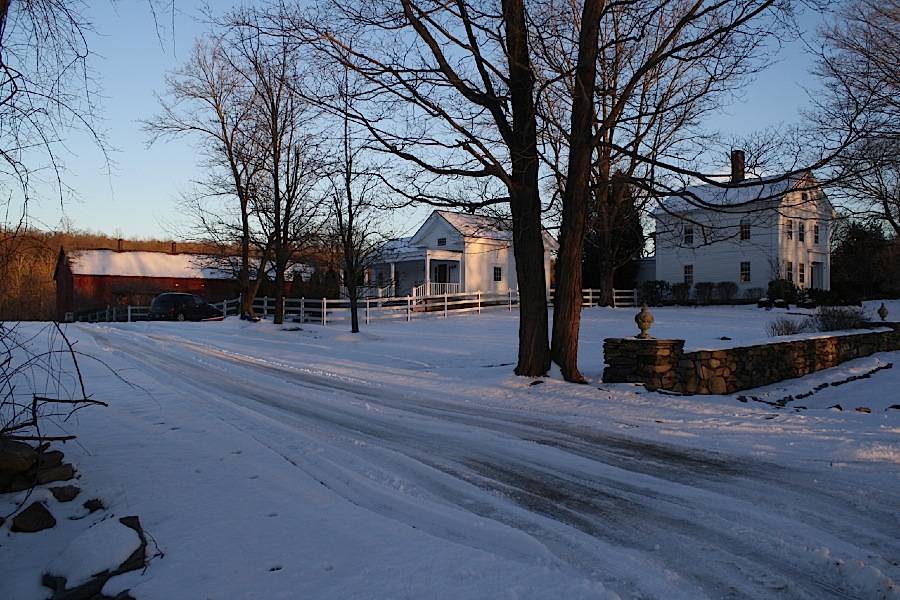
The Farmhouse is a 2 ½ -story, three-bay, front-gabled Greek Revival-style residence erected c. 1849. The main block of the house measures approximately 25’ x 29’ and faces Hatch Road with its ridge-line oriented roughly east-west. The house has a square-cut stone foundation, horizontal board siding, wood corner pilasters and window trim, six-over-six double-hung sash, wide frieze, pedimented gable roof with recessed tympanum and horizontally-oriented multi-pane window, and a central brick masonry chimney. The three-bay west gable-end consists of an offset and recessed entry with one double-hung window in each of the two bays to the north and one in each of the three bays on the second story. The Greek Revival-style door surround consists of molded pilasters with a denticulated entablature. The recessed entry is flanked by four-pane sidelights and there is a six-pane transom light above. There is a roughly 32’ x 18’, 1 ½-story side-gabled ell adjoining the southeast corner of the main block. The details of the ell largely mimic those of the main block, however, there is a row of four three-pane attic-story windows just below the roof-line on the west eave-side and cornice returns rather than a pedimented gable on the south gable-end. A shed-roofed dormer extends across the east eave-side of the ell, below which there is a 1-story cross-gable block, this measuring 12’ x 14’, extending to the east.
Two additional frame buildings are located northwest and west of the Farmhouse and east of the Tobacco shed. One is a 1 ½-story guesthouse erected in 2012 to replace a chicken coop formerly located on the site. The main block of the new structure measures roughly 15’ x 25’ and there is a 19’ x 13’ cross-gable ell adjoining its east eave-side. The building simulates the profile and massing, as well as the Greek Revival character, of the Farmhouse. It has a poured concrete foundation, horizontal board siding, wood corner boards and window trim, six-over-six double-hung sash, and a gable roof. Between the Guesthouse and the Tobacco shed there is a 20’ x 50’ in-ground swimming pool, directly southeast of which there is a 1-story frame shed measuring 13’ x 18’. The shed has a front-gabled roof, this oriented south-north, side-hinged double doors with multi-pane transom on its south gable-end, and vertical board siding painted dark red with white trim.- Typology & Materials
-
Building Typology
Materials
Structural System
n/a
Roof materials
Roof type
Approximate Dimensions
n/a
- Source
-
Date Compiled
07/30/2011
Compiled By
Lucas Karmazinas, reviewed by CT Trust
Sources
Photographs and field notes by Lucas A. Karmazinas, 3/11/2013.
Interview with Dana Wiehl, owner, 3/11/2013, at the site.Town of Bridgewater Assessor’s Records, Bridgewater Town Hall
Parcel ID: Map 28/35Aerial views from:
http://maps.google.com/ and http://www.bing.com/maps/ accessed 3/11/2013.
Historical aerial photography and maps accessed at UConn MAGIC:
http://magic.lib.uconn.edu/mash_up/1934.html
http://magic.lib.uconn.edu/historical_maps_connecticut_towns.html .
USGS Historical Maps at http://historical.mytopo.com/ accessed 3/11/2013.
UTM coordinates: http://itouchmap.com/latlong.html .Bridgewater Historical Society, Landmarks of Bridgewater, Bridgewater Historical Society, Bridgewater, CT, 1958.
Connecticut State Library online: iconn.org or http://www.cslib.org/iconnsitemap/staff/SiteIndex.aspx#directoriesKurumi: Connecticut Roads web site: http://www.kurumi.com/roads/ct/towns/bridgewater.html .
Sexton, James, PhD; Survey Narrative of the Connecticut Barn, Connecticut Trust for Historic Preservation, Hamden, CT, 2005, http://www.connecticutbarns.org/history.
Visser, Thomas D., Field Guide to New England Barns and Farm Buildings, University Press of New England, 1997.
- PhotosClick on image to view full file
-