Barn Record Roxbury
RETURN TO ‘FIND BARNS’
- Overview
-
Designations
Historic Significance
Architectural description:
Barn I:
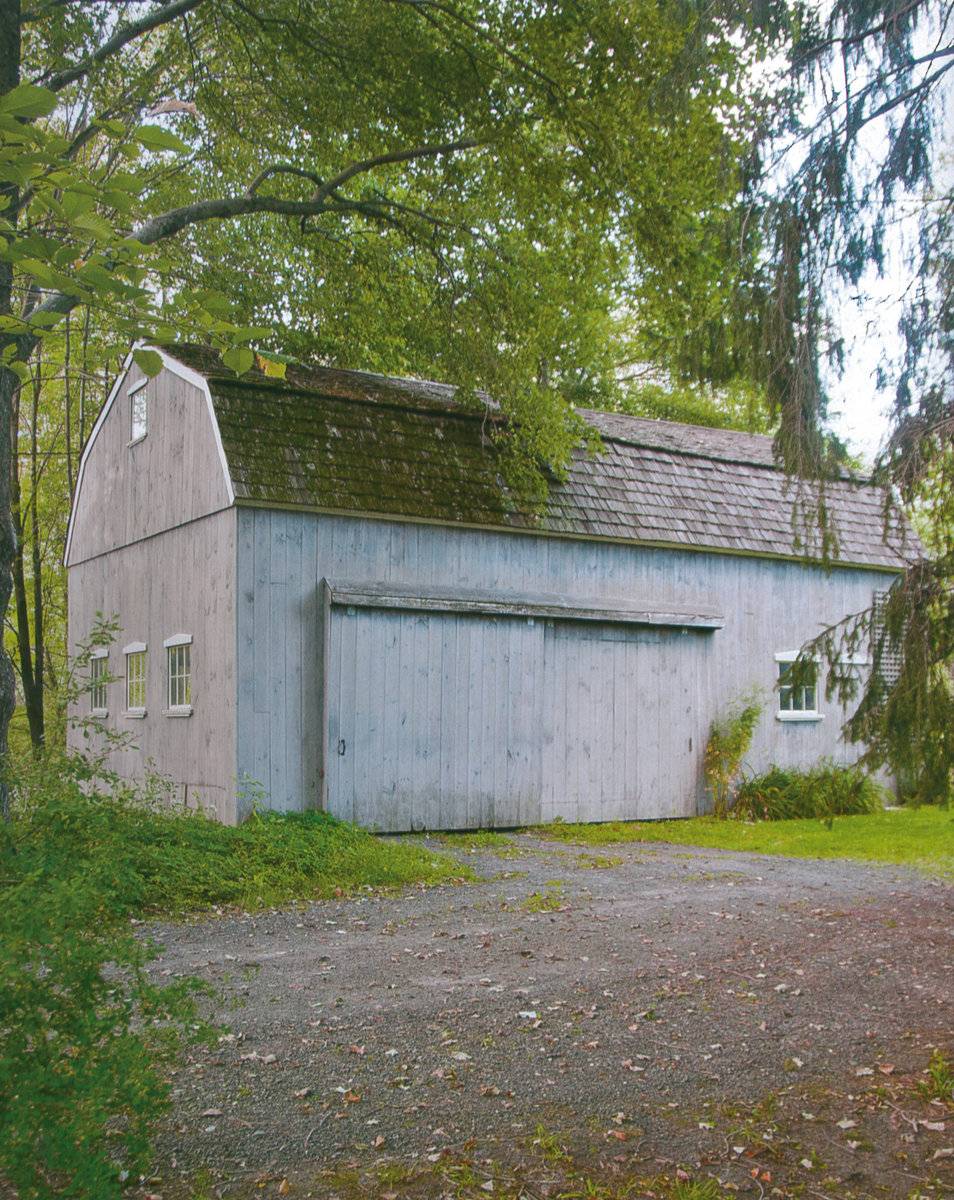
Moved to this site from the Congregational Church property, this fine example of an English barn features a hand-hewn frame and gambrel roof, a roof type rare to early Connecticut barns. The barn is also notable for its substantial timbers, including a massive cross beam some 18” wide. The lack of a ridge pole also suggests an early building date. The doors and windows are not original, and some of the timbers have been repaired or replaced, but overall the integrity of the building is very good. It is a rare survivor, probably from the 1700s.
The barn stands in a grassy clearing among trees to the east of North Street with a drive from North Street. There is a pond to the east. Features include: 34 x 22; gambrel-roofed barn stands with its gable ends to the east and west; primary elevation faces south; rolling wagon doors on exterior mounts set to west of 6-pane window hinged door on strap hinges; five 6-pane windows light north elevation; rolling door, east gable end; canted window lintels; 3 bay plan; post-and-beam (scribe rule); vertical tongue-and-groove barn board; grey stain.
Barn II:
This is an early barn, possibly dating to the ownership of this property by Amos Lathrop (1793-81), who bought the property in 1820 and worked as a hatter. The building is notable for its plank flooring and hewn timbers, including the half-log rafters. The lack of a ridgepole suggests an early building date. There appears to have been a wagon door at one time in the south gable end.
The barn stands on a grassy site on the north side of Church Street, to the east of the house. A small garden fronts it to the west. Features include: 36 x 14; elongated barn stands with gable ends to the north and south; door on iron strap hinges set near north end of west elevation; three 6-over-6 double-hung windows at uneven intervals; south gable end, pair of 6-over-6 double-hung windows set under wide, double-board lintel; canted window lintels; three-bay plan; plank floor; loft at north gable end; hewn post-and-beam framing members (scribe rule); log rafters; dropped girts at gable ends; grey paint.
Barn III:
This narrow backhouse is notable for retaining its original framing members and roof boards despite being remodeled. The structure was almost certainly moved to this location, perhaps from elsewhere on the property, and attached to the house. The framing and lack of ridgepole suggests an early building date, possibly from the late 18th century.
The backhouse is attached to the rear (north) side of the house, located on the north side of Church Street. Features include: 22 x 14; barn stands with gable ends oriented to the north and south; fieldstone foundation; hewn post-and-beam frame; dropped tie beams; untrimmed roof boards; vertical tongue-and-groove barn board; dark gray paint with white trim.
Historical significance:The oldest barns still found in the state are called the “English Barn,” “side-entry barn,” “eave entry,” or a 30 x 40. They are simple buildings with rectangular plan, pitched gable roof, and a door or doors located on one or both of the eave sides of the building based on the grain warehouses of the English colonists’ homeland. The name “30 by 40” originates from its size (in feet), which was large enough for 1 family and could service about 100 acres. The multi-purpose use of the English barn is reflected by the building’s construction in three distinct bays - one for each use. The middle bay was used for threshing, which is separating the seed from the stalk in wheat and oat by beating the stalks with a flail. The flanking bays would be for animals and hay storage.
The gambrel roof design was universally accepted for ground-level stable barns as it enclosed a much greater volume than a gable roof did, and its shape could be formed with trusses that did not require cross beams, which would interfere with the movement and storage of hay. Also known as the curb roof, the double slopes of the gambrel offer more volume in the hayloft without increasing the height of the side walls.
Rather than hurriedly carting large loads of hay from distant fields to the main barn at harvesttime, farmers often found it easier to store New England’s leading crop near its source. Field barns were used to store hay until it was needed during the winter. By waiting until a good snow cover, farmers often found it easier to draw the hay by sled to the main barn to replace that consumed by the herd. During the second half of the nineteenth century, farmers occasionally converted their older, obsolete English barns into field barns by moving them into fields. Some of these field barns had formerly served as sheep barns during the sheep boom of the early nineteenth century.
Connected barns tied all of the functions of a farmstead - home, hearth, workplace and barn - into a series of linked buildings. This is the “big house, little house, back house, barn” of nursery rhymes.
Field Notes
Information from a survey of Roxbury by Rachel Carley. Located in the Roxbury Center National Register and Local Historic District.
- Use & Accessibility
Use (Historic)
Use (Present)
Exterior Visible from Public Road?
Yes
Demolished
n/a
Location Integrity
Moved
- Environment
Related features
Environment features
Relationship to surroundings
n/a
- Typology & Materials
-
Building Typology
Materials
Structural System
Roof materials
Roof type
Approximate Dimensions
Barn I: 34 x 22, Barn II: 36 x 14, Barn III: 22 x 14.
- Source
-
Date Compiled
08/02/2011
Compiled By
Rachel D. Carley - KY
Sources
Carley, Rachel D., Barn Stories from Roxbury Connecticut, Roxbury Historic District Commission/Town of Roxbury/CT Commission on Culture & Tourism, 2010.
Cunningham, Jan, Roxbury, A Historic and Architectural Survey, Roxbury Historic District Commission, 1996-97.
Plummer, Dale S., Roxbury Center National Register Historic District Nomination No. 83001271, National Park Service, 1983.
Sexton, James, PhD; Survey Narrative of the Connecticut Barn, Connecticut Trust for Historic Preservation, Hamden, CT, 2005, http://www.connecticutbarns.org/history.
The Roxbury Historic District Commission, Roxbury Past & Present: A Survey of the Evolution of Roxbury Center’s Historic District and Walking Tour, 2007.
Visser, Thomas D.,Field Guide to New England Barns and Farm Buildings, University Press of New England, 1997, 213 pages.
- PhotosClick on image to view full file
-