Barn Record Haddam
RETURN TO ‘FIND BARNS’- Building Name (Common)
- Spencer, Hubbard, Farmstead
- Building Name (Historic)
- Spencer, Hubbard, Farmstead
- Address
- 39 Christian Hill Road, Haddam
- Typology

- Overview
-
Designations
Historic Significance
Architectural description:
Barn I:
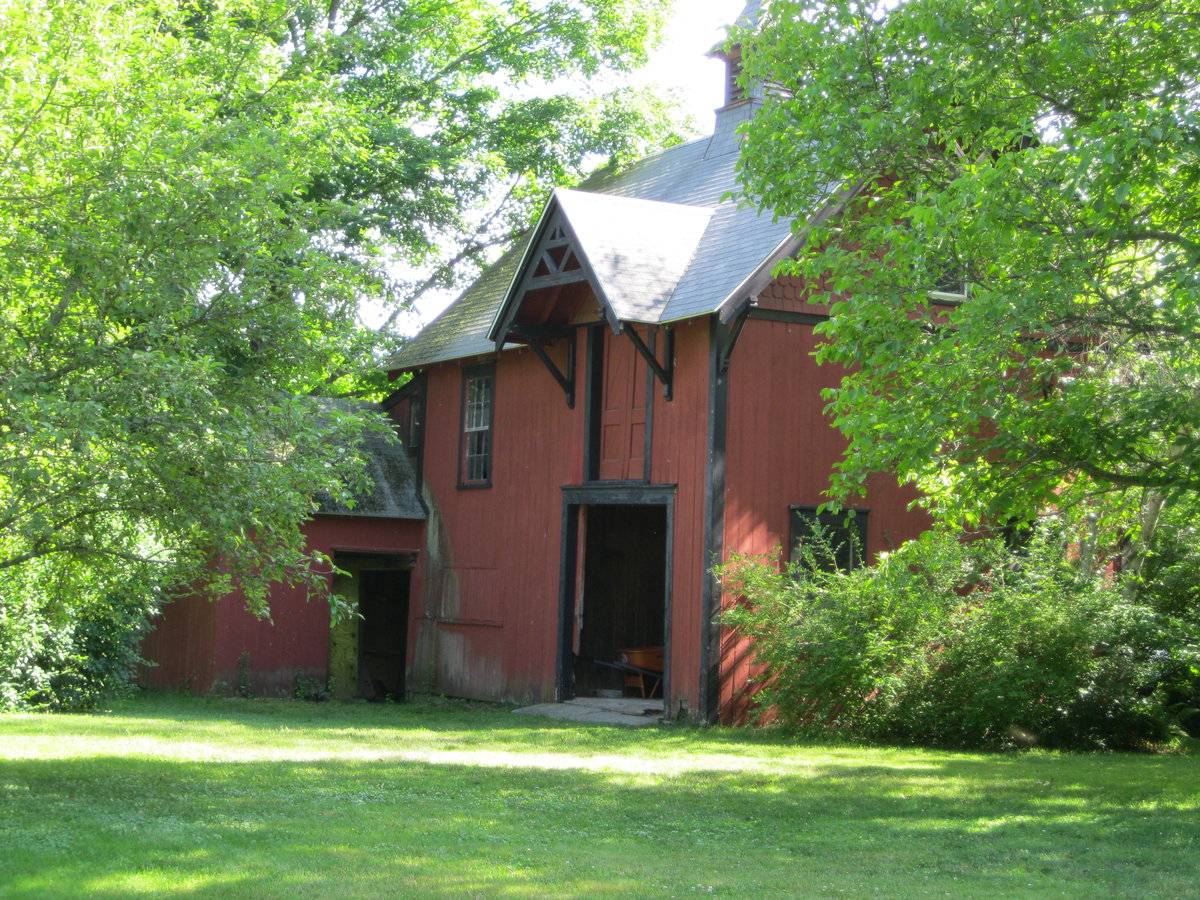
This is an approximately 30’ x 40,’ 1 ½-story, gable-roof Carriage barn with an addition built during the late 19th-century. The ridge-line runs approximately north-south, perpendicular to Christian Hill Road which runs east-west. A hipped-roof cupola is centered atop the ridge-line of the barn and has louvered vents on all four sides. The barn is sheathed in vertical board siding painted red with black trim. Fish scale wood shingles are in both the gable-ends of the barn, providing a decorative element. Decorative brackets and trusses are found in the gable-ends of the barn as well, both indications of stick style. The roof has asphalt shingles and the foundation is poured concrete.Exterior:
The east eave-side of the barn has an open entry, which is reached by a ramp, and appears to have once been a pair of interior-hung sliding doors with trim. Just above this is a pair of hay doors with trim and diagonal bracing. A gable-roof dormer with decorative brackets and truss protrude over the hay doors. Fish scale shingles are found in this gable peak, just above the doors. To the south of the entry is what used to be an opening that has now been sealed. It is the belief this is where a farm stand once operated. Just above this is a six-over-six double-hung window with trim. The addition is attached to the south corner of the east eave-side of the barn, extending to the east. The addition wraps around the south gable-end of the barn, encompassing the lower half of that side.
An open pass-through entry is located on the north side of the addition. A hay door sized opening is in the gable-peak of the east side, and the east half of the south side of the addition is open. The west half has no openings. There are no openings on the west side of the addition. The south gable-end of the barn has a one-over-one double-hung window with trim in the gable attic. There are no openings along the west eave-side of the barn.
The north gable-end of the barn has two single-pane windows with trim along the lower level. A one-over-one double-hung window with trim is in the gable attic. There are no other features on this side besides the fish scale wood shingles, decorative brackets, and a decorative truss.Interior:
The barn is accessed by the entry on the east eave-side of the barn and by the opening in the addition. The barn has concrete floors and wood plank walls. A wall separates the north and south halves of the lower level of the barn. In the north half is storage space while the south half was once used for cold storage for fruit such as apples. The cold storage space has plywood walls, a drop ceiling, and concrete floors. A staircase in the addition leads to the upper level of the barn. This level has wood plank floors and walls. The frame is a hybrid form of post-and-beam and balloon framing techniques. Heavy timbers, typical of post-and-beam frames, are prevalent throughout the barn; however, lighter timbers typical of balloon frames are found in the gable ends. Circular saw marks are visible on the lumber throughout the barn. Both these features indicate a late-19th-century construction date. Furthermore, the timbers appear to be uniform sizes and mass produced. Heavy timbers are attached together by mortise and tenon joints with tree nails. End girts are dropped and attached to corner posts by mortise and tenon joints. Common rafters meet at the peak with a ridge-board, and the roof deck is made of wood planks.Historic significance:
This is an intact typical example of a carriage barn from the late 19th-century with characteristic Stick-style details. The associated Farmhouse is intact as well, forming a well-preserved complex. Although surrounding environment and the usage of the barn have changed over time, it remains an example of a time when farming was abundant in this area.
Field Notes
Listed on the State Register of Historic Places 3/05/2014.
- Use & Accessibility
Use (Historic)
Use (Present)
Exterior Visible from Public Road?
Yes
Demolished
n/a
Location Integrity
Unknown
- Environment
Related features
Environment features
Relationship to surroundings
This barn sits on 2.6 acres of land on the south side of Christian Hill Road. A driveway extends to the south off the road and leads past the west side of the farmhouse, ending at the north side of the barns. There are two barns on this property, both of which are to the southwest of the house. Barn I, a Carriage barn, is directly to the south of Barn II. A pool is to the southeast of the barns. Trees line the west and east borders of the property, separating it from the parcels to the west and east. Forested land is directly to the south, located in the south portion of this parcel.
The 2-story Farmhouse with which this barn is associated is set back from the road, has a hip roof, and was built c. 1875. It has many Gothic Revival and Stick style decorative elements including decorative trusses in the gable ends and bargeboards. A porch is on the north side of the house, and has decorative narrow posts holding up the roof. The main entry is located within the porch and has a transom window just above the door. A two-over-two double-hung window with shutters is to the west of the door. Above are two two-over-two double-hung windows with shutters. The house is clad in clapboard siding painted blue with asphalt shingles on the roof.
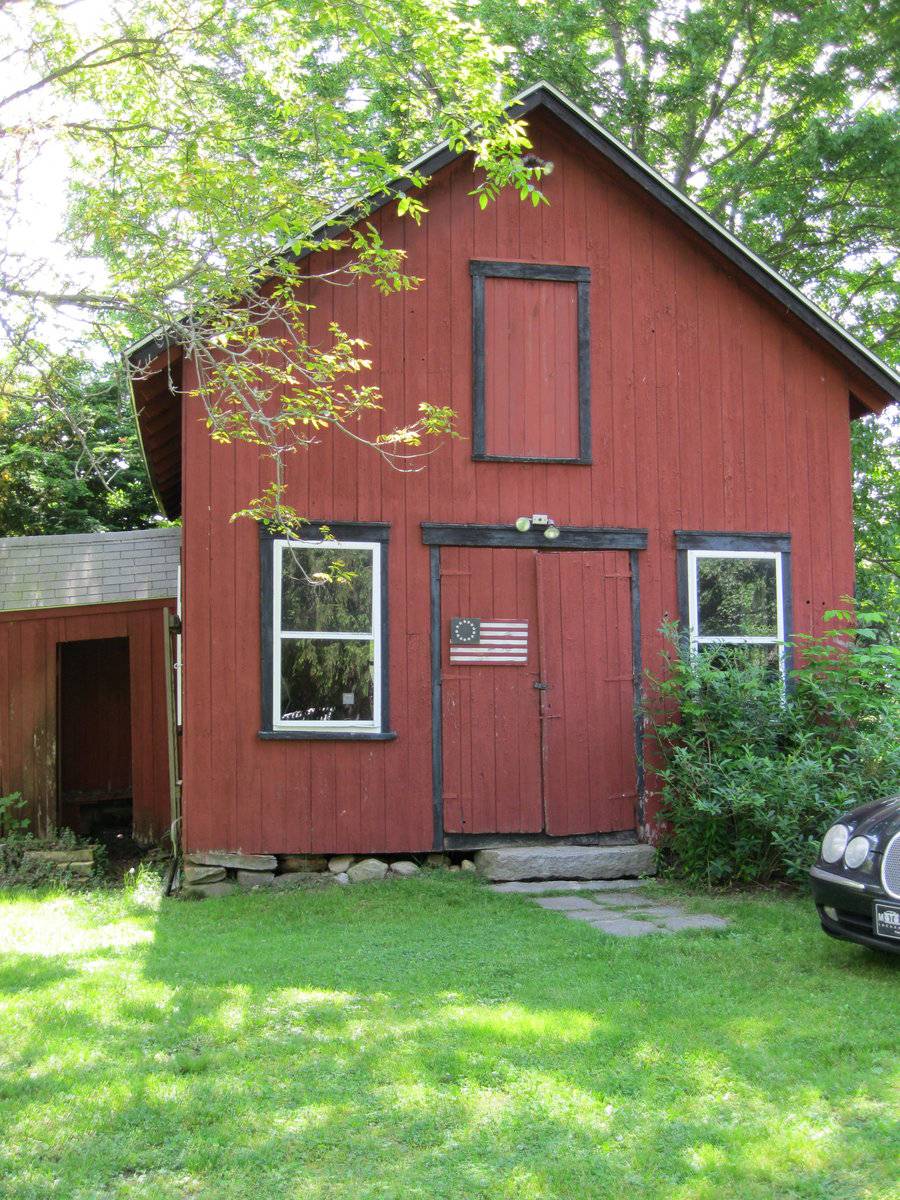
Barn II is a vernacular style 1 ½-story two-bay gable-roofed barn or workshop building with a pair of hinged doors in the east gable-end, flanked by six-over-six double hung windows. A hinged hay door is located above for access to a loft level. The north and south eave-sides each have two similar windows while the west gable-end has three. Some sash have been replaced with one-over-one. In the northwest corner a steep stair provides access to the loft level. The structure is a hybrid of heavy timber and balloon framing, with an un-mortared fieldstone foundation and a wood-framed main level floor over a crawl space. It has vertical siding painted red with black trim.
This property is located in the Higganum district of Haddam, in the north portion of town. Christian Hill Road extends to the west off Saybrook Road (Rte. 154), which runs through the east half of Haddam, along the Connecticut River. The property is one mile to the west of the Connecticut River, and half a mile to the west of the center of Higganum. Three and a half miles to the southeast is the center of Haddam, where both the Haddam Center National Register Historic District and the James Hazelton House, also listed on the National Register, are located. Surrounding the property is forested land and residential properties.- Typology & Materials
-
Building Typology
Materials
Structural System
Roof materials
Roof type
Approximate Dimensions
n/a
- Source
-
Date Compiled
08/04/2011
Compiled By
Kristen Young, reviewed by CT Trust
Sources
Photographs and field notes by Kristen Young - 6/14/2013.
Interview with Tracy Lacomb - 6/14/2013, 39 Christian Hill Rd, Higganum, CT.
Haddam Tax Assessor’s Records accessed 7/19/2013 - http://data.visionappraisal.com/HaddamCT/search.asp
Parcel ID: 15/ 040Haddam GIS Viewer accessed 7/19/2013 - http://107.20.209.214/HaddamCT_Public/index.html
Aerial views from: http://maps.google.com/ and http://www.bing.com/maps - accessed 7/19/2013.
Historical aerial photography and maps accessed 7/19/2013 at UConn MAGIC:
http://magic.lib.uconn.edu/mash_up/1934.html
http://magic.lib.uconn.edu/historical_maps_connecticut_towns.html .USGS Historical Maps accessed 7/19/2013 at http://historical.mytopo.com/ .
UTM coordinates accessed 7/19/2013: http://itouchmap.com/latlong.html .
Connecticut Trust for Historic Preservation, Historic Barns of Connecticut Resource Inventory, 2010,
http://www.connecticutbarns.org/46841Cunningham, Janice P. and Warner, Elizabeth A., Portrait of a River Town: The History and Architecture of
Haddam, Connecticut, The Greater Middletown Preservation Trust, Middletown, Connecticut, 1984.
Malloy, Elizabeth, Executive Director of Haddam Historical Society, 2011, interview 6/14/2013.
McAlester, Virginia and Lee, A Field Guide to American Houses, Alfred A. Knopf, New York, 1984.
Sexton, James, PhD; Survey Narrative of the Connecticut Barn, Connecticut Trust for Historic Preservation,
Hamden, CT, 2005, http://www.connecticutbarns.org/history.
U.S. Federal Census, accessed 7/19/2013Visser, Thomas D., Field Guide to New England Barns & Farm Buildings, University Press of New England, 1997.
- PhotosClick on image to view full file
-