Barn Record Bethany
RETURN TO ‘FIND BARNS’- Building Name (Common)
- RoJo Farm - Part 1 of 2
- Building Name (Historic)
- Jerome Downs Barns / RoJo Farm
- Address
- 312 Litchfield Turnpike (Rte 69), Bethany
- Typology

- Overview
-
Designations
Historic Significance
Architectural description:
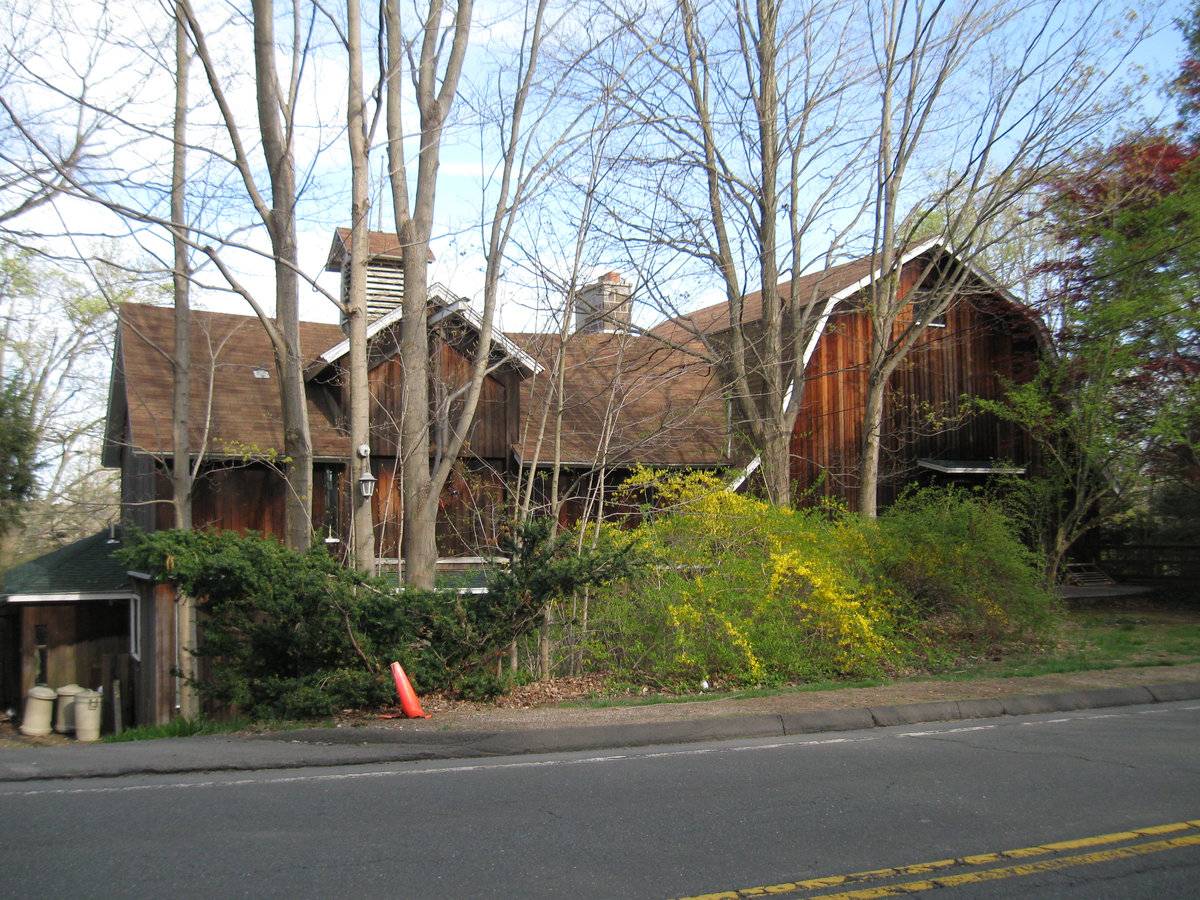
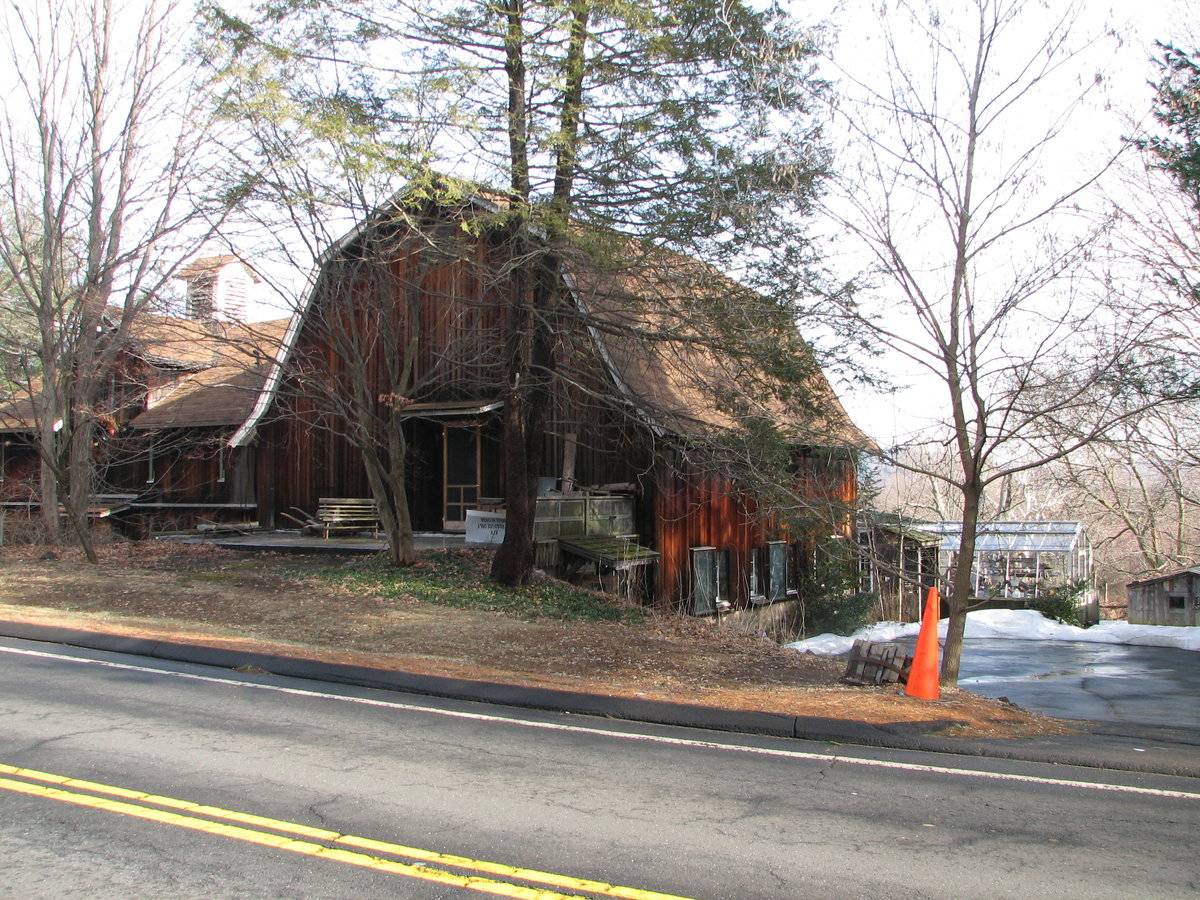
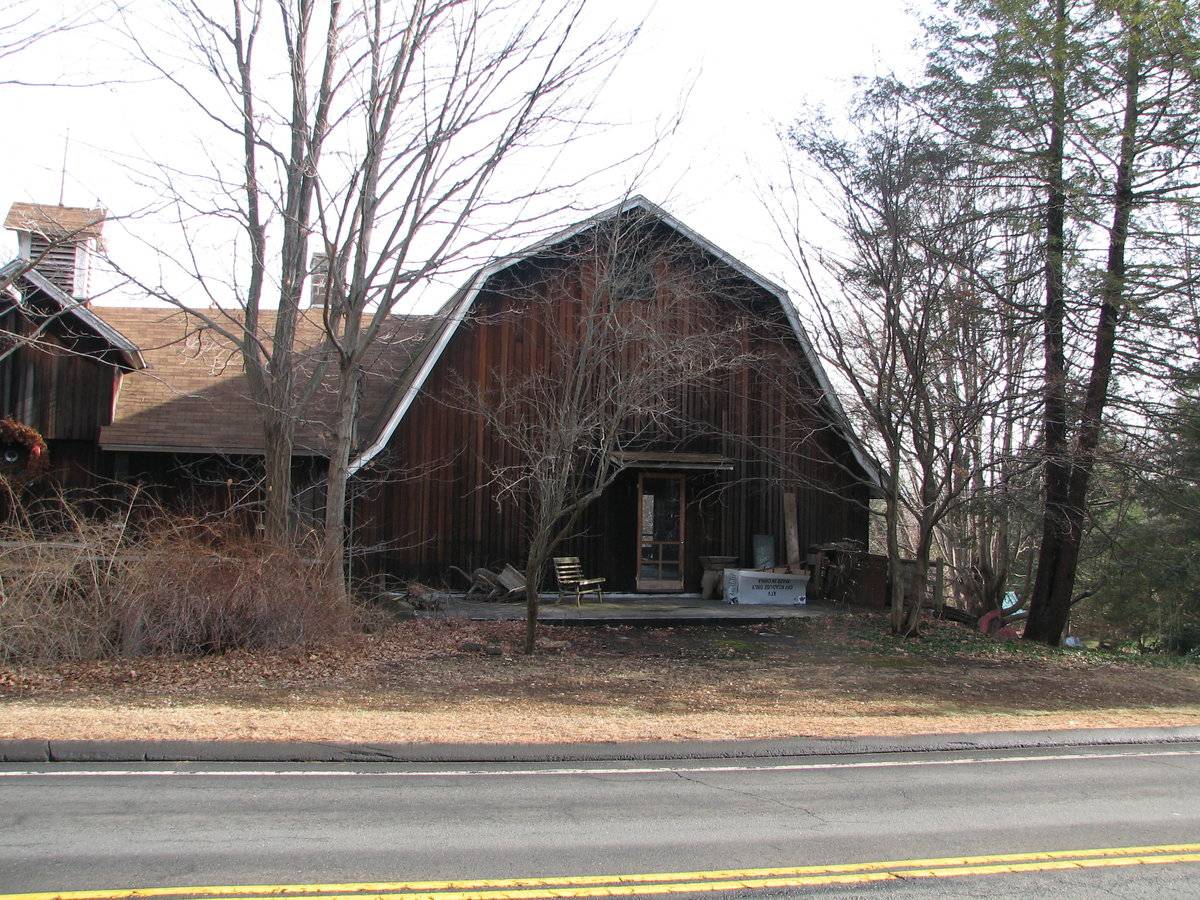
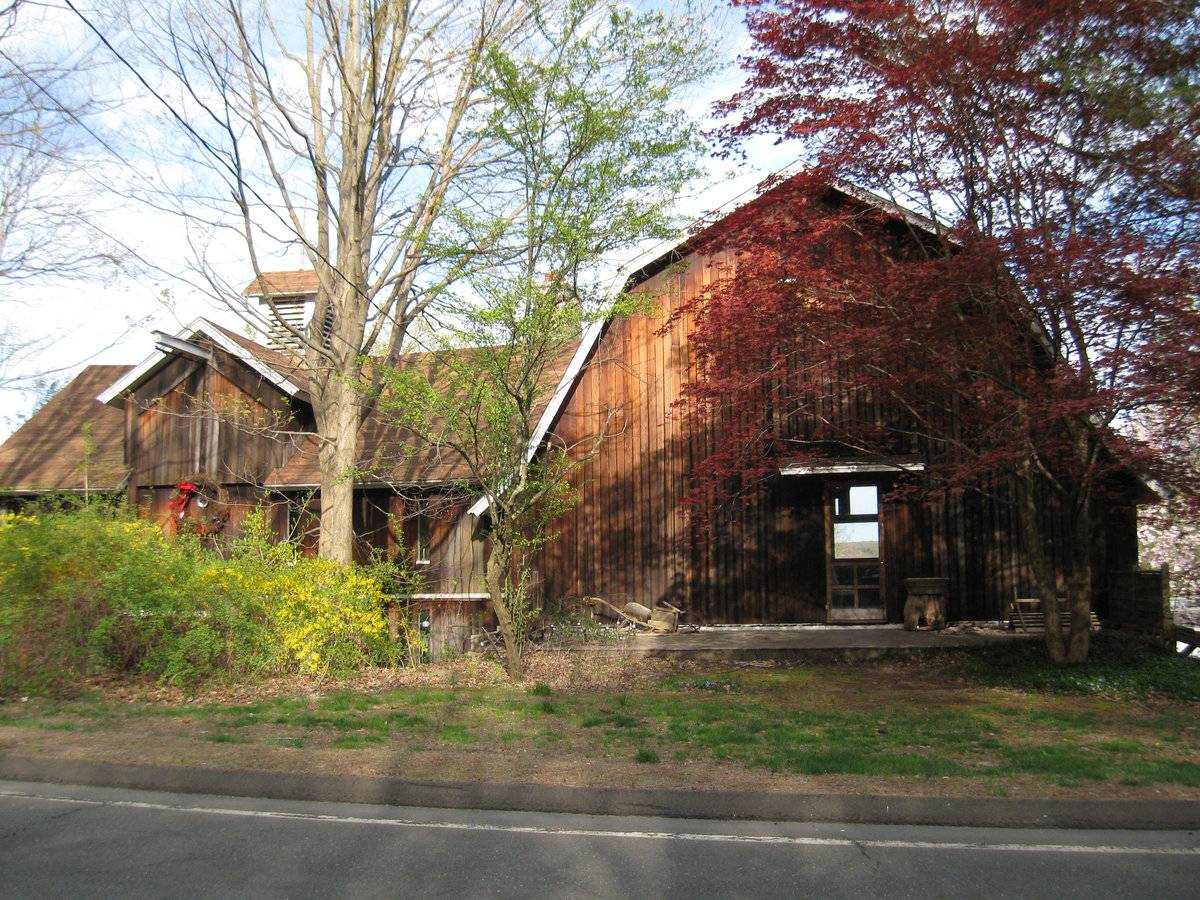
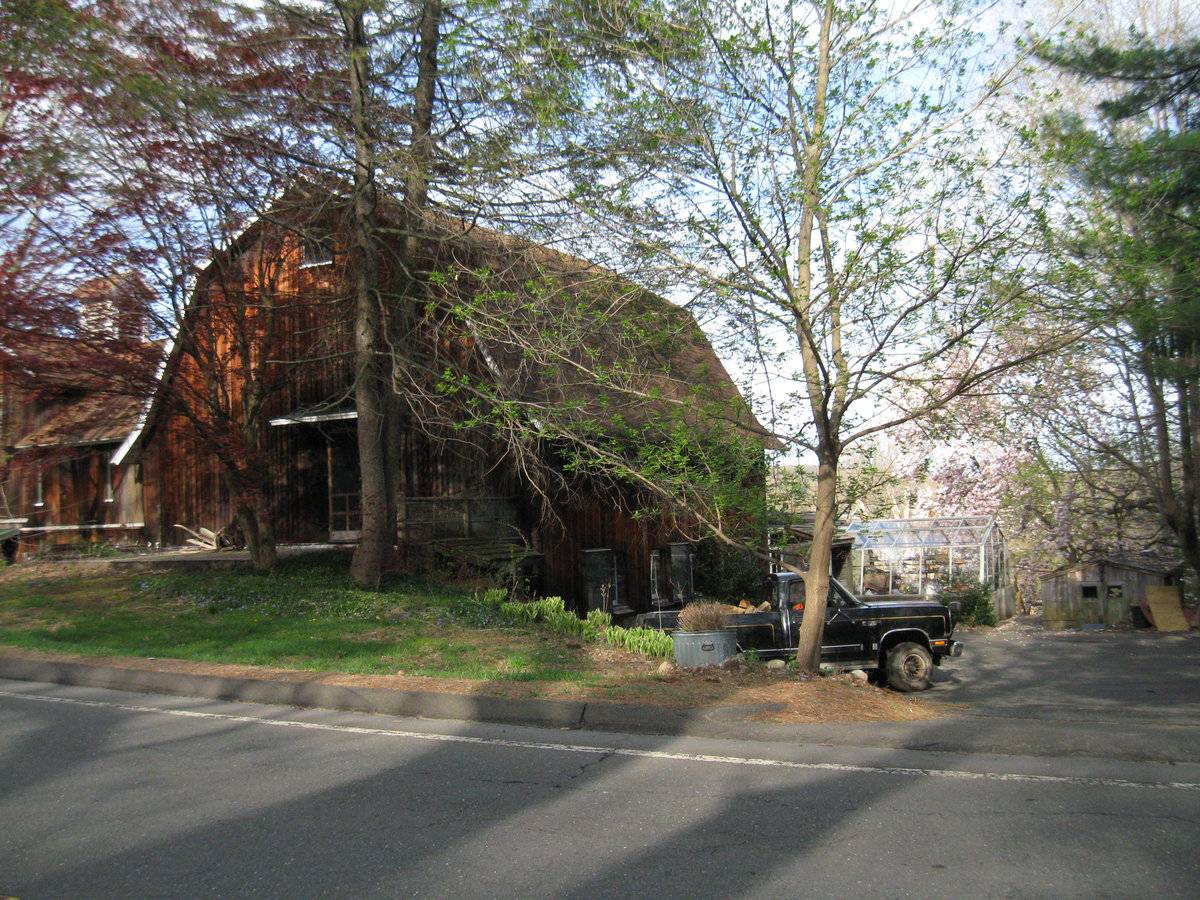
The main barn is a banked Dutch gambrel-roofed dairy barn, 32’ x 36’, with its ridge-line oriented east-west perpendicular to the road. The main block has its floor level at the upper grade along the road on the west side and the banked lower level originally opened to the lower grade on the east side and south sides.
On the east gable-end, a large 1-story addition, 20’ x 33’, with a hip roof, was added when the building was converted to a residence in approximately 1963; this encompasses the entire east side of the basement level. The addition has a full-width glazed wall looking eastward over the view toward Lake Bethany. Above the hip roof the east gable-end of the barn has a bank of four windows, also added in 1963.
The south eave-side exposes the basement level to the lower grade elevation. The basement formed a ground level dairy stable. The interior has two rows of steel columns supporting longitudinal built-up girders. These in turn carry the floor joists of the upper level. The south wall has a row of five nine-pane stable windows; the wall is finished with horizontal tongue-and-groove board paneling, painted white. On the exterior between the windows there are rectangular frames which appear to be passive solar heating elements dating from the 1960s. The exterior siding is vertical boards from the window sills up and mortared fieldstone masonry below.
At the southeast corner of the barn there is a small mid-20th-century greenhouse of a type erected from stock components. It has a low masonry knee-wall supporting the gambrel-profile glass and metal rib structure. This is connected to the hip-roofed addition.At the west end of the barn there is a concrete milk room structure which is banked into the hill and has a flat concrete slab roof. The west door of the upper level opens out onto this surface. The south wall of this milk room is flush with the main barn and has a door with a hood above and a window to the right.
The exterior of the west gable-end has an entry door to the upper floor level, with a flat-roofed hood supported with angled brackets.
The interior of the upper level of the main barn is a clear span hay loft, now converted to a large full-height living room with the structural system remaining fully exposed. The gambrel-roofed structure consists of four trussed ribs forming three 12-foot bays. Each rib is made up of two scissor trusses tilted up and meeting at the peak, each forming the knee wall, lower and upper roof pitches of one side of the barn. These ribs are composed of 2 x 10 sawn dimension lumber with bolted connections, braced longitudinally with angle braces connecting to double purlins at the change of roof pitch. Between the major trusses, balloon framing with 2 x 6 rafters fills in to complete the roof surface. Narrow spaced deck boards support the original wood shingles which are visible between the decking. The roof has been subsequently over-shingled with asphalt shingle roofing. A hay track is suspended from the ridge.Barn II:
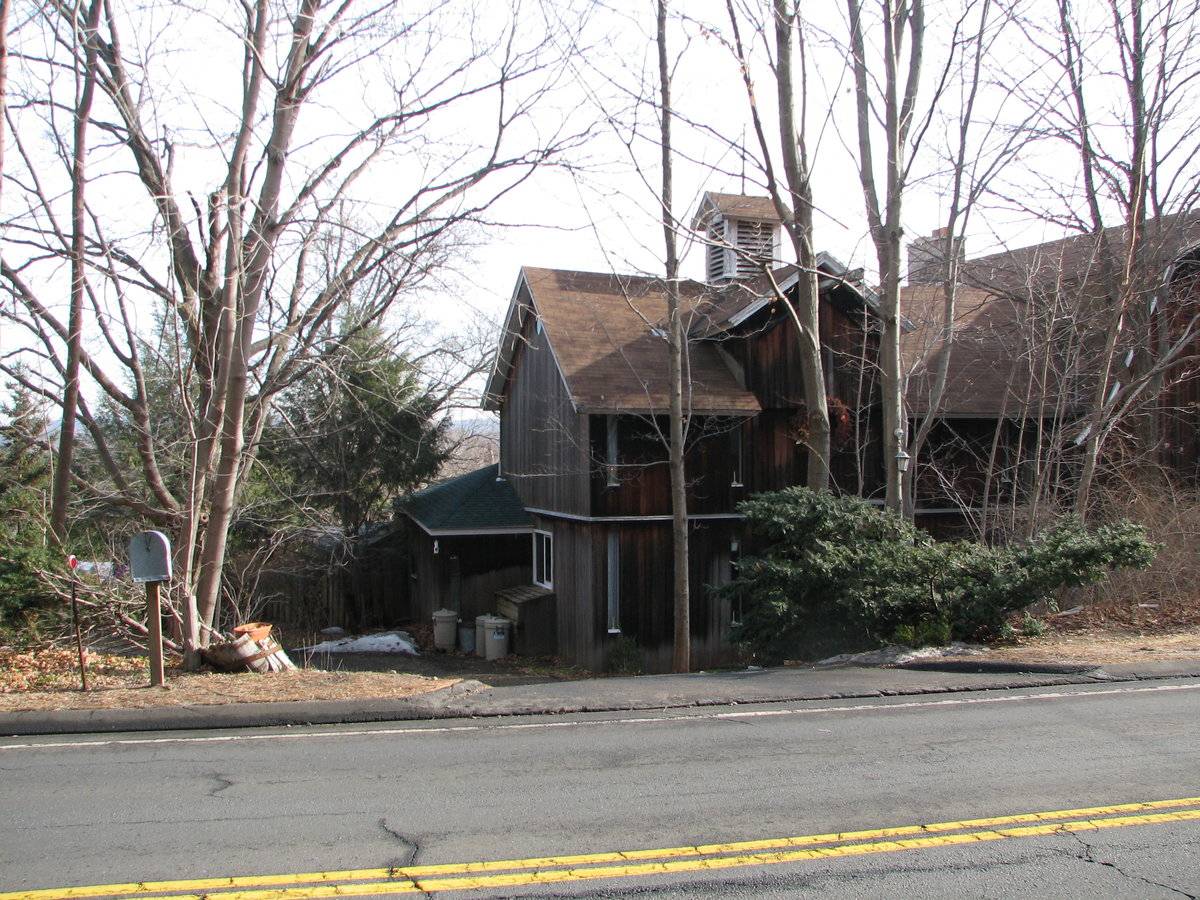
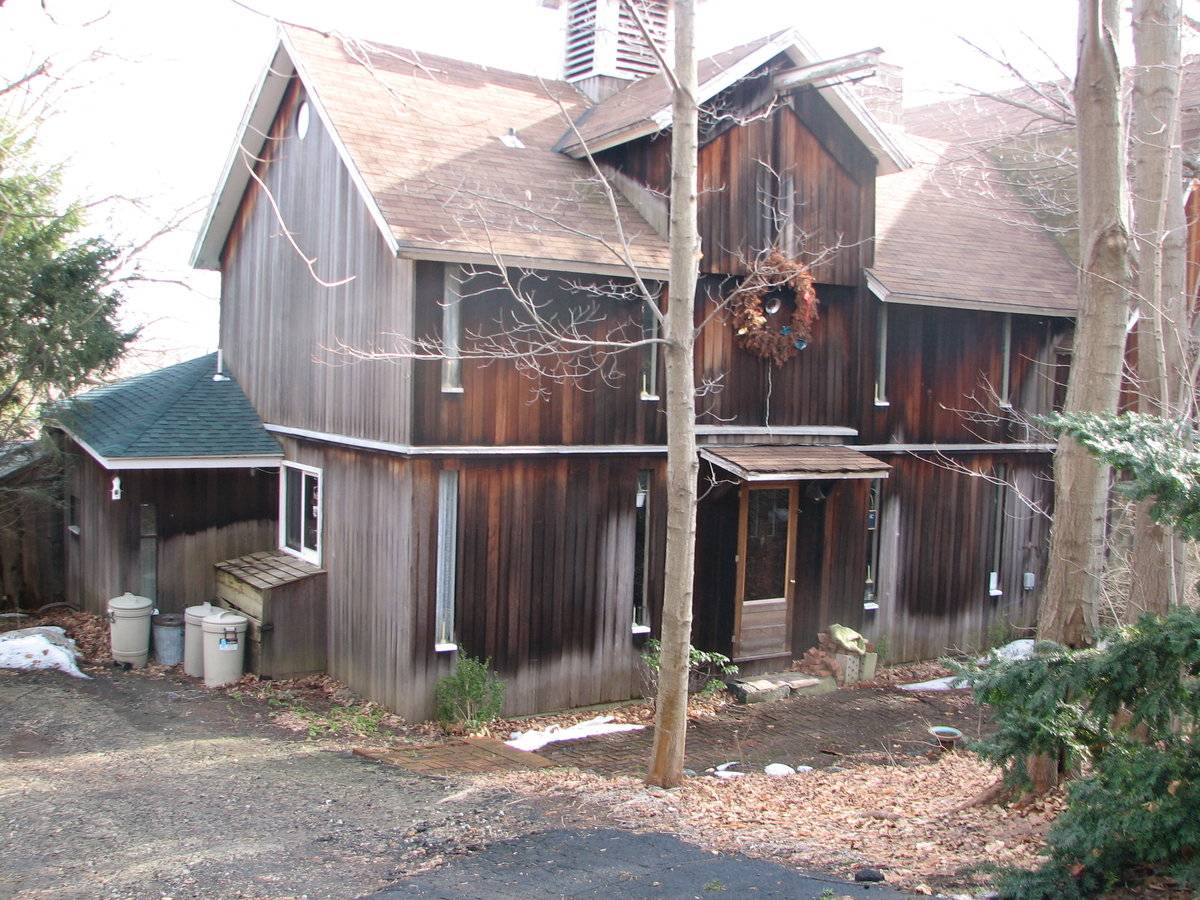
The northern section of the residence is a post and beam structure, originally a barn, approximately 25’ x 35’, which was formerly located slightly further north and west, closer to the road. During the conversion to a residence, the barn was moved to its present location abutting Barn I.The barn structure appears to have been a three-bay 1 ½-story English barn with its ridge-line oriented north-south. A full second floor was inserted on the interior. The west eave-side has a gable-roofed wall dormer with a projecting hoist arm with a hay track. Alterations include a residential entry door centered below the dormer, a shallow-pitched porch roof over the entry, and tall narrow windows on the first and second floor levels. A narrow horizontal trim board visually demarcates the second floor. The north gable-end has an ocular window at the peak and a square two-sash sliding window at the ground level. The east shed-roofed extension wraps partially around the north end. The east eave-side has a gambrel dormer with a gabled projecting bay window, added in the 1963 renovation, as well as a shed-roofed 1-story extension.
The roof has an overhang at eaves and rake, and a gable-roofed cupola with louvered openings on all sides. Siding is narrow vertical boards stained dark brown, trim is painted white, and roofing is asphalt shingles.
The interior is finished as two floors of residential space in which some structural posts and beams are exposed. In the attic, the roof structure is visible, consisting of sawn dimension lumber king post trusses which appear likely to be of late 19th-century date, later than the timber frame of the lower portion which shows evidence of sash-sawn milling and square rule mortise and tenon joinery.
Historical significance:
By the early 20th century agricultural engineers developed a new approach to dairy barn design: the ground-level stable barn, to reduce the spread of tuberculosis bacteria by improving ventilation, lighting, and reducing the airborne dust of manure. A concrete slab typically serves as the floor for the cow stables. Many farmers converted manure basements in older barns into ground-level stables with concrete floors. Some older barns were jacked up and set on new first stories to allow sufficient headroom. With the stables occupying the entire first story, the space above serves as a hayloft. By the 1920s most ground-level stable barns were being constructed with lightweight balloon frames using two-by-fours or two-by-sixes for most of the timbers. Novelty or tongue-and-groove beveled siding is common on the walls, although asbestos cement shingles also were a popular sheathing. Some barns have concrete for the first-story walls, either poured in place or built up out of blocks.
The gambrel roof design was universally accepted as it enclosed a much greater volume than a gable roof did, and its shape could be formed with trusses.The oldest barns still found in the state are called the “English Barn,” “side-entry barn,” “eave entry,” or a 30 x 40. They are simple buildings with rectangular plan, pitched gable roof, and a door or doors located on one or both of the eave sides of the building based on the grain warehouses of the English colonists’ homeland. The name “30 by 40” originates from its size (in feet), which was large enough for 1 family and could service about 100 acres. The multi-purpose use of the English barn is reflected by the building’s construction in three distinct bays - one for each use. The middle bay was used for threshing, which is separating the seed from the stalk in wheat and oat by beating the stalks with a flail. The flanking bays would be for animals and hay storage.
This gambrel barn is particularly significant as an unusually fine example of an early gambrel structural system, apparently following designs published in the early 1900s at the time when plank or balloon framing began to replace post and beam techniques. It is an exceptionally elegant structure and has survived intact through re-use as a residential space. The farmstead gains significance from its association with the Jerome Downs family, residents at this site since at least 1832, and with two family members prominent in local politics, serving as First Selectman. The site is also of interest because of the re-use of the agricultural structures as residential and studio space for artist-owner Gene Kluszewski in the 1960s. Finally, the two parts of the historic property are re-united and agricultural use is ongoing again, under the ownership of Bill Fischer, resulting in preservation of the rural landscape.
Field Notes
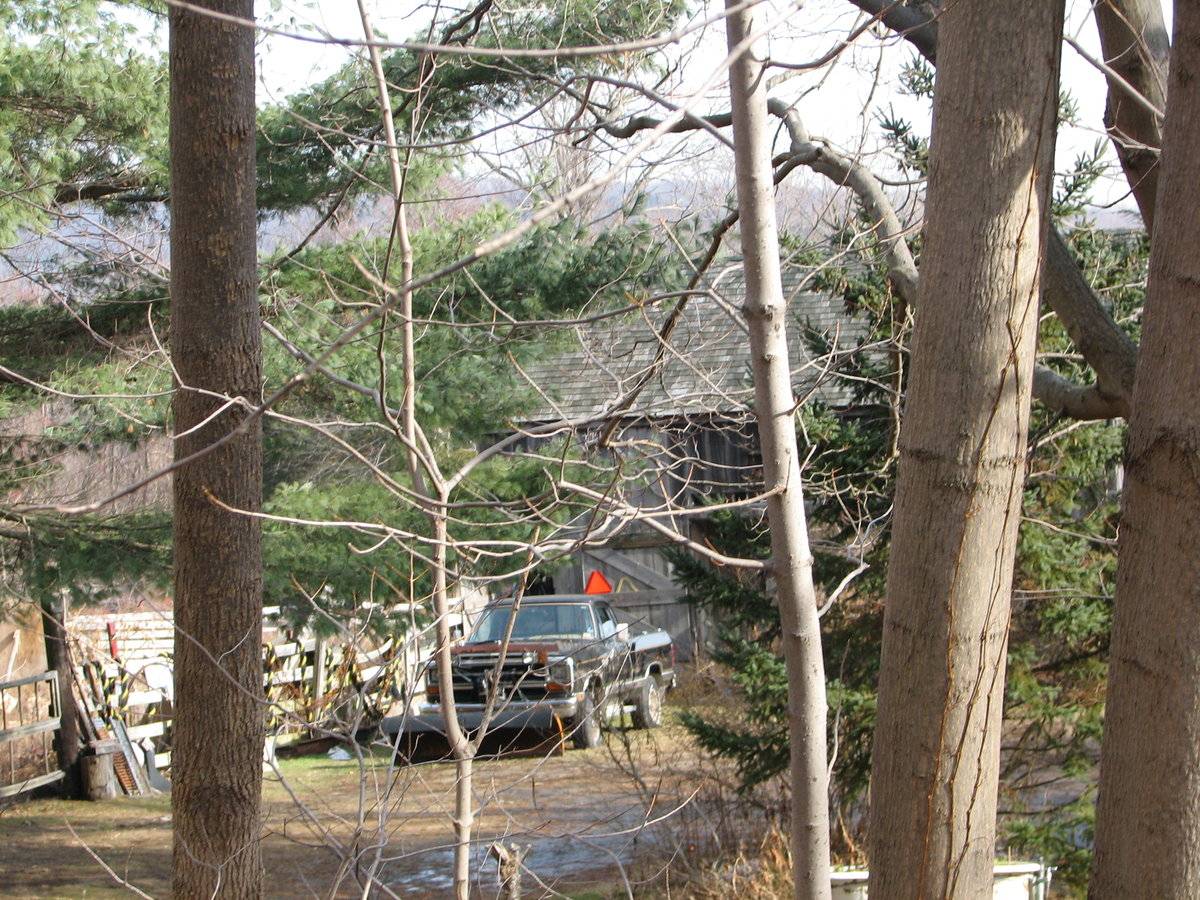
Listed on the State Register of Historic Places 11/06/2013. 312 and 327 Litchfield Turnpike, the original extent of RoJo Farm. A former barn complex that has been rehabilitated as a residence. Picture 5 shows a separate outbuilding that appears to be historic. Bill Fischer, Contradance caller, dances in the barn. See also Record No. 5010 for the associated farmhouse at 327 Litchfield Turnpike.
- Use & Accessibility
Use (Historic)
Use (Present)
Exterior Visible from Public Road?
1
Demolished
n/a
Location Integrity
Moved
- Environment
Related features
Environment features
Relationship to surroundings
The RoJo Farm includes two parcels of land located on both sides Litchfield Turnpike in Bethany, north of the intersection with Hatfield Hill Road. The 1879 Jerome Downs House is on a 2-acre parcel on the west side of the road with a small barn and garage, while the main barns, now converted to a residence, are on a 1.8-acre parcel on the east side.
Litchfield Turnpike runs north-south along the side of a hill which slopes down toward the east to the valley of the West River. Extending from New Haven through Woodbridge, the road passes several lakes, which are water supply reservoirs owned by the South Central Connecticut Regional Water Authority. Lake Bethany, constructed in 1894 by damming the West River, is immediately adjacent to the eastern parcel.
The primary village centers of Bethany were historically located along Amity Road (Route 63) which runs roughly parallel to the west, along a ridge top. The Congregational and Episcopal Churches are located on Amity Road near the northern edge of the town, with the Congregational Church carriage shed listed on the National Register of Historic Places. The c. 1807 Wheeler-Beecher House, also on Amity Road slightly north of the two churches, is also a National Register-listed property. Farmsteads in Bethany also included in this thematic State Register nomination are: the Russell Homestead, 20 Round Hill Road; Clover Nook Farm, 50 Fairwood Road; the Abram Carrington Farmstead (Cherry Tree Farm), 144 Bethmour Road; the Doolittle Farm at 329 Downs Road, the Bishop-Tuttle-Megin Farmstead, 163 Carrington Road, and the Davidson Farmstead (Minnow Brook Farm), 539 Litchfield Turnpike. The last two are located nearby, within a mile of this property.
The Farmhouse is a 2 ½-story gable-roofed vernacular Italianate-style building, 25’ x 45’ with its ridge-line oriented east-west and its east façade facing the road. There are shallow cross-gable wings projecting north and south from the eave-sides, and a lower 2-story ell extends west at the rear. The east gable-end is a three-bay façade with a side-hall plan and a porch and entry at the left (south) bay. The porch has Italianate-style posts and detailing; windows are mostly two-over-two double-hung sash and have molded cornices and simple casings. Arch-topped decorative windows are in the attic – a pair on the east and a single on the south gable – and at the stair along the south eave-side. At the rear wing a 1-story porch on the south side has a secondary entrance, and at the north side there is another entrance with a 1-story porch. The walls are covered with vinyl siding but the the original wood trim remains. Roofing is asphalt shingles and the foundation is random ashlar stone, probably locally-quarried basalt.
To the northwest of the Farmhouse is a small barn (Barn IV), a balloon-framed 1 ½-story gable-roofed structure, 15’ x 25’, with its ridge-line oriented north-south. It appears to be of early 20th-century construction, has a banked lower level with a fieldstone retaining wall at the north and west sides, a door opening in the south gable-end, single-pane attic windows in both gable-ends, and a window in the west eave-side. It is currently used as a woodshed. A driveway enters the western part of the side south of the Farmhouse, and terminates in a paved parking area; a modern small garage structure is to the south.
On the eastern parcel, Barns I and II are abutting and located close to the road, while Barn III is to the northeast. A paved driveway to the south of Barn I enters the site and terminates in a paved area along the south side of Barn I. Another unpaved drive enters north of Barn II and leads to an open area north of the barns and west of Barn III. Southeast of the buildings is an open garden area with garden sheds and a small pond.
Barn III is an 18’ x 30’ gable-roofed English barn, moved here in 1994 from a location near the Lake Bethany dam. Its ridge-line is oriented north-south and it is set on a newly-built fieldstone foundation which provides a banked basement for the northern bay, while the other bays have dirt floors. The three-bay structure has a square rule timber frame with dropped tie-girts. The end bays are enclosed as stalls or work areas while the center bay has pairs of hinged doors on both the west and east eave-sides. The east side doors are notable for their chamfered head corners, a feature which was present on the west doors as well prior to re-construction. The east side has a pair of multi-pane stable windows in each of the end bays. The south gable-end has two stall doors, and the west side has a second opening to the north bay work area. The attic peak has a louvered vent in each gable-end. Siding is vertical boards, unpainted, which were recycled from another structure. The roof is wood shingles.- Typology & Materials
-
Building Typology
Materials
Structural System
Roof materials
Roof type
Approximate Dimensions
n/a
- Source
-
Date Compiled
01/23/2008
Compiled By
Charlotte Hitchcock, reviewed by CT Trust
Sources
Photographs and field notes by Melissa Antonelli, 2008, Charlotte Hitchcock 7/24/2013.
Interview with Bill Fischer, 7/24/2013, at the site.Map resources:
Aerial views from: http://maps.google.com/ and http://www.bing.com/maps/ accessed 8/16/2013.Historical aerial photography and maps accessed at UConn MAGIC:
http://magic.lib.uconn.edu/mash_up/1934.html
http://magic.lib.uconn.edu/historical_maps_connecticut_towns.html .USGS Historical Maps accessed 6/22/2012 at http://historical.mytopo.com/ .
UTM coordinates: http://itouchmap.com/latlong.html .
Print and internet resources:
Barnett, Joni, The Barns of Bethany, Bethany Historical Society, video, 1996.Bethany Historical Society, Bethany Timeline: http://www.bethany-ct.com/historicalSociety/bhs-facts.htm .
Bunton, Alice Bice, Bethany’s Old Houses and Community Buildings, Bethany Library Association, 1972.
Clouette, Bruce, Wheeler-Beecher House National Register Nomination No. 77001400, National Park Service, 1977.
Connecticut State Library online: iconn.org or http://www.cslib.org/iconnsitemap/staff/SiteIndex.aspx#directories
Connecticut Trust for Historic Preservation, Historic Barns of Connecticut Resource Inventory, 2010,Cunningham, Jan, Connecticut’s Agricultural Heritage: an Architectural and Historical Overview, Connecticut Trust for Historic Preservation & State Historic Preservation Office, 2012.
James Manufacturing Company, The James Way Catalog No. 27, Fort Atkinson, Wisconsin, 1919, accessed at Google Books, http://books.google.com .
RoJo Farm web site: http://www.rojofarm.com/RoJo_Farm/Home.html , accessed 8/16/2013.
Sexton, James, PhD; Survey Narrative of the Connecticut Barn, Connecticut Trust for Historic Preservation, Hamden, CT, 2005, http://www.connecticutbarns.org/history.
U.S. Federal Census, accessed at http://persi.heritagequestonline.com/hqoweb/library/do/census/search/basic
Visser, Thomas D., Field Guide to New England Barns & Farm Buildings, University Press of New England, 1997.
- PhotosClick on image to view full file
-