Barn Record Suffield
RETURN TO ‘FIND BARNS’- Building Name (Common)
- Fish Farmstead
- Building Name (Historic)
- Lothrop, Horatio J., Farmstead
- Address
- 410 Taintor Street, Suffield
- Typology
- Overview
-
Designations
Historic Significance
Barn:
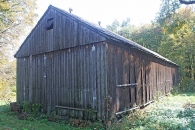
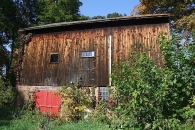
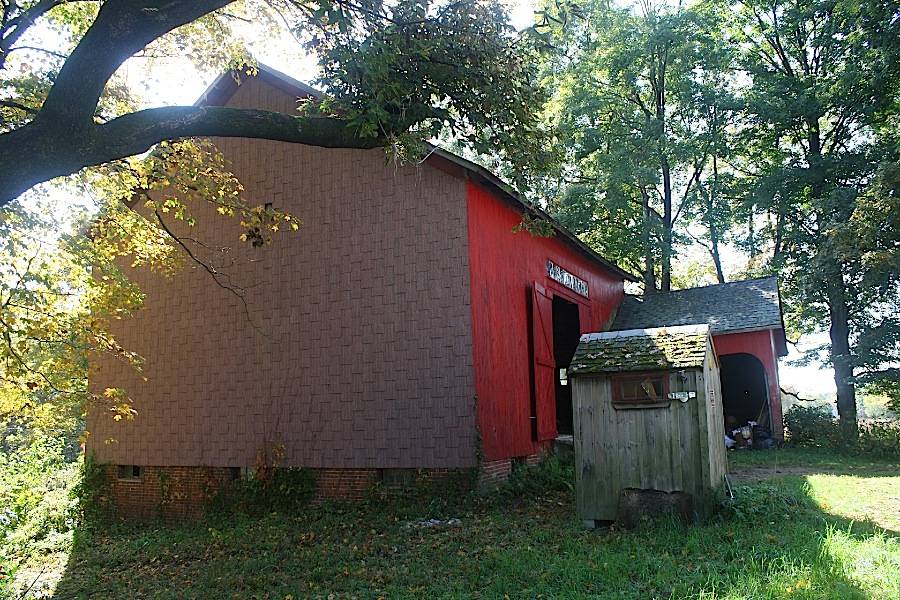
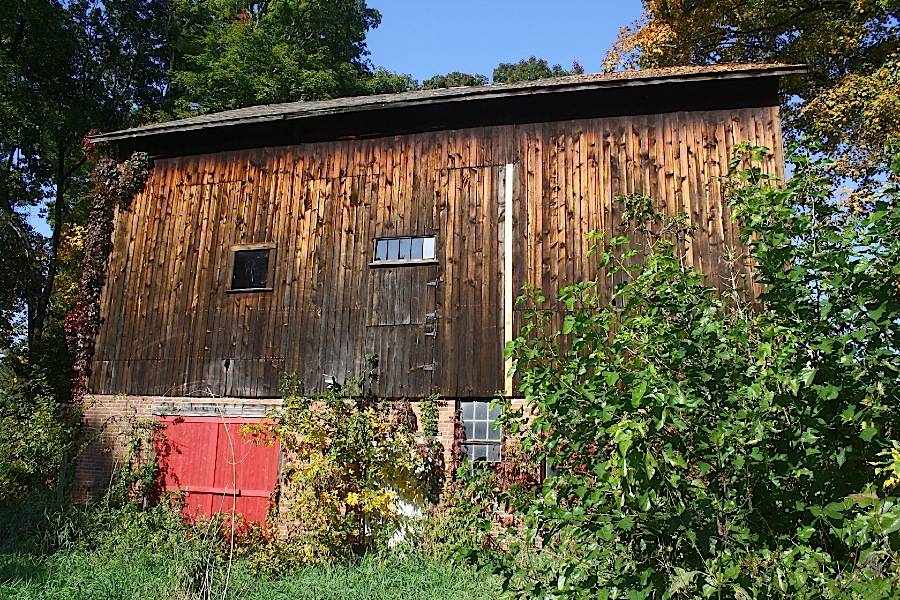
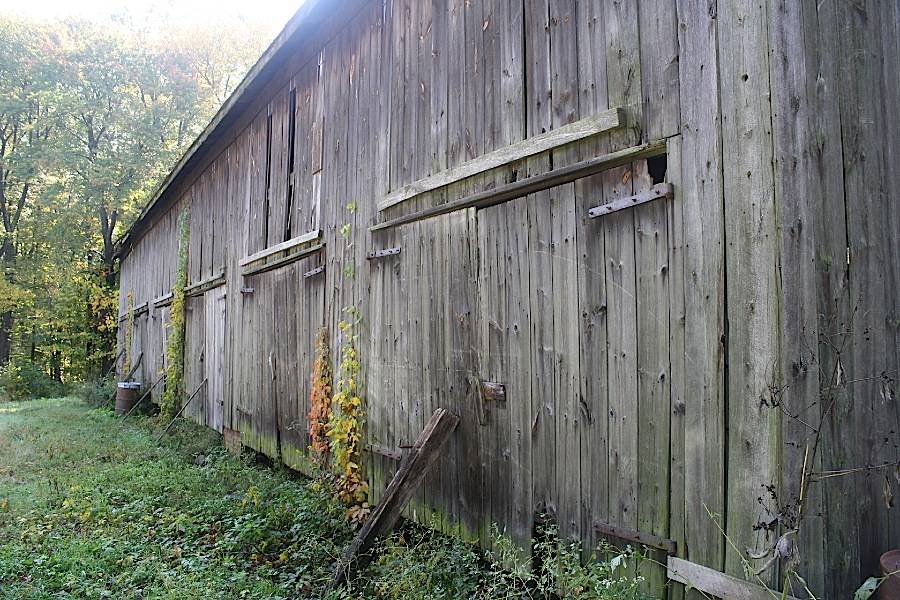
This is a 1 ½-story, three-bay English bank barn with a gable-roofed addition extending west from the southwest corner. The barn measures approximately 36’ x 50’ with a 20’ x 21’ gable-roofed addition. The ridge-line of the barn runs approximately north-south. The grade of the site inclines slightly from east to west, plateauing at the house. East of the barn the grade declines, resulting in the hill necessary for a bank barn. The grade plateaus again at the tobacco shed. The barn is covered with vertical wood board siding painted red on the west side, with unpainted vertical wood boards on the east side, and with asphalt shingles on the north and south sides. The foundation is mortared fieldstone in the west and part of the north side. The rest of the foundation is brick. The roof is slate and has a projecting overhang. The main entry of the barn is on the west eave-side.
Exterior:
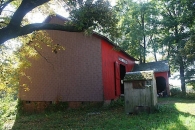
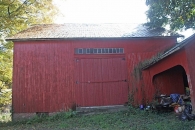
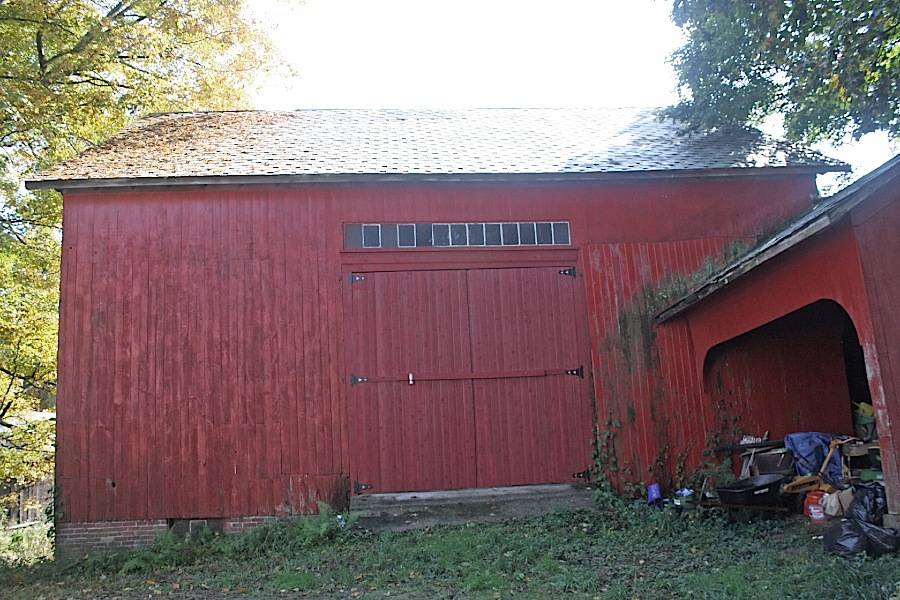
The main entry of the barn is a pair of z-braced, double-height wagon doors with trim in the center of three bays in the west eave-side of the barn. Above the entry is a thirteen-pane transom. The extra-tall height of the walls results in added attic space. The entry is accessed by a concrete ramp as wide as the middle bay. The grade declines slightly to the north, resulting in the exposed brick foundation. Centered in the foundation under grade in the north bay is a three-pane window. The grade declines slightly to the south from the middle bay. Encompassing most of the south bay is a gable-roofed addition. The ridge-line of the addition is perpendicular to the barn and runs east-west. The addition is open to the north like a wagon shed, and is covered in vertical wood siding painted red. The roof has a projecting overhang and is covered with slate. The foundation is brick and mortared fieldstone. The addition appears to be contemporary with the barn.
The southwest corner of the south gable-end of the barn is encompassed by the gable-roofed addition. The grade declines from west to east, exposing the full basement, which is composed of mortared and un-mortared fieldstone at the bottom topped with brick. The basement level of the south gable-end of the barn has two two-pane windows; one off-center to the west and the other in the east half of the level. The main level of the gable-end has two windows; a small two-pane window in the west half and a one-over-one double-hung window in the east half.
The grade at the east eave-side of the barn plateaus; the basement foundation wall is fully exposed and is a solid masonry wall. Centered in the basement level of the east eave-side of the barn is a pass-through door painted white. In the south half of the basement level is a pair of swinging hinged doors painted red. In the north half of the basement level are a pair of six-over-six double-hung windows. The main level of the east eave-side of the barn has a centered Dutch-door with a five-pane transom above opening out a story above grade. Centered in the main level of the south bay is a single-pane window with trim.The grade on the north gable-end of the barn inclines from east to west. In the basement level are three three-pane windows. The rest of the north gable-end of the barn is blank.
Interior:
The doors in the middle bay of the west eave-side of the barn open into a large open space in the north and middle bays. The south bay is enclosed at the main level and has a hay loft above. The floors are wood planking. The post and beams are 8” x 8” and connected with square rule mortise and tenon timber frame joinery. The girts and diagonals are 4” x 4”. The gable-ends have dropped girts and canted queen posts. In the southwest corner of the north bay is a staircase with a pass-through door which leads to the basement level. The rest the north bay is empty. There is a single post in the bent between the north and middle bay towards the east side. The construction technique used to support the roof without a bent with vertical queen posts uses a trapezoid truss system with tension rods connecting the wood timber top and bottom chords to span the entire 36’ span of the barn without the need for additional beams, resulting in the open space on the main level. The two bents flanking the middle bay share this construction technique; the use of wood trusses with iron tension rods is characteristic of barn construction after about 1870.The south bay is enclosed, contains three horse stalls, and is accessed by two pass-through doors, at the west and east ends, that enter into the stall area. The wall between the middle and south bay has a series of top- and bottom-hinged access doors used to add hay into the stalls for feed. The room has a hallway along the exterior wall of the barn with the stalls towards the interior. There are two trap doors in the hallway that lead to the basement; one towards the south wall and one towards the west wall. Two stalls are identical and measure 4’ wide and 10’ deep, running north-south and in the west portion of the room. The third stall is 8’ x 10’ and is to the east of the room.
Above the south bay is a hay loft, measuring 16’ wide x 36’ long. There is no access to the loft other than a ladder. There appears to have been a centered hay door in the attic level of the south bay of the barn, now covered in the exterior by asphalt shingles.
The ceiling is made up of common rafters and has 8” x 8” purlin plates on the eave-sides supported by the trusses. The slate roof is attached to wood decking above the rafters.The basement level is accessed from the exterior by the pass-through door in the north bay. There are thirteen risers in the staircase to the main level. The basement level is a single large white-washed room used for dairy at one time, although no stanchions remain. The north, west, and south walls of the basement level are made up of fieldstone and brick. The east wall is entirely brick. There are four posts or piers; two beneath each bent that flanks the middle bay above. The two easternmost are brick piers, the northwest post is wood and the southwest pier is concrete block masonry.
Tobacco shed:
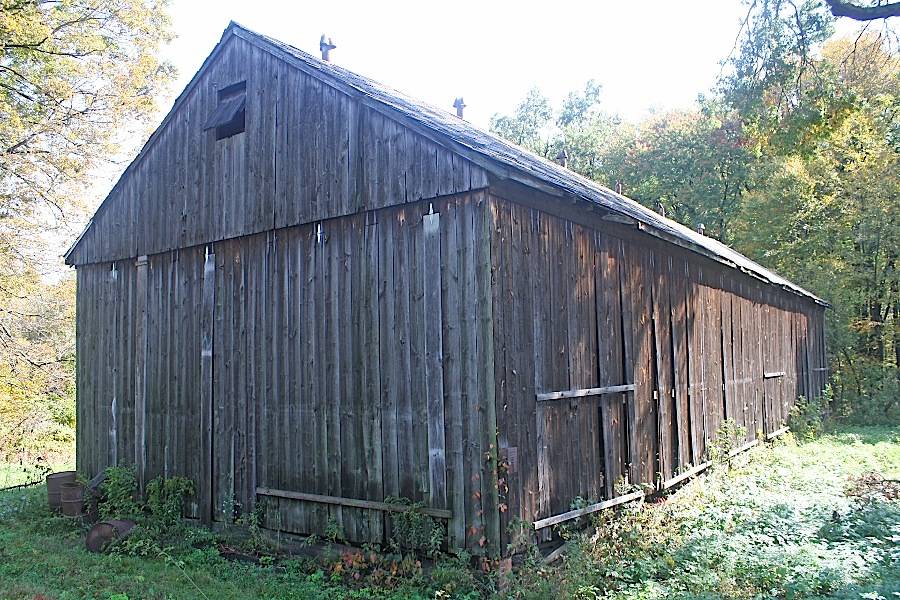
The tobacco shed is a two-aisle, seven-bent shed, measuring 33’ wide x 95’ long. The ridgeline of the shed is perpendicular to Taintor Street and runs roughly east-west. The shed has vertical and horizontal wood siding. The foundation is brick piers. The roof is covered with slate.
Exterior:
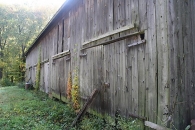
There are three of four possible venting systems on this tobacco shed; five large swinging hinged doors in the north eave-side of the barn; top-hinged vertical boards above the swinging hinged doors on the north eave-side as well as in the west, south and east sides; and top-hinged horizontal boards along the bottom edge of the gable-ends. There are six pipe vents along the ridgeline of the shed, each with three conical-shaped vents.Historical background:
The site appears to have been originally owned by Thomas Jefferson Austin. The house is attributed to Horatio J. Lothrop, who appears to have acquired the site around 1867, although the records are confusing; it looks as if Austin sold the site to William H. Remington in 1857, who sold the site to Thomas Pattison in 1867. The records then show that in 1867 there were a number of transactions regarding the site, finally ending with Lothrop from Charles E. Rogers and others. There was already a house on the lot across Taintor Street to the west, according to a Baker and Tilden map of 1869; Lothrop demolished that house and built the current one. All the buildings have the same brick used in their foundation suggesting that that they were all contemporary to each other, although the barn also has mortared and un-mortared fieldstone, which may have been from an earlier barn on the site. The land at that time was already in agricultural use, but the farm buildings are no longer present. Lothrop apparently built the barn, three tobacco sheds, the outhouse and ice house c. 1870, along with the house. By 1874 Lothrop was raising Jersey cows. The tobacco sheds were used for curing Havana seed tobacco. In 1889 Lothrop sold the site to Nathan F. Tufts, who then sold it to Andrew J. Fish in 1900, great-grandfather of the current owner. Andrew J. Fish served in the Connecticut 12th Volunteers in the Civil War.
In 1903 Andrew J. Fish installed a furnace in the house that lasted until the 1970s. Mortar in the basement of the barn also has a date of 1903, but it may be from a repair of the fieldstone foundation rather than a new build. Andrew J. Fish did well with the farm until the Great Depression in 1928, when things became difficult. One of the tobacco sheds was destroyed in the Hurricane of 1938. The stalls in the barn housed draft horses used for tobacco cultivation until the 1940s, when the sheds and tobacco fields were rented to the General Cigar Company. From then on, the stalls were used for riding horses. General Cigar rented the sheds and fields until the 1970s. A second tobacco shed was lost due to arson in 1980. Today, one of the adjacent farms, the Sheldon Farm, still uses the last remaining shed for curing tobacco. The site had pigs in the 1940-50s and goats in the 1970s. The basement of the main barn was used for dairy up until mid- 20th century.
A chicken coop fell down in the 1970s and a corn crib collapsed in 2011. In 2009, the development rights were sold to the State of Connecticut, ensuring that the land will remain open space in agricultural use.Architectural significance:
This English bank barn is an outstanding example of an English bank barn with a distinctive construction technique. The barn is built using square rule mortise and tenon timber frame construction. What makes this structure unusual is the use of a truss system that allows the width of the barn, 36’, to be free of vertical posts on the main level. Further significance is added by the height of the barn, which is taller than usual. The owner suggested that the barn may have been built by Shakers. While there is no empirical evidence to support this thesis, it is possible as the Enfield Shaker community was nearby. Added significance to the site derives from the use of two types of foundation materials (dry laid & mortared fieldstone and brick) and the history of the site. The site has been in agricultural use for 150 years and in the same family for more than a century. The tobacco shed is also an excellent and intact example of its type. The brick piers and slate roof mark it as an early example of the purpose-built tobacco shed and the venting systems including the roof vents are an uncommon type. The site illustrates the commercial production of tobacco in purpose-built sheds in the late 19th century co-existing with subsistence dairy farming using a traditional English barn.
Field Notes
Listed on the State Register of Historic Places 3/05/2014. Barn framed with roof trusses and iron tension rods; early purpose-built tobacco shed with slate roof.
- Use & Accessibility
- Environment
Related features
Environment features
Relationship to surroundings
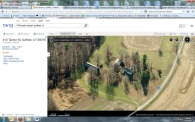
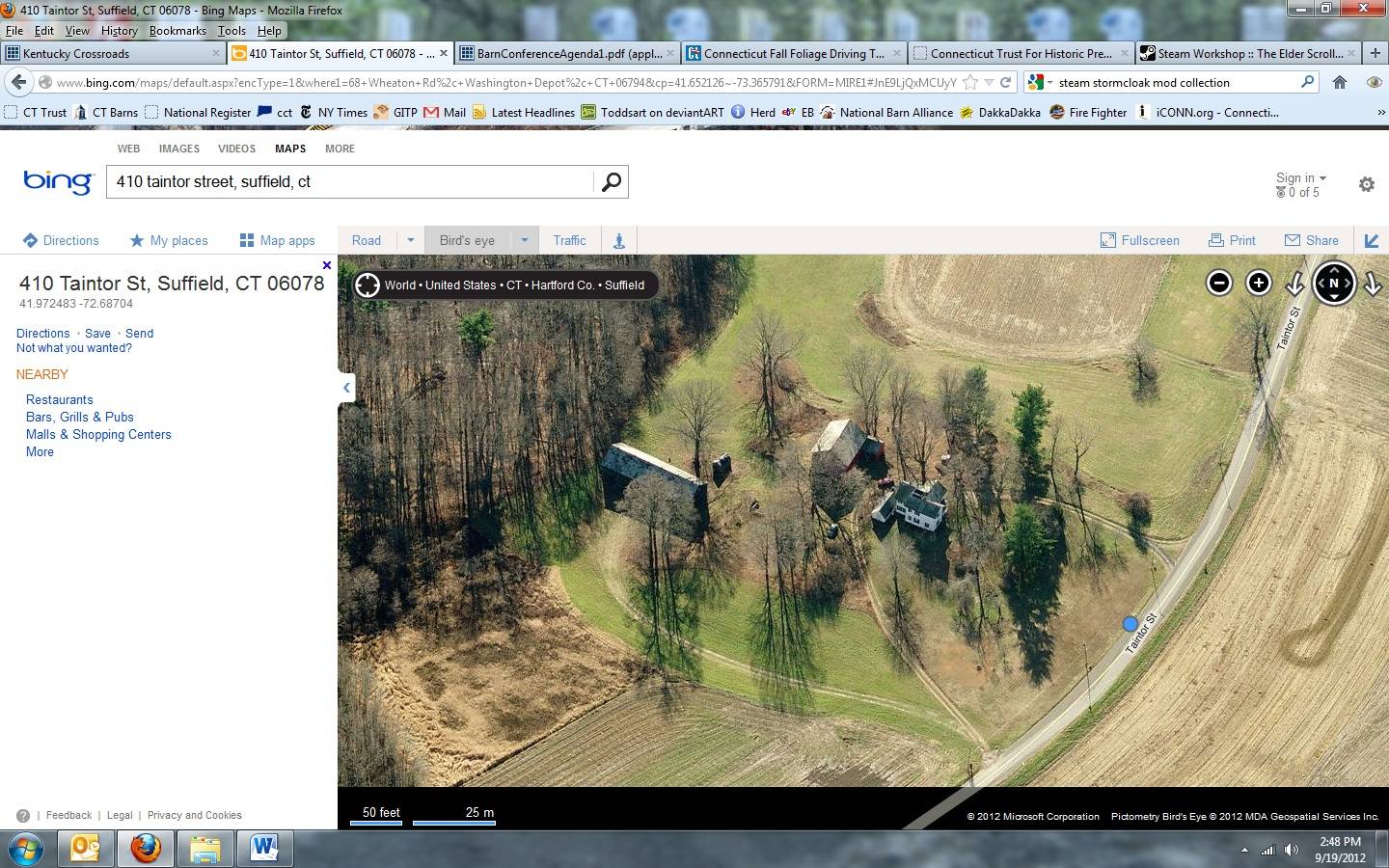
This is a 91.29-acre site including acreage on both sides of Taintor Street. All the extant buildings of this farm are on the east side, associated with 410 Taintor Street. The land on the west side has the property I.D. 1894. Taintor Street runs roughly north-south, extending south from Sheldon Street (Route 526). The site includes the farmhouse, barn, tobacco shed, ice house, and outhouse. The house is set back from the road and accessed by a semi-circular unpaved driveway that passes south of the house to the east side of the barn. The barn is behind and to the east of the house. The ridge-line of the house and barn are parallel to the road and run roughly north-south. The icehouse is adjacent to the house to the east. The outhouse is adjacent to the barn to the west. The tobacco shed is northeast of the barn and the ridge-line of the shed runs east-west.
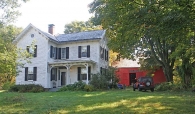
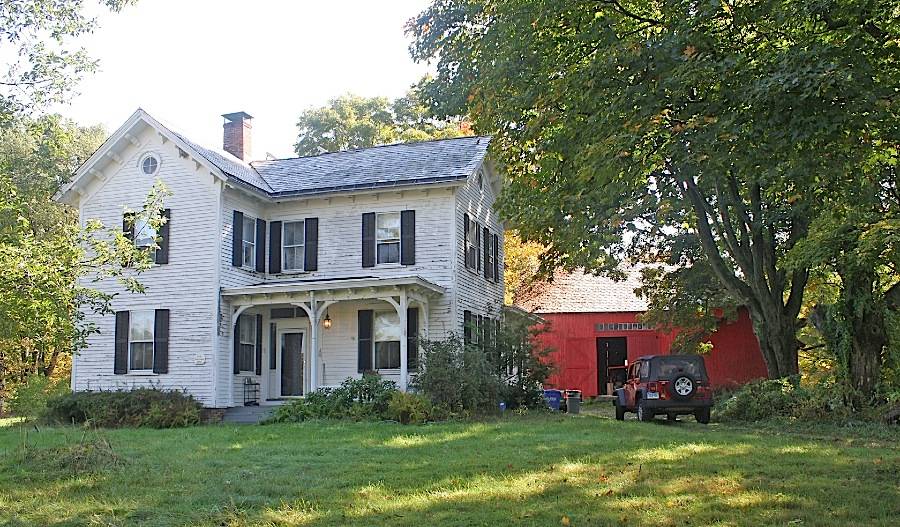
The 2 ½-story L-shaped farmhouse appears to have built in the second half of the 19th century, c. 1870. The main gable-end facade of the house faces west towards Taintor Street. A perpendicular wing extends south, with a 1-story porch in the angle of the building. The house has Victorian features, including wide fascias, scroll sawn brackets, and corner boards. Centered in the gable attic is an ocular window. The rest of the windows are shuttered four-over-four double-hung sash. The house has a brick foundation and is covered with clapboards painted white.
The site is just north of Bradley International Airport and is a level area in the river bottom land of the Connecticut River Valley, surrounded by open space used for active agriculture, woodland and residences. Devine Brook runs southward along the western edge of the side, eventually draining toward the east into the Connecticut River.
- Typology & Materials
-
Building Typology
Materials
Structural System
Roof materials
Roof type
Approximate Dimensions
Barn: 36' x 50', Tobacco shed: 33' x 95'
- Source
-
Date Compiled
01/25/2013
Compiled By
Todd Levine, reveiwed by the Connecticut Trust
Sources
Photographs and field notes by Todd Levine 10/05/2012.
Interview with Andrew J. Fish, 10/05/2012, 410 Taintor Street, Suffield, CT.
Suffield Assessor’s Records, Vision Government Solutions- http://www.vgsi.com accessed 10/05/2012.
Parcel ID: 24/26/103Suffield GIS Viewer http://www.crcog.org accessed 10/05/2012.
Aerial views from:
http://maps.google.com/ and http://www.bing.com/maps/ accessed 10/05/2012.UTM coordinates: http://itouchmap.com/latlong.html
Ancestry.com, Suffield, Hartford county, Connecticut, headstone inscriptions, 1660-1937, accessed 10/05/2012.
http://freepages.genealogy.rootsweb.ancestry.com/~kathycamp/Inscriptions/Page063.htm
Baker and Tilden, Suffield map, Hartford City and Country, 1869.Clark, Delpha, Notebooks on Houses in Suffield, CT, 1940.
Hadwen, O. B., American Jersey herd book, Volume 6 By Association of Breeders of Thorough-Bred Neat Stock, Volume 6, The Franklin Press, 1878.
Sexton, James, PhD; Survey Narrative of the Connecticut Barn, Connecticut Trust for Historic Preservation, Hamden, CT, 2005, http://www.connecticutbarns.org/history.Visser, Thomas D., Field Guide to New England Barns and Farm Buildings, University Press of New England, 1997, 213 pages.
- PhotosClick on image to view full file
-