Barn Record Kent
RETURN TO ‘FIND BARNS’- Building Name (Common)
- North, Susan, Farmstead
- Building Name (Historic)
- Ramutan, Joseph and Agnes, Farmstead
- Address
- 390 Kent Cornwall Road (Rte 7), Kent
- Typology

- Overview
-
Designations
Historic Significance
Architectural description:
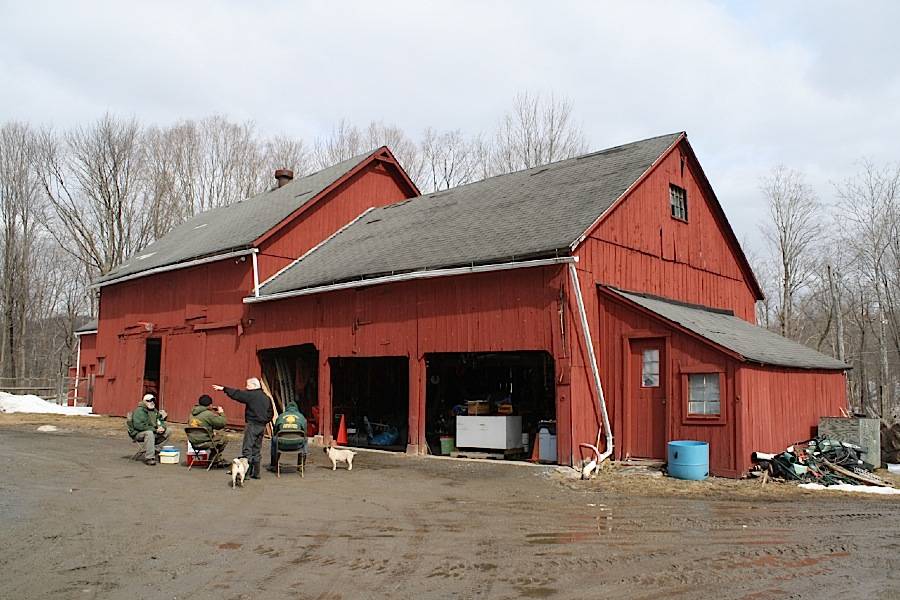
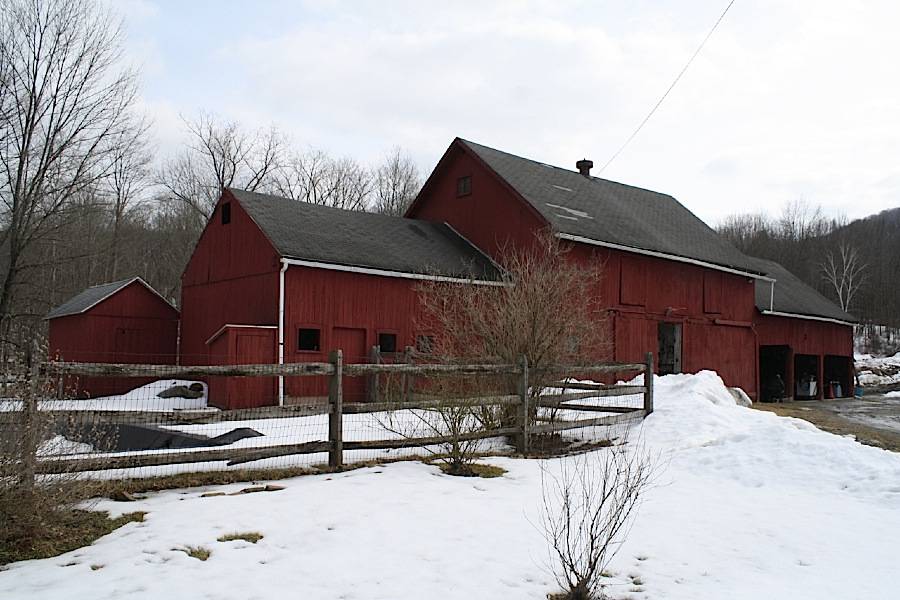
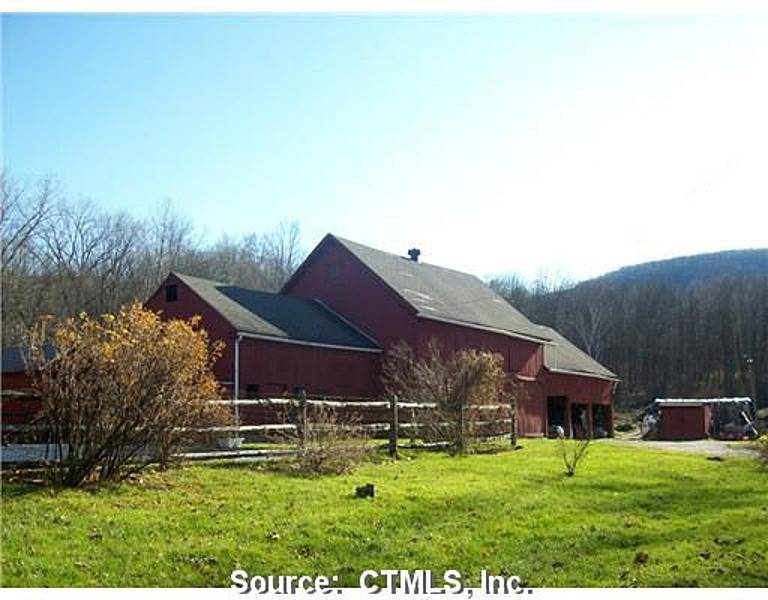
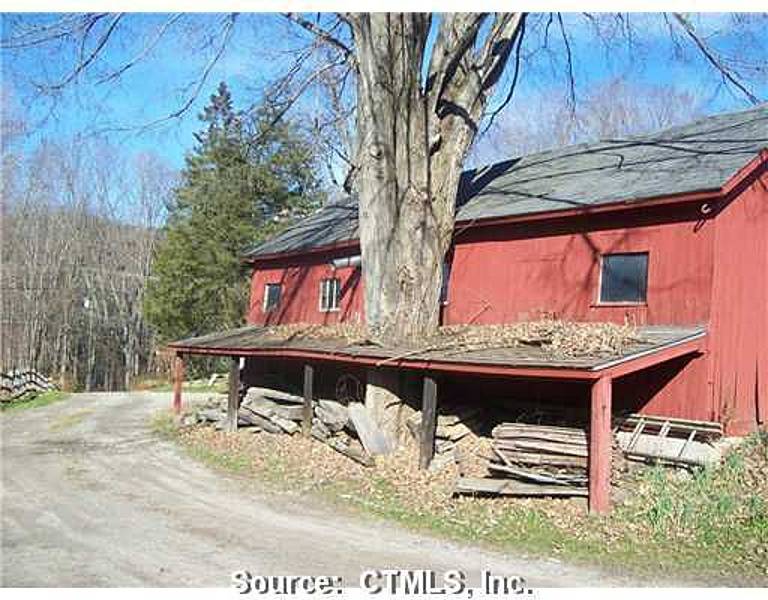
The barn on this property is located southeast of the Farmhouse and is oriented with its ridge-line running north-south and the entries in the west eave-side. The structure consists of three parts. The central block is a 1 1/2-story English barn, 26’ x 34’. A lower 1 1/2-story gable-roofed addition, 20’ x 25’, is attached at the north gable-end. Attached on the south gable-end is a lower 1 1/2-story gable-roofed wagon shed addition, 26’ x 32’. All have vertical wood board siding. The west pitches of the roofs are all asphalt shingle roofs. The east pitch of the central block is also asphalt shingles, while the additions have older pressed metal shingle roofing.
Exterior:
The central block is a two-bay English barn with a single height sliding door just north of center in the west eave-side. There is one stable window to the left near the north corner, and two hinged hay doors above at the loft level.
The east eave-side has a barn door corresponding to the west side, and boarded-up stable windows flanking the door. The north addition has a series of stable windows in its east eave-side, flanking a pass-through door which is off center toward the left (north). The north gable-end is blank except for a vent at the peak. A small shed-roofed addition the size of an outhouse, is attached to the northwest corner, with a pass-through door in its west side. The east eave-side has two small stable windows.The south wagon shed addition has three bay-wide openings in the west eave-side. The south gable-end has a twelve-pane attic window near the peak. A small shed addition is attached to the gable-end. This has a pass-through door and six-pane window in its west gable-end and a small six-pane window in the east gable-end. The east eave-side of the wagon shed has no visible openings but is tarped with plastic sheeting.
Interior:
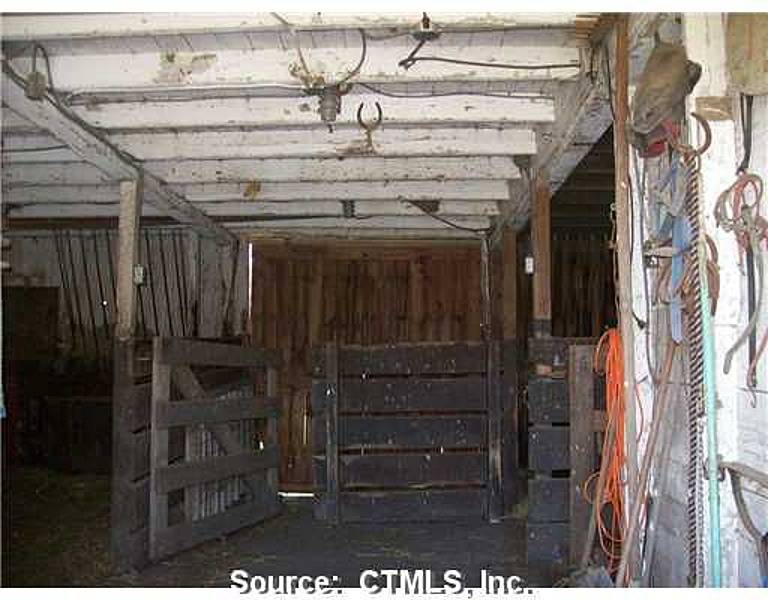
The central block of the barn is a two-bay square rule post and beam frame with dropped tie-girts. The common rafters are of sawn dimension lumber although the major timbers are mostly hand hewn. The rafters span from the plates to the peak without intermediate supports, although a few collar ties have been added in recent years. The interior tie-girt has an added steel tension cable installed below the girt. The loft floor, inserted approximately five feet below the plate elevation, is framed with sawn dimension lumber which has been painted or whitewashed; this appears to have been an addition to the original post and beam structure. The ground floor is fitted out as horse stalls.
The northern addition is constructed with post and beam framing as well, and has un-planed poles as roof rafters.
The northern section of this was most recently used for poultry.The southern wagon shed addition may be the oldest portion of the barn, being constructed with hand-hewn post and beam framing, dropped tie-girts, and hand-hewn rafters supported by a typical queen post and longitudinal purlin system. Here too a loft floor has been inserted at about four feet below the plate elevation. The tie-girts have been truncated, with a central section removed. Some steel cable reinforcement has been added in about 2011.
Historical significance:
The oldest barns still found in the state are called the “English Barn,” “side-entry barn,” “eave entry,” or a 30 x 40. They are simple buildings with rectangular plan, pitched gable roof, and a door or doors located on one or both of the eave sides of the building based on the grain warehouses of the English colonists’ homeland. The name “30 by 40” originates from its size (in feet), which was large enough for 1 family and could service about 100 acres. The multi-purpose use of the English barn is reflected by the building’s construction in three distinct bays - one for each use. The middle bay was used for threshing, which is separating the seed from the stalk in wheat and oat by beating the stalks with a flail. The flanking bays would be for animals and hay storage.
Historical background:
The Farmhouse appears to be roughly contemporary with the early 19th-century Federal style houses in the Flanders Historic District, where the first village center of Kent was located in the late 18th and early 19th centuries. The 1874 Beers Map lists L. Stuart Estate as the owner. Nearby at the time was a marble quarry at the site of today’s Kent Falls State Park. This may have been the source of marble stone used in the foundation of the Farmhouse.
In the second quarter of the 20th century, the Ramutan family, Joseph B. (b. 1882), Agnes (b. 1890), and son Edward (b. 1925) were dairy farmers in Kent. It was from the Ramutan estate that Susan North purchased the Farmhouse and associated barn in 1970 after it had stood vacant for several years. The Ramutans were from Lithuania.Architectural significance:
The house and barn together are significant as typical examples of their type in a rural setting along with adjacent
properties that were formerly under a single ownership. They remain in a setting reflective of the earlier character of the agricultural landscape. The Farmhouse retains original window sash and some distinctive Federal-style details, although much is obscured by 20th-century siding. The Farmhouse and its barn sit on a prominent knoll, facing across the road to the main barn and tobacco barn in the floodplain of the Housatonic River, at a gateway location near the northern border of Kent. The barn has elements of hand-hewn post and beam framing, combined with later alterations to adapt it to a horse barn and wagon shed. The distinctive tin shingles remaining on the east pitch of the barn roofs are historic materials of interest.The 20th-century ownership represents the history of northern European immigration and the pattern of immigrants moving onto farms with their already-historic buildings and adapting them for commercial dairy operations.
Field Notes
Listed on the State Register of Historic Places , 4/03/2014.
- Use & Accessibility
Use (Historic)
Use (Present)
Exterior Visible from Public Road?
Yes
Demolished
n/a
Location Integrity
Unknown
- Environment
Related features
Environment features
Relationship to surroundings
The site is located on the southeast side of Kent-Cornwall Road (US Route 7) at the southeast corner of Carter Road, near the northern border of Kent. The Housatonic River parallels the road on the west side; to the north is Kent Falls State Park, where in the 19th century a marble quarry was located. The site of the North Kent District No. 3 School was on the northwest side of the road just to the south of this property. The Flanders National Register Historic District, the earliest area established by English settlers and town center in the 18th century, is 2.5 miles to the south. The present owner has lived here since 1970. She formerly owned 11.4 acres, but has since sold land, leaving the current 5-acre parcel. To the west across the road a 35’ x 65’ gable-roofed former barn and a 30’ x 70’ former tobacco barn have been converted to residences. These were at part of the same larger property, the Ramutan dairy farm prior to 1970.
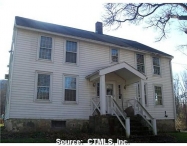
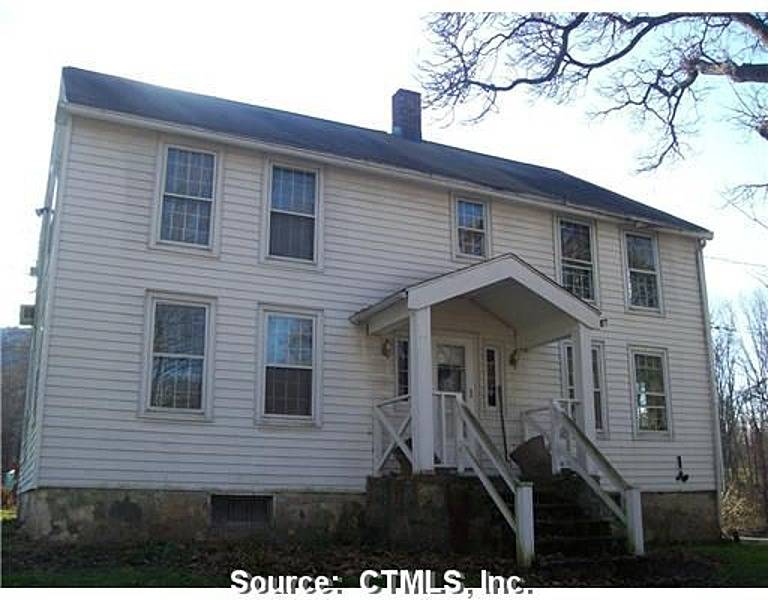
The farmhouse at 390 Kent Cornwall Road is sited on a knoll overlooking the road. It is a 2 ó-story Colonial-style structure with its north eave-side facing toward the road, river, and the main barn across the road. The ridge-line is oriented approximately east-west. The five-bay façade has two twelve-over-twelve double-hung windows on each side of a central entry door under a gable-roofed 1-story porch. The second floor has matching windows with a small six-over-six double-hung window at the center above the porch roof. Vinyl siding obscures any original details of siding or trim; original windows are extant. The entry door is flanked by narrow sidelights. The east gable-end attic has a three-part window consisting of a central double-hung sash flanked by narrow sash, also double-hung. The west gable-end has a Federal-style lunette window with radial muntins. Some openings on the first floor have been replaced by modern bay windows. The roof has short cornice returns on the gable-ends and is asphalt shingles. A single chimney is off-center toward the west. The foundation is marble fieldstone masonry, with the west end exposing a half-height basement as the grade declines. A 1-story rear porch across . of the south side has marble masonry steps and a hipped roof.
A driveway enters the site to the west of the house and extends southeast into the interior of the site where it circles around a garage-workshop building. A small brook runs parallel to the west of the drive through the middle of a fenced paddock where several llamas graze and have a small roofed shelter. The garage-workshop structure, 1-story with a gable roof is located south of the house. It is oriented northwest-southeast and has a garage door opening in its northwest gable-end. To the east of this is the barn complex, oriented perpendicular to the house. A small 1-story gable-roofed shed, 9’ x 14’, is located adjoining the northeast corner of the barn, with its ridge-line east-west; its concrete floor and board wainscot walls suggest use as a calf shed or similar function.
The southern part of the site is wooded. Stone walls line the north and east borders adjacent to Kent Cornwall Road and Carter Road.- Typology & Materials
-
Building Typology
Materials
Structural System
Roof materials
Roof type
Approximate Dimensions
30' x 35' plus additions
- Source
-
Date Compiled
02/27/2013
Compiled By
Charlotte Hitchcock, reviewed by CT Trust
Sources
Photographs and field notes by Charlotte Hitchcock 2/26/2013.
Interview with Susan North, 2/26/2013, at the site.
Aerial views from:
http://maps.google.com/ and http://www.bing.com/maps/ accessed 3/31/2013.Historical aerial photography and maps accessed at UConn MAGIC:
http://magic.lib.uconn.edu/mash_up/1934.html
http://magic.lib.uconn.edu/historical_maps_connecticut_towns.html .USGS Historical Maps accessed 3/30/2013 at http://historical.mytopo.com/ .
UTM coordinates: http://itouchmap.com/latlong.html .
Clouette, Bruce, Keiner, Hal, Flanders National Register Historic District No. 79002618, National Park Service,
1979.Connecticut State Library online: iconn.org or http://www.cslib.org/iconnsitemap/staff/SiteIndex.aspx#directories
Sexton, James, PhD; Survey Narrative of the Connecticut Barn, Connecticut Trust for Historic Preservation,
Hamden, CT, 2005, http://www.connecticutbarns.org/history.U.S. Federal Census, accessed at http://persi.heritagequestonline.com/hqoweb/library/do/census/search/basic.
Visser, Thomas D., Field Guide to New England Barns & Farm Buildings, University Press of New England, 1997.
- PhotosClick on image to view full file
-