Barn Record Woodbury
RETURN TO ‘FIND BARNS’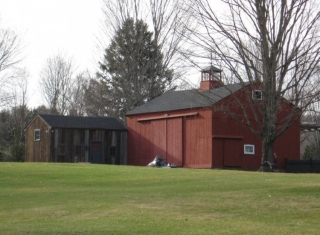
- Overview
-
Designations
Historic Significance
Architectural description:
There are two structures of note.
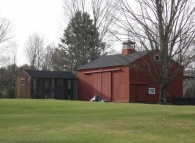
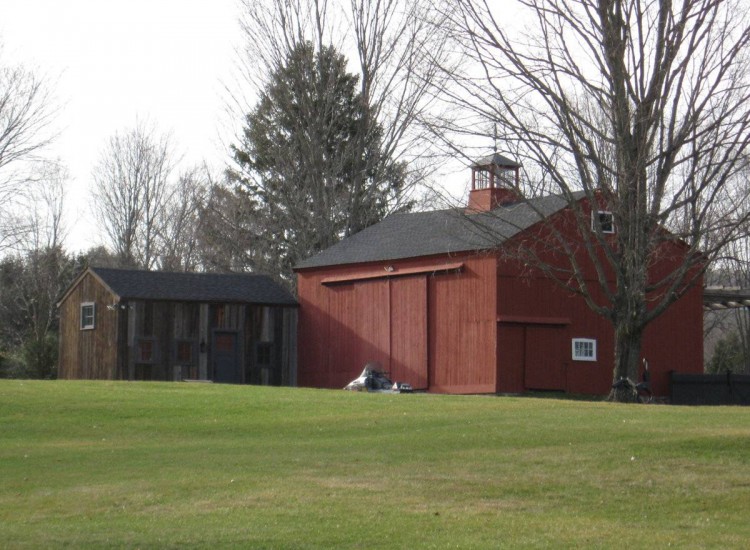
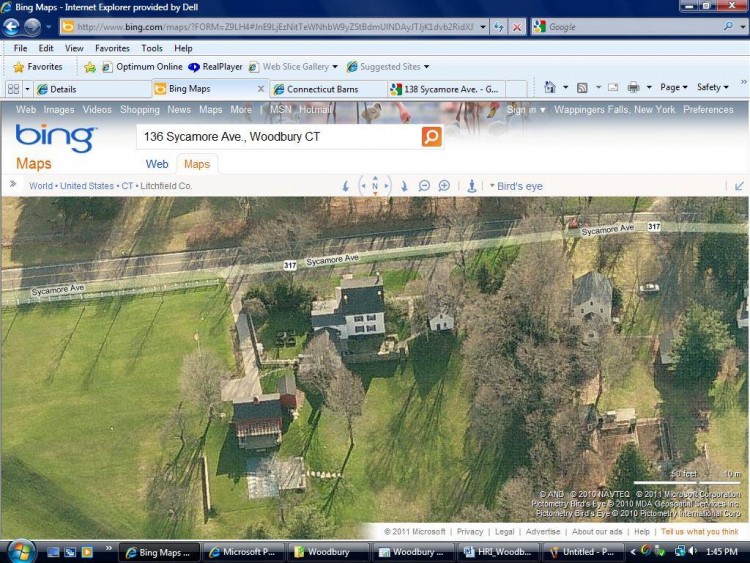
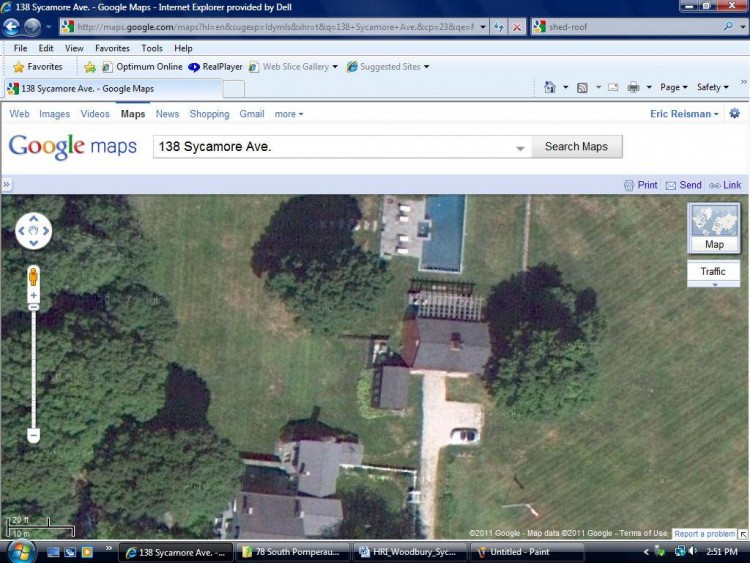
Structure I is a 1-½ story eave-entry barn with a gable-roof. The main façade faces south, and the ridgeline runs east-west, parallel to Sycamore Avenue which lies to the south. Principal entry is provided by a pair of centered double-height sliding doors constructed of vertical wood boards mounted on an external track. The rest of the facade is blank. The east gable-end of the barn has a sliding pass-through door constructed of vertical wood boards mounted on an external track at the south corner with an eight-pane stable window with trim just to the north. Beneath the apex of the roof is a window with trim. On the north eave-side of the barn appears to have exposed shed-roof rafters supported by posts. The west gable-end of the barn appears to have a stable window beneath the apex of the roof. The walls are covered with vertical board siding painted red. The roof is covered with asphalt shingles. In the center of the roof at the ridgeline there is a square-shaped cupola with four eight-pane windows. The cupola is topped with a hipped roof covered with asphalt shingles.
Structure II is located at the southwest corner of Structure I. This is a 1-½ story, eave-entry shed with a gable roof. The main façade faces east, and the ridgeline runs north south, perpendicular to Structure I and Sycamore Avenue which lies to the south. Along the main façade is a wood-paneled pass-through door with six-panes and three four-pane stable windows with trim. There is a six-pane stable window with trim on the south gable-end of the barn. On the west eave-side of the barn are four stable windows. The walls are covered with painted vertical board siding. The roof is covered with asphalt shingles.
Historical significance:The oldest barns still found in the state are called the “English Barn,” “side-entry barn,” “eave entry,” or a 30 x 40. They are simple buildings with rectangular plan, pitched gable roof, and a door or doors located on one or both of the eave sides of the building based on the grain warehouses of
the English colonists’ homeland. The name “30 by 40” originates from its size (in feet), which was large enough for 1 family and could service about 100 acres. The multi-purpose use of the English barn is reflected by the building’s construction in three distinct bays - one for each use. The middle
bay was used for threshing, which is separating the seed from the stalk in wheat and oat by beating the stalks with a flail. The flanking bays would be for animals and hay storage.A shed is typically a simple, single-story structure in a back garden or on an allotment that is used for storage, hobbies, or as a workshop. Sheds vary considerably in the complexity of their construction and their size, from small open-sided tin-roofed structures to large wood-framed sheds with shingled roofs, windows, and electrical outlets. Sheds used on farms or in industry can be large structures.
Field Notes
Listed on the State Register of Historic Places 4/06/2013 Large English barn with cupola, smaller barn or shed perpendicular. Now appears to be a horse farm.
- Use & Accessibility
Use (Historic)
Use (Present)
Exterior Visible from Public Road?
Yes
Demolished
No
Location Integrity
Unknown
- Environment
Related features
Environment features
Relationship to surroundings
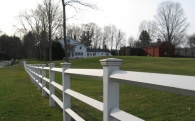
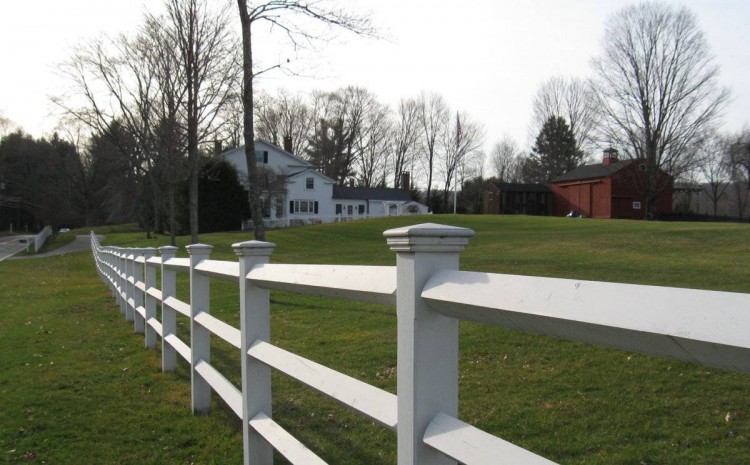
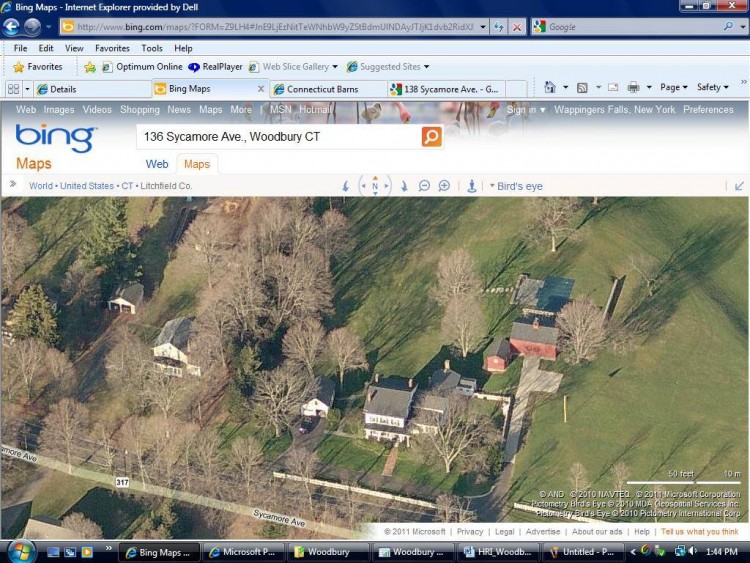
This property is located on Sycamore Avenue (CT 316) to the west of the Town of Woodbury. The barn is located on a 30.0-acre parcel that consists largely of open fields to the north and east. In addition to the three outbuildings, the property also features a c.1845 house with Greek Revival detailing a garage and an in-ground pool.
The c. 1845 house is located to the south of structures I & II. This is a 2-½ story, eave-entry house with 3-bays, a square-shaped plan and a gable roof. The main façade faces south and the ridgeline runs east-west, parallel to the road. Principle entry is via a pass-through door in the eastern most bay flanked by a transom and side-lights. To its west are two full-height windows with shudders. There is a single-story porch with a shed-roof supported by four Doric pilasters that spans the entire length of the main façade. On the second story, there are three 6/6 double-hung sash windows with trim and shudders. On the west gable-end of the house are five 6/6 double-hung sash windows with trim and shudders. Along the north eave-side of the house there appears to be four identical windows. There are three additions off the east gable-end of the house, a single-story shed-roof addition and a 1 ½ story gable-roof addition, its ridgeline running parallel to that of the original structure. To the north of the gable-roof addition is a third addition with 1 ½ stories and a gable-roof, its ridgeline running perpendicular to that of the main structure. The walls are covered with painted clapboard siding. The roof is covered with asphalt shingles. The foundation appears to be concrete.
To the west of the c. 1845 house is a 1-½ story, gable-entry garage with two bays. The main façade faces south, and features two overhead garage doors, and a window below the apex of the gable. Along the east eave-side of the garage there is a window with shudders and trim and a pass-through door at the northern corner. On the north gable-end of the garage is another pass-through door and two windows. The west eave-side of the barn features a window. The roof is covered with asphalt shingles.
- Typology & Materials
-
Building Typology
Materials
Structural System
Roof materials
Roof type
Approximate Dimensions
Larger English barn with cupola, smaller shed.
- Source
-
Date Compiled
03/16/2011
Compiled By
Eric Reisman & Todd Levine, reviewed by CT Trust
Sources
Field notes and photographs by Charlotte R. Hitchcock, 4/21/2008.
Town of Woodbury, Connecticut GIS Viewer http://www.cogcnvgis.com/woodbury/AGS_MAP
(Parcel ID # 036-037: 30.00 acres: c. 1845 house, 3,789 sq. ft.)
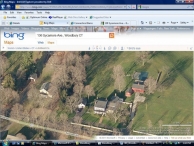
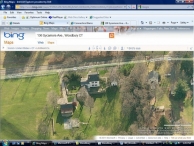
Aerial Mapping:
http://maps.google.com accessed 3/10/2011
http://www.bing.com/maps accessed 03/10/2011.Sexton, James, PhD, Survey Narrative of the Connecticut Barn, Connecticut Trust for Historic Preservation, Hamden, CT, 2005, http://www.connecticutbarns.org/history.
Visser, Thomas D., Field Guide to New England Barns and Farm Buildings, University Press of New England, 1997.
- PhotosClick on image to view full file
-